Talks are off unless US shifts strategy, Iranian lawmakers say
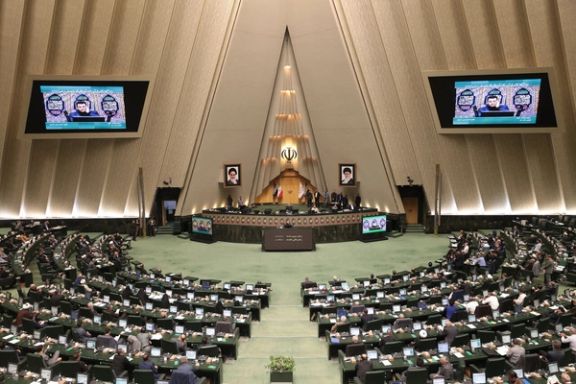
Iran’s Parliament in session in Tehran, July 2025.
Iran’s parliament on Wednesday demanded that the government halt all new negotiations with the United States unless strict preconditions are met, citing what lawmakers called Washington’s use of diplomacy as cover for military escalation.
“When the US uses negotiations as a tool to deceive Iran and to cover for sudden military attacks by the Zionist regime, talks cannot continue as before,” members of parliament said in a joint statement read during an open session by MP Ahmad Naderi, according to state media.
While the tone of the statement points to demands such as security assurances, respect for sovereignty, and a fundamental change in US conduct, lawmakers did not outline any specific or actionable preconditions.
The declaration came one day after US President Donald Trump said he was in “no rush” to resume talks and pointed to last month’s airstrikes on Iranian nuclear facilities as leverage. “They would like to talk. I’m in no rush to talk because we obliterated their site,” Trump said Tuesday.
Parliament says no new talks without guarantees
The lawmakers said any new diplomatic engagement must be conditional and guided by Iran’s top leadership. “Preconditions must be established, and until they are fully met, no new negotiations should take place,” they said.
They accused the US of deliberately using the appearance of diplomacy to enable Israeli military action and warned that Iran would no longer engage under the same terms. “The American president, while pretending to favor diplomacy, authorized a direct attack on our nuclear infrastructure,” the statement said.
Lawmakers framed the issue as part of a larger campaign to undermine Iran’s sovereignty. “The goal is to weaken and divide the country,” they said. “But our response must be unity under the commands of the Supreme Leader.”
Iran faces pressure as Europe moves toward snapback
The warning came amid growing pressure from the US and its European allies, who on Monday set an end-of-August deadline for Iran to return to the nuclear deal or face the reimposition of full UN sanctions under the JCPOA’s snapback mechanism, Axios reported.
The snapback mechanism, created under UN Security Council Resolution 2231—which endorsed the 2015 nuclear deal—allows any party to the agreement to reimpose sanctions if Iran is found non-compliant. If no resolution is passed within 30 days to continue sanctions relief, all prior UN measures automatically come back into force.
The US, France, Britain, and Germany said Iran could avoid snapback only by providing new assurances over its nuclear activities. A US official told Axios that Trump was frustrated by Iran’s refusal to return to talks and wants any future discussions to be direct.
“The snapback is leverage,” the official said. “And Witkoff has told the Iranians clearly: no intermediaries this time.”
Parliament defends law limiting IAEA access
In the statement, Iranian lawmakers also defended their recent vote to restrict cooperation with the International Atomic Energy Agency, saying it was a response to security threats following the June airstrikes.
“The Parliament of Iran has voted for a halt to collaboration with the IAEA until the safety and security of our nuclear activities can be guaranteed,” the lawmakers said.
Tehran says it has not ended cooperation with the International Atomic Energy Agency despite the new legislation. Instead, future coordination with inspectors will be managed by Iran’s Supreme National Security Council, Foreign Minister Abbas Araghchi said earlier this month.
“Iran remains committed to the NPT and its Safeguards Agreement,” Araghchi wrote on X, rejecting reports of a full suspension as “fake news.”
He said the shift in procedure was necessary due to rising security concerns. “Under the new law, all cooperation with the IAEA must go through the Supreme National Security Council,” he wrote.
Lawmakers target IAEA and Western states
Iranian lawmakers accused the IAEA of legitimizing military aggression by sharing sensitive information with hostile governments. They also criticized Germany and other European states for backing US and Israeli actions.
“The IAEA and its partners must understand that until Iran is assured of no further violations, no new information will be handed to spies and aggressors,” the statement said.
The IAEA said inspectors remain in the country and await clarification from Tehran. But tensions have continued to rise, with a senior Iranian judicial official recently threatening the IAEA chief with trial in absentia.
Iran signals no retreat from enrichment
The Pentagon said last month’s strikes had degraded Iran’s nuclear program by up to two years. “We have degraded their program by one to two years, at least,” Pentagon spokesman Sean Parnell said.
Araghchi confirmed “serious and heavy damage” to the Fordow facility but said Iran would not halt enrichment. “Enrichment is a matter of national pride and glory,” he said.
Lawmakers echoed that stance. “We will not allow anyone to use the language of pressure and expect submission,” they said. “Diplomacy is not surrender—it is another front in the war.”
The United States is in no hurry to enter talks with Iran, President Donald Trump said on Tuesday, pointing to last month’s American strikes on Iranian nuclear facilities as a source of leverage.
“They would like to talk. I’m in no rush to talk because we obliterated their site,” Trump told reporters.
The US president made the remarks shortly after returning from Pittsburgh, adding that Washington remained in control of the diplomatic timeline.
Iranian lawmakers responded Wednesday by urging the government to set firm preconditions before entering any new negotiations with the United States.
“When the US uses negotiations as a tool to deceive Iran and to cover for sudden military attacks by the Zionist regime, talks cannot continue as before,” a statement read during parliament’s open session said, according to state media.
The declaration called for a fundamental shift in Iran’s approach to diplomatic engagement. “Preconditions must be established, and until they are fully met, no new negotiations should take place,” the statement said.
Axios reported Tuesday that Steve Witkoff, Trump’s special envoy for Middle East affairs, had conveyed a message to Iranian officials: any future discussions must take place directly, without intermediaries.
“Witkoff has made it clear to the Iranians that any future talks must be direct, rather than mediated by a third party, to avoid misunderstandings and expedite the process,” the outlet quoted a senior US official as saying.
Iran’s foreign ministry has not confirmed any progress toward such talks. Spokesman Esmail Baghaei said Monday that no time or location had been agreed for a meeting between Foreign Minister Abbas Araghchi and Witkoff.
“So long as we are not assured of the effectiveness of diplomacy and the negotiation process, we will not enter such a process,” Baghaei said.
Iran is negotiating with four neighboring countries to import water, Energy Minister Abbas Aliabadi said Tuesday, warning that critical reservoirs could run dry within weeks.
“We are in talks with Turkmenistan, Afghanistan, Tajikistan and Uzbekistan,” Aliabadi said, adding that five years of drought have left Iran with a 44 percent deficit in rainfall compared to long-term averages.
“There is no water now—we must use it slowly to make it last,” he said. “If your income is low, you spend more cautiously; it’s the same with water.”
The Islamic Republic has long been criticized for its inability to manage drought and water scarcity, and the current crisis is affecting much of the country, including Tehran, Khorasan, Markazi, Hormozgan, and Sistan and Baluchestan provinces.
Aliabadi warned that the capital’s Mamloo Dam may be lost within a month, and conditions at Latian and Karaj dams were also deteriorating. He cited a 30 to 40 percent drop in rainfall and dam reserves across the country.
“We must find different ways to control consumption,” he said.
Meanwhile, residents in Tehran report receiving exorbitant water bills. The CEO of the Tehran Water and Wastewater Company, Mohsen Ardakani, urged households to prepare storage tanks and pumps, saying disruptions may occur in coming days.
“With limited resources, we have no choice but to manage supply,” Ardakani said. “Water will only reach the first and second floors of buildings.”
Behzad Parsa, who heads the Tehran regional water authority, said this year marked the fifth consecutive year of low precipitation in the province. “Rainfall this year has been unprecedentedly low in the past 60 years,” he added.
Five Iranian nationals were arrested earlier this month near Mooers Forks, New York, while attempting to enter the United States from Canada illegally, a Customs and Border Protection spokesman said Tuesday.
"On July 1… agents located a minivan occupied by five citizens of Iran and two citizens of Uzbekistan," CBP's Swanton Sector said in a statement as reported by Fox News. "They are currently detained and pending removal proceedings."
All seven men had previously been apprehended for unlawful entry into the US, CBP said. The arrest occurred near the Champlain Station, a border patrol unit operating in a rural stretch of northern New York, near the Canadian border.
Fox News Digital highlighted renewed warnings earlier this month from former FBI special agent Jonathan Gilliam, who suggested Iranian-linked operatives may already be embedded in the US. “Where these sleeper cells may be is in plain sight,” Gilliam said. “And that's the real terrifying part.”
This comes as the US airstrikes in June targeted Iranian nuclear infrastructure and there are growing concerns around individuals tied to Iran entering Western countries under unclear pretenses.
A December 2023 US State Department report documented plots by Iranian operatives in the US and Europe, including a foiled assassination attempt in New York and attempts to collect information for terrorist purposes on the London-based Iran International.
Other European states—including Albania, Belgium, Denmark, and the Netherlands—have taken actions in recent years against Iranian-linked actors accused of involvement in similar schemes.
Iran has seized a foreign oil tanker in the Gulf of Oman for allegedly smuggling 2 million liters of fuel, the chief justice of Hormozgan province said on Wednesday, according to state-linked media.
“In the course of monitoring suspicious fuel smuggling activity in the country's maritime borders in the Sea of Oman, a foreign oil tanker was inspected and seized due to incomplete legal documents related to its cargo,” Mojtaba Ghahremani said, according to a statement carried by the judiciary’s public relations office.
Ghahremani said a criminal case has been opened in the public and revolutionary prosecutor’s office in Jask and legal proceedings are ongoing. “Based on the report of the authorities, a case has been filed, and judicial investigation into the charges continues,” he said.
He added that 17 people, including the ship’s captain and crew, were arrested. “Seventeen suspects, including the captain and crew of this foreign tanker, are currently in detention for further investigation and legal procedures,” Ghahremani said.
Authorities are now collecting evidence to verify the total volume and nature of the cargo. “Sampling and relevant testing of the tanker’s fuel cargo, and inquiries into the authenticity of its documents, are underway,” he said. Results will be announced by the judiciary when the investigation concludes, he added.
Iran has not named the ship or its country of origin.
Iran has stepped up maritime enforcement in recent months, especially in waters near the Strait of Hormuz and the Persian Gulf, where fuel smuggling remains a persistent issue. In April, Iran’s Revolutionary Guard Corps (IRGC) Navy said it had seized a tanker carrying 100,000 liters of smuggled fuel and detained six people, according to Fars News Agency. That followed a separate operation in which two tankers allegedly transporting more than 3 million liters of diesel were intercepted and taken to the port of Bushehr.
The IRGC regularly announces such seizures as part of what it calls efforts to curb fuel trafficking in the region, a key route for global oil shipments. Iran has also seized tankers over maritime disputes or in response to international sanctions enforcement.
United Nations sanctions on Iran will be restored via the so-called "snapback mechanism" if no nuclear deal is reached by end of August, the US, British, French and German foreign ministers agreed in a Monday call, according to a report by Axios.
The European countries now plan to engage with Iran in the coming days and weeks with the message that Iran can avoid the snapback sanctions if it takes steps to reassure the world about its nuclear program, the report said citing two informed sources.
The snapback mechanism is part of UN Security Council Resolution 2231, which endorsed the 2015 Joint Comprehensive Plan of Action, or JCPOA. It allows any participant in the nuclear agreement to reimpose sanctions if Iran is deemed non-compliant. If no resolution to maintain sanctions relief is passed within 30 days, all previous UN measures return automatically.
The Trump administration supports activating snapback mechanism and sees it as leverage in the talks with Iran, the report added citing a US official.
The US official said Trump is highly frustrated that the Iranians haven't come back to the table yet, adding that US Special Envoy to the Middle East Steve Witkoff has made it clear to the Iranians that any future talks must be direct, rather than mediated by a third party, to avoid misunderstandings and expedite the process.