US military says Yemeni forces seized vast Iranian weapons shipment
Yemeni forces fighting the Iran-backed Houthi movement have carried out their largest ever seizure of advanced Iranian conventional weapons bound for the group, US Central Command (CENTCOM) said on Wednesday.
US military says Yemeni forces seized vast Iranian weapons shipment | Iran International
CENTCOM said the National Resistance Forces (NRF) confiscated over 750 tons of advanced weaponry including anti-ship and anti-aircraft missiles, warheads, hundreds of drone engines, air defense equipment, radar systems and communications equipment.
The NRF is an anti-Houthi force led by General Tareq Saleh, nephew of Yemen’s former President Ali Abdullah Saleh, and operates independently of the internationally recognized government.
CENTCOM added that many of the systems were manufactured by a company affiliated with Iran’s defense ministry and included manuals in Farsi.
“We commend the legitimate government forces of Yemen who continue to interdict the flow of Iranian munitions bound for the Houthis," General Michael Erik Kurilla, commander of CENTCOM said in a statement.
"The interdiction of this massive Iranian shipment shows that Iran remains the most destabilizing actor in the region. Limiting the free flow of Iranian support to the Houthis is critic to regional security, stability, and freedom of navigation,” he added.
Since the outbreak of the Gaza war, Yemen’s Houthis have launched missiles, rockets, and drones toward Israel and enforced a maritime disruption in the Red Sea, in what it describes as support for Palestinians in Gaza.
Last month, the group's rivals in Yemeni government said that Iran is transferring parts of its military industry, including ballistic missile and drone production to Houthi-controlled areas in Saada, Hajjah, and the outskirts of Sanaa.
The Houthis resumed attacks on the high seas following a June 24 ceasefire ending a 12-day war between Israel and Iran.
Houthi forces sank a Liberian-flagged carrier on July 6 with rockets and explosive drone boats. The group, which controls most of Yemen's population centers, says its maritime attacks are in solidarity with Palestinians in Gaza.
US Secretary of State Marco Rubio on Wednesday signed a nuclear cooperation deal with Bahrain and in an apparent reference to Iran said Washington was ready to back peaceful nuclear programs which do not menace neighbors.
“This is an important signing. It serves as the first step toward deeper civil nuclear cooperation — an example that the United States is prepared to be a partner with any nation on earth that wants to pursue a civil nuclear program,” he said.
Bahrain's activities, Rubio added, are “clearly not geared toward weaponization or threatening the security of its neighbors.”
A Shi'ite majority island kingdom ruled by a Western-backed Sunni monarchy, Bahrain has long been suspicious of Tehran's policies in the region. It is host to major US and British military bases.
“I want to restate our deep appreciation and backing for President Donald Trump's tireless work toward achieving ceasefires, building confidence, and ultimately creating a secure region where all its peoples can live in peace and prosperity,” Bahraini Foreign Minister Abdullatif bin Rashid Al Zayani said.
Iran’s nuclear program has long been a source of unease for its Persian Gulf neighbors. US President Donald Trump started talks with Iran in April, giving a 60-day deadline to reach a deal. On the 61st day, Israel launched a surprise military campaign against Iran.
A June 24 ceasefire paused the 12-day war, which was capped by US attacks on Iranian nuclear sites.
The United States had demanded that Iran end domestic uranium enrichment but said Tehran could pursue a civilian nuclear program.
Israel launched a national media campaign on Wednesday warning citizens against spying for Iran, cautioning that cooperating with Tehran could lead to imprisonment.
Israeli authorities say they have uncovered more than 25 cases of Iranian recruitment over the past year, with more than 35 people indicted on serious security charges.
“The campaign carries significant national importance, especially in the aftermath of (the war with Iran), after which Iranian efforts to recruit operatives and execute missions inside Israel are expected to intensify,” said Israel's National Public Diplomacy Directorate, which along with domestic security service the Shin Bet is behind the campaign.
“For 5,000 shekels, is it worth ruining your life or family?” reads one of the campaign's video ads, referencing the reported amounts some individuals have received for passing information to Tehran.
“Easy money, heavy cost – don’t help the Iranian enemy,” another message warns, saying that cooperating with Iran can lead to imprisonment of up to 15 years.
The warnings come after Israel last month fought a 12-day war with Iran, a conflict sparked by rising tensions over Tehran’s nuclear program.
In February, two army reservists were caught allegedly passing classified information on the country’s Iron Dome defense system to an Iranian operative.
Iranian state media on Wednesday announced the death of a senior Islamic Revolutionary Guard Corps commander five days after the death of top figure who also helped oversee the Islamic Republic’s suppression of protests.
The death of Gholamhossein Gheybparvar, deputy commander at the Revolutionary Guards’ Imam Ali base was attributed to “illness caused by chemical injuries” from the Iran-Iraq war which ended in 1988.
No such condition had been previously disclosed, and in a visit last month to the northern Iranian city of Qazvin he wore a face mask but appeared otherwise healthy.
Known by the alias Shahram, Gheybparvar held prominent roles across IRGC institutions involved in domestic crackdowns.
Gheybparvar (first from the right) seen during a meeting reported from Qazvin on May 26, 2025. He is not carrying any respiratory equipment in this appearance — despite the fact that chemical warfare victims typically rely on such support in the final years of life.
Gheybparvar headed the domestic militia the Basij from 2016 to 2019, overseeing paramilitary confrontations with protestors and was appointed deputy chief of the Imam Ali base the same year.
The Imam Ali base commands battalions formed in 2011 under then-president Mahmoud Ahmadinejad. Its units—often clad in black or camouflage—have appeared in nearly every nationwide protest since, engaging directly in beatings and detentions.
Ali Taeb, former representative of the Supreme Leader in the Tharallah Headquarters
Their operations are supported by the Sarallah base, which oversees security over the capital Tehran and which was targeted in Israeli attacks last month.
Ali Taeb, another key security figure whose death was announced last week, served as Supreme Leader Ali Khamenei's former representative at the base. His brother Hossein Taeb once led the Revolutionary Guard’s Intelligence Organization.
Taeb’s death, reported on Friday, was announced just hours after a gas explosion at a residential high-rise in western Tehran. State media said Taeb died of natural causes.
Israel’s 12-day military campaign against Iran began on June 13, targeting not only bases and nuclear sites but also top-ranking military and Islamic Revolutionary Guard Corps officials.
Israeli airstrikes and drone attacks killed hundreds of Iranian military personnel and nuclear scientists, as well as hundreds of civilians. In response, Iranian missile salvos killed 27 Israeli civilians.
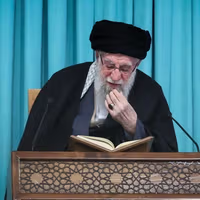
Iran could strike Israel and the United States even harder than it did during last month’s conflict, Supreme Leader Ali Khamenei said on Wednesday in his first public speech since a June 24 ceasefire.
Speaking before judiciary officials in Tehran, Khamenei said the extent of the damage inflicted—on a US base in Qatar—would become clear once media restrictions were lifted.
“The center targeted by Iran was an extremely sensitive American facility,” he said. “Once the news blackout is lifted, it will become clear what a heavy blow was delivered. And a blow even greater than this can be struck against the US and others.”
President Trump said last month that Iran provided early notice before launching missile strikes at the US Al Udeid Air Base in Qatar, downplaying Tehran’s response to US airstrikes on three Iranian nuclear sites as "very weak."
Khamenei, who had only made recorded remarks from an undisclosed location during the 12-day US-Israeli campaign, briefly appeared at a July 5 mourning ceremony without speaking.
The 86-year-old veteran theocrat said the attacks aimed at regime change but failed.
“The aggressors assumed that by targeting certain key individuals and centers in Iran, they would weaken the system. They planned to then unleash their dormant proxies — from hypocrites and monarchists to thugs — stirring unrest and dragging people into the streets to overthrow the Islamic system.”
“God Almighty nullified their scheme ... He brought the people into the field in support of the government and the system."
Amid wartime Israeli bombardments, residents of major cities fled their homes seeking safety.
Khamenei went on to say that Israel’s dependence on the United States exposed its weakness.
“If the Zionist regime could defend itself, it wouldn’t have turned to America,” he said. “It saw that it couldn’t handle the Islamic Republic.”
Israeli air strikes and drone attacks during the 12-day war killed hundreds of Iranian military personnel and nuclear scientists, along with with hundreds of civilians. Iranian missile salvos killed 27 Israeli civilians.
Turning to internal matters, Khamenei ordered the judiciary to pursue what he called “recent crimes” through all legal channels. “We must not release the collar of the criminal,” he said.
“Even if it takes twenty years, it must be pursued.” He dismissed concerns about international courts, saying they may one day act fairly “if an independent judge appears.”
The Supreme Leader also warned against public criticism of Iran’s armed forces or diplomatic corps, insisting that objections be expressed only “with an acceptable tone and after proper knowledge.” National unity, he said, must be preserved at all costs.
Iran’s parliament on Wednesday demanded that the government halt all new negotiations with the United States unless strict preconditions are met, citing what lawmakers called Washington’s use of diplomacy as cover for military escalation.
“When the US uses negotiations as a tool to deceive Iran and to cover for sudden military attacks by the Zionist regime, talks cannot continue as before,” members of parliament said in a joint statement read during an open session by MP Ahmad Naderi, according to state media.
While the tone of the statement points to demands such as security assurances, respect for sovereignty, and a fundamental change in US conduct, lawmakers did not outline any specific or actionable preconditions.
The declaration came one day after US President Donald Trump said he was in “no rush” to resume talks and pointed to last month’s airstrikes on Iranian nuclear facilities as leverage. “They would like to talk. I’m in no rush to talk because we obliterated their site,” Trump said Tuesday.
Parliament says no new talks without guarantees
The lawmakers said any new diplomatic engagement must be conditional and guided by Iran’s top leadership. “Preconditions must be established, and until they are fully met, no new negotiations should take place,” they said.
They accused the US of deliberately using the appearance of diplomacy to enable Israeli military action and warned that Iran would no longer engage under the same terms. “The American president, while pretending to favor diplomacy, authorized a direct attack on our nuclear infrastructure,” the statement said.
Lawmakers framed the issue as part of a larger campaign to undermine Iran’s sovereignty. “The goal is to weaken and divide the country,” they said. “But our response must be unity under the commands of the Supreme Leader.”
Iran faces pressure as Europe moves toward snapback
The warning came amid growing pressure from the US and its European allies, who on Monday set an end-of-August deadline for Iran to return to the nuclear deal or face the reimposition of full UN sanctions under the JCPOA’s snapback mechanism, Axios reported.
The snapback mechanism, created under UN Security Council Resolution 2231—which endorsed the 2015 nuclear deal—allows any party to the agreement to reimpose sanctions if Iran is found non-compliant. If no resolution is passed within 30 days to continue sanctions relief, all prior UN measures automatically come back into force.
The US, France, Britain, and Germany said Iran could avoid snapback only by providing new assurances over its nuclear activities. A US official told Axios that Trump was frustrated by Iran’s refusal to return to talks and wants any future discussions to be direct.
“The snapback is leverage,” the official said. “And Witkoff has told the Iranians clearly: no intermediaries this time.”
Parliament defends law limiting IAEA access
In the statement, Iranian lawmakers also defended their recent vote to restrict cooperation with the International Atomic Energy Agency, saying it was a response to security threats following the June airstrikes.
“The Parliament of Iran has voted for a halt to collaboration with the IAEA until the safety and security of our nuclear activities can be guaranteed,” the lawmakers said.
Tehran says it has not ended cooperation with the International Atomic Energy Agency despite the new legislation. Instead, future coordination with inspectors will be managed by Iran’s Supreme National Security Council, Foreign Minister Abbas Araghchi said earlier this month.
“Iran remains committed to the NPT and its Safeguards Agreement,” Araghchi wrote on X, rejecting reports of a full suspension as “fake news.”
He said the shift in procedure was necessary due to rising security concerns. “Under the new law, all cooperation with the IAEA must go through the Supreme National Security Council,” he wrote.
Lawmakers target IAEA and Western states
Iranian lawmakers accused the IAEA of legitimizing military aggression by sharing sensitive information with hostile governments. They also criticized Germany and other European states for backing US and Israeli actions.
“The IAEA and its partners must understand that until Iran is assured of no further violations, no new information will be handed to spies and aggressors,” the statement said.
The IAEA said inspectors remain in the country and await clarification from Tehran. But tensions have continued to rise, with a senior Iranian judicial official recently threatening the IAEA chief with trial in absentia.
Iran signals no retreat from enrichment
The Pentagon said last month’s strikes had degraded Iran’s nuclear program by up to two years. “We have degraded their program by one to two years, at least,” Pentagon spokesman Sean Parnell said.
Araghchi confirmed “serious and heavy damage” to the Fordow facility but said Iran would not halt enrichment. “Enrichment is a matter of national pride and glory,” he said.
Lawmakers echoed that stance. “We will not allow anyone to use the language of pressure and expect submission,” they said. “Diplomacy is not surrender—it is another front in the war.”