Four Americans held in Iran, including two arrested after June war - NYT
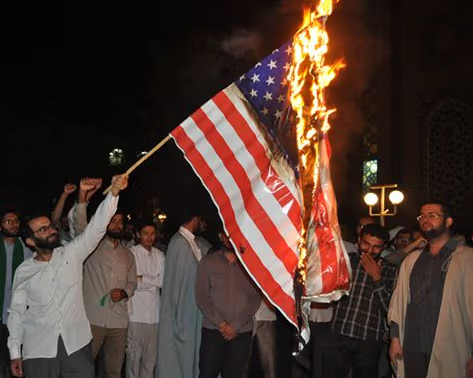
A seminary student in Qom burns a flag of the United States in October 2013, after President Rouhani's visit to New York.
The Islamic Republic is holding at least four Iranian American citizens including two individuals arrested after last month's US and Israeli airstrikes, The New York Times reported Saturday, citing rights groups and lawyers.
“Three of the Americans are in jail, and one has been barred from leaving the country,” the New York Times wrote, quoting individuals familiar with the detentions.
Hostage Aid Worldwide, a nonprofit that aids families of detainees, was quoted as saying it remains in contact with the detainees’ friends and relatives, and that all four had traveled to Iran from the United States to visit family.
Two of the four were arrested by security forces shortly after Israel’s attacks on Iran in June, according to the Human Rights Activists News Agency (HRANA) and Hengaw, independent rights groups based outside the country.
The other two were arrested last year, the report said.
The detentions “are likely to increase the already tense political climate between Tehran and Washington after the United States joined Israel’s attack on Iran and bombarded and severely damaged three of its nuclear sites in June," the report added.
One is a 70-year-old Jewish man from New York, a father and grandfather who runs a jewelry business. Rights groups and the man’s colleagues and friends said he is being questioned over a past trip to Israel.
HRANA identified him as Yehuda Hekmati on July 28.
Another case involves a California woman previously held in Evin prison, whose whereabouts remain unclear after the prison was attacked by Israel and evacuated.
Kylie Moore-Gilbert, an Australian British academic formerly imprisoned in Iran, confirmed the details, according to The New York Times.
A third Iranian American woman, initially detained in December 2024, is now out of prison but cannot leave the country, the report said. “She is currently out of prison, but her Iranian and American passports were confiscated."
Her US-based lawyer said that after the war, “the Iranian judiciary elevated her case and charged her with espionage.”
Reza Valizadeh, a US-Iranian journalist and former Radio Farda employee, was also arrested in October 2024 while visiting family and later sentenced to 10 years for “collaborating with a hostile government.”
Two Iranian officials told the Times that the New York man and California woman were detained as part of a crackdown on suspected operatives linked to Israel and the US.
The arrests come as President Masoud Pezeshkian has publicly urged members of the Iranian diaspora to return, saying he would coordinate with the intelligence and judiciary ministries to ease the process, according to local media.
“We have to create a framework so that Iranians living abroad can come to Iran without fear,” he said last week.
The United States on Friday advised citizens against traveling to Iran citing what it called escalating paranoia and an unprecedented crackdown on alleged spies and opponents following the 12-day war with Israel.
"The Iranian regime, following the 12-day war with Israel, is in the midst of unprecedented paranoia and a crackdown on spies and regime opponents," the State Department said in a post on its Persian X account USA Beh Farsi.
"Anyone considering travel to Iran should reconsider their decision. We repeat: US citizens should not travel to Iran!" the post reads.
A new national plan for civil defense training and shelter preparedness has been approved, Iran’s top military official said Saturday, just days after Israeli media warned of another potential war with Tehran.
“The new directive defines the responsibilities of executive bodies in building and managing shelters and emergency housing,” said Major General Abdolrahim Mousavi, who chairs Iran’s Armed Forces General Staff.
The announcement follows a report aired Thursday by Israel’s Channel 12, which cited analysts warning that both Iran and Israel appear to be preparing for another round of fighting despite a ceasefire in their 12-day conflict in June.
Iranian President Massoud Pezeshkian also warned this week that “Israel may attack again at any moment,” adding that Iran’s armed forces are fully prepared to repel any aggression.
"Today, within the armed forces, we are pursuing different preparedness programs across three timeframes—short-term, medium-term, and long-term," Mousavi said. "Improving readiness in the civilian sector and securing infrastructure must also be addressed with this same approach."
The new civil defense directive comes as Iranian authorities face criticism over the country’s vulnerability to airstrikes.
During the war with Israel, observers highlighted the lack of functioning air defense systems, early warning sirens, and public shelters.
Iran's government says 1,062 people were killed during the 12-day conflict with Israel, including 786 military personnel and 276 civilians.
Iranian strikes also killed 29 civilians and one off-duty soldier, Israeli media reported.
Iran’s Islamic Revolutionary Guards Corps (IRGC) on Saturday slammed efforts to promote a two-state solution to the Israeli-Palestinian conflict, a few days after a UN conference co-chaired by Saudi Arabia pushed for the solution.
“These satanic efforts are prescribing a two-state solution to end the Palestinian issue,” the IRGC said in a statement, marking the first anniversary of the Israeli killing of Hamas leader Ismail Haniyeh in Tehran.
“But the resistance remains firm on the path of martyr Haniyeh and others.”
The Guards said the path forward lies not in political compromise but in continued resistance. Quoting a Hamas slogan attributed to Haniyeh, the statement said: “We do not recognize Israel—never, never, never.”
A High-Level International Conference for the Peaceful Settlement of the Question of Palestine and the Implementation of the Two-State Solution took place at the United Nations in New York from July 28-30, 2025.
The conference, co-chaired by France and Saudi Arabia, aimed to revitalize efforts towards a two-state solution between Israel and the Palestinians, with a focus on achieving a just and lasting peace.
Traditionally, Iran has advocated for the annihilation of Israel, rejecting a two-state solution that would create an independent Palestinian state alongside Israel. Supreme Leader Ali Khamenei said in 2015 that Israel must be destroyed within 25 years.
Gaza war
The IRGC's statement described the war in Gaza as a genocide carried out with the broader aim of seizing strategic and resource-rich regions of the Islamic world.
“Those who engineered the genocide in Gaza are undoubtedly pursuing larger goals—the swallowing of the Muslim world’s rich and strategic regions,” it said.
“But with God’s help, the breaking of global silence and the surge of anti-Zionist international protest will shatter the hopes and ambitions of the Zionist-American criminal band, which must now await the unmasking of its hidden fate.”
It also condemned the killing of Haniyeh in Tehran, which occurred while he was in the city for Iran’s presidential inauguration.
The IRGC credited continued Palestinian resistance to what it called the legacy of Haniyeh and other slain leaders of the anti-Israel struggle.
“The Aqsa Storm was not a passing event but a strategic doctrine sealed by the blood of martyrs,” it said, referencing the October 7, 2023 Hamas attack on Israel.
Since the October 7 attacks which saw at least 1,200 people killed and more than 250 more taken hostage by the militant group, Israel’s military campaign has killed over 53,000 people in Gaza, according to the Hamas-run Ministry of Health statistics.
The Israeli military says at least 20,000 of those are militants.
Accusing Israel of using starvation and siege as instruments of war, the IRGC called on international organizations to recognize such tactics as war crimes and to impose serious sanctions on the Israeli government.
“The deliberate creation of famine is a recognized crime against humanity,” the statement said.
The IRGC, a powerful parallel military in Iran with extensive economic and intelligence roles, was designated a terrorist organization by the United States in 2019 under President Donald Trump. Washington and Ottawa have called on European allies to follow suit.
UK Foreign Secretary David Lammy has warned that regime change in Iran could produce outcomes “as bad or worse,” saying there is no guarantee that any successor to the Revolutionary Guards would be an improvement.
“There are lots of people in Iran who would like regime change,” Lammy told The Guardian, in an interview published on Saturday. “But there are no guarantees that what would replace the current Iranian Revolutionary Guard Corps would not be as bad or worse.”
“The US decision to bomb was not to topple Iran’s government,” he added.
Lammy emphasized that the decision over Iran’s political future “is for the Iranian people to determine,” and that his focus remains on preventing Tehran from developing nuclear weapons.
Nuclear concerns remain central
Lammy also said Iran has failed to justify its production of uranium enriched to 60% purity, a level far beyond what’s needed for civilian energy.
“Its leaders cannot explain to me, and I’ve had many conversations with them, why they need 60% enriched uranium,” he said, pointing out that enrichment in UK sites like Sellafield and Urenco does not exceed 6%.
He warned of a broader risk to the region: “We would be very suddenly handing over to our children and grandchildren a world that had many more nuclear weapons in it than it has today.”
Tehran denies talks aim at a deal
Lammy’s comments come amid renewed, but limited, diplomatic contacts between Iran and the so-called E3 — Britain, France and Germany. Tehran insists these are not formal negotiations.
“There are no talks aimed at reaching a deal with Europe at the moment,” Iranian government spokesperson Fatemeh Mohajerani told Russia’s Sputnik news agency. “These are exchanges of opinion.”
The discussions follow last week's meeting in Istanbul, the first such engagement since Israeli and US strikes on Iranian territory in June.
NPT threat underscores tensions
Iran International earlier this week reported that Tehran has warned it may withdraw from the Nuclear Non-Proliferation Treaty (NPT) if the E3 moves to trigger snapback UN sanctions under Security Council Resolution 2231.
Tehran rejects the legal basis of such a move and accuses European states of aligning themselves with US and Israeli military actions.
Iran says diplomacy backed by Supreme Leader
A senior Iranian lawmaker said on Saturday that the recent talks have full backing from the country’s top leadership.
“What is happening now is certainly the decision of the ruling system,” said Abbas Golroo, a senior lawmaker and member of the national security and foreign policy committee. He called the decision to engage diplomatically “the right one.”
Golroo said talks could help reduce threats and stressed the need to keep close ties with Russia and China. “Our backing must allow the team to protect national interests and manage challenges in these delicate conditions,” he said.
Iran is holding talks with European powers on its nuclear program, but no negotiations aimed at reaching a new agreement are currently underway, government spokesperson Fatemeh Mohajerani said in an interview published on Saturday.
“What is taking place now between Iran and the three European countries is an exchange of views on the nuclear issue, which has become highly complex,” Mohajerani told Russian state-owned news agency Sputnik.
She said Iran has never opposed dialogue with Europe but stressed that the current contacts do not amount to formal negotiations. “There are no talks aimed at reaching a deal with Europe at the moment,” she said. “These are exchanges of opinion.”
Talks follow high-level Istanbul meeting
Her comments follow last week’s meeting in Istanbul between Iranian officials and representatives from Britain, France and Germany, known collectively as the E3. The closed-door session marked the first formal nuclear discussions since Israeli and US strikes on Iranian territory in June.
Iran International earlier reported that Tehran had privately warned it may withdraw from the Nuclear Non-Proliferation Treaty (NPT) if the E3 proceeds with reimposing UN sanctions under the snapback mechanism of Security Council Resolution 2231. The warning, conveyed by Deputy Foreign Minister Majid Takht Ravanchi, was described by diplomats as firm but not a declaration of intent to build nuclear weapons.
Tehran has rejected the legal basis of any E3 attempt to trigger sanctions, with foreign ministry spokesman Esmail Baghaei saying the three countries had “marginalized themselves” by aligning with the military action from Israel and the United States.
Lawmaker says talks approved by leadership
The current diplomatic activity was authorized by the ruling system, not initiated independently by diplomats, a senior Iranian lawmaker said on Saturday.
“What is happening now is certainly the decision of the ruling system,” Abbas Golroo, a member of the national security and foreign policy committee in parliament, told state media. “This decision to negotiate is the right one in my view.”
Golroo said recent talks could help reduce threats and widen diplomatic space for Iran, particularly as the country faces pressure over the possible reimposition of UN sanctions. He also stressed the importance of parallel diplomatic channels with China and Russia.
“Our backing must allow the team to protect national interests and manage challenges in these delicate conditions,” he said.
Reuters provided close to $4 million in news content to Iran’s state-controlled broadcaster over more than a decade, the Washington Free Beacon reported on Friday, citing leaked documents and internal communications.
The payments were directed to the Islamic Republic of Iran Broadcasting (IRIB), a US-sanctioned entity that oversees English-language state news channel Press TV and other state-linked outlets.
According to private emails and invoices published by the Network Contagion Research Institute, Reuters furnished IRIB with extensive video and text services between at least 2011 and 2021.
“I want to make sure that these services continue without any interruptions,” a Reuters executive wrote to IRIB in 2021, adding, “I am under pressure from my management to start receiving payments as soon as possible.”
A Reuters spokesperson confirmed the relationship to the Free Beacon, saying that the company had sold “text newswires and video news products into Iran” for more than ten years and had disclosed the transactions to the US Treasury.
The spokesperson defended the practice, saying, “We believe that it is vital that every government and its citizens have access to Reuters' reliable and accurate news. This practice applies equally in times of conflict.”
Reuters issued payment requests totaling $3,882,116, including follow-ups to IRIB officials and acknowledgments of Press TV’s reliance on the content, the Free Beacon reported.
The documents also confirm Reuters’ contact with IRIB chief Peyman Jebelli and Press TV head Ahmad Noroozi—both under US, EU, and Canadian sanctions for their roles in “broadcasting coerced confessions and collaborating with Iranian intelligence.”
“Reuters uniquely provides the IRIB with news content that the IRIB uses for legitimacy, which Reuters officials bragged about in these emails,” a senior GOP congressional staffer told the Free Beacon. “That is a moral crime. Now it's clear from the emails that Reuters knew it was circumventing American sanctions by using third-party cutouts. That is an actual crime that people go to jail for.”
Reuters declined to answer whether the relationship with IRIB is still ongoing, according to the Free Beacon.