Belgian parliament committee backs IRGC terror listing, MP says
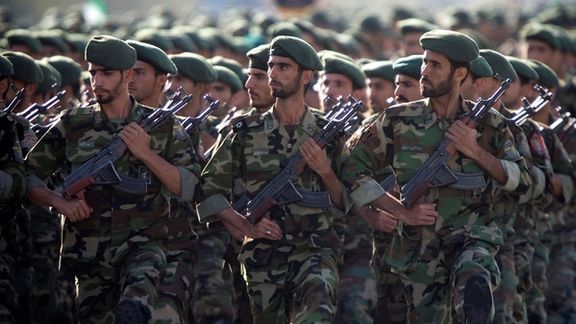
Members of the Islamic Revolutionary Guard Corps march during a military parade in Tehran, File Photo.
A Belgian parliamentary committee has approved a resolution backing the designation of the Islamic Revolutionary Guard Corps (IRGC) as a terrorist organization, MP Darya Safai said on Wednesday.
Safai, a lawmaker of Iranian descent, said the vote in the foreign affairs committee marks a key step in her long-standing campaign to hold the IRGC accountable for its role in international terrorism and domestic repression.
“Belgium is one of the first countries in Europe to take this step explicitly,” she said on X. “Belgium is leading the way internationally, and it is now up to the European Union to follow through on this stance.”
She added that the resolution also calls for “the unconditional and immediate release of Ahmadreza Djalali” and an end to executions carried out by Iran’s authorities.
Djalali, a Swedish-Iranian academic, was arrested in Iran in 2016 and sentenced to death the following year on charges of spying for Israel, which he denies. In April, Sweden’s foreign minister called on Iran to release him on humanitarian grounds, citing his deteriorating health and harsh prison conditions.
Safai's proposal has previously drawn support from then-Foreign Minister Hadja Lahbib, who said Belgium backed adding the IRGC to the EU sanctions list.
The new Belgian government, led by Bart De Wever, reaffirmed that position in its coalition agreement, which said "The government advocates for the inclusion of the Iranian Islamic Revolutionary Guard Corps on the European Union's list of terrorist organizations."
The IRGC, a powerful parallel military with extensive economic and intelligence roles, was designated a terrorist organization by the United States in 2019 under President Donald Trump. Washington and Ottawa have called on European allies to follow suit.
Iran is intensifying a nationwide crackdown in the wake of its 12-day war with Israel, targeting ethnic and religious minority groups as well as foreign nationals, in what experts describe as a bid to reassert control, deflect blame, and suppress dissent.
Iran’s Jewish community has come under intensified pressure since the end of Israel's campaign, with members directly targeted by security forces.
Beni Sabti, who fled Iran as a teenager with his family and sought refuge in Israel, told Iran International that while rumors of mass executions of Iranian Jews are untrue, more than a dozen Jewish Iranians have been detained and interrogated under suspicion of espionage.
"This is purely antisemitic," said Sabti, a researcher at the Institute for National Security Studies (INSS) in Tel Aviv, specializing in Iranian affairs.
Many Jewish conscripts in Iran were allegedly forced to participate in public demonstrations of loyalty to the Islamic Republic following Israel’s strikes on military and nuclear sites.
According to the US-based Human Rights Activists News Agency (HRANA), Iranian authorities have summoned and interrogated at least 35 Jewish citizens in Tehran and Shiraz over alleged contact with relatives in Israel. A senior member of Tehran’s Jewish community told HRANA the interrogations are “unprecedented” and have triggered profound fear and uncertainty throughout the community.
"It's a kind of sacrifice," said Sabti, "The Islamic Republic knows the Jews are not involved in espionage. It's a play that they have to do and play that game of the regime to obey them and to let them interrogate them, and after that, they most probably are released."
Crackdown on Kurds
One of the hardest-hit communities is Iran’s Kurdish minority, according to Taimoor Aliassi, the UN representative of the Kurdistan Human Rights Association in Geneva.
“Since the beginning of the 12 days war, over 300 Kurdish citizens have been detained, five executed, one died under torture in prison in Kermanshah, another killed in the street and a Kolbar was also reported killed by border officials,” Aliassi told Iran International.
He said the Islamic Republic has multiplied checkpoints and intrusive controls at the entrances to Kurdish cities, accompanied by heavy deployments of military forces.
“It’s a state of emergency and the Islamic Republic is scared of popular uprising in Kurdistan which could lead to other parts of the country,” he added.
Baha'is and Baluch minority groups
Iranian security forces have also carried out widespread raids on the homes of Baha’i citizens during and after the conflict, IranWire reports.
Headquartered in Haifa, Israel, the Baha’i faith is Iran’s largest non-Muslim religious minority but it is not officially recognized by the Iranian government.
Security forces opened fire on residents in the village in the region on Tuesday, according to the Haalvsh website. One woman, Khan-Bibi Bameri, was killed. Eleven other women — including four minors — were seriously injured. Two remain in critical condition.
Masking internal failures
Shahin Milani, director of the Iran Human Rights Documentation Center, told Iran International that these groups are being scapegoated to mask the Islamic Republic's internal failures.
“The Iranian government must know very well that Baha'is and Iranian Jews are not in the position to have access to classified information or to collaborate with Israel. Baha'is were purged from all public sector jobs after the 1979 Revolution," said Milani.
"Accusing them of espionage and other national security crimes serves only one purpose for the Islamic Republic: telling its supporters that it is doing something to address the massive security failures exposed by the war,” Milani said.
He added that these arrests reflect the Islamic Republic's inability to identify actual threats.
The Islamic Republic has also arrested leading activists such as freedom of speech advocate Hossein Ronaghi. Others, including rapper Toomaj and activist Arash Sadeghi, were reportedly beaten, arrested, and later released. Nationwide, at least 705 people have been arrested on political or security-related charges since the war began, according to HRANA.
The wave of repression has drawn parallels to the aftermath of the Iran-Iraq war, when thousands of dissidents were executed by the Islamic Republic.
“This is sadly a tried and true authoritarian tactic, and there are real fears emerging that the Iranian people may have a totalitarian terror in store for them like Saddam Hussein after his 1991 defeat,” said Behnam Ben Taleblu of the Foundation for Defense of Democracies’ Iran Program.
“Now that scope is expanding to foreign nationals as well,” Taleblu told Iran International.
Repression extends to foreign nationals
Iran has arrested several European nationals in various provinces over allegations they were "in some way cooperating with Israel" and has opened cases against them, the judiciary’s spokesperson said on Monday.
On Wednesday, AFP reported that French nationals Cécile Kohler and Jacques Paris, detained in Iran for three years, have been charged with “spying” for Israel.
Iranian authorities have also accused the pair of “conspiracy to overthrow the regime” and “corruption on earth”— which is punishable by the death penalty, the report said citing a French diplomatic source and family members.
Iran’s judiciary chief, Gholamhossein Mohseni Ejei, declared shortly after the war began that the trial and punishment of anyone arrested for alleged collaboration with Israel “should be carried out and announced very quickly.”
Iran’s parliament has recently passed a sweeping new law mandating the death penalty for anyone found cooperating with Israel, the US, or so-called “hostile groups”—while also criminalizing the use of tools like Starlink to bypass state internet controls.
Activists fear that unless checked, a new chapter of repression could once again engulf dissidents, women, and Iran’s most vulnerable minority groups.
Iran has rebuked the European Union’s top diplomat over her call for the end of Tehran’s nuclear program, warning that European countries and the UK could be excluded from any future negotiations if they insist on such positions.
If the European Union believes Tehran's nuclear program must be ended, then "the participation and role of the European Union and its member states, plus the UK, in any future negotiation would be irrelevant and therefore meaningless,” Iranian Foreign Minister Abbas Araghchi wrote on X.
His statement came in response to a post by EU foreign policy chief Kaja Kallas, who urged Iran to resume talks aimed at ending its nuclear program.
“Negotiations on ending Iran's nuclear program should restart as soon as possible. Cooperation with the IAEA must resume. The EU is ready to facilitate this,” Kallas wrote.
She added that she had discussed the matter with Araghchi in a phone call on Tuesday. “Any threats to pull out of the Non-Proliferation Treaty don’t help to lower tensions,” she said.
Araghchi also accused Kallas of disregarding the provisions of the Nuclear Non-Proliferation Treaty (NPT) "which explicitly affirm the right of all signatories to develop, research, and use nuclear technology for peaceful purposes."
On Wednesday, Iranian state media announced that President Masoud Pezeshkian had enacted a law suspending cooperation with the UN nuclear watchdog, following its approval by parliament and the Guardian Council.
The law mandates a halt to cooperation under the Safeguards Agreement tied to the Nuclear Non-Proliferation Treaty, unless Iran’s demands—such as security assurances for its nuclear sites and scientists—are met.
Despite the suspension of cooperation with the UN’s nuclear watchdog, IAEA inspectors remained on the ground in Iran as of Wednesday, according to a diplomat familiar with the agency’s operations who spoke to the Associated Press.
The IAEA said it is awaiting clarification from Iranian authorities. “We are aware of these reports. The IAEA is awaiting further official information from Iran,” the agency said in a statement.
The US State Department said on Wednesday "it is unacceptable that Iran chose to suspend cooperation with IAEA at a time when it has a window of opportunity to reverse course and choose a path of peace and prosperity."
"Iran must cooperate fully without further delay," State Department spokesperson Tammy Bruce told reporters.
"Iran must fully comply with its safeguard agreements required under the NPT including by providing IAEA with information required to clarify and resolve long standing questions regarding undeclared nuclear material in Iran, as well as provide unrestricted access to its newly announced enrichment facility," Bruce added.
French nationals Cécile Kohler and Jacques Paris, detained in Iran since three years ago, have been charged with spying for Israel, AFP reported citing diplomatic and family sources.
The pair have also been charged with "conspiracy to overthrow the regime and corruption on earth", the report added.
"All we know is that they have seen a judge who confirmed the three charges," Kohler's sister said.
Since the end of the 12-day Israeli campaign on June 24, Iran has executed several individuals and arrested hundreds of others on charges of espionage and collaboration with Israel.
Cécile Kohler and Jacques Paris were arrested in May 2022 during a tourist trip to Iran. Both were charged with espionage, which they deny. They remain in detention in Tehran.
In May, France filed a case against Iran at the International Court of Justice (ICJ), accusing Tehran of unlawfully detaining the two French citizens for three years and violating international law.
“They have been held hostage… detained in appalling conditions that amount to torture,” French Foreign Minister Jean-Noël Barrot told France 2 television. He said Iran had denied France’s requests for consular access.
Kohler, a teacher, and Paris, her partner, are the last known French citizens held in Iran. French President Emmanuel Macron has described them as “state hostages.”
France and other European Union members accuse Iran of practicing “hostage diplomacy” — detaining foreigners to pressure Western governments.
Iran denies the accusation. Its officials say the arrests followed legal procedures and reject claims of mistreatment.
Iranian investors withdrew over 132 trillion rials—nearly $145 million—from Tehran’s stock market on Wednesday alone, marking a historic record amid deepening mistrust following the recent conflict with Israel.
The selloff came as the Tehran Stock Exchange plunged for a fourth consecutive trading day after the ceasefire. The main index dropped by 57,000 points to 2.73 million.
On Tuesday, individual investors pulled out 64.78 trillion rials—around $71 million—in a single trading day, according to Iranian media.
That followed a deep-in-red opening on Saturday, the first trading day after the 12-day war, when 99% of listed stocks declined and the market lost 62,503 points.
The panic coincided with a cyberattack on Sepah and Pasargad banks that further fueled public distrust in the financial system.
In the days following, large sums were moved abroad through exchange shops. To stem the outflow, multiple exchanges experienced technical disruptions beginning Monday, Iran International previously reported.
During the war, currency and gold markets were largely inactive, but they resumed trading this week with both the US dollar and gold prices climbing.
The Tehran bourse has historically been sensitive to geopolitical stress, but recent market behavior suggests a deeper crisis of confidence—compounded by economic mismanagement, financial sector instability, and the Islamic Republic’s response to external shocks.
IAEA inspectors were still on the ground in Iran as of Wednesday and had not been instructed to leave, a diplomat familiar with the agency’s operations told the Associated Press, after Tehran enacted a law suspending cooperation with the UN nuclear watchdog.
The IAEA said it was awaiting formal clarification from Iranian authorities on what the suspension will mean in practice.
“We are aware of these reports. The IAEA is awaiting further official information from Iran,” the UN nuclear watchdog said in a statement.
On Wednesday, Iranian state media announced that President Masoud Pezeshkian had enacted the law, following its approval by parliament and the Guardian Council.
The law mandates a halt to cooperation under the safeguards agreement tied to the Nuclear Non-Proliferation Treaty (NPT), unless Iran’s demands—such as security assurances for its nuclear sites and scientists—are met.
The move follows a sharp escalation in Iranian criticism of the IAEA, particularly after a resolution passed by the agency’s Board of Governors was cited by Tehran as paving the way for Israeli and US strikes on its nuclear sites last month.
Iranian newspaper calls for arrest and execution of IAEA chief
Iran’s hardline newspaper Kayhan, overseen by Iran's Supreme Leader Ali Khamenei, published an editorial last week accusing IAEA Director General Rafael Grossi of working as an Israeli agent. The paper said Grossi should be arrested and executed if he enters Iran.
The comments triggered swift condemnation from France, Germany, and the United Kingdom. “We condemn threats against the Director General of the IAEA, Rafael Grossi,” the three governments said in a joint statement on Monday. They reaffirmed their full support for the agency and its mandate.
Judiciary signals possible in absentia prosecution of Grossi
On Wednesday, a senior Iranian judicial official suggested Grossi could face trial in absentia for his alleged role in facilitating the attacks. Deputy judiciary chief Ali Mozaffari said the case was under review by the judiciary’s international affairs office and that legal teams were compiling evidence to seek damages.
He accused the IAEA chief of “deceptive actions and falsified reports” that, in Tehran’s view, laid the groundwork for foreign aggression.
Officials press IAEA to condemn strikes
Iranian officials have also criticized the IAEA for failing to condemn the attacks on Iran’s nuclear facilities. Foreign Ministry spokesman Esmail Baghaei told the Hindustan Times over the weekend that Tehran had expected a clear denunciation from the IAEA leadership and Board of Governors.
“We are not hostile to any person at the international organizations, IAEA being one of them,” Baghaei said. “The point is that, yes, we are outraged—our people are really unhappy and angry about the IAEA’s position.”
He accused Grossi of including “concepts” in his latest report that allowed Western nations to push through the resolution. Although Grossi told CNN there was no evidence of an Iranian weapons program, Tehran claims the report provided cover for the subsequent attacks.
Atomic Energy Organization head Mohammad Eslami echoed the criticism Wednesday, saying the strikes would not deter Iran’s nuclear development. “The nuclear industry cannot be destroyed by bombing,” he said. “The path forward is open.”