Iran’s Guards want Taliban intel on UK-linked Afghans - Telegraph
People try to get into Hamid Karzai International Airport in Kabul, Afghanistan, August 16, 2021.
Tehran has requested the Taliban share a leaked list of Afghans who assisted British forces, including those linked to MI6, as part of a bid to identify and potentially detain some now in Iran for possible diplomatic leverage ahead of nuclear talks, The Telegraph reported.
Iran’s Guards want Taliban intel on UK-linked Afghans - Telegraph | Iran International
An official from the Islamic Revolutionary Guard Corps (IRGC) in Tehran confirmed to The Telegraph on Monday that the IRGC has formally asked the Taliban for the list of nearly 25,000 Afghans.
The list, dubbed the “kill list” in British media was leaked in 2022 and contains the full names, emails, and phone numbers of people in Afghanistan who applied for relocation to the United Kingdom following the military withdrawal in 2021.
It includes personal data of Afghan soldiers, government employees, and their families, as well as around 100 British special forces members and intelligence operatives who had endorsed Afghan applicants.
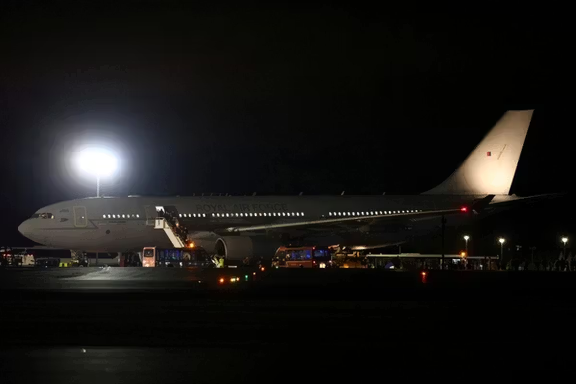
People disembark the RAF Voyager aircraft, upon arrival from Afghanistan, at the RAF Brize Norton, in Oxfordshire, Britain, August 17, 2021
A Taliban official told The Telegraph that since discovering the value of the list, the group has been working to locate and detain those still in Afghanistan, intending to use them as leverage in diplomatic pressure on the UK.
"Taliban leadership in Kandahar has also ordered officers in Kabul to arrest as many individuals as possible from the leaked document to use them as leverage in exerting diplomatic pressure on London," according to the report.
The Telegraph says the IRGC appears to have similar intentions, particularly with renewed nuclear negotiations and the threat of snapback sanctions looming over Iran.
Since the June 25 ceasefire between Iran and Israel, Tehran has accelerated the deportation of Afghan nationals from Iran, citing an inability to continue hosting large numbers of migrants and asylum seekers.
On July 25, senior Iranian diplomats met with counterparts from the UK, France, and Germany in Istanbul to discuss the path forward. They agreed to continue negotiations.
European governments are pressing Iran to resume full cooperation with the International Atomic Energy Agency (IAEA), including the reinstatement of inspections and other obligations. Following the war with Israel, Iran has moved to further limit cooperation with the UN nuclear watchdog.
Under UN Security Council Resolution 2231, any party to the now-lapsed 2015 nuclear agreement—including France, Germany, the UK, Russia, or China—can file a complaint accusing Iran of non-compliance.
If no progress is made on Iran's nuclear dossier by August 30, the so-called snapback mechanism can reinstate UN sanctions removed under the 2015 deal.
“We have made it clear to the United Nations and the Security Council that such a step is a misuse of international mechanisms, and the Islamic Republic will respond decisively,” Iran’s Deputy Foreign Minister Kazem Gharibabadi said Sunday.
Iran has announced sweeping closures across multiple provinces including the capital this week due to soaring temperatures amid severe electricity and water shortages.
Alireza Fakhari, the governor general of Tehran province on Monday announced the closure of all government offices, schools, and universities on Wednesday due to soaring temperatures and the need to manage energy consumption.
Fakhari said the decision followed a request from the country's energy ministry.
Other provinces are also implementing closures or reducing working hours this week.
Offices in Ardabil and Golestan will be closed on Tuesday, while those in Semnan, Qom, Ilam, Gilan, and Chaharmahal-Bakhtiari have reduced working hours.
On Wednesday, offices in Kerman, Hormozgan, Isfahan, Gilan, East and West Azerbaijan, and Chaharmahal-Bakhtiari will also be shut.
In Hamedan, office hours on both Tuesday and Wednesday will be limited to 6 a.m. to 11 a.m.
Similar closures were ordered last month on Wednesday July 23 as Iran's President Masoud Pezeshkian warned of a worsening water shortage.
Iranian officials are considering formal Wednesday shutdowns to create three-day weekends and a full summer week off amid worsening water and power outages caused by extreme heat and falling reservoir levels across the country.
Energy Minister Abbas Aliabadi said the shutdown of July 23 cut national power demand by 19,000 megawatt-hours and reduced Tehran’s water usage by 3,800 liters per second.
Iran has recently faced an unprecedented heatwave, and many natural and engineered water reservoirs across the country particularly in Tehran, Alborz and Fars provinces are nearly depleted.
In the capital Tehran, officials have attempted to curb consumption through emergency measures, including repeated water and electricity outages.
A US senator’s proposal to bar all Iranian students from American universities is due to pile another obstacle in the way of aspiring scholars already effectively blocked from entry by Trump administration travel restrictions.
Republican Senator Tommy Tuberville introduced legislation that would ban Iranian and Chinese nationals from studying at US universities, arguing students from adversary states pose a national security threat and displace American applicants.
The so-called Student Visa Integrity Act would restrict visas from Iran, cap overall international student enrollment and increase penalties for visa fraud.
"We want to do away with Iran ... nationals getting into this country and learning how to destroy the United States of America and our allies," Tuberville said on Fox News on Friday. “We are funding our own demise.”
Tuberville, from Alabama, serves on Senate committees focused on education and immigration.
Hopes 'shattered'
Even before the proposal, many Iranian students faced steep barriers to studying in the United States. Zanko, a PhD‑bound software engineer living in Iran whose identity Iran International is concealing for his safety, was accepted into a top American university, with classes scheduled to begin in August 2024.
He completed his visa interview last year at a US embassy in a nearby country— a costly, logistically challenging trip from Iran, where there is no US embassy — in hopes of fulfilling his dream.
Zanko says the immigration officer told him his application was under “administrative processing,” an extensive background check. He postponed his admission to August 2025, but his visa appears no closer - a limbo endured by hundreds of other Iranian students.
“Emotionally and professionally, it has been frustrating to know that despite being qualified and committed, external political factors are shaping the course of my future,” Zanko told Iran International.
The situation, Zanko said, “shattered all of my hopes.”
Search for a better life
Leila Mansouri, a US immigration lawyer, told Iran International it has been extremely difficult for Iranians to get a visa.
Even if Tuberville’s bill doesn’t pass, she warned, the government could still block applications by instructing the State Department to stop approvals.
“Behind the scenes they can tell the consulate not to approve the applications like what we saw with the first Trump travel ban that passed in 2017,” said Mansouri, adding that male applicants face especially tough scrutiny.
Much of that additional scrutiny stems from mandatory military service for Iranian men, during which many serve in units affiliated with the Islamic Revolutionary Guard Corps (IRGC) — an organization designated by the US as a foreign terrorist organization. Even routine, non‑combat roles during conscription triggers outright visa denials.
Senator Tuberville has argued that some Iranian students have questionable backgrounds. One example often raised in such debates is the 2017 case of Seyed Mohsen Dehnavi, an Iranian medical researcher turned away at a US airport. Former classmates and activists alleged he was a senior member of the Basij, a paramilitary force tied to the IRGC, and had targeted reformist students. US border officials said his denial was for “reasons unrelated” to the travel ban in place at the time.
Mansouri emphasized that such cases are rare, noting that most Iranian students have no military or security ties. With an existing ban on Iranian military members, including those with past IRGC service, she said this route is already closed.
Iranian students have made significant contributions to American society, Mansouri said, and the US could do a better job of vetting without shutting them out. She described most applicants as “innocent people just trying to have a better life.”
About 10,800 Iranian students studied in the US in 2022–23, up from the year before but still below the 2017–18 peak of nearly 12,800. In 2024, only 2,166 student visas were issued to Iranians — down 42% from 2023 — with denial rates climbing to 41%.
'Collective punishment'
The obstacles deprive the United States of Iranian talents and isolates an entire generation of Iranians, said Siamak Aram, a Sharif University graduate and active member of the Iranian academic community in the US.
“This proposal amounts to collective punishment. It fails to distinguish between the Iranian people and the oppressive regime they are fighting against,” Aram told Iran International.
“It inadvertently aligns with the goals of the Islamic Republic. So-called ‘Supreme Leader’ Ali Khamenei has long sought to limit Iranians’ interaction with the outside world, especially through academic and cultural channels.”
The human impact has also been highlighted by Iranian-American tech entrepreneur Hadi Partovi, co-founder of Code.org, who posted on X on June 30 that he and his twin brother Ali “received hundreds of messages from Iranian students who were accepted into PhD programs in the USA, only to have their legal immigration papers rescinded.”
Partovi, whose family immigrated legally in 1984, wrote, “Iran’s most precious resource is its talent, not its oil,” and pointed to relatives such as Uber CEO Dara Khosrowshahi as examples of how admitting ambitious students can translate into job creation and economic growth.
“Surely America can find a way to protect its security and its borders while also preserving the values and ideals that make it great,” he said.
The surge in visa denials — many issued after nearly a year of administrative processing — comes amid a broader immigration crackdown in the United States.
For Iranian students like Zanko, delays and silence from authorities have been compounded by Section 212(f), a presidential authority typically invoked for national security, applied this spring. Many fear Tuberville’s bill would add yet another hurdle, effectively formalizing a ban on Iranian students.
Neither the US State Department nor Tuberville’s office immediately responded to an Iran International request for comment.
Two young men have been sentenced to death for involvement in the 2022 Woman, Life, Freedom protest movement, Norway-based rights group Hengaw said on Monday.
Mohammad Darvish Narouei, 22, and Yasin Kebdani, 21, were convicted by a court in Zahedan in southeastern Iran of “waging war against God” and “corruption on Earth,” the rights group reported, adding they face imminent execution if the sentences are upheld.
A third detainee, Benyamin Kouhkan, who was 16 at the time of his arrest, has also been tried and placed in solitary confinement with his verdict pending.
All three were tortured and denied access to legal counsel, the group said.
Separately on Monday, Norway-based rights group Iran Human Rights (IHR) reported that two other Baloch political prisoners, Farhad Baranzahi, 24, and Omran Aghal, 22, have been sentenced to death in Zahedan on charges of "membership in armed opposition groups."
Both men were allegedly tortured into confessing and remain held in Zahedan Central Prison, according to IHR.
The unrest was sparked by the death in morality police custody of a young woman, Mahsa Amini. Protests were quashed with deadly force.
At least eleven protesters have been executed in Iran in connection with the 2022 uprising, with the most recent execution carried out in June.
On June 11, Iranian authorities executed Mojahed (Abbas) Kourkour, who was detained in connection with the November 2022 protests in the southwestern city of Izeh.
Last week, the US-based Abdorrahman Boroumand Center for Human Rights reported on that at least 730 people have been executed in Iranian prisons over the past seven months, including 102 in July alone.
Iran’s Lake Urima, once the largest lake in the Middle East, is now all but dry, threatening mass displacement and environmental collapse amid the country’s worst drought in living memory.
Despite repeated government pledges over two decades, the lake’s revival plans have faltered due to chronic underfunding, bureaucratic turf wars, and weak enforcement.
Over 90 percent of the country is experiencing some level of drought, with rainfall plummeting and water reserves dwindling.
The drying of major water bodies like Lake Urmia and the Zayandeh Rud River has intensified Iran’s overlapping economic and ecological crises, as decades of mismanagement catches up with the theocratic establishment.
A mighty ecosystem in retreat
Lake Urmia was once the sixth-largest saltwater lake in the world, spanning over 5,000 square kilometers. It supported rich biodiversity and helped regulate the region’s climate.
But years of poor water management, over-extraction, and climate change have pushed it to the edge. On July 20, Hojjat Jabari, an environmental official in West Azerbaijan Province, issued a stark warning:
“If current conditions continue, Lake Urmia is likely to dry up completely by the end of the summer. We haven’t reached that stage yet—but we’re getting dangerously close.”
Recent satellite images confirm that more than 95% of the lakebed is now dry. Scientists warn that full ecological collapse may soon become irreversible.
What went wrong?
Since the early 2000s, Iran has constructed over 20 major dams and countless smaller ones that divert water from the lake’s main tributaries. Tens of thousands of deep wells—legal and illegal—also draw heavily from groundwater reserves that once fed the lake.
The situation has been worsened by state policies promoting water-intensive crops such as sugar beets, melons, and apples, far beyond the region’s ecological limits.
One of the most damaging interventions came in the early 2000s, when a causeway and bridge were built across the lake, splitting it in two. The structure disrupted natural water circulation and caused the southern basin to turn into a salt flat years before the northern section followed.
Salt storms and human costs
Estimates suggest the lake holds between 1 to 2 billion tons of salt. As the water disappears, winds pick up this salt and spread it across surrounding areas. Videos shared on social media show sweeping salt storms engulfing nearby villages.
If the lake fully dries up, the health and livelihoods of over five million people in cities like Oroumieh, Salmas, and Tabriz could be severely affected. Salt particles in the air can cause respiratory illnesses, destroy farmland, and contaminate water supplies.
In the worst-case scenario, experts warn, northwestern Iran could face mass migration as the region becomes increasingly uninhabitable.
Is there still hope?
Experts caution that without immediate and drastic intervention, the opportunity to revive the lake may be lost for good. But partial recovery is still possible—if bold reforms are enacted now.
These include halting dam expansions, reducing agricultural water consumption, switching to less water-intensive crops, and modernizing irrigation infrastructure.
The challenge is immense, but failing to act would mean not just the death of a lake, but the beginning of a wider environmental and human catastrophe.
The US State Department on Monday announced a reward of up to $10 million for information related to a cyber group known as Shahid Shushtari allegedly linked to Iran's military and US election meddling.
Shahid Shushtari is the military name for a cyber unit within the Islamic Revolutionary Guard Corps (IRGC) Cyber Electronic Command, an entity currently under US sanctions.
The group is known for creating front companies and organizations with various aliases, including Ilia Net Gostar and EmenNet Pasargad.
“Shahid Shushtari has many names, but only a few addresses. Contact us if you know of any others,” the Rewards for Justice program posted on X on Monday.
The announcement also gave details about at a Rewards for Justice booth at the Black Hat 2025 cybersecurity event taking place in Las Vegas this week.
US law enforcement accuses Shahid Shushtari of repeatedly interfering with United States elections.
Last year the US Treasury Department sanctioned seven Islamic Republic operatives for attempting to influence and interfere in the 2020 and 2024 US presidential polls.
In 2020, the cyber group gained access to confidential election information from a state's website and sought to intimidate American voters by sending threatening emails.
According to information from the group Lip Stitchers and cybersecurity expert Nariman Gharib, EmenNet Pasargad's new campaign focuses on "disrupting the registration process, contaminating voting systems, spreading rumors and creating chaos, and ultimately hitting the infrastructure of the US elections".