Death row protesters left in limbo as Iran’s top court stalls, lawyer says
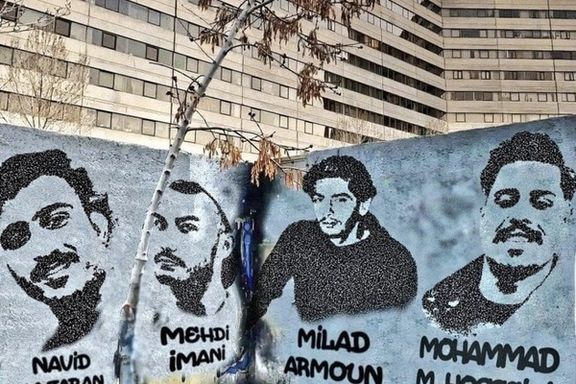
Mural of some of the detainees in Shahrak-e Ekbatan case in Tehran
The lawyer of man on death row over a high-profile protest case said on Monday that Iran’s Supreme Court has yet to respond to six defendants' appeal and the court has declined to meet with families or attorneys.
A lawyer representing Hossein Nemati, one of six defendants sentenced to death, said that courts typically respond within two months but after three official inquiries over nine months there had still been no reply.
“On July 30, we went to the relevant branch along with some of the families, but we were told that neither the lawyers nor the families would be allowed in for this case,” Payam Dorfeshan was quoted as saying by Telegram news channel Emtedad.
The so-called Ekbatan case involves multiple defendants, six of whom face execution after being convicted of killing a member of Iran's domestic enforcement militia in Tehran amid nationwide anti-government protests in 2022.
They deny the charges.
“Our clients have now reached the legal limit of two years in pretrial detention. The law clearly states that pretrial detention cannot exceed two years under any circumstances,” Dorfeshan said.
The six detainees facing execution are Milad Armon, Alireza Bormarzpournak, Amir Mohammad Khosheghbal, Alireza Kafaei, Navid Najaran and Hossein Nemati.
On October 26, 2022, during the Woman, Life, Freedom protests, a member of Iran’s Revolutionary Basij militia, Arman Alivardi, was injured in a building complex in Tehran called Shahrak-e Ekbatan and died two days later.
Following Alivardi’s death, security forces conducted mass arrests of more than 50 young residents of the complex and indictments were issued against several of them.
On July 29, Amnesty International warned that Armon, Bormarzpournak, Khosheghbal, Kafaei, Najaran and Nemati are at risk of execution.
A high-profile conservative seen as close to Iran's Supreme Leader Ali Khamenei has been appointed to lead Iran’s newly revamped Supreme National Security Council, Tasnim News reported on Tuesday.
Ali Larijani replaces Ali Akbar Ahmadian, who is due to take on an unspecified new role in the administration of President Masoud Pezeshkian, Tasnim added.
Larijani previously served three terms as speaker of parliament, secretary of the Supreme National Security Council, head of the Islamic Republic of Iran Broadcasting (IRIB), Minister of Culture and Islamic Guidance and advisor to the Supreme Leader.
His appointment may signal a doubling down on Tehran's traditional confrontational stance with Israel and the United States after a punishing 12-day war with Israel in June capped off by US airstrikes on Iranian nuclear sites.
Still, Larijani registered three time to run for president in Iran but was disqualified on two occasions by Iran's hardliner-dominated Guardian Council. His political stances on diplomacy and domestic affairs appear to have softened in recent years.
Larijani ran as a candidate in the ninth presidential election of Iran, held in 2005. He lost the race, finishing sixth out of seven candidates.
The appointment comes with some institutional changes following a 12-day war with Israel in June.
President Pezeshkian will chair the council, which will include the heads of the executive, legislative and judiciary branches, as well as top military commanders and key cabinet ministers, the report added.
Iran International on Tuesday filed an urgent appeal with United Nations experts urging them to take action against Iran over serious risks to the lives and safety of their journalists worldwide and relatives inside Iran.
Over the past six weeks, the Iranian authorities have intimidated and threatened 45 journalists and 315 of their family members with death unless they stop working for Iran International by specific deadlines, Iran International said in a statement.
All of those deadlines given by Iran's Ministry of Intelligence and Security have now passed, it added.
Iran International is a London-based Persian-language broadcaster and multilingual digital news operation that is a key source of news in Iran amid a closely policed media environment inside the country.
Iran International’s legal team has filed an urgent appeal over what it called an “alarming and unprecedented escalation” in risk to Iran International journalists and their families with five UN Special Rapporteurs.
These include experts Irene Khan responsible for freedom of expression; Morris Tidball-Binz for extra-judicial, summary or arbitrary executions; Professor Ben Saul for counter-terrorism; Dr. Alice Edwards for torture and Mai Sato for Iran.
Call for urgent action
"Iran International journalists, their families in Iran and their families outside Iran are being threatened and harassed as never before in an unprecedented and concerted campaign to force them off air," Iran International’s General Manager Mahmoud Enayat said in the statement.
"I ask the UN experts to urgently investigate and take action. Iran International will continue to stand by our journalists, targeted for their important work reporting on Iran - which is needed now more than ever."
Since its formation in 2017, Iran International journalists have been targeted by the Iranian authorities for their reporting. This has included threats of assassination, assault and abduction against staff based in Britain, the United States and Europe.
The journalists have also long faced online abuse, harassment and hacking as well as asset sequestration and attacks via Iranian State media amid Tehran's designation of Iran International as a terrorist organization.
Postwar escalation
But since the start of a 12-day war between Iran and Israel in mid-June, Iran International says the situation has deteriorated rapidly and there is now a real risk to the lives of multiple Iran International staff and to their family members.
The network added its urgent appeal comes as it faces “an alarming and unprecedented escalation” in which Iranian authorities systematically began to falsely accuse Iran International journalists of being spies for Israel responsible for providing information about Iranian infrastructure to Israeli intelligence.
Iran International journalists in seven countries - the UK, the USA, Canada, Sweden, Germany, Turkey and Belgium - have been subject to threats, the network said.
Iran International is an independent Persian-language satellite TV news channel broadcasting live 24/7 from London and Washington DC.
It started in 2017 and has become the most watched Persian-language TV channel within and outside Iran on both satellite and online platforms. With bureaux in 14 countries, its journalists are drawn from a wide background in TV, radio, news agencies and newspapers within Iran and in other countries.
China’s imports of Iranian crude fell by nearly a third in July from the previous month as demand from private refiners eased, Bloomberg reported on Tuesday citing data from intelligence firm Kpler.
Purchases fell to about 1.2 million barrels per day, nearly 30 percent lower than in June and slightly below the year-ago level, the firm said.
June surge fades
The pullback follows a sharp rise in June, when shipments reached more than 1.7 million barrels per day, the highest since March, according to Vortexa.
Emma Li, senior market analyst at Vortexa, said sellers accelerated deliveries ahead of possible supply disruptions linked to the brief Iran-Israel conflict. She said the rush reflected a strategy to front-load supplies amid uncertainty about further attacks.
Independent refiners, known as “teapots,” drove much of the June demand but have since slowed restocking, Bloomberg quoted Kpler senior crude analyst Muyu Xu as saying. Xu said demand from teapots is “far from robust” after their higher imports in June and that some refiners face a tight crude‑import quota.
US sanctions pressure grows
The slowdown in shipments comes as the United States has stepped up enforcement of sanctions targeting Iran’s oil trade.
The US Treasury said last week it imposed measures against a fourth Chinese oil terminal alleged to handle sanctioned Iranian crude.
The announcement followed broader sanctions on more than 50 individuals, entities, and vessels tied to what the US Treasury described as a “shipping empire” connected to Hossein Shamkhani, son of a senior adviser to Iran’s Supreme Leader.
Discounted oil still flows
China remains the largest buyer of Iranian crude, which is sold at steep discounts to Brent and typically flows through private channels in defiance of US sanctions. Vortexa said in June that discounts averaged about four dollars per barrel below Brent futures, compared with two dollars per barrel below Brent futures in May.
Despite repeated US sanctions, CBS said China is believed to take up to 90 percent of Iran’s crude exports, much of it bound for teapot refiners.
Official Chinese customs data, which often shows negligible or zero Iranian imports, is due this week.
Outlook uncertain
Iran’s export capacity is constrained by aging oil fields, rising domestic demand, and low investment.
A confidential Iranian Oil Ministry report seen by Iran International said Tehran averaged 1.4 million barrels per day in oil and condensate exports to China in the first half of 2025, down 12 percent from last year.
Homayoun Falakshahi, senior energy analyst at Kpler, said even with sanctions fully lifted, daily exports would likely not exceed 1.7 million barrels.
Tehran has requested the Taliban share a leaked list of Afghans who assisted British forces, including those linked to MI6, as part of a bid to identify and potentially detain some now in Iran for possible diplomatic leverage ahead of nuclear talks, The Telegraph reported.
An official from the Islamic Revolutionary Guard Corps (IRGC) in Tehran confirmed to The Telegraph on Monday that the IRGC has formally asked the Taliban for the list of nearly 25,000 Afghans.
The list, dubbed the “kill list” in British media was leaked in 2022 and contains the full names, emails, and phone numbers of people in Afghanistan who applied for relocation to the United Kingdom following the military withdrawal in 2021.
It includes personal data of Afghan soldiers, government employees, and their families, as well as around 100 British special forces members and intelligence operatives who had endorsed Afghan applicants.
People disembark the RAF Voyager aircraft, upon arrival from Afghanistan, at the RAF Brize Norton, in Oxfordshire, Britain, August 17, 2021
A Taliban official told The Telegraph that since discovering the value of the list, the group has been working to locate and detain those still in Afghanistan, intending to use them as leverage in diplomatic pressure on the UK.
"Taliban leadership in Kandahar has also ordered officers in Kabul to arrest as many individuals as possible from the leaked document to use them as leverage in exerting diplomatic pressure on London," according to the report.
The Telegraph says the IRGC appears to have similar intentions, particularly with renewed nuclear negotiations and the threat of snapback sanctions looming over Iran.
Since the June 25 ceasefire between Iran and Israel, Tehran has accelerated the deportation of Afghan nationals from Iran, citing an inability to continue hosting large numbers of migrants and asylum seekers.
On July 25, senior Iranian diplomats met with counterparts from the UK, France, and Germany in Istanbul to discuss the path forward. They agreed to continue negotiations.
European governments are pressing Iran to resume full cooperation with the International Atomic Energy Agency (IAEA), including the reinstatement of inspections and other obligations. Following the war with Israel, Iran has moved to further limit cooperation with the UN nuclear watchdog.
Under UN Security Council Resolution 2231, any party to the now-lapsed 2015 nuclear agreement—including France, Germany, the UK, Russia, or China—can file a complaint accusing Iran of non-compliance.
If no progress is made on Iran's nuclear dossier by August 30, the so-called snapback mechanism can reinstate UN sanctions removed under the 2015 deal.
“We have made it clear to the United Nations and the Security Council that such a step is a misuse of international mechanisms, and the Islamic Republic will respond decisively,” Iran’s Deputy Foreign Minister Kazem Gharibabadi said Sunday.
A US senator’s proposal to bar all Iranian students from American universities is due to pile another obstacle in the way of aspiring scholars already effectively blocked from entry by Trump administration travel restrictions.
Republican Senator Tommy Tuberville introduced legislation that would ban Iranian and Chinese nationals from studying at US universities, arguing students from adversary states pose a national security threat and displace American applicants.
The so-called Student Visa Integrity Act would restrict visas from Iran, cap overall international student enrollment and increase penalties for visa fraud.
"We want to do away with Iran ... nationals getting into this country and learning how to destroy the United States of America and our allies," Tuberville said on Fox News on Friday. “We are funding our own demise.”
Tuberville, from Alabama, serves on Senate committees focused on education and immigration.
Hopes 'shattered'
Even before the proposal, many Iranian students faced steep barriers to studying in the United States. Zanko, a PhD‑bound software engineer living in Iran whose identity Iran International is concealing for his safety, was accepted into a top American university, with classes scheduled to begin in August 2024.
He completed his visa interview last year at a US embassy in a nearby country— a costly, logistically challenging trip from Iran, where there is no US embassy — in hopes of fulfilling his dream.
Zanko says the immigration officer told him his application was under “administrative processing,” an extensive background check. He postponed his admission to August 2025, but his visa appears no closer - a limbo endured by hundreds of other Iranian students.
“Emotionally and professionally, it has been frustrating to know that despite being qualified and committed, external political factors are shaping the course of my future,” Zanko told Iran International.
The situation, Zanko said, “shattered all of my hopes.”
Search for a better life
Leila Mansouri, a US immigration lawyer, told Iran International it has been extremely difficult for Iranians to get a visa.
Even if Tuberville’s bill doesn’t pass, she warned, the government could still block applications by instructing the State Department to stop approvals.
“Behind the scenes they can tell the consulate not to approve the applications like what we saw with the first Trump travel ban that passed in 2017,” said Mansouri, adding that male applicants face especially tough scrutiny.
Much of that additional scrutiny stems from mandatory military service for Iranian men, during which many serve in units affiliated with the Islamic Revolutionary Guard Corps (IRGC) — an organization designated by the US as a foreign terrorist organization. Even routine, non‑combat roles during conscription triggers outright visa denials.
Senator Tuberville has argued that some Iranian students have questionable backgrounds. One example often raised in such debates is the 2017 case of Seyed Mohsen Dehnavi, an Iranian medical researcher turned away at a US airport. Former classmates and activists alleged he was a senior member of the Basij, a paramilitary force tied to the IRGC, and had targeted reformist students. US border officials said his denial was for “reasons unrelated” to the travel ban in place at the time.
Mansouri emphasized that such cases are rare, noting that most Iranian students have no military or security ties. With an existing ban on Iranian military members, including those with past IRGC service, she said this route is already closed.
Iranian students have made significant contributions to American society, Mansouri said, and the US could do a better job of vetting without shutting them out. She described most applicants as “innocent people just trying to have a better life.”
About 10,800 Iranian students studied in the US in 2022–23, up from the year before but still below the 2017–18 peak of nearly 12,800. In 2024, only 2,166 student visas were issued to Iranians — down 42% from 2023 — with denial rates climbing to 41%.
'Collective punishment'
The obstacles deprive the United States of Iranian talents and isolates an entire generation of Iranians, said Siamak Aram, a Sharif University graduate and active member of the Iranian academic community in the US.
“This proposal amounts to collective punishment. It fails to distinguish between the Iranian people and the oppressive regime they are fighting against,” Aram told Iran International.
“It inadvertently aligns with the goals of the Islamic Republic. So-called ‘Supreme Leader’ Ali Khamenei has long sought to limit Iranians’ interaction with the outside world, especially through academic and cultural channels.”
The human impact has also been highlighted by Iranian-American tech entrepreneur Hadi Partovi, co-founder of Code.org, who posted on X on June 30 that he and his twin brother Ali “received hundreds of messages from Iranian students who were accepted into PhD programs in the USA, only to have their legal immigration papers rescinded.”
Partovi, whose family immigrated legally in 1984, wrote, “Iran’s most precious resource is its talent, not its oil,” and pointed to relatives such as Uber CEO Dara Khosrowshahi as examples of how admitting ambitious students can translate into job creation and economic growth.
“Surely America can find a way to protect its security and its borders while also preserving the values and ideals that make it great,” he said.
The surge in visa denials — many issued after nearly a year of administrative processing — comes amid a broader immigration crackdown in the United States.
For Iranian students like Zanko, delays and silence from authorities have been compounded by Section 212(f), a presidential authority typically invoked for national security, applied this spring. Many fear Tuberville’s bill would add yet another hurdle, effectively formalizing a ban on Iranian students.
Neither the US State Department nor Tuberville’s office immediately responded to an Iran International request for comment.