Tehran to cut water for heavy consumers as drought persists
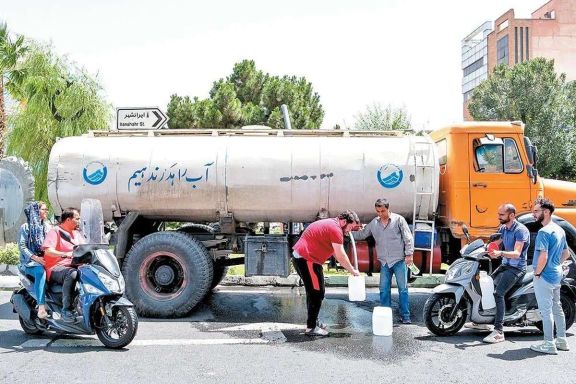
A water tanker distributes clean water in containers to residents on a Tehran street.
Tehran water authorities will cut supplies for 12 hours to households deemed heavy consumers who ignore three official warnings, a senior utility official said on Tuesday, as the capital faces its worst drought in more than a century.
“With this year’s low rainfall, surface and underground water resources have declined and the situation is not favorable,” Hossein Haghighi, head of Tehran Water and Wastewater Region 4, told the semi-official ISNA news agency. “If it does not rain, we expect even tougher conditions in autumn.”
Haghighi said authorities had adopted a “multi-layer” approach that included reducing water pressure in some areas, public awareness campaigns and promoting low-flow devices to curb household use.
New buildings are required to install storage tanks and pumps before connecting to the network, he said. Tariffs are structured to heavily subsidize low users, while “bad consumers” – the highest tier – pay sharply higher rates. “After three warnings, we cut water to heavy users for 12 hours,” Haghighi said.
'Day zero' warnings disputed
Haghighi’s remarks followed a stark warning from Mohsen Dehnavi, spokesman for Iran’s Expediency Council, who said the water crisis “has passed the warning stage and entered a critical phase.”
“Continuing this trend could bring some areas of the capital to day zero in the coming weeks – a day when drinking water is cut off in many neighborhoods and the daily life of millions is disrupted,” Dehnavi said in a post on the social media platform X.
He blamed “five years of drought, overuse of underground aquifers, rapid urban population growth, high per-capita consumption and structural weaknesses in water management” for pushing Tehran’s reservoirs towards dangerous depletion.
He called for “strict conservation policies, renovation of ageing networks, industrial consumption controls and the adoption of smart, real-time resource management systems.”
Isa Bozorgzadeh, spokesman for Iran’s water industry, rejected the “day zero” assessment, saying that with further reductions in demand the crisis could be “acceptably managed.”
“If Tehran reduces its consumption by another 12%, the capital will pass through this crisis without severe disruption,” he said. Bozorgzadeh added that July saw a 13% drop in use compared with last year, and consumption so far in August was down more than 14%.
Drought, heatwaves, and blackouts
The water crisis comes after months of extreme heat that has triggered rolling blackouts and the temporary shutdown of government offices in several provinces to conserve energy.
Iran’s meteorological organization says the country has faced a near-constant drought for more than two decades, with rainfall down sharply this year and snowpack levels at historic lows.
Environmental activists have long warned that Iran’s sprawling capital – home to nearly 10 million people – is acutely vulnerable to water shortages due to inefficient infrastructure, leaky pipes, and limited investment in modern conservation technologies.
Climatologist Nasser Karami told Iran International earlier in August that the water crisis in Iran transcends drought and is a product of government mismanagement, militarized agriculture and deliberate manipulation.
According to Haghighi, Tehran’s average household water use is more than twice the international standard.
“Changing consumption habits is no longer optional – it’s a necessity,” Haghighi said. “If every household reduces just 10% of its water use, the capital can avoid the most severe restrictions.”
Elias Hazrati, head of the government’s information council, said on Tuesday: “Today, the country is in a completely stable situation. There is no crisis, and no war is taking place or about to begin.”
Planned transport routes linking Armenia and Azerbaijan must not change the region’s geopolitics or cut Iran's access to other corridors, Iranian Foreign Minister Abbas Araghchi said in a phone call with his Armenian counterpart Ararat Mirzoyan on Tuesday.
On Friday, Armenia and Azerbaijan signed a deal at the White House to settle a longtime dispute over the corridor, a strip of land which became a flash point in the two rivals’ decades-long conflict.
The deal gives Washington leasing rights to develop the transit corridor, which would connect Azerbaijan with its exclave, Nakhchivan. It will be renamed the Trump Route for International Peace and Prosperity (TRIPP).
“In any decision or action, respect for national sovereignty and the territorial integrity of countries must be fully observed,” Araghchi added, according to a readout of the call published by Iranian media.
Earlier in the day, government spokeswoman Fatemeh Mohajerani dismissed what she called exaggerated claims about the Zangezur corridor, saying it covers only a small area near Iran’s border.
"It is not as if our entire northern border has been lost,” Mohajerani said, but added that that Iran demands stability, territorial integrity, and existing sovereignty to be preserved.
A senior adviser to Iran’s supreme leader, however, vowed to block the establishment of the transit corridor saying it would endanger regional security and alter the region's geopolitics.
“This passage will not become a gateway for Trump’s mercenaries — it will become their graveyard,” Ali Akbar Velayati said.
Velayati stressed that Iran has always opposed the Zangezur corridor, saying it would alter borders, fragment Armenia, and restrict Iran’s regional access.
Iranian police said on Tuesday they detained about 21,000 people described as suspects during the country’s 12-day war with Israel, arrests they said were largely based on public tip-offs, while the judiciary had put the figure closer to 2,000.
Police spokesman Saeed Montazeralmahdi told state media the arrests followed 7,850 reports to the national emergency line 110. “The 41% increase in public calls and the arrest of 21,000 suspects in the 12-day war shows the high level of vigilance and participation of the people in ensuring security,” he said.
Montazeralmahdi said officers had set up more than 1,000 tactical checkpoints across the country during the conflict, deploying over 40,000 police for round-the-clock road and site security.
He said security forces thwarted “field conspiracies by the enemy,” including the disruption of a planned gathering in Tehran’s Palestine Square.
The police spokesman also reported the detention of 127 escaped prisoners during an incident at Evin prison, and the seizure of unexploded bombs.
Authorities detained 2,774 undocumented foreign nationals, finding 30 “special security” cases through phone checks, and arrested 261 people on suspicion of espionage and 172 for alleged unauthorized filming, he added.
However, Judiciary Chief Gholamhossein Mohseni Ejei had given a far lower figure, saying that “around 2,000 people” were arrested during and after the conflict, some of whom face the death penalty on charges of “organizational collaboration with the enemy.”
“In our law, anyone who cooperates with a hostile state during wartime must be arrested and prosecuted,” Ejei told state TV late in July. He said some detainees had been released after investigations found no evidence of espionage, while others were freed on bail but remain under suspicion.
The judiciary says trials are being fast-tracked under wartime procedures.
UN experts, including the special rapporteur on human rights in Iran, have urged Tehran to halt what they called a “post-ceasefire crackdown,” citing the arrests of hundreds of journalists, rights defenders, social media users, foreign nationals – particularly Afghans – and members of Baha’i, Kurdish, Baluchi and Ahwazi Arab minorities.
Iran Human Rights, an Oslo-based NGO, said 21 people were executed during the June conflict period, including six accused of spying for Israel.
The arrests come as President Masoud Pezeshkian’s government faces a backlash over internet restrictions imposed during the war and a now-withdrawn cybercrime bill that critics said would have criminalized dissent.
The draft law, “Combating the Dissemination of False Content in Cyberspace,” proposed prison terms, fines and bans for online users, with harsher penalties during “crisis or wartime.”
Government spokeswoman Fatemeh Mohajerani said last month the cabinet withdrew the bill “in line with national cohesion and on the president’s directive.” Critics argued its vague language, including phrases such as “distorted, misleading, and harmful to public perception,” would have enabled arbitrary prosecutions.
A vast majority of Iranians are dissatisfied with the government's economic policies, according to a poll by Iran's leading economic newspaper Donya-ye Eqtesad, as costs of living soar and the value of the Iranian currency slips.
“Of respondents, 89% rated their agreement with the government’s economic policies as ‘low’ or ‘very low.’ 72% expressed dissatisfaction or strong dissatisfaction with government policies,” according to the poll results published on Monday.
The poll also indicated that the economy is the top priority for 53% of respondents, while 36% prioritized foreign policy.
The poll consisted of three questions, conducted via the paper’s Telegram channel with an average of 2,130 respondents per question.
Sanctions, corruption and economic mismanagement have contributed to widespread economic hardship and market instability as Iran's currency the rial has lost over 90% of its value since US sanctions were reimposed in 2018.
Tehran faces another challenge from European countries Germany, France and the United Kingdom who may be poised to trigger United Nations sanctions per the so-called the snapback mechanism.
Snapback refers to a clause in UN Security Council Resolution 2231, which endorsed the a 2015 deal on Iran's disputed nuclear program dubbed the Joint Comprehensive Plan of Action (JCPOA).
Under Resolution 2231, any party to the accord can file a complaint accusing Iran of non-compliance. If no agreement is reached within 30 days to maintain sanctions relief, all previous UN sanctions would automatically “snap back,” including arms embargoes, cargo inspections and missile restrictions.
Iran’s Ministry of Intelligence issued secret guidance on Monday, warning ministries and major companies to prepare for the likely return of punishing United Nations sanctions, documents reviewed by Iran International show.
Iran’s state-run English-language newspaper Tehran Times reported on August 8 that Tehran and Washington may start Norway-mediated indirect talks in August, covering Iran’s nuclear program and compensation demands over its June war with Israel and the United States.
Lebanese Foreign Minister Yusuf Raji will not meet Iran's newly reappointed security boss Ali Larijani when he visits the country this week, Lebanese media reported, as Beirut seethes over Iran's criticism of its efforts to disarm Hezbollah.
“Lebanese Prime Minister Nawaf Salam will convey the Lebanese government’s displeasure with Iranian officials’ statements rejecting Hezbollah’s disarmament, seen as blatant interference in Lebanon’s internal affairs,” Hona Lebanon reported, citing sources.
Founded in 1982 by Iran's Islamic Revolutionary Guard Corps, Hezbollah has long been a formidable opponent of Israel but was mauled by its arch-foe in fighting late last year.
The Lebanese government last week tasked the military with disarming the Iran-backed group, leading to sharp criticism by the Islamic Republic.
Another Lebanese media outlet, Al-Liwaa, reported that the Lebanese Foreign Minister will not meet Larijani and prefers he not visit Beirut.
Larijani is due to arrive in Lebanon on Wednesday after visiting Iraq where he signed a security agreement on Monday.
Ali-Akbar Velayati, a senior foreign policy advisor to Supreme Leader Ali Khamenei, called Hezbollah’s disarmament "a dream that won’t come true" on Saturday describing it as a policy dictated by Israel and the United States.
The Lebanese Foreign Ministry, in a statement on X, condemned the remarks as "a flagrant and unacceptable interference in Lebanon’s internal affairs," saying it would not tolerate such “unacceptable conduct."
The Lebanese government has long been under international pressure to assert a monopoly on arms, particularly from Western states that view Iran-backed Hezbollah’s military structure as a parallel force within the state.
“Hezbollah has no choice but to negotiate with the Lebanese government, as failure to do so would mean preparing for war,” Qassem Mohabaali, former Middle East Director at the Iranian Foreign Ministry, told the news outlet Khabarfori.
Iran on Monday criticized the International Atomic Energy Agency (IAEA) for what it called a failure to act over Israeli and US attacks in June after talks in Tehran with the UN nuclear watchdog’s deputy director general earlier in the day.
“The Islamic Republic expressed its objection to the failure of the agency to fulfill its responsibilities regarding the Israeli and US attack and raised its demands for correcting the agency’s improper processes,” deputy foreign minister Kazem Gharibabadi said.
Gharibabadi's remarks came following a meeting with IAEA deputy director general Massimo Aparo, who was in Tehran for a brief trip on Monday. The visit marked the highest-level meeting between the IAEA and Iran since the attacks on Iranian nuclear sites badly frayed ties.
Iran's foreign minister Abbas Araghchi had stressed earlier that the visit would not involve nuclear inspections but rather dialogue with the agency.
In June, Iran’s parliament approved a bill to suspend the country’s cooperation with the IAEA, a day after a ceasefire with Israel.
The bill, passed with 221 votes in favor, none against, and one abstention out of 223 members present, and bars the UN nuclear watchdog’s inspectors from accessing Iran’s nuclear facilities.
At the time, Iran also accused IAEA chief Rafael Grossi of bias and failing to condemn the attacks.
On July 4, Grossi said that the agency's team of inspectors had departed Iran to return to its headquarters in Vienna after the new law barred cooperation with the IAEA.
Israel launched a surprise military campaign on June 13 targeting military and nuclear sites, killing hundreds of military personnel, nuclear scientists and civilians.
Iran responded with missile strikes that killed 31 civilians and one off-duty soldier, according to official figures published by the Israeli government.
The Islamic Republic says 1,062 people were also killed by Israel during the 12-day conflict, including 786 military personnel and 276 civilians.
On June 22, the US carried out airstrikes on Iran’s key nuclear sites at Fordow, Natanz, and Isfahan.
The full extent of the damage remains unclear but President Donald Trump has repeatedly said that the strikes "obliterated" the country's nuclear program.