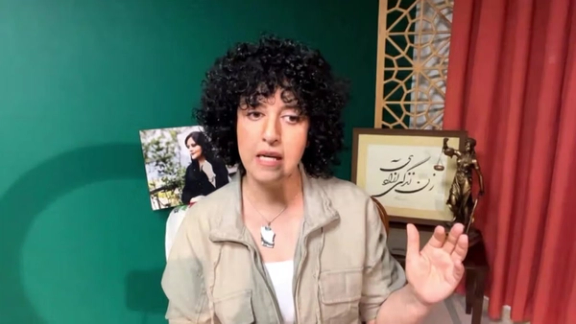
Creative defiance keeps ‘Woman, Life, Freedom’ alive, Nobel laureate says
Human rights activist and Nobel laureate Narges Mohammadi
Iranian people have kept the Woman, Life, Freedom movement alive through creative acts three years after its eruption, shaping society in ways that continue to unfold, Nobel Peace Prize laureate Narges Mohammadi told Iran International on Saturday.
“The movement is alive and ongoing, and its vitality is visible in society’s very fabric,” Mohammadi said in an interview marking the third anniversary of Iran’s 2022 protests that started with the death in morality police custody of Mahsa “Jina” Amini.
“When I walk in the streets, the presence of women with voluntary dress (hijab) reflects part of the transformation.”
The change has come from “the power and resistance of the people,” not from decisions of the Islamic Republic, she added.
Mohammadi said Iranian women have gained new power to shape their own lives, driving deep changes in society—some visible in daily life, others yet to be recognized or fully understood.
Grassroots change, diminished state control
The prominent activist said the movement has persisted through creative tactics and subtle acts of defiance.
“People do not need to constantly be in the streets and protests,” she said. “Society uses creative and very effective actions and reactions that demonstrate the movement’s vitality.”
“The Islamic Republic no longer has the same power even to hold official events,” she said. “The visible presence of women without hijab has often wrested the scene away from the organizers.”
Mahsa Amini’s death on 16 September 2022 sparked the protests that grew into a nationwide call for rights under the slogan Woman, Life, Freedom.
Mohammadi, repeatedly jailed for her activism, has spent more than a decade behind bars and faced sentences totaling over 36 years and 154 lashes.
Awarded the Nobel Peace Prize in 2023, she remains under medical leave from prison and continues to advocate for women’s rights and democracy.
The Iranian parliament on Saturday convened an emergency meeting with Foreign Minister Abbas Araghchi to review the government’s new cooperation agreement with the International Atomic Energy Agency (IAEA) signed in Cairo.
"The lawmakers had questions and concerns that are legitimate and stem from their supervisory role, which they must exercise, and we also have a duty to provide answers," Araghchi told reporters after the meeting.
Lawmakers were supposed to seek explanations on how the accord, signed in Cairo on Tuesday, complies with legislation suspending cooperation with the agency after June's conflict with Israel.
"In today’s session, some of these concerns were raised, and there was consultation on how to move forward more effectively, neutralize the enemies’ tricks in political and international arenas against the people, and safeguard the country’s interests," Araghchi said.
He described the meeting with lawmakers as "very good, constructive, and scientific."
More than 60 MPs earlier backed a request for a special session with Foreign Minister Abbas Araghchi and Supreme National Security Council secretary Ali Larijani to provide clarification. The move came after parliament went into recess until September 27, prompting criticism that oversight was being avoided.
Conservative MP Hamed Yazdian, who initiated the request, said the session was needed to assess “the extent of conformity of the Cairo agreement with the law passed by parliament.”
Strong criticism of Grossi
The deal has sparked sharp reactions from hardline lawmakers. Javad Hosseini-Kia called IAEA chief Rafael Grossi “a Mossad agent” and urged that he be arrested if he enters Iran.
Another MP, Mohammadreza Mohseni-Sani, said inspectors “have no right” to enter Iran until damaged nuclear facilities are restored, warning that if UN sanctions are reimposed under the “snapback” mechanism, parliament would pursue leaving the Nuclear Non-Proliferation Treaty (NPT).
Some lawmakers, such as Ahmad Bakhshayesh, have argued Iran should no longer limit itself to peaceful nuclear activities, while others, including Mahmoud Nabavian, have branded the Cairo accord a “cursed agreement.”
By contrast, former nuclear chief Ali Akbar Salehi has described it as “positive” but cautioned that time is running out for diplomacy.
Araghchi insists the Cairo accord safeguards Iran’s interests and is consistent with the law suspending cooperation. He said it recognizes Tehran’s security concerns, guarantees Iran’s rights, and “creates no access” for inspectors at this stage.
Any monitoring, he added, would only be discussed later with approval from the Supreme National Security Council.
The debate in Tehran comes as France, Germany, and Britain have triggered the UN “snapback” mechanism, which could restore sanctions at the end of September. One of their conditions for pausing the process is renewed IAEA access, a demand the United States and European Union have also emphasized.
Australia and New Zealand marked the third anniversary of Mahsa Amini’s death with statements to Iran International reaffirming their support for Iranian women and condemning human rights violations by the Islamic Republic.
“Australia stands with women and girls in Iran and supports their struggle for equality and empowerment,” a Department of Foreign Affairs and Trade spokesperson said on Thursday. “We remain gravely concerned by Iran’s persecution of women and girls and the use of violence to enforce mandatory hijab compliance.”
Canberra would continue pressing Tehran to uphold its human rights obligations, including accountability for “perpetrators of past and ongoing human rights violations,” the spokesperson added.
Since September 2022, Australia has sanctioned 65 individuals and entities tied to the suppression of protests that erupted after Amini’s death in police custody.
New Zealand voices concern
New Zealand’s Ministry of Foreign Affairs and Trade issued a parallel message to Iran International, expressing extreme concern over the situation inside Iran.
“New Zealand remains extremely concerned by the human rights situation in Iran, including restrictions on freedom of expression, violence and discrimination affecting women and girls, and ongoing repression of religious and ethnic minorities by Iranian authorities,” said a Ministry of Foreign Affairs and Trade spokesperson.
Wellington said it would maintain a policy of restricted engagement with Tehran and continue raising its concerns in all relevant international fora and in direct bilateral engagement.
The 22-year-old Mahsa Amini died in the custody of the morality police in September 2022. Her death sparked nationwide demonstrations under the banner Woman, Life, Freedom, met with arrests, executions, and a crackdown denounced by Western governments.
Israeli officials told French authorities that Iran’s nuclear program was not entirely destroyed in June’s US-Israeli airstrikes, Le Monde reported on Friday.
The French newspaper, citing diplomatic sources, said the information was shared in early September. Le Monde quoted Israeli intelligence as saying that “while the centrifuge manufacturing sites and most of the uranium enrichment facilities were destroyed, particularly at Fordow and Natanz, Iran still possesses this type of equipment.” Officials added: “Too few to restart the program in the short term, but it’s only a matter of time.”
Le Monde said France values the Israeli assessment because US intelligence has stopped sharing information on Iran’s program with European partners since the June war.
Cairo deal and snapback
Iran has rejected the idea that its program was wiped out. Foreign Minister Abbas Araghchi told Le Monde in July that “the claim that a peaceful nuclear program has been annihilated is a miscalculation” and said the strikes had “reignited” a nuclear arms race.
This week, Araghchi said Iran’s new agreement with the International Atomic Energy Agency, signed in Cairo, does not currently allow inspectors into nuclear sites. He said the deal is consistent with a law passed after the June strikes that suspended cooperation pending approval by the Supreme National Security Council. He added that its continuation depends on Western powers not restoring UN sanctions under the “snapback” mechanism.
Britain, France and Germany triggered snapback in late August, which could restore sanctions at the end of September. They said they would pause the process only if Iran restored IAEA inspections, accounted for its highly enriched uranium stockpile, and engaged in nuclear talks with the United States.
Western pressure
The United States and European Union pressed Tehran to act quickly. Acting US envoy Howard Solomon told the IAEA board that Iran had “ceased implementing its most basic obligations.” The EU said safeguards access is “non-negotiable,” while France, Germany and Britain said they were “alarmed” by Iran’s uranium stockpile.
A senior adviser to Iran’s Supreme Leader warned on Saturday that Azerbaijan would damage the image of Shiites if it proceeds with plans to host a major rabbinical meeting.
Ali Akbar Velayati said he hoped reports of the event were false, describing it as “anti-Islamic and against the dignity of Shiites.”
Such a move by Baku, he added, was unprecedented and suggested it might be tied to efforts to widen the Abraham Accords, under which several Muslim states normalized ties with Israel.
The remarks appeared aimed at the Conference of European Rabbis, scheduled for Nov. 4–6 in Baku, where Jewish leaders from across Europe are due to convene.
Velayati’s comments come as Azerbaijan deepens international links, including through a landmark peace deal reached in Washington last month. Armenian Prime Minister Nikol Pashinyan and Azerbaijani President Ilham Aliyev signed the accord at the White House with US President Donald Trump, granting exclusive US development rights to a transit corridor through the South Caucasus.
The route will connect Azerbaijan to its Nakhchivan exclave across southern Armenia. The White House said the project, named the Trump Route for International Peace and Prosperity, would expand energy and resource exports.
Tehran has objected to the corridor, warning it sidelines Iranian trade routes and diminishes its role in the region. Iranian officials have also accused Azerbaijan of permitting Israeli activity on its soil, intensifying mistrust.
The dispute over the rabbinical gathering now adds a cultural and religious dimension to already fraught relations between Iran and Azerbaijan.
Talks on a prisoner swap between Iran and France were in their final stage, state media reported late Thursday, and potentially involve French detainees in Iran and an Iranian woman jailed in Paris.
Foreign Minister Abbas Araghchi told state television the process was moving forward. “Negotiations are in their final stages,” he said. “We hope the process will be completed in the coming days.”
The detainee in France is Mahdieh Esfandiari, 39, who has been held in Fresnes prison near Paris since March on charges of glorifying terrorism. Prosecutors said she posted messages on Telegram in support of Hamas’ Oct. 7 attack in Israel, which they considered incitement to terrorism and insults against the Jewish community.
On Friday, outgoing French Foreign Minister Jean-Noël Barrot said Paris was demanding the “immediate and unconditional” release of its nationals. “France has always called for the immediate and unconditional release of our compatriots in Iran,” he told France Inter radio, declining to comment on Araghchi’s remarks.
Among those imprisoned are Cecile Kohler and her husband, Jacques Paris, detained in May 2022. Iranian authorities accused them of spying for Israel and trying to stir labor protests, charges their families call baseless.
They have been held for more than three years under conditions family members describe as harsh, with limited access to lawyers and relatives.
Kohler's sister Noemie told Iran International that the family had not been informed about any progress and was wary of the reports.
"Unfortunately, we have no information beside what is said in the media," she said. "We are very cautious regarding this statement."
A third detainee is 19-year-old dual national Lennart Monterlos, who disappeared in Iran in June while cycling. Araghchi confirmed his arrest in July without specifying the charges.
Araghchi said Iran’s judiciary and security agencies were involved in the process and that practical steps would follow once legal procedures were complete. Tehran rejects Western accusations that it detains foreign nationals as leverage in disputes.
Rights groups say Iran has a record of detaining foreigners for political ends. Human Rights Watch and others have described such cases as “state hostage-taking.”