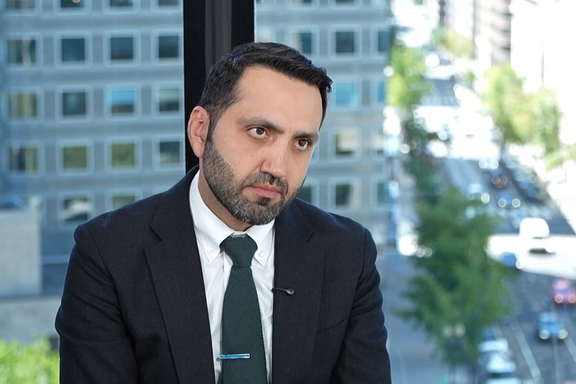
Miad Maleki, former head of the US Treasury’s Office of Global Targeting within the Office of Foreign Assets Control (OFAC) speaks to Iran International's Bozorgmehr Sharafedin
Iran hemorrhages the value of about four out of every five barrels of oil it manages to export, a former senior US Treasury official told Iran International, as sanctions forced funds to be lost in corrupt smuggling networks.
“They push this oil through corrupt networks and the worst actors in the government— people already sanctioned internationally," said Miad Maleki, former head of the US Treasury’s Office of Global Targeting within the Office of Foreign Assets Control (OFAC), "They get paid for only one out of five barrels they ship.”
The United States has maintained sanctions on the Islamic Revolution for decades but the measures were dramatically ramped up in 2018 when Donald Trump launched his so-called maximum pressure campaign.
Tehran has developed elaborate methods to evade sanctions, including a dark fleet of tankers that baffle tracking by switching off their transponders and conduct ship-to-ship transfers to mask the origin of its oil.
Maleki, a US air force veteran, argues these methods renders oil sales extremely costly. “Most of the money is wasted on shipping, discounts and commissions paid to layers of corrupt actors,” he said.
In nearly eight years at OFAC, Maleki helped design and implement the Treasury's sanctions campaigns against the Islamic Republic and its regional allies including Hezbollah and Hamas
'Malign intent'
Maleki said he never saw signs that goal of Iran’s leadership was sustainable growth for its citizenry.
“It was mostly about day-to-day survival and paying political rent to supporters,” he said. Instead, Iran’s oil revenues have been funneled to the Islamic Revolutionary Guard Corps (IRGC), its elite clandestine wing, the Quds Force and other heavily sanctioned actors.
Born in Iran and a first-hand witness to life's hardships there, Maleki said he saw sanctions as a way to ultimately help the Iranian people, since Iran’s rulers would not use oil revenue for public benefit.
“Any value taken away from this cycle is value taken away from corruption and malign intent,” he said.
During President Trump’s first term, Maleki was an architect of the new sanctions regime and helped pushed their remit beyond oil.
“Sanctions on the financial sector were the key,” Maleki said. “Targeting IRGC and Defense Ministry-owned banks tied the regime’s hands in dealing with the global financial system. It was very impactful.”
In 2019, Washington also sanctioned the office of Supreme Leader Ali Khamenei.
Maleki sees it as one of the most impactful measures against the Islamic Republic, citing the vast wealth controlled by sprawling state foundations under Khamenei’s supervision including Bonyad Mostazafan, the Execution of Imam Khomeini’s Order (Setad) and Astan Quds Razavi.
Enmeshed in critical sectors spanning the economy, many of the entities disguised their activities as philanthropy.
“They invest in metals, petrochemicals and agriculture. But you don’t see much charity work,” he said.
Maleki said the sanctions were designed so that even after Khamenei, the next supreme leader and his appointees will remain under sanctions.
“The Bonyads and foundations and all the subsidiaries are operating Iran's economy and stealing from their own people and also engaging in funding a wide range of nefarious activities, supporting terrorism, instead of using those funds to help Iran's economy," he said.
Nuclear costs and wasted billions
US and Israeli attacks on Iran’s nuclear facilities in June destroyed key parts of Iran’s nuclear program and ended tense talks between Tehran and Washington.
The United States urged Iran last week to take "immediate and concrete action" to meet its nuclear safeguards obligations.
France, Germany and Britain last month triggered the the so-called snapback mechanism of a 2015 international nuclear deal with Iran which could soon restore global sanctions unless resumed diplomacy secures a reprieve.
Maleki said it was unclear how damaging the move might be.
“The US sanctions are in place. Adding UN sanctions on top of it, I don't know how much meaningful financial restrictions that's going to bring on the regime, but politically, it's going to increase the pressure," he said. "You are going to see some shifts in governments, their approach to Iran, and how diplomatically they are engaged with Iran."
Estimates of Iran’s nuclear spending range from $500 billion to $1 trillion. Maleki said even per the low-range estimate of around half a billion dollars—equivalent to 17-20 years of oil revenue— the program produced only about 11–12% of Iran’s electricity.
A surge in electricity outages across Iran has caused severe disruption to daily life and economic activity, leaving Iranians frustrated and businesses paralyzed.
For roughly €15 billion (about $16 billion), Maleki continued, Iran could have built enough conventional power plants to avoid worsening shortages.
“Even if the goal was peaceful, the nuclear program never made economic sense."
Nobel laureate Narges Mohammadi praised Iranian civil society on the third anniversary of Mahsa Amini’s death in morality police custody, saying victims' families have kept the pursuit of justice alive by turning grief into a force for change.
In an exclusive editorial for Iran International, Mohammadi said the slogan Woman, Life, Freedom which became the mantra of the protest movement ignited by her death carries forward a decades-old struggle for human rights in Iran.
"From the image of the Khavaran mother standing tall over an unmarked grave, to the embrace of Mahsa Jina Amini’s parents in a hospital corridor as they endured her final moments in pain and tears, countless scenes have been created that will remain eternal in the history of our nation’s quest for justice," Mohammadi said, referring to mass graves for dissidents executed in 1988.
"In the wasteland of injustice and oppression, justice-seeking is a lamp to light the way, a hope in the darkness of despair, and an effort to resist defeat and passivity," Mohammadi wrote.
She traced a continuous line of activism from executions since the Islamic Republic's earliest days and the so-called chain murders of intellectuals inside Iran in the nineties to student protests, the Green Movement, 2017 and 2019 demonstrations and most recently the Women, Life, Freedom movement.
"Our society, in its pursuit of justice and its struggle to expose oppression and discrimination so that history cannot erase them, stands among the greatest in the world,” Mohammadi said.
Iran’s human rights situation remains dire according to watchdogs, with widespread state surveillance, arbitrary arrests and harsh crackdowns on political activists, journalists and women’s rights defenders.
Ethnic and religious minorities face systemic discrimination, international and Iran-focused rights groups say, and the ruling system continues to suppress protests and civil society movements with imprisonment, torture and executions.
Iran's Islamic Revolutionary Guard Corps (IRGC) said on Wednesday that its retaliation for Israeli strikes during a 12-day war in June has deterred its arch-foe.
IRGC spokesman Brigadier General Ali-Mohammad Naeini told Tasnim News that the depth of Iran’s response caused Israel to reconsider its war aims.
“It was an eye for an eye, one for one, with precision. And when we struck the minus-one level of a 31-storey building, it showed our intelligence was complete and our missile attacks were carefully planned,” Naeini said.
“When the enemy struck our research center, we hit theirs. When they attacked our refinery, we immediately struck their refinery. When they targeted our air base, we wasted no time in hitting their air base,” Naeini added.
A surprise Israeli military campaign on June 13 targeted military and nuclear facilities in Iran. Iran responded by launching drones and ballistic missiles at Israel.
On June 22, the United States joined the conflict, striking three major nuclear sites at Fordow, Natanz and Isfahan. A US-brokered ceasefire ended fighting two days later.
IRGC spokesman Brigadier General Ali-Mohammad Naeini
Miscalculation of weakness
Naeini said Israel had assumed the surprise attack would devastate Iran, but the outcome showed they had miscalculated.
“The enemy’s assumption in both wars was that Iran had been weakened. They believed Iran had no deterrence, no response capability, and no ability to regain strength,” he said.
He was referring to the Iran–Iraq War (1980-1988), fought between the neighbours led by Saddam Hussein and Ayatollah Khomeini, which ended with a UN-mediated ceasefire.
“They thought Iran would lose Khuzestan in a short, intense war during the eight-year Sacred Defense, and that in this 12-day war the Islamic Republic would lose its elements of power, leading to unrest, overthrow and even partition," Naeini added. "But the outcome was different.”
Major General Abdolrahim Mousavi, chief of staff of Iran’s armed forces, said on Wednesday that Tehran’s defensive preparations had deterred enemies from launching a new assault.
US and Israeli officials said their strikes aimed to block Iran from developing nuclear weapons.
Britain, France and Germany have triggered the resumption of international sanctions which could take effect within weeks if Iran doesn't accede to their demands on transparency and renewed talks with the United States.
Tehran denies seeking a nuclear bomb and describes the measures as diplomatic blackmail in service of American and Israeli interests.
Iran’s top security official said on Wednesday that Tehran and Riyadh had held discussions on defense cooperation during talks in the Saudi capital, while the United States and Saudi Arabia concluded their largest-ever counter-drone exercise in the region.
Ali Larijani, secretary of Iran’s Supreme National Security Council, met Crown Prince Mohammed bin Salman and other senior Saudi officials in Riyadh.
Iranian media quoted Larijani as saying Saudi officials had already viewed regional security with concern before Israel’s strike on Qatar this month, and “now saw the situation much more clearly.”
“Countries in the region feel that what Iran has long said -- that an adventurous actor prevents stability -- has now taken a more concrete shape,” Larijani said, in comments seen as a veiled reference to Israel. He added the talks could pave the way for “greater understanding to counter shared threats and strengthen regional stability.”
Larijani’s visit to Riyadh, followed by a regional tour that also included Baghdad and Beirut in August, came just days after an Israeli strike in Doha killed Hamas leaders on September 9. Qatar and other Arab states, including Saudi Arabia, condemned the attack as a violation of sovereignty.
The meetings marked the latest high-level contact since the two countries restored diplomatic ties in 2023 after years of rupture. In April, Saudi Defense Minister Khalid bin Salman made a rare trip to Tehran, where he was received by Supreme Leader Ali Khamenei.
The Iran–Saudi meetings coincided with the conclusion of Red Sands 2025, a large-scale US-Saudi exercise focused on countering drones, held from September 7 to 14 at the Shamal-2 range in northeastern Saudi Arabia.
US Central Command described it as the biggest live-fire counter-drone exercise ever conducted in the Middle East, involving more than 600 personnel and 20 advanced systems.
The drills tested radar, electro-optical and acoustic sensors, as well as electronic warfare platforms designed to detect, jam or disable drones.
Ground-based systems such as Skyguard and Shikra were paired with the Mobile Low, Slow, Small Unmanned Aircraft Integrated Defeat System (MLIDS) to counter simulated swarms. A final defensive layer involved shotgun-fired “drone defeat rounds” to stop low-flying aircraft.
US and Saudi commanders said the exercise directly addressed threats posed by armed drones used in conflicts from Yemen to Ukraine, expressing their shared commitment to regional air defense.
Defense officials said the Red Sands series, launched in 2023, is now central to planning for integrated air and missile defense across the Persian Gulf and may expand to include other regional partners.
Major General Abdolrahim Mousavi, chief of staff of Iran’s armed forces, said on Wednesday that Tehran’s defensive preparations had deterred enemies from launching a fresh assault, after visiting a tactical headquarters of the Islamic Revolutionary Guard Corps’ ground force.
“Our defensive and combat readiness has reached a level that deters enemies from committing miscalculations, including thoughts of renewed invasion of the country,” Mousavi said.
“We thank God that, thanks to the vigilance and wisdom of the armed forces and the use of historical experience, our defensive and combat preparedness has reached a stage that prevents enemies from making calculation errors.”
He described boosting defensive and offensive capabilities across the military as an “undismissable strategic priority” and called for greater use of the IRGC’s paramilitary Basij volunteer force to expand Iran’s deterrent power and operational reach.
“These strategies will guarantee lasting security and Iran’s deterrent defensive power against any aggression,” he added.
Israel launched a 12-day campaign that killed Iranian nuclear scientists and hundreds of military personnel and civilians and was followed by US bombings of key nuclear sites, while Iranian counterattacks killed 31 Israeli civilians and an off-duty soldier.
US and Israeli officials said the strikes were intended to block Iran from developing nuclear weapons. European powers have pressed for renewed diplomacy and the restoration of UN sanctions, while Tehran denies pursuing a bomb and describes the measures as diplomatic coercion.
Israel’s recent strike on Hamas leaders in Qatar could undermine fragile efforts toward ending a nearly two-year-old war in Gaza, South Dakota Republican Senator Mike Rounds (R-SD) told Iran International.
“Number one, Hamas is a terrorist organization. We recognize Israel is going to go after every single one of those terrorists," said senator Mike Rounds.
"But at the same time, Qatar is a different country, and this took place in a different country that was our ally, and it is a country which was allowing for a peace process to try to proceed."
The senator stressed that while he backs what he called Israel’s right to target Hamas, he was concerned by the assassination attempts on the soil of a US ally at the heart of ongoing mediation.
“I think the President of the United States is correct in addressing his concern with Israel’s decision to literally attack individuals, even if they were terrorists, in a foreign country. And I think this is going to cause problems for any peace process to move forward in a timely fashion now.”
The White House has said it was notified of the strike only after missiles were already in the air, giving President Trump no chance to intervene. However, Axios, citing unnamed Israeli officials, reported that Washington had earlier notice and had informed the president.
On September 9, 2025, Israel carried out an airstrike in Doha, Qatar, targeting a meeting of Hamas political officials. At least five Hamas members and a Qatari security officer were killed.
The attack was the first known Israeli strike on Qatari soil — a state that has long hosted Hamas’ political leadership while also mediating ceasefire and hostage talks.
Israel defended the strike as a necessary step to eliminate Hamas leaders it accused of orchestrating attacks against Israeli civilians. For Qatar, however, the attack represented a violation of sovereignty and a blow to its credibility as a mediator.
The fallout was immediate and sharp. Qatar denounced the strike as “cowardly and treacherous,” vowing to raise the issue at the United Nations. The United Arab Emirates, despite its normalized ties with Israel, summoned Israel’s deputy ambassador and described the attack as “blatant and cowardly.”
Turkey accused Israel of adopting “state terrorism as policy.” The UN Security Council, with US support, condemned the operation as a violation of international law and a threat to peace talks.
Iran seized on Israel’s strike in Doha to portray itself as the defender of Arab sovereignty and Palestinian resistance, with President Masoud Pezeshkian and other officials condemning the attack as illegal and anti-peace. Officials in Tehran argue that this could push regional states closer to Iran.
Leaders of the Arab League and the Organization of Islamic Cooperation convened an emergency summit in Doha on Monday, where a draft communiqué warned Israeli operations on foreign soil risk unraveling normalization efforts across the Arab world.
Rounds’ remarks underscore Washington’s delicate balancing act — supporting what it calls Israel’s right to defend itself while also defending the sovereignty of a Persian Gulf ally critical to US diplomacy.