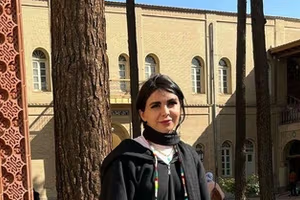
Erfan Qaneifard, an Iranian political activist and author, has been in a Texas immigration detention center for six months and faces possible deportation to Iran, his attorney told Iran International on Friday.
Masoud Peyma, who has represented Qaneifard since 2017, said his client was arrested on March 28 after reporting to the Immigration and Customs Enforcement (ICE) office in Dallas to register a new address. Qaneifard had recently moved from California after accepting a teaching offer at a Dallas college, he said.
Instead of processing the address change, ICE detained him and sent him to a facility for undocumented migrants, according to Peyma.
Qaneifard is being held at the Prairieland Detention Center in Alvarado, Texas, which houses more than 700 people and has faced complaints of overcrowding and harsh conditions, US media have reported.
Between 2003 and 2012, he spent long periods in the United States on a student visa or making visits to the country, his lawyer added.
Previous arrest and failed deportation attempt
Peyma said Qaneifard first sought asylum in 2013 but left the United States before the case was resolved. He re-entered in 2017 via the Mexico border, applied for asylum, and was detained at an ICE facility in El Paso until July 2020.
During that detention, the US attempted to deport him through Azerbaijan in 2019, but Qaneifard refused to board a Tehran-bound plane, according to Peyma.
After his release, he lived in Washington and later in California under an “Order of Supervision,” which allowed him to remain in the country but required regular check-ins with ICE.
Peyma said Qaneifard has never married, has no record with the FBI, and has never been employed by US government agencies. He has supported himself in recent years through teaching, writing and giving interviews.
Risk of forced return
Peyma said ICE contacted Iran’s Interests Section in Washington six months ago, asking for travel papers to deport Qaneifard, but Tehran has yet to respond.
“The risk is real. If he is sent back, his life will be in danger,” Peyma said. “There is no reason for him to remain in detention after six months.”
The lawyer said Qaneifard’s case is being pursued on two tracks. “I have filed a petition in federal court in Texas for his release, given that more than six months have passed since his detention,” he said. “At the same time, a second lawyer has filed an appeal in the immigration court in Virginia with new documents to support his asylum claim.”
Peyma said Qaneifard’s earlier asylum request was rejected in 2018 for lack of evidence. “We hope the new materials on his recent political activities convince the appeals court that deportation would put his life at serious risk,” he said.
Other Iranians deported
The case comes after the United States deported a group of Iranians to Tehran in a chartered operation coordinated with Iranian authorities, the New York Times reported.
The paper said a US-chartered flight took off from a military airport in Louisiana, stopped in Puerto Rico to pick up more deportees, and then continued to Doha, Qatar, before passengers were transferred to another chartered plane to Tehran.
Iranian officials told the Times that ICE had initially said 120 people would be on the flight, but later notified them only 55 were on board, with the rest to follow. Many of those deported had spent months in US detention facilities with asylum claims rejected and accepted return because the alternative was deportation to third countries such as Sudan or Somalia, the Times said.
Immigration attorney Ali Herischi told Iran International that some deportees were political dissidents or Christian converts. He said they were shackled on flights, separated from their families, and their belongings and documents were handed to Iranian authorities. “That is very dangerous,” he said.
The New York Times reported the deportations followed months of talks between Washington and Tehran. US officials have not publicly confirmed the details.
The United States deported two Iranian asylum seekers to Tehran against their will — shackling them on the flight and delivering them into the hands of the very authorities they fled, their attorney told Iran International.
The deportations were part of a larger operation that returned 120 Iranians from US custody to Tehran.
Ali Herischi, an immigration attorney at Maryland-based Herischi & Associates, told Iran International that one of his clients is a political dissident and the other a Christian convert.
Both had crossed into the United States from the border with Mexico to claim asylum. The dissident’s wife, who recently gave birth in the United States, is now caring for their three-month-old child alone.
“She is devastated,” Herischi said. “There’s significant uncertainty about the future and when they can reunite.”
Herischi said neither client consented to deportation, warning that their files, phones and documents were handed to Iranian authorities.
“Unfortunately, their belongings — including their files, evidence and cell phones — have been handed to Iranian authorities. That’s very dangerous.”
The State Department and the Department of Homeland Security did not immediately respond an Iran International request for comment.
On Tuesday, the New York Times reported that a US-chartered flight carrying over 100 Iranians left a military airport in Louisiana, stopped in Puerto Rico to pick up additional deportees, and then continued to Doha, Qatar, before the passengers were transferred onto another chartered flight to Tehran.
Herischi estimates as many as 220 people were deported, though some were left in Qatar. The deportees, he added, were denied the chance to fully argue their asylum cases per rules during the Trump presidency that restricts claims by those who entered through the southern border.
‘Pick your poison'
Earlier this year, the United States deported another group of Iranians — many of them Christian converts — to Costa Rica and Panama, despite the risk of persecution they could face back home.
According to Herischi, deportees were sometimes presented with a choice: “ICE would say, 'either you consent to deportation to Iran, or we send you to Somalia or Sudan.' It was, 'pick your poison.' In the case of my clients, they didn’t even get that. They just said, you’re done, let’s go.”
The deportation flight, The New York Times reported, followed “months of negotiations” between Washington and Tehran, citing two senior Iranian officials involved in the talks and a US official with knowledge of the plans.
According to the Times, the State Department first approached Iran’s interests section in Washington about coordinating deportations three months ago. Iran had to verify identities and issue travel documents for some detainees.
Herischi said, “We need to know what has been exchanged in price of deportation of those individuals... Whether Iran had any influence on the list of deportees or set the priority of who is going to accept.”
The move, Herischi added, risks normalizing Iran’s human rights record and undermining America’s stated commitment to protecting persecuted minorities. “It’s like, oh, it’s just a normal country, why do we care? That’s not right.”
Canada’s Federal Court has upheld a government decision to block a former Iranian oil executive from entering the country, dismissing his appeal as baseless, Global News reported on Friday.
The ruling concerns Mohammadreza Mazloumi Aboukheili, 64, a former director of operations at the National Iranian Oil Products Distribution Company, a state-owned firm reporting to Iran’s Ministry of Petroleum.
He had applied for a visa to visit his son in Ontario, but Canadian authorities determined he was inadmissible due to his senior role in "a regime engaged in terrorism and systematic human-rights abuses," according to the court ruling.
Mazloumi had previously visited Canada before Ottawa introduced a 2022 policy targeting high-ranking Iranian officials, the court decision cited by Global News said.
Immigration officials argued his position placed him only two ranks below Iran’s oil minister, undermining his assertion that he was a “middle manager.”
Mazloumi challenged the assessment, but the judge rejected his arguments, saying the government’s decision was reasonable and supported by evidence. The court found “no error” in how the visa officer handled the case, noting the executive knowingly served in a government accused of terrorism and repression.
The case reflects Ottawa’s broader effort to prevent senior Iranian officials from entering Canada.
Almost three years after the policy was introduced, authorities have stopped nearly 200 suspected Islamic Republic figures at the border.
However, deporting those already inside Canada has proven more difficult. Only one suspected official has been removed to Iran, while several others remain in the country due to legal challenges.
Oil revenues play a central role in funding the Iranian state, which Ottawa has accused of supporting groups such as Hezbollah, Hamas and Yemen’s Houthis, and supplying drones to Russia for its war in Ukraine.
Canadian authorities have also accused Tehran of targeting critics abroad, including activists and journalists living in Canada.
Mazloumi did not respond to a request for comment, Global News reported.
International sanctions renewed on Tehran over the weekend are already making life harder for ordinary Iranians and may signal an impasse that could lead to renewed war, experts told Iran International’s podcast Eye for Iran.
The renewed restrictions are biting deep into society, yet they are ultimately the result of Tehran’s own policies, economist Mahdi Ghodsi told Eye for Iran.
“In the past 10 years, the real income of Iranians has been halved. The middle class has become poor and the poor cannot live under these conditions,” he said.
“I consider sanctions as the effect of bad management, bad policy and bad governance. If you think about the benefits of your own people, you don’t impose policies that attract sanctions,” he added.
Iranians themselves are pointing the finger at their leaders, analyst Holly Dagres said.
“You’re hearing chants from retirees, you’re hearing labor unions saying enough — stop blaming sanctions and inflation. This is all on you. The West is not the problem here. You’re the problem,” said Dagres, a fellow at the The Washington Institute think tank.
Currency tank
The rial has collapsed to 1,170,000 to the US dollar — or 117,000 tomans on the free market — the weakest in Iran's history.
Iran’s Central Bank Governor blamed the plunge on an “enemy’s psychological war,” but for families, it has meant soaring costs for food, rent, and medicine. The broad scope of the new sanctions, covering oil, banking and dual-use goods, is already eroding purchasing power across the country.
The volatility is also taking a psychological toll.
“People are constantly checking the exchange rate, they’re constantly checking the gold rate,” Dagres said. “It’s like a stock market for them, because they know that tomorrow their bread or their rent or their medicine could cost more.”
The so-called snapback of United Nations sanctions was welcomed on October 1 by the foreign ministers of the G7 countries, joined by the EU’s High Representative.
Tehran was accused of failing to meet its nuclear obligations, and urged to return to direct talks with Washington. The measures restore sweeping restrictions first imposed between 2006 and 2010, which had been lifted under the 2015 nuclear deal.
The United States, European Union, and allies including Canada and Japan have also moved to reimpose their own measures.
Research highlights how devastating such measures have been. Sanctions between 2012 and 2019 shrank Iran’s middle class by up to 28 percentage points compared with a no-sanctions scenario, according to a study by Mohammad Reza Farzanegan of Philipps-Universität Marburg and Nader Habibi of Brandeis University, published in the European Journal of Political Economy.
Sanctions “laid waste” to the very group that once drove reform and moderation in Iran, the authors wrote in an op-ed published by Al Jazeera.
War fears
The sanctions appear to deepen an impasse that may culminate in more war.
"The specter of war is still on Iran. Iranian airspace is still under control of Israel and the United States, Ghodsi said. "Either the Iranian government will try to resolve all these issues or the tensions will escalate soon."
Dagres said average Iranians are fearful of another war and its attendant death and displacement, but Tehran's hard line hard line may augur another conflict.
"To me, it seems like things are not changing in the view of the Islamic Republic. And the way that things are going, it does look like a path to confrontation."
You can watch the full episode of Eye for Iran on YouTube or listen on any podcast platform of your choosing like Castbox, Spotify, Apple or Amazon Music.
A top commander in Iran's Revolutionary Guards said on Friday the Oct. 7, 2023 Hamas attack on Israel came as a surprise to them, its Hezbollah allies and even the Palestinian group's political leaders.
Iran, slain Hezbollah chief Hassan Nasrallah, and senior Hamas leaders such as Ismail Haniyeh "were unaware of the October 7 attack,” said Esmail Qaani, head of the foreign operations wing of Iran's Islamic Revolutionary Guard Corps (IRGC), the Quds Force.
Israel has accused Iran of orchestrating the October 7 attacks, with Prime Minister Benjamin Netanyahu insisting that Tehran funded, trained and planned the assault as the culmination of its longstanding support for Hamas.
Successor to Qassem Soleimani, who was killed in a US drone strike in Baghdad in 2020, Qaani has mostly maintained a low profile and survived serial Israeli assassinations of IRGC commanders during a surprise military campaign in June.
According to Qaani, Haniyeh was preparing for a trip to Iraq when he was surprised to learn of the assault on Israel by Hamas. Haniyeh, a senior Palestinian politician and Hamas’s political leader, served as chairman of the group from 2017 until his assassination by Israel in Tehran in July 2024.
Qaani said he traveled to Lebanon on the afternoon of October 7 and met Hezbollah chief Hassan Nasrallah to discuss next steps.
“During the meeting, Nasrallah decided to launch attacks on Israel on October 8,” he said, noting that a large number of Lebanese civilians were holidaying away from homes in southern Lebanon at the time.
On October 8, Hezbollah fired rockets and artillery at multiple Israeli military sites in northern Israel, including around the disputed Shebaa Farms in solidarity with Hamas. Israel responded with heavy artillery fire.
The Jewish State carried out multiple strikes against Hezbollah in Lebanon, including pager explosions in September 2024 that killed more than 30 Hezbollah commanders.
Later that month, an Israeli airstrike in Lebanon killed most of Hezbollah’s senior leadership, including Nasrallah. A subsequent air campaign and ground incursion killed over 3,000 people.
Hezbollah disarmament
Qaani added that if Israel could disarm or destroy Hezbollah militarily, it would have continued fighting without pause, but instead Israel requested a ceasefire to regroup.
“While some Israeli officials prematurely claimed Hezbollah’s destruction, battlefield realities showed otherwise,” he said.
Lebanon’s government has unveiled plans to disarm Hezbollah by the end of 2025, aiming to make the Lebanese Armed Forces the country’s sole armed force even as Israel maintains an armed presence in parts of the country's south.
Hezbollah, with backing from Iran, has resisted handing over its weapons.
A Tehran appeals court upheld prison terms totaling 41 years and 10 months for five Christian converts convicted on formal charges of violating Islamic law and spreading deviant propaganda.
An Islamic Revolutionary Court had originally sentenced Morteza (Calvin) Faghanpour Sassi, Abolfazl (Benjamin) Ahmadzadeh Khajani, Hossam al-Din (Yahya) Mohammad Joneydi, and two others whose names were not disclosed.
The defendants have chosen Christian names for themselves.
Each was given seven years and six months for “deviant educational and propaganda activities contrary to and disruptive of Islamic Sharia, involving foreign connections,” plus an additional seven months for “propaganda against the system,” according to the Christian outlet Mohabbat News.
Faghanpour Sassi received an extra 17 months for “insulting the leadership.”
The court cited reports from the Intelligence Ministry, defendants’ statements and evidence of house churches, Christian promotion, enrollment in foreign online universities, training trips to Turkey and efforts to recruit others as grounds for upholding the convictions.
The defendants were pressured to sign statements renouncing their faith in exchange for reduced sentences, while “at least one of them, Morteza Faghanpour Sassi was subjected to physical torture,” according to the advocacy group Article 18.
Iran has shut down Persian-language churches and frequently raids homes and house-churches. Converts often face accusations such as promoting “Zionist Christianity,” membership in groups opposed to the Islamic Republic or attempting to convert Muslims - charges that can lead to lengthy imprisonment often without substantial evidence.
Under Iranian law, only ethnic Armenians and Assyrians born into Christianity are recognized as Christians. Conversion from Islam is prohibited.