Iran official mocks ‘Don Quixote’ Trump’s Nobel Prize snub
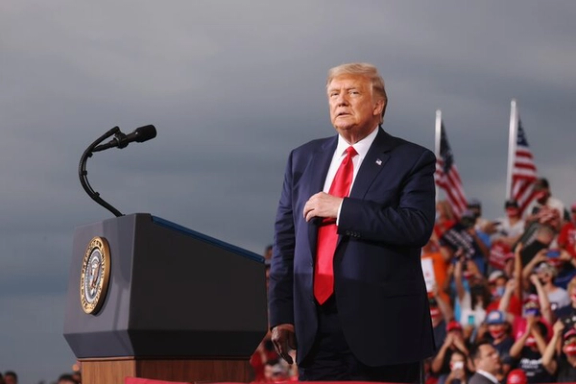
US President Donald Trump holds a campaign event at Smith Reynolds Regional Airport in Winston-Salem, North Carolina, US, September 8, 2020.
An Iranian presidential aide on Friday ridiculed US President Donald Trump’s failed bid for the Nobel Peace Prize, saying his record of militarism and complicity in Israeli "genocide" in Gaza belied any claim to peace.
“He turned the US Department of Defense into the Department of War, believed in 'peace through strength,' launched a direct military attack on Iran’s monitored nuclear facilities, is now preparing for war with Venezuela, and gave the Israeli regime a free hand in the historic genocide in Gaza — yet he still expected to receive the Nobel Peace Prize,” Abbas Mousavi, deputy chief of staff to Iran’s president, wrote on X.
"From today on, may God have mercy on the world—this modern-day Don Quixote will probably not even bother pretending to be a peacemaker!" he added.
In August, Mousavi, faced criticism from hardliners in Tehran for addressing the US president as "Dear Mr. Trump" during a televised interview.
Iran's hardliners excoriated him for overlooking that Trump ordered the assassination of powerful Iranian general Qassem Soleimani in 2020.
The Norwegian Nobel Committee awarded the 2025 Peace Prize to María Corina Machado on Friday “for her tireless work promoting democratic rights for the people of Venezuela and for her struggle to achieve a just and peaceful transition from dictatorship to democracy.”
The 58-year-old opposition leader, who remains in hiding, has been barred by Venezuelan authorities from running for office against President Nicolás Maduro.
In a message on X, Machado said her movement was “on the threshold of victory” and counted on “President Trump, the people of the United States, the peoples of Latin America, and the democratic nations of the world” as allies in the fight for “freedom and democracy.”
"I dedicate this prize to the suffering people of Venezuela and to President Trump for his decisive support of our cause!"
Trump, who has long spoken publicly about his desire to win the Nobel Peace Prize, has received several nominations over the years, including one this year from Israeli Prime Minister Benjamin Netanyahu.
“In a period of just seven months, I have ended seven ‘un-endable’ wars,” Trump said during his address to the United Nations General Assembly last month. “No president or prime minister — and for that matter, no other country — has ever done anything close to that.”
He raised the count to eight during a press conference on Thursday, adding the Gaza ceasefire announced Wednesday to his list.
The White House's communications director lamented the Nobel committee's decision, saying the "Nobel Committee proved they place politics over peace".
Trump, Steven Cheung wrote on X, "will continue making peace deals, ending wars, and saving lives".
Iranian Nobel laureates Shirin Ebadi and Narges Mohammadi praised the selection of 2025 winner, Venezuelan opposition leader María Corina Machado, saying her courage and leadership serve as an inspiration for Iran’s pro-democracy movement.
The two prominent Iranian rights defenders drew parallels between Venezuela’s democratic movement and their own struggle for change in Iran, emphasizing shared aspirations for freedom and resistance to authoritarian rule.
“She is one of the most deserving recipients,” said Ebadi, who won the Nobel Peace Prize in 2003.
She described Machado as the woman “who succeeded in uniting Venezuela’s opposition,” adding that her political leadership “can offer valuable lessons for Iran’s opposition.”
Ebadi said Machado’s model of unity and courage “should be a role model for the Iranian opposition.”
From Tehran, Narges Mohammadi — awarded the Nobel Peace Prize in 2023 — said the democratic transitions in Iran and Venezuela are part of a “shared path from tyranny to democracy.”
Calling Machado “one of the most remarkable examples of civil courage in Latin America,” Mohammadi wrote on X, “I stand in solidarity with you and the freedom-loving people of Venezuela. Hand in hand until the day of victory.”
The Nobel Committee on Friday awarded the Peace Prize to Machado, recognizing her role in "promoting democratic rights for the people of Venezuela and for her struggle to achieve a just and peaceful transition from dictatorship to democracy.”
Iran’s Foreign Ministry on Friday condemned what it called the United States’ interventionist military activities in the Caribbean and Latin America, warning that recent strikes against Venezuela could endanger regional peace and stability.
The United States’ measures in the Caribbean and Latin America, particularly its latest military activities targeting Venezuela, are destabilizing and tension-provoking, Foreign Ministry spokesman Esmail Baqaei said.
The US military has conducted four lethal strikes in the Caribbean following its buildup of naval forces, part of what President Donald Trump has described as an “armed conflict” against drug cartels.
The Venezuelan government insists that Washington is using the fight against drug trafficking merely as a pretext for its military operation.
Iran’s Foreign Ministry spokesman disputed the Trump administration’s claim that the targets were drug cartels, saying the US was actually attacking “fishing boats.”
He warned about the consequences of what he called Washington's continued lawlessness and aggressive unilateralism for global peace and stability.
The government of Nicolás Maduro, a close ally of Tehran, on Thursday urged the United Nations Security Council to hold an emergency session over recent US military operations in waters near Venezuela’s coast, citing “mounting threats” from Washington following the US strikes.
Venezuela submitted the request in a letter to Russia’s ambassador to the UN and current Security Council president, Vassily Nebenzia, accusing the Trump administration of attempting to overthrow President Maduro and of endangering “peace, security, and stability at the regional and international levels.”
Iran's foreign ministry spokesman urged the UN Security Council and the Secretary-General to pay immediate attention to what he called the dangerous situation created by the United States’ insistence on illegal interference in the internal affairs of the Bolivarian Republic of Venezuela, a sovereign member of the United Nations.
He also denounced the US threats to use force against Venezuela’s national sovereignty and territorial integrity, calling these actions a blatant violation of the principles of the UN Charter and the fundamental rules of international law, according to a foreign ministry statement.
More than $95 billion in foreign currency from Iran’s non-oil exports since 2018 has not been repatriated to the country, the Guards-linked Tasnim news agency reported on Friday, citing official trade data.
“Out of over $270 billion in total non-oil exports from 2018 to 2025, nearly $95.6 billion—about 35 percent—has yet to return to Iran’s official financial system,” Tasnim said.
The report said the unreturned funds relate to exports excluding government-controlled sectors such as oil, gas, and electricity.
Iran's top non-oil exports are dominated by petrochemical products such as liquefied propane, methanol, and bitumen, as well as agricultural products like pistachios and saffron. Key export destinations include China, Iraq, and the United Arab Emirates, though China has recently been a particularly important market for petrochemicals.
In the period since 2022, Iran recorded $146 billion in non-oil exports, of which $56 billion, or nearly 38 percent, has not been brought back into the country.
Hossein Samsami, a member of the parliament’s economic committee, criticized the government’s handling of the issue following recent remarks by the president about a shortage of foreign exchange.
“The president said that we do not have even one billion dollars and must bargain to find it,” Samsami wrote on his personal page. “Meanwhile, nearly 100 billion dollars of export revenues have not returned to the country over the past seven years. If the law were properly enforced, we would even have surplus currency.”
Under Iranian law, exporters are required to repatriate foreign currency earned abroad, and failure to do so constitutes a violation under anti-smuggling legislation. However, Tasnim quoted experts as saying that lax enforcement and loopholes have allowed large sums to remain overseas or be used for informal imports.
Israeli Prime Minister Benjamin Netanyahu said on Friday he resisted international pressure to halt the war in Gaza because Israel’s security depended on removing the threat from Iran and its armed allies.
In a televised address a day after his government approved a deal to free hostages and end the fighting, Netanyahu said the campaign’s objectives went beyond Gaza. “I firmly rejected all the pressure because I had one consideration in mind — the security of Israel,” he said.
“That meant achieving the goals of the war: freeing the hostages, eliminating the nuclear and ballistic threat from Iran that endangered our existence, and breaking the Iranian axis, of which Hamas is a central part,” he said.
“Hamas, Hezbollah, the Assad regime, and Iran are all under one umbrella,” he said. “But despite the pressure, we stood firm and acted solely for the security of Israel.”
A day earlier, Iran said it supported the US-brokered Gaza ceasefire and any initiative that would end what it called Israel’s ‘genocidal war’ and secure Palestinian rights. The foreign ministry said Tehran backed efforts leading to “the withdrawal of occupying forces, the entry of humanitarian aid, the release of Palestinian prisoners, and the realization of the fundamental rights of the Palestinian people.”
Government spokeswoman Fatemeh Mohajerani said Tehran would support any lasting peace that benefits Palestinians, while a conservative lawmaker voiced a tougher line, saying Iran-aligned armed groups would keep up their operations against Israel and the United States despite the ceasefire.
Behnam Saeedi, secretary of Iran’s parliament national security commission, told local media that “groups in the resistance front are today stronger and more active than two years ago against America and Israel.” He dismissed US President Donald Trump’s peace plan as unreliable, saying any deal that undermines Palestinian sovereignty “is doomed to fail.”
The ceasefire agreement, reached under a 20-point US proposal backed by Egypt, Qatar and Turkey, includes the release of hostages and prisoners, the withdrawal of Israeli troops from parts of Gaza, and the entry of humanitarian aid.
The two-year Gaza conflict triggered a wider regional war that pitted Israel and the United States against Iran and its allies. Tehran and its partners suffered heavy losses during that period, including the assassination of Hezbollah leader Hassan Nasrallah, the fall of Syria’s Assad government, and Israeli and US strikes that crippled Iran’s nuclear infrastructure in June.
At least 1,537 people were executed by hanging in Iran between October 2024 and October 2025, the highest figure in a decade, the Human Rights Activists News Agency (HRANA) reported on Thursday in its annual report marking the World Day Against the Death Penalty.
The report documented an 86 percent increase in executions compared with the previous year’s 823 cases. Of those executed, eight were hanged in public, 49 were women, and three were under 18 at the time of the alleged crimes.
“This increase peaked between 2024 and 2025, with at least 1,537 executions recorded, the highest number documented in the past decade,” HRANA said.
The data were collected from a combination of judicial sources, local reports, and the agency’s network of independent observers, according to HRANA.
94.14 percent of executions, it said, were carried out secretly and never announced by official sources, a pattern it said reflected the authorities’ efforts to “omit, conceal, or restrict the collection of such data.”
Nearly half of all executions, 48.34 percent, were related to drug offenses, while 43.46 percent were for murder. Other charges included rape, moharebeh (ear against God), espionage, and corruption on earth.
The report showed the highest number of executions in Alborz province, where Ghezel Hesar Prison accounted for 183 hangings. Isfahan and Fars provinces followed, with 124 and 118 executions respectively at Dastgerd and Adelabad prisons. The data also indicated that the months of September, August, and May 2025 saw the most executions, with 191, 165, and 162 cases respectively.
A decade of reversal
Its ten-year analysis, HRANA said, revealed that after a relative decline between 2015 and 2019, executions in Iran have increased steadily since 2021. The report found that the majority of those executed came from socially and economically vulnerable groups, including defendants convicted under Iran’s strict anti-narcotics laws.
Inside prisons, resistance has grown. On October 7, prisoners across 52 facilities continued hunger strikes under the “Tuesdays No to Execution” campaign, which has been running for 89 consecutive weeks.
The death penalty was being used by the authorities as a political tool to suppress dissent amid economic crisis and public discontent, HRANA added.
Call for international response
The agency urged the United Nations and foreign governments to intervene. It called for “urgent and coordinated action by the international community to halt the ten-year wave of executions, reform domestic laws, hold perpetrators of extrajudicial executions accountable, and take unified international measures to confront the growing wave of executions in Iran.”