US president says Iran cannot survive sanctions, urges dialogue
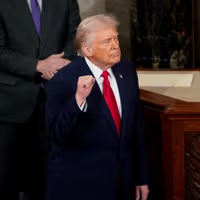
US President Donald Trump speaks to the media aboard Air Force One, amid a US-brokered prisoner-hostage swap and ceasefire deal between Israel and Hamas, October 13, 2025.
US President Donald Trump on Monday said Iran could not survive sanctions but that Tehran would likely return to negotiations, in the latest conciliatory comments in the wake of diplomatic progress on Gaza.
"I think Iran will come along. They've been battered and bruised and, you know, they're out there. They need some help. There are big sanctions, as you know, tremendous sanctions," Trump told reporters alongside Egypt's President Abdul Fattah al-Sisi.
"I'd love to take the sanctions off when they're ready to talk. But they can't really survive with those sanctions," he added ahead of a summit in Sharm al-Sheikh.
Trump on Monday clinched the release of 20 Israeli hostages in exchange for hundreds of Palestinian political prisoners in a complex international deal he says will bring the devastating two-year-old war in Gaza to a close.
A troika of European powers triggered the reimposition of international sanctions on Iran last month, accusing Tehran of spurning diplomacy and nuclear inspections.
Trump reinstated the so-called "maximum pressure" campaign of US sanctions when he resumed office in January.
Iran denies seeking a nuclear weapon, has rejected a US demand that it renounce domestic enrichment and sees sanctions as a violation of international law.
"I think Iran is going to be fine. I know so many Iranian people. They're great people. They're smart. Great, great people. Engineers, lawyers. I mean, they're academics. But they took a big hit," Trump added.
Trump has frequently spoken of wanting better ties with Tehran, even surprising Israeli lawmakers in a speech to the Israeli parliament earlier in the day when he opined: "It would be great if we made a peace deal with them, wouldn’t it be nice,"
The statement earned a smattering of applause from attendees.
Trump earlier this year gave Iran a 60-day ultimatum to reach a nuclear deal, demanding it end all domestic uranium enrichment. Tehran denies seeking a weapon and sees enrichment as a right.
On June 13, the 61st day since talks began, Israel launched a surprise military campaign which killed nuclear scientists along with hundreds of military personnel and civilians.
On the ninth day of fighting, the United States bombed three Iranian nuclear sites which US President Donald Trump has repeatedly said "obliterated" the country's nuclear program.
Trump has long asserted his deal-making prowess and has cited the Abraham Accord normalization agreements between several Arab states and Israel as a main accomplishment of his first term.
Elected in part on pledges to keep the United States out of foreign wars, Trump took a risk and alienated some in his right-win base with the June 22 strikes, but has described the attacks as necessary to paving the way toward a Gaza deal.
"And frankly, if we didn't hit them with the nuclear, I don't think you would have been able to have this incredible, this deal, this once-in-a-lifetime deal. Nobody's ever said anything like what's happening today," Trump added.
The President has repeatedly said Iran had publicly supported the deal but a foreign ministry statement on Thursday offered only a measured blessing, saying the Islamic Republic supports any accord backed by Palestinians which ends Israeli "genocide".
"Iran did put out a statement that they support this deal very wholeheartedly. So that was, in itself, something," Trump added. "That's all I do in my life. I make deals. And they want to make a deal."
After Hamas militants in Gaza and other Iranian-armed allies took punishing blows throughout a two-year war regional melee since Oct. 7 2023, analysts say war-torn Sudan could provide an unlikely haven to recoup their power.
Sudan may serve as a gateway for rearming groups like Hamas, as Tehran’s so-called Axis of Resistance has been weakened by military and political losses, Danny Citronowicz, head of the Iran and Shia Axis program at Israel’s Institute for National Security Studies told Iran International.
“We have to pay attention to Iranian entrenchment in Sudan. (The Iranians) are working hard to build a base there. Recent reports indicate they are selling drones to the Sudanese army to strengthen their foothold," he said.
"Sudan has been a crucial waypoint for Iran to smuggle arms to Hamas,” Citronowicz added. “Iran’s activity in Africa, especially the eastern region, is significant. Sudan is key if they want to rearm Hamas again.”
Khartoum began to expel Hamas-linked operatives following the ouster of longtime Islamist President Omar al-Bashir in 2019, as new authorities mended ties with the West and inked a normalization accord with Israel.
Sudan’s ongoing civil war has reshaped its political landscape, unleashing deadly chaos and barely governed swathes of contested lands in which some Islamist groups have thrived.
Last year, Israel reportedly considered exiling the assassinated Hamas leader Yahya Sinwar from Gaza to Sudan before he was ultimately killed in a drone attack.
Earlier this year, Sudanese and Israeli media reported discussions about relocating Hamas leadership to Sudan, a possibility that could gain traction following recent Israeli airstrikes on Hamas bases in Qatar.
Red Sea combat
Behnam Ben Taleblu, an Iran expert at the US-based Foundation for Defense of Democracies, said the Red Sea remains a critical focus for Tehran and the Iran-allied Houthi group in Yemen have traded blows for nearly two years.
“Tehran has doubled down on the Houthis while rebuilding ties in Africa, particularly in war-torn Sudan. The Red Sea’s importance has grown due to Houthi maritime and aerial campaigns,” he told Iran International.
Iran reestablished relations with Khartoum in late 2023 as Sudan’s army, led by General Abdel Fattah al-Burhan, struggled against the paramilitary Rapid Support Forces during the ongoing civil war.
Arash Azizi, Iran expert and author of What Iranians Want: Woman, Life, Freedom, said Sudan’s conflict provides Tehran a strategic opportunity. However, Sudan’s recognition of Israel under the 2020 US-brokered Abraham Accords remains a barrier.
“Iran’s gambit will have limited results because Khartoum has not reversed the 2020 recognition of Israel. Burhan is reportedly seeking a new deal with Israel,” Azizi said.
A foothold in Sudan also challenges Iran’s Persian Gulf rivals, the United Arab Emirates and Saudi Arabia, which are deeply involved in the civil war.
Sudan’s 530-mile coastline offers Tehran a route to regain influence in the Red Sea and support the Iran-backed maritime blockade by the Houthis, which started in November 2023.
Tehran has supplied combat drones, munitions and intelligence in the urban conflict, which has killed thousands of civilians. US authorities accuse Iran of supporting the Islamist Ibn Malik battalion.
Since the October 7, 2023 in which 1,200 Israelis were killed and over 200 dragged back to Gaza in captivity, Iran’s allies have suffered major blows in fighting which has flared around the Middle East.
Israel’s ground incursion and air attacks on Gaza aimed to retrieve hostages and destroy Hamas, which seized control of the Strip in 2007.
Large portions of Gaza were destroyed and over 67,000 people killed according to local health authorities and much of the population displaced.
Waning fortunes
Iran lost its foothold in Syria last year when President Bashar Assad was toppled, leaving Tehran without easy conduits to enervated allies Hamas and Hezbollah.
Hezbollah was sapped by Israeli attacks targeting military infrastructure and leadership, including slain leader Hassan Nasrallah. A US-France-brokered ceasefire has increased international pressure to disarm the group.
In Iraq and Syria, Iranian allies conducted limited strikes toward Israel, while Iran continues arming Palestinian militias in the West Bank. The Houthis in Yemen also turned into the most active threat during the Gaza war, launching drones and missiles nearly daily.
“In general, the axis hasn’t achieved its intended deterrence against Israel. Unless we talk about the Houthis, they are unlikely to intervene in future conflicts,” Citronowicz said.
However, missile supplies dwindled as shipments from Iran were increasingly intercepted, forcing groups to rely more on drones.
British military expert Andrew Fox noted that Hamas remains the primary surviving element of Iran’s weakened network.
“Hezbollah is now a local militia, the Houthis are a minor nuisance, Iraqi militias have declined to participate," he said. "Only Hamas retains significant capability.”
Speaking before the Israeli Knesset on Monday, President Donald Trump said that Iran is tired of war and Washington is ready for peace after US attacks on Iranian nuclear sites in June.
"Iran, we are ready when you are and it will be the best decision Iran has ever made, and it’s gonna happen," he said in an address welcoming the first phase of a US-mediated Gaza peace plan.
"Because of us, the enemies of all civilization are in retreat, thanks to the bravery and skill of the Israeli defense forces and Operation Rising Lion," he said, referring to Israel's surprise air strikes on Iran on June 13 which triggered the 12-day war.
Praising Israeli Prime Minister Benjamin Netanyahu in his first foreign address to a parliament during his second term, he said: "Great job and my people loved working with you. Many of Iran’s top terrorists including nuclear scientists and commanders have been extinguished from this earth."
During Operation Midnight Hammer, he said, which saw the US join the war and strike Iran's three main nuclear facilities, Natanz, Fordow and Isfahan, "the US military flew seven of those beautiful B2 bombers, (we just ordered 28 more of them, a little updated version) and almost 100 other planes went with them, including fighter jets".
As 20 living hostages were released from Gaza after two years in Iran-backed Hamas captivity, Trump said that since he came to office, the US had finished eight wars in eight months, including the Iran war.
"We dropped 14 bombs on Iran’s nuclear facilities, which has been confirmed to have obliterated those facilities and together we helped stop the world’s number one state sponsor of terrorism from making nuclear weapons. If we didn’t do that, there would be a dark cloud over this [Gaza] deal. This was our last shot,” he said.
"If there were large scale nuclear weapons in the hands of iran we wouldn’t be here today. We took a big cloud off the Middle East and off Israel,” he said, referring to the other nations in the region who have for decades feared Iran’s nuclear capabilities. "They took a big hit."
As Trump now looks to expand the 2020 Abraham Accords, which saw Arab nations such as the United Arab Emirates normalize relations with Israel, he spoke of peace with Iran.
"It would be great if we made a peace deal with them, wouldn’t it be nice, I think they want to, I think they’re tired," he said.
"When someone told me they had started their nuclear program again, I said, they’re not starting anything, they want to survive, the last thing they want is to start digging holes again in mountains that just got blown up. But first we have to get Russia done."
Speaking of Iran's military allies in the region, he said that "the enemies of all civilization are in retreat".
"In Lebanon, the dagger of Hezbollah long aimed at Israel’s throat has been totally shattered and my administration is supporting the new president of Lebanon and permanently disarm Iran’s Hezbollah brigades," he said.
Since October 7, when Iran-backed Hamas invaded Israel, killing 1,200 mostly civilians and taking more than 250 hostage, Iran and its allies across the region joined Hamas in attacking Israel from countries including Syria, Iraq and Lebanon.
"By force of arms you’ve won," Trump told Israel's parliament after the longest Gaza war since Hamas took control of the strip in 2007 came to an end.
The United States’ destruction of Iran’s nuclear facility prevented Tehran from obtaining a nuclear weapon just months before the Gaza peace deal, US President Donald Trump said Sunday, calling it key to achieving the current ceasefire framework.
“Had we not taken out Iran’s nuclear facility… it would have a really dark cloud over" the Gaza peace deal, "because in two months they would have had a nuclear weapon,” Trump told reporters aboard Air Force One on his way to the Middle East.
He recalled that Israeli Prime Minister Benjamin Netanyahu had pleaded with former President Barack Obama and then–Vice President Joe Biden not to move forward with their Iran policy.
“Remember when Netanyahu came and he begged that Obama and Biden not do what they were doing with Iran? Begged him and they wouldn’t even listen to him. Everything they did was the opposite of what you should have done. Biden and Obama backed Iran,” Trump told reporters.
Iran’s president Masoud Pezeshkian has declined Egypt’s invitation to attend the Sharm el-Sheikh peace summit on Monday, where more than twenty world leaders are expected to discuss Gaza’s post-war future.
Foreign Minister Abbas Araghchi also announced he would not attend, citing continuing US sanctions and what he called “threats against the Iranian people.”
The summit, co-chaired by Trump and Egyptian President Abdel Fattah el-Sisi, includes leaders or top diplomats from Germany, France, the UK, Italy, Spain, Qatar, Turkey, Saudi Arabia, the UAE, Jordan, Pakistan, and Indonesia.
“Iran wants to work on peace now,” Trump said earlier this month. “They’ve informed us they are totally in favor of this deal. We appreciate that, and we’ll work with Iran.”
Washington remains ready for “serious and direct dialogue” with Tehran, the US state department told Iran International on Sunday, hours after Iranian leaders declined invitations to attend a Gaza peace summit in Egypt chaired by President Donald Trump.
“We are ready to talk directly,” a state department spokesperson said. “The United States has kept the door open for serious and direct dialogue, even as Iran has consistently rejected negotiations.”
“Should the Iranians want to negotiate, the ball is in their court,” the spokesperson added, quoting President Trump. “They are the ones that stand to benefit from the negotiation.”
Iran’s president Masoud Pezeshkian turned down Egypt’s invitation to attend the Sharm el-Sheikh peace summit scheduled for Monday, where more than twenty world leaders are expected to discuss a post-war framework for Gaza.
Foreign minister Abbas Araghchi said he too would skip the meeting, citing ongoing US sanctions and what he called “threats against the Iranian people.”
The summit, co-chaired by Trump and Egyptian counterpart Abdel Fattah el-Sisi, will bring together leaders or foreign ministers from Germany, France, the UK, Italy, Spain, Qatar, Turkey, Saudi Arabia, United Arab Emirates, Jordan, Pakistan and Indonesia.
Moderates urged the president to seize what they described as a rare diplomatic opening, while hardliners denounced any participation as a betrayal of the Palestinian cause and a tacit recognition of Israel.
Responding to Iran International’s query after Tehran’s refusal, the US state department reaffirmed Washington’s readiness for “full cooperation” in exchange for Iran suspending its nuclear program.
“Iran cannot have a nuclear weapon,” the spokesperson said. “Beyond that … it is not in our national interest to negotiate these issues publicly.”
“Iran wants to work on peace now. They’ve informed us they are totally in favor of this deal,” the president told reporters on October 9. “We appreciate that, and we’ll work with Iran.”
Iran's President Masoud Pezeshkian has turned down an Egyptian invitation to attend the Sharm El-Sheikh summit on Gaza chaired by Donald Trump despite calls from moderates not to forgo what they called a historic opportunity.
During a cabinet meeting on Sunday afternoon, Foreign Minister Abbas Araghchi said while Egypt’s invitation for Pezeshkian was declined, another invitation was extended to him instead.
Araghchi later said on his X account that he too will not attend the Sharm El-Sheikh summit.
"While favoring diplomatic engagement, neither President Pezeshkian nor I can engage with counterparts who have attacked the Iranian People and continue to threaten and sanction us," he said.
The summit will bring together leaders from twenty countries in a bid “to end the war in the Gaza Strip, strengthen efforts to achieve peace and stability in the Middle East, and open a new chapter of regional security and stability,” according to the Egyptian presidency.
With Pezeshkian’s decision finalized, attention shifted to Araghchi. His potential participation could mark Tehran’s cautious engagement — signaling interest without fully endorsing the summit’s framework.
Had Araghchi accepted the invitation, Iran could define how it navigates its revolutionary identity while engaging with the emerging regional order shaped by the Trump-brokered Gaza ceasefire.
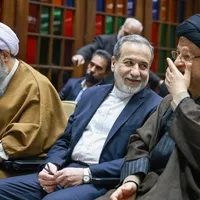
Tehran is split between those who view participation as a betrayal and those who see it as a diplomatic opportunity.
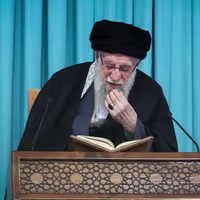
Many Iranians online pointed out that the decision to accept or reject such invitations ultimately depends on Supreme Leader Ali Khamenei’s approval, not the president.
Reformists call it ‘historic opportunity’
Moderates and reformists urged Pezeshkian to seize what they called a rare diplomatic opening.
Prominent reformist journalists Mohammad Mohajeri and Mohammad Ghoochani issued a joint statement urging Pezeshkian “not to miss this historic opportunity.” They argued attending would not signify recognition of Israel but align with Iran’s strategy of indirect negotiation. Their message: “If (the chance in) New York (during the UNGA summit) was lost, seize Sharm el-Sheikh.”
In a post on X, former diplomat Hamid Aboutalebi, a longtime adviser to ex-president Hassan Rouhani, called the reported US invitation as “a positive and welcome signal,” even if informal. “It shows a desire to return to dialogue and constructive engagement,” he said, suggesting it could pave the way for “direct and comprehensive talks.”
Aboutalebi stressed that Iran had “paid a heavy price for the Palestinian cause for over four decades” and should not be absent as results are achieved. He continued: “Iran’s role must not end with resistance — it should extend to reconstruction and state-building. Staying out would waste our strategic investments in the Axis of Resistance.”
Reformist figure Ghorbanali Salavatian echoed that sentiment in a post on X, urging Tehran to send former foreign minister Javad Zarif if it participates: “The Sharm el-Sheikh summit should be seen as an opportunity. Let’s remember — Israel is not attending.”
“The West and the Islamic world have agreed on a plan for Gaza. Iran should attend, reaffirm its stance, and engage with the world.” Playing on the host city’s name, he warned: “Don’t turn ‘Sharm el-Sheikh’ into shame for the officials!” wrote user Hamed Hesari on X.
Hardliners warn of betrayal
Hardline figures vehemently oppose any participation, arguing that sitting at a table hosted by Donald Trump would mean “recognizing the Zionist regime, accepting the defeat of the Palestinian cause, and undermining Hamas.”
Abdollah Ganji, former editor-in-chief of the IRGC-linked Javan newspaper, dismissed moderates and reformists’ calls to attend as “a new show by naïve dreamers.”
Hardline user Mohammad Sajjad Parchami posted: “The leg of Pezeshkian — or anyone representing the government — who wants to attend Sharm el-Sheikh must be smashed.”
Strategic arguments
Some foreign policy experts also backed participation on pragmatic grounds.
Analyst Reza Nasri wrote in a post on X that three decades after being excluded from the Madrid peace process, this summit could be “a new beginning.” He warned that Iran’s absence would allow others to “shape arrangements unfavorable to both Iran and Palestine.”
Former ambassador Nosratollah Tajik added in a post on X: “Iran’s absence won’t heal the Palestinians’ pain. Participation, however, would signal a new behavioral model — a soft power card that can become a lever of influence.”
In their joint statement, Ghoochani and Mohajeri further argued that participation could strengthen Iran’s ties with Arab states such as Egypt and Saudi Arabia and help reduce international ‘Iranophobia’ linked to the nuclear issue.
Criticism over indecision
Even before Pezeshkian declined the invitation, many criticized his indecision.
Moderate journalist Mostafa Faghihi posted on X: “It’s obvious Iran should attend — but we can easily predict it won’t. The decision must balance national interests, regime expediency, and the demands of hardliners.”
Veteran reformist journalist Ali Hekmat voiced frustration in a post on X: “This government lacks even the ability to influence complex situations on a limited scale. Mr. Pezeshkian has failed to deliver on his promises.”
A user posted with the hashtag #SharmElSheikh: “The people were wrong to think there was a difference between Raisi and Pezeshkian. This system makes everyone the same.”