Shamkhani urges unity after leaked wedding video draws backlash
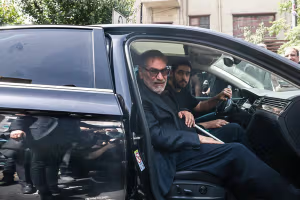
Ali Shamkhani, Iran's former security chief and a senior adviser to Supreme Leader Ali Khamenei, October 19, 2025
Ali Shamkhani, a senior advisor to Supreme Leader Ali Khamenei, warned on Wednesday that internal divisions could damage Iran’s stability, speaking as a leaked video of his daughter’s wedding stirred anger over Iran’s ruling establishment.
In an interview with ISNA, Shamkhani said national cohesion was vital in the face of external pressure and domestic challenges.
“We are all in the same boat shaped by the sacrifices of the martyrs of the Islamic Revolution, and it would be a shame if our differences created weaknesses,” he said.
He urged all political groups to “act together under the leadership of the Supreme Leader,” adding that adversaries were trying to exploit divisions to harm the country.
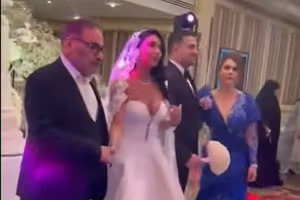
The comments came just days after footage surfaced online showing Shamkhani escorting his daughter at a wedding ceremony in a Tehran luxury hotel.
The video, shared widely on X since mid-October, appeared to show a large, Western-style celebration and drew sharp criticism from social media users accusing officials of hypocrisy amid the country’s deepening economic crisis and renewed enforcement of hijab rules.
The wedding reportedly took place in April 2024 at Tehran’s Espinas Palace Hotel. At the time, Iranian outlets estimated the cost at about 14 billion rials (over $21,000). The family did not comment on the reports, and Shamkhani has not publicly addressed the new controversy surrounding the footage.
Shamkhani, a former secretary of Iran’s Supreme National Security Council and now a member of the Expediency Council, has long been a prominent figure in Iran’s security establishment. He also serves as the Supreme Leader’s representative in the National Defense Council.
Leak fuels political blame game
The video has drawn reactions even from hardline circles. Some conservative commentators questioned how senior officials could call for patience under sanctions while appearing at opulent private events. Others defended Shamkhani, saying the ceremony was private and attended only by family members.
Former state broadcaster chief Ezzatollah Zarghami described the exposure as “a new method of assassination,” accusing Israel of waging psychological warfare through cyberattacks. IRGC-linked Mashregh News also said the leak aimed to “undermine an effective official,” blaming both “foreign enemies and certain domestic circles.”
The hardline daily Kayhan, which is funded by the Supreme Leader’s office, went further, accusing allies of former president Hassan Rouhani and ex-foreign minister Mohammad Javad Zarif of involvement. The paper called the release of the footage a “proxy character assassination,” saying that Shamkhani’s past criticism of Rouhani’s handling of nuclear policy had fueled political resentment.
Pro-hardline activists echoed that view online, arguing that the leak followed Shamkhani’s recent comments implicating the previous administration in the delayed acknowledgment of the 2020 downing of a Ukrainian airliner by the Revolutionary Guards.
Figures close to Rouhani have denied any connection to the leak. A source told the news outlet Khabar Online that the act was “unethical and contrary to Islamic norms.”
Iranian President Masoud Pezeshkian has signed into law the country’s conditional accession to the United Nations Convention for the Suppression of the Financing of Terrorism (CFT), approving it only within the limits of Iran’s constitution and domestic legislation.
In a formal decree on Tuesday, Pezeshkian instructed the judiciary, the ministries of interior, intelligence, justice, foreign affairs, and economy, as well as the Central Bank, to implement the law in accordance with national regulations -- a condition that could limit its impact even as Tehran seeks to ease its isolation from the global financial system.
Under conditions set by parliament and endorsed by the Expediency Council, Iran will act “within the framework of the constitution,” and in cases where any provision of the convention conflicts with national laws, “domestic legislation will take precedence,” council spokesman Mohsen Dehnavi said.
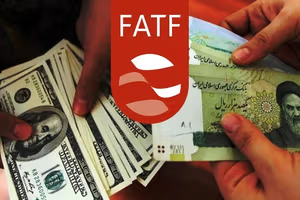
The move, which follows years of political wrangling, comes just a day before the Financial Action Task Force (FATF) plenary in Paris on October 22–24, where delegates from over 200 jurisdictions will discuss mutual evaluations and global efforts to combat money laundering and terror financing.
Iran’s Financial Intelligence Unit chief, Hadi Khani, has traveled to Paris to attend FATF plenary for the first time in six years at the group’s official invitation, according to state media.
Khani, who also serves as deputy economy minister and secretary of Iran’s Anti–Money Laundering and Counter-Terrorist Financing Council, is expected to outline Iran’s progress on its action plan, focusing on the recent approval of its accession to the UN Palermo Convention against transnational organized crime.
The Iranian delegation will brief FATF members on legislative and implementation steps and coordinate future meetings to address questions and clarify outstanding issues, IRNA reported.
In May, Iran’s Expediency Council, conditionally approved the country’s accession to the Palermo Convention, one of the two key legislative items tied to the FATF standards, alongside the CFT.
The Expediency Council, overseen by Supreme Leader Ali Khamenei, mediates disputes between parliament and the Guardian Council, a body that vets laws and candidates.
Supporters say joining the UN convention could help Iran align with FATF standards, reconnect with global banking systems, and attract investment, while hardliners warn it risks exposing financial channels used to evade US sanctions and fund regional allies.
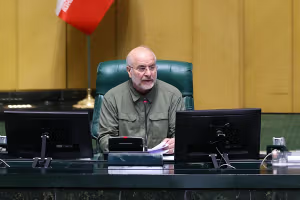
Parliament Speaker Mohammad Bagher Ghalibaf sent the bill to Pezeshkian for implementation under Article 123 of the constitution last week after lawmakers rejected a conservative-backed motion to block the move, clearing the way for Iran to finalize its accession.
Iran and North Korea remain the only two countries still outside the FATF framework.
The political storm unleashed over a leaked video depicting the daughter of Iran's ex-security chief in a revealing wedding dress shows no sign of calming, with claims of Israeli cyberwarfare pitted against suspicions of skullduggery within the ruling elite.
The footage of Ali Shamkhani walking his daughter down the aisle—dressed in a strapless, décolleté gown—instantly went viral and drew cries of double standards from a nation bound by strict Islamic codes.
But beyond issues of morality, elite privilege or invasion of privacy, the leak itself has triggered a new wave of political blame games, exposing heightened factional tensions in the aftermath of Israel’s June attack on Iran.
Shamkhani’s only reaction to date has been a cryptic post on X quoting Steve McQueen prison-break drama Papillon: “You bastards, I’m still alive.” He had used the same phrase to deny rumors of his death during the 12-Day War.
Notably, the message was written in Persian and Hebrew, shifting attention from the video's content to the act of leaking itself and framing the exposure as possible foreign interference.
‘Character assassination’
Former state broadcaster chief Ezzatollah Zarghami put it bluntly.
“Hacking into people’s privacy is Israel’s new method of assassination,” he posted on X, calling the leak a new form of psychological warfare aimed at national morale.
On social media, the theory of Israeli involvement gained traction when users claimed that the clip first appeared on a Hebrew-language Telegram channel—though this claim remains unverified.
Mashregh News, affiliated with the IRGC Intelligence Organization, said the leak aimed to “discredit Shamkhani” because of his “effectiveness,” blaming “certain domestic circles” as well as Israel.
Hardline daily Kayhan, funded by the Supreme Leader’s office, went further and laid blame on former President Hassan Rouhani and his allies.
The paper called the leak a “proxy character assassination,” arguing that Rouhani and former foreign minister Mohammad Javad Zarif were “hostile” to Shamkhani because he promoted a 2020 law on “reciprocal nuclear measures” that increased Western pressure on Rouhani.
‘Culprits at home’
Ali Bitafaran, a pro-hardline activist, wrote: “The equation is very simple: Shamkhani exposed Rouhani, (close Rouhani aide) Hesamodin Ashena threatened (him), two days later the threat was carried out by the counterrevolutionaries when dirt on Shamkhani was released.”
He claimed the video revealed the link between “an evil domestic ring and the exiled overthrow-seekers.”
The accusation refers to a recent disclosure by Shamkhani that Rouhani had known “from the earliest minutes” that the IRGC had shot down a Ukrainian passenger plane in 2020, long before officials publicly admitted it.
Hardliners allege that the revelation provoked the anger of Rouhani, his foreign minister Javad Zarif, and their reformist allies.
Denials and counterclaims
Rouhani’s camp has firmly denied any link to the leak.
A source close to his office told Khabar Online that the act was “an ugly, unfair action contrary to Islamic norms.”
Hesamodin Ashena, Rouhani’s longtime adviser and a frequent target of hardliners, also pushed back, warning against “beating the empty drum of divisions.”
Ironically, Ashena’s earlier post—warning against compelling Rouhani and Zarif to reveal what they know—has been cited by hardliners as evidence of the duo’s involvement.
Whether the leak was a foreign intrusion or a domestic vendetta, it has laid bare the mutual suspicion and fragility within Iran’s political establishment.
Tehran may be preparing for confrontation rather than calm, if the recent remarks of Supreme Leader Ali Khamenei are any indication, preferring the uncertainties of further conflict over meeting US peace demands seen as humiliating.
In a speech on Monday, Khamenei dismissed any Mideast-wide peace deal, threatened renewed missile attacks and derided Donald Trump—all at a moment when the US president was taking credit for brokering the Gaza ceasefire.
Despite visible fatigue within the political establishment and the military setbacks that followed the June war, 86-year-old Khamenei continues to project defiance. His choice of language suggests a leader who sees few acceptable alternatives.
Even amid widening divisions, those around him seem to recognize that Iran faces two narrow paths—negotiation on terms seen as humiliating, or confrontation whose outcome remains uncertain.
For now, the veteran leader appears inclined toward the latter. Negotiations, in his view, offer neither leverage nor time.
Hardball in Washington
Trump has made clear he would accept nothing short of dismantling Iran’s nuclear program, curbing its missile capabilities, and ending support for armed allies in the region—conditions that Tehran reads as surrender.
The most recent talks, which were cut short by US-Israeli strikes, appear to have convinced the decision-makers in Tehran that diplomacy to buy time may no longer be viable.
Still, for Khamenei and his closest advisers, war may appear the less constraining option—one that carries risks but also the potential for unexpected outcomes that preserve or even strengthen their rule.
One factor shaping this outlook is a belief that Washington and its allies are reluctant to open another front. With strategic focus fixed on China and Russia, the West appears more interested in containing instability than deepening it.
From Tehran’s perspective, that caution could reduce the likelihood of sustained military engagement and therefore make confrontation a manageable gamble.
Diplomacy with predetermined outcomes, in that calculation, holds little appeal.
The succession factor
Since the June ceasefire, speculation about life after Khamenei has become more open.
With power struggles simmering, no faction wishes to inherit leadership while Iran’s confrontation with Israel and the West remains unresolved. Any successor would bear the stigma of defeat.
Some insiders therefore appear willing to let Khamenei shoulder responsibility for the current standoff, expecting that his eventual departure could clear the way for a recalibration of policy.
Events since Hamas’s October 7 attack on Israel have highlighted Iran’s limited capacity to protect its regional allies and assets. Yet Khamenei’s rhetoric continues to emphasize endurance and faith in ultimate victory.
A parallel pattern is evident at home, where intensified repression and executions signal an attempt to assert authority and restore control in the face of uncertainty.
Khamenei’s current stance seems driven less by confidence than by constraint—a conviction that confrontation, though perilous, still allows the system to act rather than be acted upon.
Whether that belief prolongs the system’s survival or deepens its vulnerabilities remains unclear.
For now, Iran’s leadership appears to have chosen uncertainty over surrender—a gamble that may define the final phase of Khamenei’s rule.
Many Iranian journalists and activists abroad have begun to treat state intimidation and harassment as part of daily life, UN Special Rapporteur on Iran Mai Sato said on Tuesday, criticizing the persistence of what she called Iran's transnational repression.
“What once felt dangerous has become routine. For many, normalizing these threats is no longer a choice" said Sato on a social media post written in Persian on X.
A group of United Nations human rights experts joined Sato in a statement in August saying threats and harassment of BBC Persian and Iran International journalists have surged since a 12-day war between Iran and Israel in June.
Journalists abroad and their families inside Iran have faced death threats, surveillance, and smear campaigns, while some relatives have been interrogated, detained, or had their passports confiscated.
They said women journalists face particularly violent gender-based harassment, both online and through intimidation of their relatives inside Iran.
Iran International filed an urgent appeal in August with the experts urging them to take action against Iran over serious risks to the lives and safety of their journalists worldwide and relatives inside Iran.
UN experts said several UK-based journalists have required police protection, with some forced to move into safe houses or relocate abroad.
The experts said such actions violate fundamental rights including freedom of expression, privacy, and personal security, urging Tehran to halt all intimidation and investigate the attacks.
Sato added that Iranian journalists and activists told her they had “normalized” living under constant threat, redefining what it means to feel safe. That normalization, she warned, has led to self-censorship, withdrawal from public life and in some cases, abandoning their work entirely.
“Many journalists and human-rights defenders I spoke with have begun to normalize transnational repression — they see constant threats, phishing attempts, and cyberattacks as part of daily life," said Sato.
Iran’s government has denied the allegations, calling them politically motivated.
In its response to the UN, Iran’s Permanent Mission to the United Nations in Geneva described BBC Persian and Iran International as “propaganda outlets” and said any actions taken against them were lawful measures to protect national security.
Tehran’s behavior after the June war with Israel reflects a state of suspended decision-making—a fragile equilibrium that may nevertheless endure, sustained by continuing control and the absence of any obvious alternatives.
The 12-day conflict ended without a written agreement, leaving Iran trapped between war and peace.
Instead of rebuilding through reform or reconciliation, the Islamic Republic has doubled down on surveillance, militarization and the distribution of privilege among loyalists.
What has emerged is a system of permanent crisis management: endurance without renewal.
The real decision-makers in Tehran show no appetite for dialogue with the West, and are unwilling to acknowledge recent political and military setbacks or contemplate change.
The priority has become the securitization of every sphere of life—with key decisions even more concentrated in security bodies, and politics almost wholly transferred to backrooms.
A web of military institutions, economic foundations and domestic platforms mediates between state resources and loyal factions. Executions and heavy sentences have surged; and digital rationing and surveillance have expanded.
More ominously, perhaps, official rhetoric is now focused on the threat of foreign enemies and the need for “constant readiness.” Public life is framed as part of a “media war,” while selective enforcement of hijab laws seeks to contain public anger.
Securitized economy
The boundary between political and security institutions has effectively vanished, with routine governance filtered through bodies such as the Supreme National Security Council.
This securitization coincides with an economic shift.
The government’s developmental role has withered, replaced by a mechanism that distributes limited resources among the faithful.
Economic access—to loans, licenses, or capital—now depends more than ever on political trust, reinforcing the role of intermediaries and fueling the rise of new oligarchs.
Together, these dynamics have produced a control-centered order where security agencies, economic foundations, and data platforms operate as a single network.
Decisions are shaped by military priorities and calibrated to maintain balance among loyal factions. Society is governed through access management, creating obedience through the fear of exclusion.
Longevity but no renewal
This post-war order relies on the state’s ability to maintain control and contain crises.
For now, it has prevented wider instability, but its tools are inherently exhaustible. Surveillance must constantly expand to preserve the same level of discipline; redistribution, when not backed by production, steadily drains what remains of the economy.
Decision-making has become reactive and short-term, aimed at averting immediate risks rather than shaping a long-term vision. Institutions function but no longer evolve; ad-hoc councils have replaced political processes
The result is a façade of coordination that in reality narrows the space for reform.
The endurance of this system stems less from institutional strength than from fear—of both domestic unrest and external pressure—and from the absence of political alternatives.
Dissenting forces lack organization; insiders lack capacity for change. The Islamic Republic thus persists through a passive form of survival, feeding on control and limited access to resources.
It may last for years, but this durability is merely a postponement of decisions, one whose eventual cost will fall on both the state and the Iranian people.