UN experts condemn Tehran’s threats against Iran International journalists | Iran International
UN experts condemn Tehran’s threats against Iran International journalists
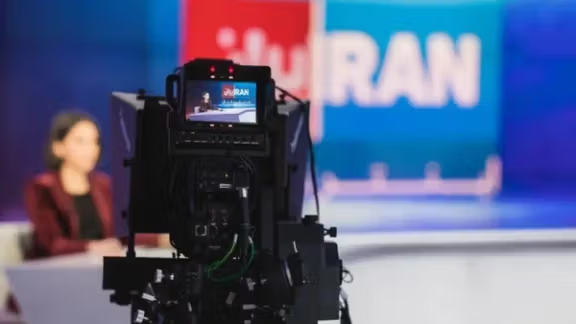
UN human rights experts on Thursday condemned what they called Iran’s intensifying campaign of repression against journalists working for Iran International and the intimidation of their families, particularly after the 12-day war with Israel.
“We are deeply concerned by credible threats to the lives and safety of 45 Iran International journalists and staff and 315 of their family members,” the experts said in a joint statement.
The statement comes after Iran International filed an urgent appeal earlier this month with the experts urging them to take action against Iran over serious risks to the lives and safety of their journalists worldwide and relatives inside Iran.
UN experts said several UK-based journalists have required police protection, with some forced to move into safe houses or relocate abroad.
"Reports suggest that journalists have been followed, had tracking tags attached to their cars, and their cars repeatedly broken into. Women journalists have faced threats of death and sexual violence on social media and instant messaging services, some receiving hundreds of messages a day."
The experts which included UN Special Rapporteur on the situation of human rights in Iran, Mai Sato, said the latest phase of repression had increasingly targeted family members in Iran, who have been interrogated, placed under surveillance, and threatened with arrest or death.
Interrogators allegedly demanded that relatives pressure journalists to quit Iran International or serve as informants, particularly concerning alleged ties to Israel, the statement said.
“This campaign is an attempt to silence and censor critical reporting and courageous public interest journalism by a fragile Government that appears afraid of legitimate criticism."
“Such intimidation violates both freedom of expression and media freedom and may have a chilling effect on other journalists. It also deprives the public of their right to information. Civic space in Iran is already severely limited, and transnational repression further impedes those seeking to expose human rights violations,” they added.
The UN experts urged Iran to “immediately stop threatening and intimidating journalists and their families” and to investigate all such threats, prosecute those responsible, including state officials, and prevent future violations.
Iran International is an independent Persian-language satellite TV news channel broadcasting live 24/7 from London and Washington DC.
The network started in 2017 and has become the most watched Persian-language TV channel within and outside Iran on both satellite and online platforms.
The United States imposed sanctions on 13 companies and eight vessels over suspected ties to Iran, the Treasury Department said on Thursday, in the latest effort to stop Tehran's oil exports in violation of US sanctions.
The designations target Greek national Antonios Margaritis and his network of companies, including Marant Shipping and Trading, Square Tanker Management, Comford Management and United Chartering, which Washington said had facilitated Iranian petroleum shipments for years.
“Today’s action against Margaritis and his network degrades Tehran’s ability to fund its advanced weapons programs, support terrorist groups, and threaten the safety of our troops and our allies,” Secretary of the Treasury Scott Bessent said in a statement.
"He (Antonios Margaritis) has most recently been involved in the operations of OFAC-sanctioned vessel MS ENOLA and MS ANGIA, which has carried Iranian oil," the Treasury said.
“Treasury remains determined to hold accountable all those who seek to aid the Iranian regime and threaten global security," he added.
The companies sanctioned on Thursday are based in Hong Kong, China, the United Arab Emirates and the Marshall Islands, according to the Treasury.
The Treasury accused Changbai Glory Shipping of moving more than four million barrels of Iranian oil to China on the LAFIT since March, Regal Liberty of delivering about two million barrels on the GIANT, and U Beacon Shipping of transporting over a million barrels on the ADELINE G.
It also accused Hong Kong Hangshun Shipping of shipping millions of barrels on the KONGM, and Ares Shipping of moving nearly ten million barrels on the ARES, often via ship-to-ship transfers with already sanctioned tankers.
UAE-based Ozarka Shipping was also sanctioned for managing vessels that transported Iranian petroleum products to China, while additional Hong Kong firms, including U Beacon Shipping, Hong Kong Hangshun Shipping and Ares Shipping, were sanctioned for their role in moving Iranian oil.
The Austrian Embassy in Iran has suspended all consular services citing an “insurmountable obstacle” but giving no further details or timeline for reopening.
According to the embassy’s official website, all consular services are suspended until further notice, which means that even previously submitted applications cannot be processed.
The announcement also said that existing appointments for residence and settlement services are canceled until the end of September, advising applicants to “book new appointments as soon as the situation has returned to normal.”
No further details were provided about what prompted the decision.
The Austrian foreign ministry told Iran International it was"working to re-establish the conditions which would allow us to resume consular services at the Embassy in Tehran."
However, it said "there is no concrete indication when consular services will resume."
Several embassies and consulates in Iran suspended services in June during the 12-day war with Israel.
The Czech Embassy suspended its services in June and has not yet resumed its operations, though it announced plans to gradually restart services in September.
The German Embassy, citing security concerns, relocated some consular staff to other countries in the region, but continues to provide services in Iran.
Embassies of Portugal, Switzerland, and the United Kingdom also suspended services in June but have since resumed full operations.
The closure of foreign embassies in Tehran during and after the 12-day war left between 3,000 and 4,000 Iranian passports stuck in diplomatic missions, stranding visa applicants, Iranian officials said earlier this month.
Omid Mohammad-Alikhan, a member of Iran’s Association of Travel Agencies, told state news agency IRNA that with some embassies halting tourist visa issuance, between 40,000 and 50,000 people remain in limbo.
The disruption has hit hardest those needing to travel on fixed dates, such as students who must arrive for the start of the academic year and athletes travelling to competitions or training camps.
Iran currently faces a deadline from France, Germany, and the United Kingdom to reach a deal with world powers on its disputed nuclear program by the end of August or face the return of UN sanctions through the so-called "snapback" mechanism.
Iran's foreign minister said on Wednesday that the UN sanctions could return, but that Tehran was working with Russia and China to prepare for such a scenario.
The Iranian rial slid further on Thursday, with the US dollar trading around 957,000 rials in Tehran’s free market, as markets braced for the possible reinstatement of UN sanctions through the so-called "snapback" mechanism.
Sterling reached 1,289,000 rials while the gold coin climbed to 860 million rials, reflecting safe-haven demand amid currency weakness.
The losses come ten days before the European powers' deadline to decide on triggering the mechanism that could reimpose UN sanctions on Iran. Washington has also vowed to halt Tehran’s oil exports to China as part of its maximum pressure campaign.
The snapback mechanism, part of UN Security Council Resolution 2231 that endorsed the 2015 nuclear deal between Tehran and world powers, allows any party to restore UN sanctions if Iran is accused of non-compliance.
France, the UK and Germany have warned Iran they will restore UN measures unless talks resume and produce results by the end of August.
Experts say the looming deadline is driving the rial's downfall. Iranian officials, however, have sought to play down the potential economic fallout of renewed sanctions.
Earlier this month, Foreign Minister Abbas Araghchi said that the consequences of the snapback mechanism had been “exaggerated” and made to appear more serious than they are.
Last week, Iran International reported that Iran’s Ministry of Intelligence has issued confidential guidance to ministries and major companies to prepare for the possible return of punitive UN measures.
The ministry warned of “severe currency fluctuations, reduced purchasing power, increased unemployment, layoffs and heightened social discontent” if sanctions return, and urged companies to seek alternative suppliers in countries including China, Russia and Iraq.
International Atomic Energy Agency (IAEA) officials will travel to Washington next week for consultations with the United States as concerns grow over their inability to account for Iran’s stockpile of near-bomb grade uranium, Bloomberg reported.
Citing diplomats familiar with the matter, the report said the move follows the failure of IAEA safeguards chief Massimo Aparo to secure Iranian approval earlier this month to resume monitoring after Israel and Iran’s 12-day conflict in June.
Inspectors were expelled during the fighting, effectively halting international oversight of Tehran’s nuclear program. A few days after the war ended, Iran’s parliament passed a bill suspending cooperation with the agency, including inspections.
Diplomats told Bloomberg that Iran has continued to deny access to its main nuclear-fuel complex, citing chemical and radiological hazards from US and Israeli strikes. Tehran has suggested limited access may be possible to unaffected facilities, including its Russian-built Bushehr nuclear power plant on the Persian Gulf.
Iran’s Foreign Minister Abbas Aragchi said in an interview published Wednesday by state media: “We have not reached the point of cutting off cooperation with the agency, but future cooperation will certainly not resemble the past.”
The IAEA has not verified Iran’s inventory of highly enriched uranium since June 13, when Tehran informed inspectors it was prepared to move 409 kilograms of material enriched up to 60% to an undisclosed location, Bloomberg said.
Iran has repeatedly denied seeking nuclear arms, and both IAEA inspectors and US intelligence agencies have said there is no evidence of a weapons program since the early 2000s.
The consultations in Washington come as European powers warn Tehran that failure to resume negotiations and allow inspections by the end of August could trigger the snapback of UN sanctions.
Iran has dismissed the threat and warned it could withdraw from the Nuclear Non-Proliferation Treaty if sanctions are restored.
According to Bloomberg, the IAEA is compiling a dossier highlighting inspector experience working in hazardous environments, citing precedents from Fukushima and Ukraine. But the agency faces budget strains, with member states questioning whether the $23 million earmarked for Iran monitoring should continue if inspections remain suspended.
Israeli Prime Minister Benjamin Netanyahu said that US President Donald Trump acted in a judicious way in ordering attacks on Iran’s nuclear facilities in June.
Speaking to the TRIGGERnometry podcast aired Wednesday evening, Netanyahu said: “President Trump has proven an exceptional, exceptional friend of Israel, an exceptional leader. And he did exactly the right action, the precise action using American power, and came in, I think, in a very forceful but judicious way."
Trump ordered strikes on three of Iran’s main nuclear sites, calling the program “obliterated,” but experts dispute that, saying bombs likely failed to penetrate underground halls, and with UN inspectors barred, the true damage is uncertain.
The long-time Israeli premier told the show that the war on Iran was a preemptive attack after years of threats to annihilate the Jewish state.
Israel launched surprise strikes on June 13 that killed senior Iranian commanders and nuclear scientists and damaged nuclear and air defense sites. Iran says 1,062 people were killed, including 786 military personnel and 276 civilians.
Netanyahu said, “I'll tell you the lessons we, the Jewish people, took from history. Number one is when somebody says they're going to annihilate you, take it seriously. Don't wait for them to do it, but prevent them, as we did in the remarkable action that we took against Iran, because they were developing nuclear weapons, and they were going to have 20,000 ballistic missiles, one tonne ballistic missiles... that would obliterate us."
Netanyahu said the October 7 attack was part of “the Iranian terror axis,” describing how Tehran built a network of proxies to annihilate Israel through a simultaneous assault: Hamas from the south, Hezbollah from the north, waves of ballistic missiles and rockets from Lebanon, Gaza, the Houthis in Yemen, Shiite militias in Iraq and Syria, and even Iran itself.
He added that Hamas’s October 7, 2023 attack on Israel came prematurely, disrupting Iran’s broader plan for a coordinated assault by all its regional allies.
“This was meant to be a simultaneous surprise attack that would hobble Israel and destroy it. I think what happened was that they [investigators] discovered that, basically Hamas fired too soon. They didn't coordinate," he added.