Tehran says US pushing for diplomacy after strikes fell short
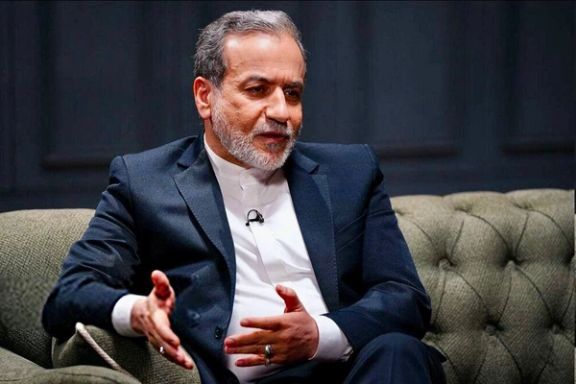
Iranian Foreign Minister Abbas Araghchi
Tehran on Wednesday accused Washington of seeking through diplomacy what it failed to achieve with military strikes, suggesting that talks with the United States have not yet reached a “mature stage.”
Foreign minister Abbas Araghchi said the US wants to ensure Iran’s nuclear activities are completely disabled, and is pressing Tehran to sign a binding agreement since that has not happened.
“One of our problems, both during previous negotiations and now, is that we have not heard a coherent statement from the Americans. Their statements constantly change, and the messages we receive are contradictory,” Araghchi said.
“Sometimes the messages differ from each other, and sometimes they differ from the interviews. I think perhaps the Americans have not yet reached a final conclusion and may be caught up in other issues,” he added.
Iran’s national security chief Ali Larijani said last week that talks with the US are possible, but only if aimed at a genuine resolution.
Negotiations under the Trump administration began with a 60-day ultimatum to Iran.
On the 61st day, June 13, Israel launched a surprise military campaign. Less than two weeks later, on June 24, the United States struck three major nuclear sites in Esfahan, Fordow, and Natanz, claiming Iran’s facilities had been “obliterated.”
Strained relations with watchdog
Araghchi said Tehran is also negotiating with the International Atomic Energy Agency (IAEA), stressing that unless Iran withdraws from the Non-Proliferation Treaty, cooperation will continue.
“We cannot completely cut off cooperation with the Agency,” he added. “In about a month, it’s time to replace the fuel at the Bushehr power plant, and this must be done in the presence of Agency inspectors.”
But that would not mean a return to pre-war arrangements, he stressed quickly.
“This new cooperation with the Agency will definitely not be like before, especially since, according to parliament’s law, all matters must go through the Supreme National Security Council, which decides where and how inspections will take place, or whether they will happen at all.”
“For several years, we’ve been working with China and Russia on this issue. We’ve held numerous joint meetings and designed a set of joint measures to implement if snapback is triggered,” he said.
The snapback mechanism, part of UN Security Council Resolution 2231 that endorsed the 2015 nuclear deal, allows any party to restore sanctions if Iran is accused of non-compliance.
France, the UK and Germany have warned Iran they will restore UN measures unless talks resume and produce results by the end of August.
“Regarding solutions to ultimately prevent snapback, discussions have taken place among our three countries, and we have some measures in mind, though we may not succeed,” Iran’s foreign minister said.
The G7 Non-Proliferation Directors Group on Wednesday called on Iran to avoid escalatory action and to cooperate with the UN nuclear watchdog.
“We urge Iran to refrain from any escalatory action and to urgently resume full cooperation with the IAEA (International Atomic Energy Agency), including by providing verifiable information about all nuclear material in Iran,” the group said in a statement.
The forum, which brings together senior officials from the United States, Canada, Britain, France, Germany, Italy, and Japan, stressed that Tehran must never obtain a nuclear weapon.
The G7 statement comes as Iranian Foreign Minister Abbas Araghchi said earlier in the day that Tehran is negotiating with the IAEA to establish a new framework for cooperation. He added that unless Iran withdraws from the Non-Proliferation Treaty (NPT), cooperation with the agency will continue.
“This new cooperation with the Agency will definitely not be like before, especially since, according to parliament’s law, all matters must go through the Supreme National Security Council, which decides where and how inspections will take place, or whether they will happen at all,” Araghchi said.
The G7 said that it is essential for Iran “to remain a party to the NPT” and fully implement its obligations under the treaty, including its “Comprehensive Safeguards Agreement as a non-nuclear weapon state.”
“We call for the resumption of negotiations aimed at achieving a comprehensive, verifiable, and durable agreement that addresses Iran’s nuclear program,” the statement added.
France, the United Kingdom and Germany told Iran they would restore UN sanctions unless it reopened talks on its nuclear program immediately and produced concrete results by the end of August.
Iranian diplomats last met representatives of the three countries in Istanbul on July 25.
The G7 also voiced concern over Iran’s missile activities and regional role. “We continue to express our serious concerns about Iran’s proliferation of ballistic missiles, and its support for its proxies and partners such as Hamas, Hezbollah, the Houthis, and Iran-aligned militias in Iraq,” the statement said.
Meanwhile, Iran’s defense minister announced on Wednesday that the country has developed a new generation of missiles with greater capabilities than those used in its recent 12-day conflict with Israel, and said they would be deployed in the event of further hostilities.
The extent of damage from recent US strikes on Iran’s Fordow centrifuges remains uncertain, The New York Times reported on Wednesday, with experts questioning President Donald Trump’s assertion that the site was completely obliterated.
US aircraft dropped two cascades of six GBU-57 “bunker buster” bombs on Fordow’s ventilation shafts on June 22.
A Defense Department official told the Times the bombs likely did not penetrate into the underground centrifuge chambers, and that the plan instead relied on shockwaves, pressure, and fire to disable equipment.
The report stressed that only the Pentagon—with access to classified data and advanced computer simulations—can assess the actual scale of destruction.
Experts offered three main scenarios, depending on the shafts’ design, the surrounding geology, and the reinforcement of the concrete.
If the shafts were built in a straight line, the bombs could have penetrated more deeply, transmitting destructive force downward. But if constructed in zig-zag formations, the underground halls may not lie directly beneath the shafts, shielding them from the blasts.
For the attack to fully succeed, shockwaves would have needed to reach depths of 260 to 360 feet underground.
Shafts, rocks, concrete
Geologists cited by the Times said academic studies suggest the presence of ignimbrite, a rock formation that could have absorbed much of the explosive energy. Another expert said volcanic tuff, if present, would have had a similar shock-absorbing effect.
The report also examined Iran’s use of construction materials, noting that if steel fibers were mixed into the concrete, they would have significantly strengthened the bunkers.
That could have reduced the effectiveness of the bombs, though experts agreed the ventilation shafts were natural weak points in Fordow’s design.
Trump vs. experts
Several experts doubted the strikes amounted to a “complete obliteration.”
One mechanical engineer said if the attack was based on precise geological surveys and ventilation mapping, the damage could still be significant. Another noted that if intense fires followed the blasts, Iran might be left with little recoverable equipment.
Trump, who ordered the operation, has continued to describe the attack in absolute terms.
An Iranian lawmaker warned that Tehran would resume war with Israel and withdraw from the nuclear Non-Proliferation Treaty (NPT) if European powers trigger the so-called “snapback” mechanism that would reinstate UN sanctions on Iran.
Fada-Hossein Maleki, a member of parliament’s National Security and Foreign Policy Committee, told Didban Iran that “if the Europeans want to activate the snapback mechanism, we will also continue the war with the Zionist regime.”
Maleki argued that such a step would destabilize global and regional equations. “Triggering this mechanism will entangle many players,” he warned.
He also accused Israel of undermining diplomacy by attacking Iran during ongoing nuclear negotiations, saying: “With that aggression, we practically saw the death of diplomacy.”
"Now, the activation of the snapback mechanism would once again mean abandoning diplomacy, and if the Europeans choose this path, this time we will put forward the tools of war and continue the 12-day conflict.”
He added, “The next war will not be one that ends in 12 days, or even one or two months. Dangerous events will inevitably unfold for all countries in the region.”
Iranian lawmaker Fada-Hossein Maleki
Maleki said Iran’s “first step” in response to a European move would be withdrawal from the NPT. “This issue has long been on the agenda of the commission and parliament,” he said.
Britain, France and Germany — the so-called E3 — have warned Iran that unless it returns to nuclear talks by the end of August, they will trigger the mechanism that could reimpose all UN sanctions lifted under the 2015 nuclear deal.
The lawmaker said Iran had now rebuilt its military readiness after the 12-day conflict and was “prepared for offensive operations in case of any new confrontation.”
Iranian President Masoud Pezeshkian said on Wednesday that US and European unilateralism was unbearable as he met Belarusian leader Alexander Lukashenko in Minsk, where the two allies signed 12 cooperation documents and a joint statement.
“Today America and some European countries are seeking to expand unilateralism and impose their views on other nations,” Pezeshkian said, according to Iran’s state news agency IRNA. “This approach has not been and will not be tolerable for you or for us.”
Pezeshkian, who arrived in Belarus on Tuesday night, said Tehran and Minsk enjoyed “broad common ground” not only in bilateral relations but also in regional and international forums, citing the Eurasian Economic Union, the Shanghai Cooperation Organization and BRICS as platforms for cooperation.
“Western countries led by America want to force us to move according to their will,” he said. “But Iran and Belarus believe they lack nothing compared with countries that impose sanctions, and that together they can overcome sanctions and difficulties.”
Lukashenko, a close ally of Russia, welcomed Pezeshkian and said: “Belarus is a friendly country and a reliable partner for Iran. You have come to a friend.” He assured his Iranian counterpart that Minsk wanted to expand cooperation and resolve obstacles to existing agreements.
Belarusian President Alexander Lukashenko and Iranian President Masoud Pezeshkian during a meeting in Minsk, Belarus, August 20, 2025
"In conditions of geopolitical turbulence, Minsk and Tehran are undertaking consistent and balanced steps to further develop cooperation, and are working hard to turn each new challenge into a new opportunity," Belarusian state news agency Belta quoted Lukashenko as saying.
"We are ready to discuss any issues, we have no closed topics," Lukashenko said, adding that the two countries could partner across a range of areas including "military-technical cooperation".
Recalling his own visit to Tehran, Lukashenko said: “I have very good memories from this trip, especially the meeting with the Supreme Leader of Iran. I ask you to convey my best wishes to him. I believe that there are no closed paths before us and we can elevate our relations to the highest levels.”
The two leaders witnessed the signing of 12 cooperation documents in areas including politics, international law, tourism, culture, media, health, pharmaceuticals, industry, environment, free zones, special economic zones and investment, as well as a joint statement.
Pezeshkian also laid a wreath at Minsk’s Victory Square memorial before beginning his official meetings. His trip to Belarus followed a state visit to Armenia earlier this week.
Iran’s state-affiliated Farhikhtegan newspaper warned on Wednesday that Tehran should prepare for “potential threats from its northern borders” following the US-brokered Armenia-Azerbaijan deal to develop the Zangezur corridor.
The daily compared the situation to Iran’s missile strike on a US base in Qatar during the June conflict, saying Tehran must make clear that “if threats arise from the soil of neighboring states, security considerations will prevail over diplomacy.”
The article comes after a US-brokered peace deal between Armenia and Azerbaijan earlier in August granted Washington leasing rights to develop the Zangezur transit corridor, now renamed the Trump Route for International Peace and Prosperity (TRIPP).
The deal allows a US company to build and manage the route connecting Azerbaijan with its exclave Nakhchivan, a project Tehran has repeatedly described as a geopolitical risk.