Iran questions Europe's right to reinstate UN sanctions ahead of fresh talks
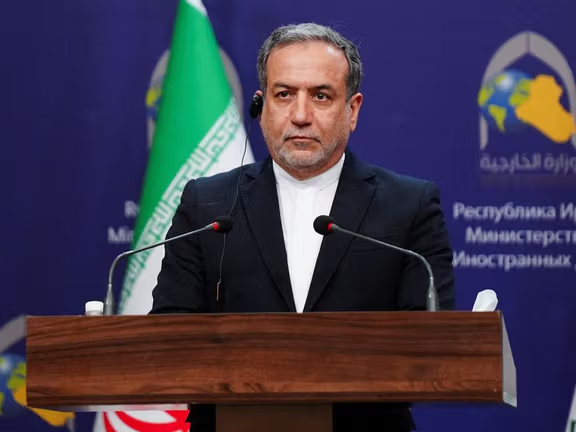
France, Germany, and Britain lack the authority to trigger a mechanism under the 2015 nuclear deal to reinstate UN sanctions on Tehran, Iran’s foreign minister said in a letter to the UN secretary general ahead of a fresh round of talks with the E3 slated for Friday.
“The E3 have relinquished their role as ‘Participants’ in the JCPOA, making any attempt to reinstate terminated UNSC resolutions null and void,” Abbas Araghchi said in a post on X on Sunday.
He said the three European countries "lack any legal, political, and moral standing to invoke the mechanisms of the JCPOA and UN Resolution 2231" after what he called their support for the Israeli-American war on Iran and their violation of their commitments under the deal and the resolution.
The remarks were part of a letter he wrote to UN Secretary-General António Guterres, EU foreign policy chief Kaja Kallas and the president of United Nations Security Council (UNSC).
New round of talks
Iran and the European troika will hold nuclear talks on Friday in Istanbul, Turkey, Iran's state TV announced on Sunday, citing the foreign ministry spokesman.
Deputy foreign ministers Kazem Gharibabadi and Majid Takht-Ravanchi will represent Iran in the nuclear talks with Britain, France and Germany, Esmaeil Baghaei said.
The talks are being held upon the E3's request, he added.
“We are in a strong position and are pursuing our rights more firmly than before,” the state broadcaster reported citing foreign minister Araghchi.
Tehran's diplomatic efforts come ahead of the E3's late August deadline to trigger the so-called "snapback" mechanism.
On Thursday, the E3 told Iran that they would restore the UN sanctions unless it reopened talks on its nuclear program immediately and produced concrete results by the end of August.
The snapback mechanism is part of UN Security Council Resolution 2231, which endorsed the 2015 Joint Comprehensive Plan of Action, or JCPOA. It allows any participant in the nuclear agreement -- the E3, Russia and China -- to reimpose sanctions if Iran is deemed non-compliant. If no resolution to maintain sanctions relief is passed within 30 days, all previous UN measures return automatically.
In a phone call with Araghchi on Thursday, EU foreign policy chief Kallas offered the extension of the snapback deadline under the nuclear deal, the Wall Street Journal reported citing sources, provided Iran resume cooperation with the International Atomic Energy Agency (IAEA) and place specific limits on its enriched uranium stockpile.
Germany’s foreign minister,. vowed to trigger the snapback mechanism if no deal is reached by the end of summer.
"We are firmly determined, firstly, to do everything possible to achieve a negotiated diplomatic solution (on Iran nuclear program), but secondly, we are equally determined, if that fails, to activate the snapback mechanism," Johann Wadephul said on Friday.
A senior advisor to Iran's Supreme Leader and the Russian president discussed the Middle East tensions and Tehran's atomic program in a meeting in Moscow, a Kremlin spokesperson said, as the two sides prepare for joint naval drills in the Caspian Sea.
Ali Larijani briefed Vladimir Putin on the Iranian officials’ assessments regarding the escalating crisis in the Middle East and developments related to Iran’s nuclear program, the Russian state news agency RIA said citing Kremlin spokesperson Dmitry Peskov.
Sky News reported on Sunday that Iran and the European troika are set to hold nuclear talks next Sunday in Geneva.
In his meeting with Larijani, Putin reaffirmed Russia’s support for a political resolution to concerns over Iran’s nuclear activities and also regional stability, according to Peskov.
Putin’s remarks came almost a month after the end of Israel’s 12-day military campaign against Iran, a conflict that sharpened Tehran’s concerns about future strikes and sparked widespread criticisms in Iran about Russia's alleged failure to support its ally.
Last month, the Russian president told Iran’s foreign minister in Moscow that Israel's "absolutely unprovoked aggression against Iran is unfounded and unjustified." However, Putin stopped short of directly calling out the United States or Israel for attacking Iran.
On June 19, the Russian president refused to speculate on the possibility of Israel or the US targeting Iran's Supreme Leader Ali Khamenei. "I do not wish even to discuss such a possibility," he told Reuters.
One day later, Kremlin spokesman Peskov told Sky News that Russia would react "very negatively" if Khamenei was killed. He also dismissed the idea of a regime change in Tehran, calling it "unimaginable".
"It should be unacceptable, even talking about that should be unacceptable for everyone," Peskov said, in a thinly veiled reference to Washington.
Iran-Russia naval drills
Iran and Russia will begin a joint naval exercise in the Caspian Sea on Monday, July 21, part of a three-day drill aimed at boosting maritime safety and regional cooperation, Iranian state media reported.
The CASAREX 2025 search-and-rescue exercise, hosted by Iran’s Navy, will include units from the Iranian Army and IRGC naval forces, Iran’s national police, and the Russian Navy, with observers from other Caspian littoral states.
Held under the slogan “Together for a Safe and Secure Caspian Sea,” the drill is designed to enhance coordination and operational readiness among coastal nations, IRGC media reported.
Iran’s Islamic Revolutionary Guard Corps has warned of the looming return of UN sanctions and called for psychological readiness among the public, as IRGC-linked Tasnim says Iran has reached an agreement in principle with Europe to resume nuclear talks.
In a bulletin published on Sunday, Sobhe Sadegh, the daily outlet of the IRGC’s political department, described the prospect of renewed UN sanctions as a multidimensional threat and said policymakers must focus on preparing the public and economic actors rather than relying on hopeful messaging.
“A change in the tone of policy—from absolute hope-building to psychological readiness—is essential,” the outlet said.
The comments come amid growing concern in Tehran that Britain, France, and Germany may move to trigger the snapback mechanism before the 2015 nuclear deal’s 10-year term expires in October.
Once activated, the mechanism would restore all UN sanctions on Iran without the possibility of veto from Russia or China.
Meanwhile, a source quoted by the IRGC-linked Tasnim News Agency said Iran has reached an agreement in principle with the three European countries to hold negotiations, though discussions are ongoing about time and location.
“There is agreement on holding the negotiations, but consultations on where and when are ongoing,” the source said.
However, Sky News reported on Sunday that Iran and the European troika are set to hold talks next Sunday in Geneva.
Officials warn of retaliation
On the other hand, lawmakers from Iran’s Parliament National Security and Foreign Policy Committee repeated Tehran’s position that any effort to revive UN sanctions would prompt a response.
“Europeans have no right to consider reactivating snapback sanctions when they themselves failed to meet their JCPOA obligations,” said committee member Vahid Ahmadi in an interview with Didban Iran.
“The Islamic Republic has prepared responses and will implement corresponding actions.”
Tehran's preconditions for nuclear talks
Ahmadi listed three conditions for Iran’s return to the negotiating table: condemnation of recent US and Israeli attacks on Iran, recognition of war-related damages, and guarantees against future aggression.
“If the West expects Iran to come back to the negotiating table, it must first recognize and rectify the aggression committed against us,” Ahmadi added. “There must be international condemnation, a clear assessment of the damages, and credible guarantees that our sovereignty won’t be violated again.”
MP says snapback is 'psychological ploy'
Committee member Esmail Kowsari dismissed the snapback threat as a “psychological ploy,” though Sobhe Sadegh warned that failure to manage expectations could intensify inflation and trigger capital flight.
The outlet proposed measures including new taxes and restrictions on foreign transactions.
“If the Westerners are acting in good faith, they must first condemn the aggressions and crimes of the United States and the Zionist regime, and only then speak of negotiations. We have not walked away from the negotiating table and have acted based on logic and the law. Even now, if they intend to make threats, the Iranian nation is prepared,” he added.
"If the enemies move toward using force," Kowsari warned, “they will undoubtedly face a firm and severe response. We will make important decisions and will not allow the security and authority of the Iranian nation to be undermined.”
Washington must maintain pressure to stop Iran from building nuclear weapons, two US senators told Iran International, expressing support for further sanctions and potential military action against the Islamic Republic.
“I support making sure the Iranian regime never becomes a nuclear power,” Senator Ron Johnson of Wisconsin said.
“It’s unfortunate they continue to pursue a nuclear weapons program. I don’t think they’ve ever stopped.”
Speaking separately on Capitol Hill, Senator Jim Risch of Idaho said, “Obviously, the program has been decimated. People say it’s just a setback, but substantial damage has been done — much more than has been publicly reported.”
He was referring to the impacts of US and Israeli attacks on Iranian nuclear infrastructure in recent months.
Risch, the chairman of the Senate Foreign Relations Committee, added that any renewed effort by Tehran to produce a bomb would provoke further action.
“If the regime tries to build a nuclear weapon, the same thing is going to happen again,” he said. “Prime Minister Netanyahu has said so. President Trump has said so. And they mean it.”
Both senators expressed confidence that continued Western pressure, especially from Israel and the United States, would keep Iran from crossing the nuclear threshold.
Asked about recent reports that President Donald Trump’s campaign raised millions in donations following an alleged Iranian-linked plot to assassinate him, Risch underlined a distinction between Iran’s rulers and its people.
“Anything the regime does, we don’t ascribe to the Iranian people,” he said. “We know they’re good people who want to be free.”
Senator Johnson also welcomed reports that France and Germany are now backing a snapback of UN sanctions against Iran.
The snapback, created under UN Security Council Resolution 2231, lets any party to the 2015 nuclear deal restore UN sanctions if Iran is found non-compliant. If no resolution is passed within 30 days to extend sanctions relief, all previous measures return automatically.
Israeli air strikes and drone attacks during the 12-day war killed hundreds of Iranians including civilians, military personnel and nuclear scientists. Iran's retaliatory missile strikes also killed 27 Israelis.
On June 22, the United States joined the war by striking Iran’s nuclear sites in Isfahan, Natanz, and Fordow using long-range bombers and submarine-launched missiles.
A US-brokered ceasefire was announced on June 24 between Iran and Israel after Tehran launched a retaliatory airstrike against a US airbase in Qatar.
Iran’s foreign minister said last month's attacks on its nuclear facilities proved that military pressure cannot stop its atomic program, warning that only diplomacy can prevent further conflict, in an interview broadcast Saturday.
Speaking on the sidelines of a Shanghai Cooperation Organization meeting, Abbas Araghchi said Iran remains open to a negotiated deal but only if the US “puts aside military ambitions” and compensates for past actions.
“There is no military option to deal with Iran’s nuclear program,” he told CGTN. “There should be only a diplomatic solution.”
He added that Iran is ready to re-engage in talks, but only “when they put aside their military ambitions.”
No clear path back to negotiations
Iranian officials say any future negotiations will require what they describe as fair and balanced terms. Araghchi reiterated that Tehran is willing to share evidence of the peaceful nature of its nuclear program but warned that “real intention” is needed from the other side.
“There should also be a real intention for a win-win solution,” he said. “Our nuclear program is for peaceful purposes, and we are 100% confident in that.”
“We have no problem to share this confidence with anybody else,” he added. “That can happen only through negotiation.”
The comments follow a warning by European powers that UN sanctions could return if Iran does not rejoin negotiations by late August. Tehran has rejected those calls, insisting Washington was the first to walk away from the 2015 nuclear deal and escalate with military action this year.
Iran’s position has hardened in recent weeks, with officials demanding firm guarantees before any new round of talks. Araghchi reiterated that Iran was committed to the original deal and blamed the current crisis on the US withdrawal.
“Everything we saw today is the result of that withdrawal,” he said, referring to the Trump administration’s 2018 exit from the nuclear agreement. “We remain committed to that [deal],” he said, recalling that the original accord was once “celebrated… as an achievement of diplomacy.”
Iran calls Israel ceasefire fragile
Asked about last month's war with Israel, Araghchi said the ceasefire that ended the fighting remains fragile. He added Iran is prepared to respond if it collapses, though it is not seeking further confrontation.
“We didn’t want this war,” he said. “But we were prepared for that.”
Diplomatic prospects between Iran and the West appear increasingly bleak, with Tehran’s political class voicing growing skepticism that a negotiated breakthrough is still possible.
“The hostile posture of the three European powers and the cautious approach of China and Russia—Iran’s tactical partners—have made a return to diplomacy increasingly unlikely,” wrote Etemad columnist Noushin Mahjoub in her July 17 column.
Mahjoub dismissed Beijing’s role as a potential mediator, arguing that Tehran’s own actions—halting cooperation with the IAEA and clinging to hardline red lines—have left diplomacy with “few prospects.”
Former parliamentary foreign relations chief Heshmatollah Falahatpisheh echoed that view.
“The activation of the trigger mechanism means an end to diplomatic relations between Iran and Europe,” he told the moderate daily Etemad. “And countries like China and Russia, facing their own tensions with the US, cannot be effective mediators.”
He pointed to their passivity during the recent 12-day war with Israel and proposed Oman or Qatar as more realistic options—if Iran recommits to the Non-Proliferation Treaty (NPT).
Searching for way out
But with US officials insisting that only direct engagement is acceptable, the question of mediation may already be obsolete.
Iran’s path out of the current crisis likely hinges not on finding the right go-between, but on its own willingness to fundamentally shift course.
Political analyst Hassan Beheshtipour offered a possible framework, arguing that Tehran needs to embrace a strategy that balances deterrence, confidence-building and responsiveness to major powers.
“Iran’s situation has grown more precarious following accusations by three European states that it undermined nuclear safeguards,” he wrote in the moderate daily Arman Melli, calling for a phased “suspension-for-suspension” model.
“Iran would pause enrichment for one year, while the other side progressively lifts sanctions and releases frozen assets. Afterward, Iran would cap enrichment at 67.3%, while retaining technical capability for higher levels,” Beheshtipour proposed.
Iran remains the only non-nuclear state enriching uranium to 60%—a level close to weapons-grade. But Washington appears adamant that no enrichment is acceptable inside Iran.
Window closing
Tehran is left at a familiar but increasingly perilous crossroads.
The Islamic Republic must either relinquish its revolutionary doctrine to avoid punishing sanctions—or brace for deeper isolation that even China and Russia won’t be able to counterbalance.
Abandoning its ideological identity would transform the ruling system beyond recognition. But choosing resistance without compromise would come at a steep cost: greater hardship for ordinary Iranians and a further erosion of state legitimacy.
Tehran’s long-favored third option—stalling, hedging and tactical ambiguity—may no longer be sustainable. The economy may be too fragile, global patience too thin.
Leader’s defiance
President Pezeshkian’s proposed workaround—reviving barter trade with select neighbors—offers little in the way of real relief. It is a dated, impractical system unlikely to serve any party’s long-term interests.
Yet Supreme Leader Ali Khamenei shows no sign of blinking. This week, he reiterated that Iran is prepared for military and diplomatic action but provided no endorsement of diplomacy with adversaries.
Mistrust runs deep, and Khamenei loyalists miss no opportunity to amplify it.
“Decades of experience and US arrogance, aided by its lackey Israel, show that they want to bring misery upon us and erase our glorious history,” former vice president and hardliner Masoud Zaribafan told Khabar Online.