Iran takes over failing bank as sector struggles with economic headwinds
A branch of the Ayandeh Bank in Tehran in this 2022 file photo.
Iran’s Central Bank revoked Ayandeh Bank’s operating license on Thursday, dissolving one of the country’s largest lenders due to massive losses and chronic inefficiency in another sign of gathering economic storm clouds as sanctions bite.
“Despite all the efforts made, this bank could not be placed on the path of reforms as desired by the central bank,” official media cited Central Bank Governor Mohammadreza Farzin as saying.
Farzin said that the bank had 5.5 quadrillion rials ($5.1 billion) in accumulated losses, 3.13 quadrillion rials ($2.9 billion) in overdrafts, and a negative 600 percent capital adequacy ratio.
Iran’s economy minister said all customer deposits will be transferred to state-owned Bank Melli Iran, with branches rebranded and funds accessible from October 25.
“Serious measures for banks that did not comply with regulations were necessary, but in the past, legal shortcomings prevented decisive action,” Ali Madanizadeh said.
Madanizadeh said the accumulated losses of Ayandeh Bank would be covered by the bank’s main shareholders, without providing further details.
The collapse underscores Iran’s deepening banking crisis, worsened by sanctions and mismanagement. Earlier this year, the Central Bank warned that eight other banks risk dissolution without reforms.
The Central Bank of Iran has not publicly disclosed the names of the eight banks at risk of dissolution due to financial instability.
Ayandeh Bank was established in 2013 following the merger of several smaller financial institutions, most notably Tat Bank, Saman Bank’s credit institutions, and Ansar Financial and Credit Institute.
Iran’s banking system has been one of the hardest-hit sectors under decades of United States and international sanctions, which have crippled access to global finance, cut off dollar transactions, and eroded confidence in the rial.
Iran’s foreign minister said on Thursday that his ministry aims to soften and counter the effects of UN sanctions reinstated on Iran last month which are expected to deepen economic pain.
“Of course, this does not mean that we will abandon our mission to have the sanctions lifted," Abbas Araghchi told a seminar in the northeastern city of Mashhad on Thursday.
"Rather, alongside that mission, we are pursuing the neutralization and counteraction of sanctions and the fulfillment of the country’s needs — responsibilities that rest with both the government as a whole and the Foreign Ministry.”
The United Nations Security Council reimposed international sanctions on Iran on last month after European powers triggered the “snapback” mechanism under Resolution 2231.
The decision effectively restored all UN sanctions lifted under a 2015 nuclear deal and is expected to deepen Iran’s economic isolation.
“One can only complain about sanctions when all domestic capacities have been fully utilized,” Araghchi added, suggesting that internal failings bear some blame for Iran’s economic doldrums.
Defiant in crisis
President Masoud Pezeshkian on Thursday acknowledged the country’s dire situation, saying: “Japan, South Korea and Turkey have no oil, yet they are better off than Iran. We have oil and gas, and we are hungry.”
Economists have warned that renewed sanctions will likely worsen inflation, accelerate the currency’s decline, and aggravate shortages of essential goods.
Despite growing pressure, Tehran has maintained a defiant tone since the June war with Israel.
On Wednesday, Araghchi said Iran would not return to talks with the United States unless Washington abandons what he called “unreasonable and excessive demands.”
Five rounds of indirect talks, he added, had taken place before US and Israeli strikes on June and that follow-up discussions at the UN General Assembly also collapsed for the same reason.
Iran’s defense minister on Thursday told a senior visiting military-industrial official from Belarus that Tehran seeks to deepen military cooperation with Minsk as both countries grapple with deep Western sanctions.
“Iran welcomes the expansion of defense and industrial cooperation with friendly and independent countries, and Belarus holds a special place in this partnership,” Defense Minister Aziz Nasirzadeh told Belarus’s chairman of the State Authority for Military-Industrial Cooperation in a visit to Tehran, according to state media.
Iran and Belarus have both turned to Russia for economic and defense support amid harsh sanctions imposed by the United States and Europe, but advanced air defense systems provided by Moscow were likely destroyed in Israeli attacks last year.
Dmitry Pantus, head of the Belarus State Authority for Military-Industrial Cooperation meets with Iranian Minister of Defense Brigadier General Aziz Nasirzadeh in Tehran on Oct. 23, 2025.
Tehran has supplied Moscow with drones and ammunition for its invasion of Ukraine, while Minsk has hosted Russian troops and allowed its territory to be used as a launchpad for attacks.
Both governments see closer coordination with Russia as a counterweight to Western pressure.
Minsk and Moscow have been joined in a supranational Union State since 1999.
US sanctions on Belarus include prohibitions on transactions with key government entities such as the Ministry of Finance of the Republic of Belarus and the Development Bank of the Republic of Belarus, as well as restrictions on exports and re-exports.
Facing sanctions
Iran remains under broad US sanctions targeting its energy, financial and military sectors over its nuclear activities and arms transfers to Russia.
Following a 12-day war with Israel in June and the return of UN sanctions last month, Iran is seeking to rebuild its economy and strengthen its military readiness.
Western countries have called for Tehran to engage in renewed diplomacy with Washington and restored access to international nuclear inspectors.
Russian Foreign Minister Sergey Lavrov said last week that Russia would help Iran meet its military needs even after European-triggered international sanctions further restricted trade with Tehran.
Iran denies seeking nuclear weapons, decried the attacks in June as illegal and say US demands that Tehran rein in its defense capabilities are unacceptable.
US President Donald Trump said US attacks in June on three nuclear sites had left Tehran weakened to the point that it is no longer respected, adding in an interview with TIME magazine that his actions knocked out a "big bully" in the region.
“(Iran) was a very big, strong bully. And they used that power very strongly across the Middle East, and they really controlled it. But they don't control it anymore. They're not respected anymore at all,” Trump said in the interview conducted on October 15 and published on Thursday.
Trump said US airstrikes in June “bombed the hell out of” Iran’s nuclear facilities and “knocked out their nuclear potential,” leaving Tehran “fighting for survival."
The return last month of UN sanctions triggered by European powers has further strained Iran's economy after a punishing 12-day war with Israel and the United States.
Trump added that sanctions had left Iran “very weak,” citing the killing of senior Iranian military commanders, including Qassem Soleimani in a US drone strike in 2019, as key to curbing Tehran’s power.
Talks with Tehran over its disputed nuclear program began earlier this year with a 60-day ultimatum. On the 61st day, June 13, Israel launched a surprise military campaign which was capped with US strikes on June 22 targeting key nuclear sites in Esfahan, Natanz and Fordow.
“By doing it, we were able to—you see, if Iran was sitting there, powerful and a bully, it would have been impossible to make a deal like this, because you would have had this looming threat over the region. Now it’s not a looming threat,” Trump said, referring to a Gaza ceasefire he clinched this month.
Iran denies seeking nuclear weapons and has called the attacks illegal.
The US President told the Israeli Knesset last week that it would be ideal if Tehran could be folded into a broader Middle East peace deal. Still, he has often mooted bombing Iran again if it seeks to rebuild its nuclear program.
Iranian Supreme Leader Ali Khamenei appeared to rule out any renewed talks with Tehran in a rare speech on Monday. He denied the attacks had destroyed the nuclear program, telling Trump, to "keep dreaming".
Bush invasion, Obama deal
Trump criticized previous administrations for their Middle East policies, saying the so-called War on Terror disrupted the balance between Iran and Iraq.
“The problem was when Bush went in and blew up Iraq, he destabilized the region, because when we blew up one of the two powers, all of a sudden you had one bully," Trump said, referring to Iraq and Iran. "See, they weren’t bullies when they were fighting each other. But when one fell, Iran became a serious bully.”
Trump called the 2015 nuclear deal with Iran under the Obama administration another grave mistake, arguing it failed to stop nuclear proliferation.
“Under the Iran nuclear deal, they would have had a massive nuclear weapon by now. You know, it expired a long time ago. I canceled it, but I said it was ready to expire anyway. They had a clear road to a nuclear weapon—unchallenged,” Trump said.
Iran said its nuclear program was peaceful and that repeated US accusations were aimed at justifying aggression.
On paper, Iran’s law still mandates the compulsory hijab. But the streets tell a more complicated truth.
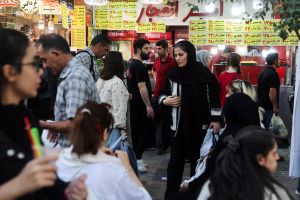
In Tehran, many women now walk unveiled. At airport checkpoints, they pass bareheaded—and officers look away. Yet that fragile tolerance evaporates beyond the capital.
In Isfahan, women receive automated text messages accusing them of “improper veiling,” detected by license-plate cameras. In Qom and Mashhad, inspectors visit offices to “remind” employees of the rules.
Inside the state, there is no agreement on how to confront defiance.
President Masoud Pezeshkian concedes that “coercion doesn’t work.” Parliament hard-liners demand new crackdowns. Friday-prayer leaders thunder about moral decay. The country’s morality directorate boasts of “eighty thousand trained field operatives.”
The people, however, have made their choice.
Across Iran’s cities, millions of women walk unveiled—not in protest marches, but in daily, deliberate normalcy. Their quiet defiance has become an act of collective civil resistance, echoing Rosa Parks’s refusal to give up her seat in Montgomery: simple, silent and transformative.
In doing so, Iranian women have written a new, unwritten law.
From street vans to soft surveillance
The morality police of the 2000s were visible, violent and crude. The new version is quieter but no less insidious.
The loud green vans are gone, as are the street scuffles and viral videos of women being dragged away. In their place stands a bureaucratic apparatus: text warnings, sealed storefronts, administrative summonses and digital dossiers.
Three years after the death of Mahsa Amini, the state has returned to where it began—only this time, it wears a digital mask. The danger is deeper because it is diffuse.
But society has moved on. The question is no longer just about the veil; it is about the freedom to choose one’s own life.
The morality police are no longer merely an institution; they are a symbol of a larger confrontation—the logic of control versus the logic of choice.
One seeks to recreate a past that no longer exists. The other insists on claiming a future that has already begun.
In that struggle, victory will not belong to those with the greater machinery of repression, but to those who still possess the will to live free.
Iranian President Masoud Pezeshkian said on Thursday there is no doubt that gasoline prices must rise, signaling that long-anticipated fuel reforms are moving closer despite fears of renewed public unrest.
Speaking during a visit to West Azarbaijan province, Pezeshkian acknowledged that raising fuel prices is unavoidable to address Iran’s worsening energy shortages but cautioned that any decision would require “careful planning” to avoid deepening economic hardship.
“There is no question that gasoline must become more expensive,” he said, according to state media. “But it is not a simple decision. We cannot act overnight or create more difficulties for people.”
His comments came amid intensifying debate over Tehran’s plans to introduce a new pricing system aimed at curbing soaring fuel consumption and smuggling.
Over the past two weeks, Iranian media have reported that the government is reviewing several reform scenarios, including multiple pricing tiers and possible changes to fuel quotas.
Last week, Khaneh Eghtesad published what it said was a leaked cabinet decree outlining a roadmap for “gradual correction” of gasoline prices. The government initially denied the report but later confirmed that the issue was under study by cabinet working groups.
Cabinet secretary Kamal Taghavi-Nejad said this week that fuel reform had been discussed but “no final decision” had been taken. A lawmaker, Amirhossein Sabeti, said the debate over introducing three fuel price tiers had become serious in parliament.
Energy officials say domestic gasoline consumption has surged well beyond refining capacity, forcing costly imports and draining subsidies that analysts estimate at more than $30 billion annually.
Pezeshkian has pledged to overhaul Iran’s energy subsidy system, arguing that maintaining the current artificially low prices is unsustainable. “Even water costs more than gasoline in Iran,” he said earlier this week.
The last major fuel price hike in November 2019 sparked nationwide protests that were met with a violent crackdown. Rights groups and Reuters reported that at least 1,500 people were killed.
Officials have since stressed that any future reform would be gradual and paired with compensation measures for low-income households. The administration insists it will not repeat the sudden price shock of 2019.
Economists warn that aligning prices with real production costs could sharply raise inflation but may also help reduce smuggling and waste. The government is expected to unveil its energy reform framework before submitting next year’s budget in December.