Iran, Russia, China question IAEA’s mandate after end of UN resolution
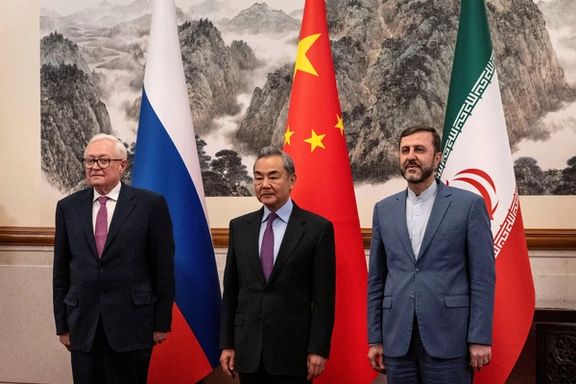
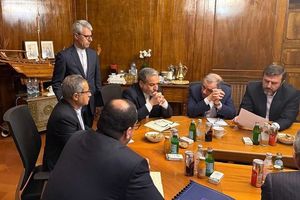
Russian Deputy Foreign Minister Sergei Ryabkov, Chinese Foreign Minister Wang Yi and Iranian Deputy Foreign Minister Kazem Gharibabadi pose for a photo as they meet on March 14, 2025 in Beijing, China.
Iran, Russia and China have told the International Atomic Energy Agency that its monitoring and reporting linked to the 2015 nuclear deal should end following the expiry of the UN resolution that endorsed it, Iranian media said on Friday.
Kazem Gharibabadi, Iran’s deputy foreign minister, said the three countries sent a joint letter to IAEA Director General Rafael Grossi arguing that Resolution 2231, which endorsed the 2015 Joint Comprehensive Plan of Action (JCPOA), formally expired on Oct. 18.
He said the letter followed a previous joint message the countries had sent to the UN secretary-general and the president of the Security Council, declaring the resolution terminated. “All provisions of Resolution 2231 have now lapsed, and attempts by European countries to reactivate sanctions through the so-called snapback mechanism are illegal and without effect,” Gharibabadi said, according to state media.
In their letter, the ambassadors of Iran, Russia and China wrote: “With this termination, the reporting mandate of the Director General of the IAEA concerning verification and monitoring under Security Council Resolution 2231 has come to an end.” The letter added that the IAEA Board of Governors’ decision of Dec. 15, 2015, which authorized verification and monitoring for up to 10 years or until the agency issued a broader conclusion on Iran’s nuclear program, whichever came first, “remains valid and constitutes the sole guidance which the IAEA Secretariat is obliged to follow.”
According to the three governments, “as of 18 October 2025, this matter will be automatically removed from the Board of Governors’ agenda, and no further action will be required in this context.”
Iran, Russia and China have maintained that the resolution’s expiry removes Iran’s nuclear file from the Security Council’s agenda and ends the IAEA’s mandate tied to it.
Grossi urges diplomacy, notes Iran stays in NPT
IAEA chief Rafael Grossi said earlier this week that diplomacy must prevail to avoid renewed conflict and noted that Iran had not withdrawn from the Nuclear Non-Proliferation Treaty despite tensions. He said continued cooperation between Iran and the agency was vital to prevent escalation.
Grossi told Le Temps newspaper on Wednesday that Iran holds enough uranium to build ten nuclear weapons if it enriched further, though there is no evidence it seeks to do so. He said Israeli and US airstrikes in June had caused “severe” damage to Iran’s nuclear facilities in Isfahan, Natanz and Fordow, but that the country’s technical know-how “has not vanished.”
Tehran and the IAEA have yet to agree on a framework to resume full inspections at the bombed sites. Grossi said Tehran was allowing inspectors access “in dribs and drabs” for security reasons, adding that efforts were continuing to rebuild trust and restore routine monitoring.
Iran is isolated and under pressure but its robust counterattacks in a 12-day war with Israel may embolden it to fight another more deadly conflict, author and former Israeli ambassador to Washington Michael Oren told Eye for Iran.
“The Middle East is at an inflection point,” Oren said. “Iran feels cornered, and that’s when nations become most dangerous.”
Oren said Tehran does not believe it was defeated in the last conflict and may now see little to lose by reigniting hostilities.
“Toward the end of the war, the percentage of interceptions went down,” he recalled. “The Shahab rockets didn’t take down a room; they took down a neighborhood. I don’t know how many nights we could have gone on.”
He said Iran’s ability to adapt under fire—learning Israel’s missile defense systems in real time—was one reason Israel accepted a ceasefire sooner than expected.
“They were learning how to get through our umbrella,” Oren said. “They were causing us some very severe damage.”
Redefining the Middle East
The former envoy said the aftermath of the conflict has already begun reshaping the region. The Six-Day War of 1967 saw Israel capture vast territory and redraw the Middle East map. Oren, who has written extensively about that war, said the current transformation could be even more consequential.
“The Middle East has been transformed in ways more far-reaching than even the changes after the Six-Day War,” he said.
Oren pointed to Iran’s growing isolation and new alignments forming around Israel. He said some governments that publicly criticized Israel during the fighting are now quietly engaging with it, drawn by shared concerns about Tehran’s role in the region.
“Peace in the Middle East is made through strength,” he said. “Soft power alone has never worked.”
Iran's nuclear file and new fault lines
Oren’s comments come amid renewed tension over Iran’s nuclear program. Tehran, backed by Moscow and Beijing, has informed the International Atomic Energy Agency (IAEA) that European efforts to reimpose sanctions are illegitimate, arguing that UN Resolution 2231 has expired.
In Jerusalem earlier this week, US Vice President JD Vance said Washington will continue to pursue diplomacy to ensure Iran does not obtain a nuclear weapon.
“President Trump actually wants Iran to be prosperous,” Vance said, “but they cannot have a nuclear weapon.”
According to the IAEA, Iran holds about 400 kilograms of uranium enriched to 60 percent—enough for roughly ten bombs if refined further—but there is no evidence Tehran intends to build one. Agency chief Rafael Grossi has warned, however, that if diplomacy fails, “a renewed resort to force cannot be ruled out.”
Inside Iran, Friday sermons reflected a defiant tone. Senior clerics denounced Washington and praised what they called the country’s resilience. Ahmad Khatami vowed to “break the horn of this wild bull,” while Mohammad Saeedi in Qom thanked Supreme Leader Ali Khamenei for “crushing the arrogance of the US president.”
Despite speculation that Israel’s prime minister might pursue another strike, Oren said Israel understands the risks. He noted that the previous conflict could have been far more costly and that few in Israel want to test those limits again.
“Iran is isolated,” he said. “And it may feel that it has nothing to lose by triggering a second round.”
Still, Oren said he remains cautiously optimistic that the region could ultimately move toward a new equilibrium.
“If cards are played right,” he said, “the Middle East could look unrecognizable in two years.”
You can watch the full episode of Eye for Iran on YouTube or listen on any podcast platform of your choosing.
A court in the Iranian holy city of Qom sentenced a 26-year-old man to rewrite a religious book by hand as punishment for wearing shorts while skateboarding.
His father, a practicing attorney, said that officers had handcuffed his son and transferred him to the local police station, where he was held overnight, legal advocacy website Dadban reported on Thursday without providing their names.
The young man was released on bail during a preliminary investigation but a judge on Friday sentenced him to write out the whole text of the religious book “Thirty Minutes in the Afterlife” as part of his sentence.
The book is reportedly used to illustrate Islamic concepts of the afterlife, divine judgment and personal accountability, often drawing from Shi'ite religious teachings and narratives about the Day of Judgment.
“Wearing shorts is not a crime and cannot be considered as provoking public sentiment,” the father said. “I have filed a complaint against the police station and the prosecutor for their unlawful behavior.”
“Iranian law contains no provision criminalizing the wearing of shorts by men. The act also does not fall under articles of the Islamic Penal Code, which addresses public acts of immorality, and therefore cannot be legally classified as a crime,” Dadban reported.
Iran enforces Islamic dress codes primarily through mandatory hijab regulations for women and girls, while men are also expected to observe modesty standards, such as avoiding shorts and keeping their shoulders and knees covered — although there is no written law prescribing specific clothing rules for men.
Iran's Supreme Court has upheld the death sentence of Manouchehr Fallah, a 42-year-old laborer from northern Iran who now faces imminent execution for allegedly detonating a small sound bomb outside a local courthouse.
The explosion caused minor damage estimated at 150 million Iranian rials or about $138 to a metal door and the building's stone facade. No injuries were reported, and public services were not disrupted.
Fallah, currently held in Lakan Prison in the town of Rasht in Gilan province where the incident occurred, was sentenced to death in February by an Islamic revolutionary court. Earlier this week, Iran's Supreme Court rejected his lawyer's appeal.
His lawyer, Milad Panahipour, has condemned the ruling as a "clear violation of proportional justice," arguing that the punishment far exceeds the severity of the alleged offense.
"The court relied on an article in the penal code which penalizes damage to vital public infrastructure. The judiciary building was not classified as a vital facility, and the explosion occurred at midnight when no one was present. This was a small sound firecracker, not a weapon of war," Panahipour said.
'War against God' charge
Fallah was arrested at Rasht Airport in July 2023 and initially sentenced to 15 months in prison of insulting Supreme Leader Ali Khamenei and propaganda against the Islamic Republic.
Despite completing that sentence, authorities filed a new case against him with charges of "moharebeh" or war against God, a charge that carries the death penalty.
Reza Akvanian, a human rights activist based in Brussels, criticized the legal basis of the ruling, saying that even under the Islamic Republic's own laws, the charge of moharebeh is unjustified.
"The law clearly defines a mohareb as someone who takes up arms, which Fallah did not do," Akvanian said. "The court's claim that this act qualifies as moharebeh is unprecedented even within Iran's judicial system."
He said that Fallah has denied all charges against him, asserting his innocence.
"These days, they’re once again looking for necks to fit their nooses," US-based activist Masih Alinejad wrote on her Instagram, referring to Fallah's case.
"There’s no proportion between the act and the punishment, but these people see killing a prisoner as a show of power," Alinejad said.
Forced confessions
Throughout the legal proceedings, Fallah was denied access to a lawyer and subjected to coercive interrogation tactics, including threats against family members.
Sources familiar with the cased told Iran International that Fallah had no access to legal counsel during his 18 months in detention. His death sentence was delivered via video conference, raising further concerns about the fairness of the judicial process.
Religious scholars in Qom, the sources added, have been urged to intervene and help overturn the sentence.
While Fallah's case has not yet been highlighted by major international human rights organizations, it reflects broader patterns documented in Iran's judicial system.
According to Iran Human Rights and other advocacy groups, more than 70 political prisoners currently face confirmed or pending death sentences, while over 100 others are at risk of receiving similar verdicts.
The Iran Human Rights Society called October “the bloodiest month for prisoners since the mass executions of 1988.” The deaths, it said, mostly linked to drug offenses or murder, included several Afghan nationals and were sometimes carried out without notifying families or allowing final visits.
Amnesty International on October 16 also urged an immediate halt to executions, saying more than 1,000 had been recorded so far in 2025, many following unfair trials aimed at silencing dissent and persecuting minorities.
Senior Iranian clerics denounced US President Donald Trump in Friday prayer sermons, accusing the United States of aggression and deceit as Tehran’s tone toward Washington hardens following a defiant speech by Supreme Leader Ali Khamenei.
Friday prayer leaders are state appointees in Iran's theocracy, and their political speeches reflect the official stance of the ruling clerical establishment.
Ahmad Khatami, the Friday prayer leader in Tehran, said Iran would never yield to what he called US coercion. “Trump says he wants to deal with Iran, but a deal made with force is surrender,” Khatami said during his sermon, according to state media.
He said Iran would “break the horn of this wild bull” through faith and endurance, using the phrase to describe what he called Washington’s policy of pressure.
Referring to the US withdrawal from a 2015 nuclear deal, he said Washington “tore up the agreement in front of the world” and “cannot be trusted for any negotiation.”
In Qom, Mohammad Saeedi praised Supreme Leader Ali Khamenei’s recent response to Trump’s remarks about Iran’s nuclear program, saying it “crushed the arrogance of the US president.” Saeedi said the reply showed that Iran would not let “foreigners decide its needs,” according to Mehr news agency.
Khamenei, speaking in Tehran on Monday, had dismissed Trump’s assertion that US air strikes destroyed Iran’s nuclear program.
“The US president proudly says they bombed and destroyed Iran’s nuclear industry. Very well, keep dreaming,” he said. Khamenei added that Washington had no authority over Iran’s nuclear work and accused the United States of backing Israel’s war in Gaza.
“Trump tries to look powerful, but his words only reveal weakness,” Saeedi said. “The world saw that our leader’s wisdom silenced his noise.”
In Ahvaz, Mohammadnabi Mousavi-Fard said the Persian Gulf would turn into “a hell for global arrogance” if the US or its allies threatened Iran. He said Iran’s strength came from its faith and self-reliance.
“Every dollar of non-oil exports builds our national power,” he said, urging officials to focus on production and technology to counter sanctions.
The clerics’ remarks followed comments by national security chief Ali Larijani, who on Thursday likened Trump to Adolf Hitler and mocked his behavior at a US-led Gaza ceasefire summit in Egypt.
Larijani said Trump “spoke only by himself,” showed “disrespect to other leaders,” and turned the event into a “Trump show.”
Iran’s dam reserves have dropped by nearly a quarter from last year, official figures showed on Friday, as rainfall across much of the country fell close to zero and drought reshaped rural areas in the central province of Isfahan.
Water inflow to dams stood at about 780 million cubic meters as of Oct. 18, a 39% decline from the 1.29 billion cubic meters recorded a year earlier, according to data reported by ILNA news agency. Despite a 29% cut in water discharge to conserve supplies, total storage in the country’s reservoirs fell to 17.7 billion cubic meters from 23.3 billion, leaving national reserves around one-third full.
Twenty-two major dams are in critical condition, holding less than 15% of their designed capacity, wrote ILNA. In Tehran province, the five dams supplying the capital’s drinking and agricultural water are among the hardest hit. Amir Kabir Dam is at 11% capacity, an 80% drop from last year, while Lar Dam has fallen to just 2%, and Latyan, Mamlu and Taleghan dams each recorded declines of more than a third.
Reservoirs in other key provinces, Khuzestan in the southwest, Fars and Kerman in the south, and East and West Azarbaijan in the northwest, have registered deficits ranging from 20% to 70%, while some dams in Golestan province in the north, including Voshmgir and Bustan, have run completely dry, the report said.
Average rainfall since late September has been just 1.9 millimeters, far below the long-term average of 56 millimeters, and no measurable rain has been recorded in 21 provinces, including Tehran, Isfahan, Khuzestan, Kerman, and Kurdistan. Officials have warned of growing risks to both drinking water and crop irrigation in the coming months.
Drought altering rural life in Isfahan
In the central province of Isfahan, the water crisis has gone beyond agriculture to reshape entire communities. “Water scarcity has had deep effects on land subsidence, migration, and the changing character of rural areas,” said Gholamreza Goudarzi, head of Iran’s Statistical Center, in remarks published on Friday.
Experts warn that without immediate conservation measures, technological upgrades in irrigation, and coordinated drought management, Iran faces escalating water shortages that could endanger both rural livelihoods and urban supply in the months ahead.