Iran economist warns inflation could top 60% as poverty deepens
A senior Iranian economist warned on Saturday that annual inflation could exceed 60% by the end of the year (March 2026), as the government struggles to contain soaring prices and widening poverty amid renewed sanctions and fiscal strain.
Official data show point-to-point inflation nearing 50%, while food costs have surged far faster, underscoring what analysts describe as a severe stagflation gripping the country.
“If the Pezeshkian administration fails to calm economic tensions, Iran will face a major stagflation crisis,” said Morteza Afghah, an economist at Ahvaz University, quoted by the Khabar Online website.
Afghahsaid the crisis was the result of years of “right-wing economic policies” and warned that hundreds of thousands of Iranians no longer earn enough to cover basic nutrition. He urged the government to cut unnecessary spending and overhaul the tax system so that “large-scale earners shoulder the burden” instead of further squeezing low-income families.
The remarks came as Iranian media reported that food inflation and basic living costs have sharply outpaced general prices, with many middle- and working-class families now below the poverty line. Parliament’s Research Center previously estimated that 30% of Iranians lived in poverty; new assessments put that figure closer to 36%.
According to lawmaker Rahmatollah Norouzi, even workers earning 450 million rials (around $400 at today’s market rates) “live below the poverty line” if they rent their homes.
Official labor data show the base monthly wage is less than 110 million rials, rising to about 150 million with benefits (about $100 to $150) -- far below the estimated 230 million needed for basic subsistence, according to the Supreme Labor Council.
Government spokeswoman Fatemeh Mohajerani recently said the poverty line per person stands at 60 million rials, prompting sharp criticism from unions and economists who called the figure “divorced from reality.”
Economic hardship has already taken a toll on health and education. The Health Ministry estimates poor nutrition contributes to about 35% of annual deaths in Iran, with tens of thousands dying each year from dietary deficiencies, including lack of fruits, grains, and essential fatty acids.
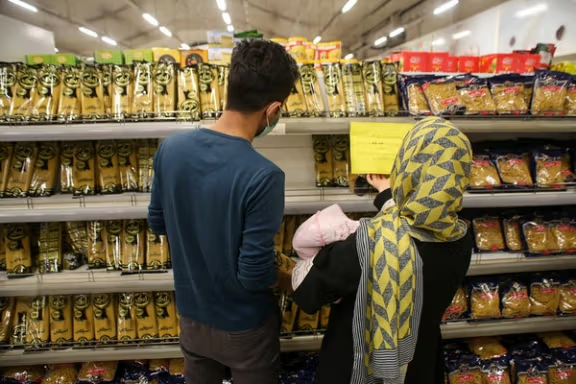
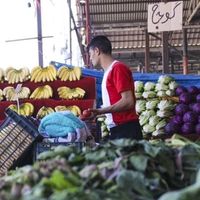
A report last week by Iran’s Statistical Center showed food inflation at nearly 64% -- a rate far higher than the overall 48% inflation estimate. Agricultural output has shrunk by more than 7% amid drought and a shortage of foreign currency for food imports.
Analysts say the situation risks worsening as renewed UN sanctions and a potential fuel price hike add further pressure.
A new report by Iran’s Statistical Center (ISC) reveals a sharp acceleration in food inflation, hitting millions of families where it hurts most.
According to the report, food prices in September rose by nearly two-thirds compared to the same month last year, with the cost of grains, bread and fruits nearly doubling.
For millions of low-income Iranians—estimated to make up over half the population and whose living conditions have consistently worsened each year—this surge in inflation is nothing short of catastrophic.
It remains unclear why food inflation has reached 64 percent while the overall inflation rate stands at 48 percent, but severe drought, water shortages and the government’s failure to allocate sufficient foreign currency for food imports appear to be the main drivers.
The Parliament Research Center estimated that agricultural output had shrunk by over 7 percent during the summer of 2025.
Sweeping sanctions along with years of corruption, opaque budgeting and mismanagement of already strained resources have deepened the crisis.
‘Nutrition crisis’
As the national currency collapses and inflation spirals, Iranian households’ dining tables are shrinking every year, and the country’s food security is facing an increasingly dire crisis.
According to data from the Food and Agriculture Organization (FAO), per capita meat consumption in Iran has dropped by 40 percent and dairy consumption by 30 percent over the past decade.
A field study conducted by a group of trained volunteer social workers—published two months ago by the reformist daily Shargh—paints an alarming picture of the nation’s nutrition.
It found that only 2 percent of Iranian children consume dairy daily, while 50 percent receive none at all.
The same survey, conducted across 14 provinces, showed that just 1.7 percent of households consume protein daily, while 26.9 percent do not consume any protein products whatsoever.
School dropouts
The crisis extends beyond food shortages and soaring prices.
The ISC reports that education costs jumped by nearly 23 percent in September—a major blow to families just as the new school year began, further aggravating dropout rates already at alarming levels.
Last September, the parliament’s Education Committee revealed that about two million students had not enrolled for the 2024 academic year, largely due to worsening economic hardship that prevented families from completing registration.
Education in Iran is free in theory, but private schools have mushroomed over the past decade, while public schools routinely charge families under various labels such as “donations” or “maintenance fees.”
Fear of unrest
This wave of inflation and skyrocketing prices comes as United Nations sanctions— reimposed at the request of the three European signatories to the 2015 nuclear deal (Britain, France, and Germany)—have further destabilized Iran’s economy.
Western countries, alongside the United States, accuse Iran of refusing to cooperate with the International Atomic Energy Agency (IAEA) and of concealing elements of its nuclear activities.
The IAEA’s reports have repeatedly confirmed Iran’s lack of transparency and urged Tehran to answer its questions and allow broader access to nuclear facilities.
With the return of international sanctions, inflation in Iran is expected to worsen, especially when the long-anticipated fuel price hike takes effect.
Based on President Masoud Pezeshkian’s recent remarks, it seems only a matter of time—a decision delayed mainly out of fear of renewed public unrest.
Oman on Saturday called on Iran and the United States to resume suspended nuclear negotiations, as Tehran’s foreign minister ruled out halting uranium enrichment or curbing its missile program.
Omani Foreign Minister Badr Albusaidi said during the Manama Dialogue conference in Bahrain that Muscat wanted to see “a return to negotiations between Iran and the United States.” He said the talks, which Oman had hosted earlier this year, were derailed in June when Israel launched air and missile strikes on Iranian nuclear sites.
“Just three days before the sixth and possibly decisive round of talks, Israel unleashed its bombs and missiles in an illegal and deadly act of sabotage,” Albusaidi said, according to AFP.
Oman, a traditional mediator between Tehran and Washington, has helped facilitate indirect talks this year aimed at reaching a deal to limit Iran’s nuclear work in exchange for sanctions relief.
Iran’s Deputy Foreign Minister Majid Takht-Ravanchi visited Muscat earlier this week for a meeting of the Iran-Oman Political Strategic Committee, where he and Albusaidi discussed regional developments and plans to expand bilateral cooperation, according to Iranian media.
Tehran denies US message via Oman
The United States did not send a message to Iran through Oman, Iran’s IRGC-affiliated Tasnim News Agency reported on Saturday, citing an informed source. The outlet said the comment came after Iraq’s Baghdad Al-Youm alleged that Washington had used Muscat to convey a proposal to resume suspended nuclear talks.
Iranian Foreign Minister Abbas Araghchi told Al Jazeera on Saturday that Tehran would not stop uranium enrichment or negotiate on its missile program, warning that any new Israeli attack would have “bad consequences.”
Araghchi said Iran was open to indirect talks with Washington to reach what he called a fair agreement on its nuclear program but would not make concessions after being attacked. He added that Iran would not accept Western pressure or what he described as “dictates.”
Cairo urges Iran, IAEA to resume cooperation
His comments came a day after Egypt said it had urged both Iran and the International Atomic Energy Agency to end the standoff over inspections of damaged nuclear sites. Egyptian Foreign Minister Badr Abdelatty said he conveyed the appeal to Araghchi and IAEA chief Rafael Grossi in separate phone calls aimed at reviving cooperation between the two sides.
Iran suspended full cooperation with the UN nuclear watchdog after the June war with Israel and the United States. Under a post-war law, inspections now require approval by Iran’s Supreme National Security Council and exclude access to bombed facilities.
Albusaidi said regional states should seek dialogue rather than confrontation. “Over the years, the Gulf Cooperation Council has at best sat back and permitted the isolation of Iran,” he said. “I believe this needs to change.”
Iran’s hardline newspaper Kayhan, which operates under the supervision of Supreme Leader Ali Khamenei, has warned that the growing tolerance toward unveiled women has now extended to “semi-nudity,” accusing officials of neglecting to uphold the country’s hijab laws.
In a commentary published on Saturday under the title Hijab and the Second Step, Shariatmadari said some authorities were publicly condemning “semi-nudity” among women while neglecting to reaffirm that unveiling itself remains prohibited. “It is as if unveiling has been removed from the list of forbidden acts,” he wrote, “and officials only caution against full or partial nudity.”
“This is exactly the enemy’s second-step tactic,” he added.
Shariatmadari described the approach as part of a deliberate psychological strategy to desensitize society. “When society suffers from a harmful phenomenon, the enemy seeks to normalize it by introducing an even more disastrous version,” he wrote. “In this case, they present semi-nudity so that people tolerate unveiling.”
Since the 2022 death of Mahsa Amini in the custody of Iran’s morality police, enforcing compulsory hijab has become increasingly difficult, and the state’s ability to impose the rules has sharply eroded, particularly in major cities.
Since then, many women have continued to appear unveiled in public despite warnings, fines, and the return of hijab patrol vans, turning defiance into a daily act of resistance.
‘Officials still playing in the enemy’s field’
The Kayhan editor also repeated his long-standing criticism of the government’s handling of the hijab and chastity law, calling the legislation “suspicious” and “likely designed by infiltrators.” He said it “not only fails to stop unveiling but will expand it,” accusing the heads of Iran’s three branches of government of “preventing even the implementation of this incomplete law.”
Shariatmadari cited Khamenei’s earlier remarks that foreign enemies had deliberately turned the hijab issue into a political conflict. “They want to return the country to the pre-revolutionary state,” he wrote.
Addressing “semi-nudity” without confronting unveiling itself would embolden those seeking to erode Islamic values, he concluded. “Nudity is the result and continuation of unveiling,” he said. “Fighting it cannot succeed without a serious confrontation with unveiling.”
Iran’s foreign minister said Tehran will not halt uranium enrichment or negotiate over its missile program, warning that any new Israeli attack would have “bad consequences,” Al Jazeera reported on Saturday.
Foreign Minister Abbas Araghchi said Iran had managed the June war with Israel effectively and prevented it from spreading to the wider region, according to the Qatari network. He said Iran was fully prepared for any new confrontation and warned that Israel would face “another defeat” if fighting resumed.
Araghchi said Iranian nuclear sites were damaged in the war but its enrichment technology remained intact, with nuclear materials still at the bombed facilities.
He said Iran would not accept Western pressure and was ready for indirect talks with Washington to reach what he called a fair agreement on its nuclear program. Tehran was willing to address international concerns, he added, but would not make concessions after being attacked.
His remarks came a day after Egypt said it had urged both Iran and the International Atomic Energy Agency to end the standoff over inspections of damaged nuclear sites. Egyptian Foreign Minister Badr Abdelatty said he conveyed the appeal to Araghchi and IAEA chief Rafael Grossi in separate calls aimed at reviving cooperation.
Iran suspended full cooperation with the UN watchdog after the June war with Israel and the United States, which struck several nuclear facilities. Under a post-war law, inspections now require approval by Iran’s Supreme National Security Council and exclude access to the bombed sites.
Western powers accuse Tehran of hiding military dimensions to its program, while Iran insists its nuclear work is peaceful.
Tensions with Washington have sharpened after US President Donald Trump ordered the first American nuclear weapons tests in more than three decades. Araghchi called the move a regressive and irresponsible step and said it showed what he called US hypocrisy for condemning Iran’s nuclear work while restarting its own testing.
Iraq’s communications ministry said on Friday that its contract with a company tied to Iran-backed militias was legal and unrelated to the management of the country’s data network, after a recent US report raised security concerns.
“The contract was concluded according to proper procedures and has no connection with the management of Iraq’s communications network,” the ministry said. It added that operations and data systems remain under the authority of ministry staff.
The statement followed an article in The Atlantic that described the Muhandis General Company as an Iraqi version of Iran’s Revolutionary Guard Corps. The magazine said Prime Minister Mohammed Shia al-Sudani had created the firm and awarded it government contracts, including for fiber-optic maintenance, giving Iran-aligned militias new influence inside Iraq’s economy. The Atlantic also reported that Washington sanctioned the company in October, calling it a front for terrorist groups and corruption.
According to The Atlantic, the Popular Mobilization Forces—an umbrella for mostly Shi’ite militias formed in 2014 to help the army fight Islamic State—have gained wider power under al-Sudani, who has embraced and enriched them through public-works contracts. The report said recent deals with the Muhandis company give the militias something they have long sought: a foothold in Iraq’s data network.
The communications ministry rejected what it called “targeted attacks” against its work and said its projects were being carried out transparently and in line with Iraqi law.