Freed hostage torches Iran, allies as 'brutal ignoramuses'
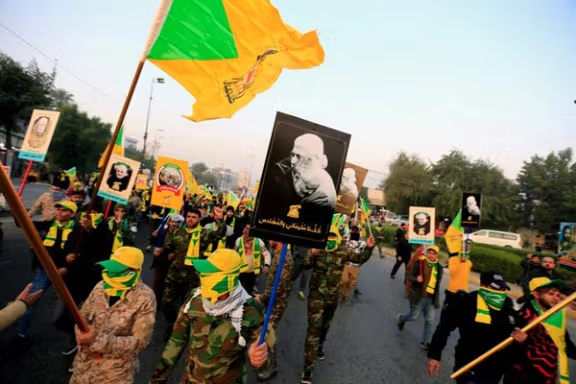
Kataib Hezbollah Iraqi militia gather ahead of the funeral of the Iraqi militia commander Abu Mahdi al-Muhandis, who was killed in an air strike at Baghdad airport, in Baghdad, Iraq, January 4, 2020
Israeli-Russian academic Elizabeth Tsurkov who was freed by an Iran-backed Iraqi militia in September offered some of her first insights yet on her captors on Monday, decrying Iran and its regional allies as "brutal ignoramuses".
"I am confident that so many of the successes Israel has had vs. the Iranian axis is not due to Israeli genius but due to the stupidity of the men who make up the rank-and-file and commanders of these militias & Iranian regime," Tsurkov wrote on X.
"Having spent 903 days in the captivity of an Iraqi militia servicing Iran, I can tell you that I've never met more ignorant people in my life," the Princeton PhD candidate added.
Tsurkov was abducted by Iran-backed Shi'ite militia Kata’ib Hezbollah and was released after a Trump administration hostage envoy traveled to Iraq in February to push for her release.
She is a prolific analyst on social media and announced her return to X last month with an animation of rapper Dr. Dre with the caption "Guess who's back." Her posts are frequently critical of Israeli policy.
"Commanders who think tracking devices can be planted in teeth, but don't know white [non-silver] fillings exist. Commanders who think Masons rule the world," Tsurkov said of her captors. "Senior commanders who are literally illiterate. An Iranian commander who thinks there is such a thing as spoken vs. written Hebrew."
"What a travesty that Iraqis, Yemenis, Gazans, Iranians, and Lebanese are subject to the rule of these brutal ignoramuses," she added.
Kata’ib Hezbollah denied responsibility, but Israel’s Channel 11 cited an Iraqi official as saying that Tsurkov was initially detained by Iraq’s intelligence service—or by individuals posing as its officers—before being transferred to Kata’ib Hezbollah.
The group is one of several Tehran -backed and funded armed groups which took part in Iraq's conflict against Islamic State militants but amassed power and influence by maintaining their arms after fighting largely winded down.
Charities benefiting the Iran-backed Lebanese militant group Hezbollah are relying on digital banking apps to circumvent US anti-terrorism sanctions, the Financial Times reported on Monday citing documents.
New Lebanon-based digital banking services like Whish and rival OMT are connected to international banking systems such as Visa and Mastercard and facilitate the money transfers to and from Lebanon, the report said.
A series of sanctioned Iran-linked organizations, like the Lebanese branch of the Imam Khomeini Relief Foundation known as the Emdad Association and Hezbollah's Martyr Foundation and Wounded Foundation, actively use the services.
OMT allows individuals to transfer money using the recipient’s name and phone number, meaning these organizations could raise money from the vast Lebanese diaspora populations such as in the Democratic Republic of Congo.
The UK-based newspaper reported that it had monitored a transaction via Whish's international partner RIA involving a dollar-denominated transfer, after which a donor to Emdad received a receipt from the organization matching the transaction.
This mechanism allows individuals to send large amounts of money to the charities and organizations in small tranches to different names and numbers via Emdad's WhatsApp account.
Both Whish and OMT denied any wrongdoing or mishandling related to sanctions on Hezbollah and its affiliates.
Lebanon's banking sector has been in crisis since 2019, when widespread protests and capital controls triggered a near-collapse, slashing deposits by over 90% and fueling hyperinflation.
In response digital banking has surged with apps like Whish and OMT amassing millions of users for quick transfers amid chronic cash shortages.
Israel assassinated Hezbollah's veteran leader Hassan Nasrallah last year and dealt the group historic blows, and the group faces a major challenge after Lebanon's President Joseph Aoun instructed the military to confiscate its weapons.
Netanyahu warning
Tensions continue to flare with Israel, which occupies outposts of Lebanese territory and has launched repeated deadly airstrikes.
“We expect the Lebanese government to do what it has pledged to do, namely to disarm Hezbollah ... We will not allow Lebanon to become a renewed front against us,” Israeli Prime Minister Benjamin Netanyahu said at the beginning of a cabinet meeting on Sunday.
Hezbollah's has refused to fully disarm, fueling concern in Lebanon that a standoff over the issue could devolve into civil war.
Tom Barrack, US ambassador to Turkey and special envoy to Syria, told a security conference in Bahrain on Saturday that it was unlikely Hezbollah could be disarmed despite Washington's stated policy goals.
“Lebanon is a failed state,” Barrack said, adding it was run by "dinosaurs."
“The idea of disarming Hezbollah — in our opinion, it’s not reasonable to tell Lebanon, ‘Forcibly disarm one of your political parties,'” Barrack added. “Everybody’s scared to death to go into a civil war. The idea is, what can you do to have Hezbollah not utilize those rockets and missiles?”
Founded in 1982 by Islamic Revolutionary Guard Corps, Hezbollah has grown into Lebanon’s most powerful military force, surpassing the national army in capabilities.
The group has fought multiple wars with Israel and has rejected any initiatives to dismantle its military wing.
Iranian security agents detained four and summoned two leftist intellectuals critical of state policies including two economists on Monday, according to local media reports.
Those targeted include economists Parviz Sadeghat and Mohammad Maljoo, sociologist Mahsa Asadollahnejad, writers and translators Shirin Karimi and Heyman Rahimi, and researcher Rasoul Ghanbari.
Tehran's reformist leaning Shargh daily reported that security forces arrested Sedaghat early on Monday morning after searching his home and seizing books and electronic devices, while fellow economist Maljoo was summoned for questioning.
“We still don’t know why this happened. Up to this moment my father has not contacted us,” Shargh quoted Sedaghat's daughter Mahtab as saying.
Shargh also said that Maljoo had been scheduled to appear before security authorities for questioning. According to his family, after his belongings were confiscated he went to the location specified by the security agencies.
The report added that there is currently no information about Maljoo’s status and the reason for Sedaghat’s arrest remains unclear.
In a July article, Sedaghat had written that despite the ceasefire with Israel, “we continue to live within the same rhetoric, the same confrontational tone.” He warned that Iran’s economy “has been caught in structural blockage” and that without political reform, it is “pushing the country toward systemic collapse.”
Iranian sociologist Mahsa Asadollanezhad
In a separate report, Shargh said Mahsa Asadollahnejad, a PhD graduate in political sociology, was detained on Monday morning while at her parents’ home after agents seized her electronic devices.
Her whereabouts remain unknown and she has not yet contacted her family, it added.
Radio Zamaneh reported the arrest of Shirin Karimi, a writer, translator and researcher, after security forces raided her home in the morning searched the premises and confiscated her books and electronic devices before taking her to an undisclosed location.
Her family has received no information about the reason for her detention, according to the reports.
In another report, Shargh said security agents confiscated the electronic devices and books of writer and translator Heyman Rahimi on Monday morning.
Rahimi has been ordered to appear at a designated location on Tuesday for questioning, according to the report. No further details have been released about the reason for the summons.
Activists say Monday’s arrests targeted left-leaning intellectuals.
“The arrests of Parviz Sedaghat, Rasoul Ghanbari, Mahsa Asadollahnejad, Shirin Karimi and Mohammad Maljoo — all prominent leftist figures — show that the government is more concerned about the growing influence of independent leftist movements than about criticism from within the system (reformist or conservative),” Iranian Kurdish activist and journalist Kaveh Ghoreishi said on X.
Ali Khomeini, the grandson of the founder of the Islamic Republic, said on Monday that the 1979 seizure of the US embassy in Tehran was pivotal to shaping Iran’s current political and defense standing, arguing that without it “the Islamic Republic might not exist."
Speaking at a ceremony marking the anniversary of the embassy takeover, Khomeini said the Iranian people supported the move, which came nine months after the 1979 revolution.
“The nation stood behind the decision to seize the US embassy,” he said, adding that the action proved in practice that America was not the ultimate decision-maker.
Khomeini drew a parallel between that event and what he described as Iran’s current military and technological advances. “As long as our missiles did not strike our enemies, no one understood their value,” he said, referring to Iran’s missile capabilities.
He also contrasted Iran’s position with that of regional states, saying many of them remain closely aligned with US policies.
The takeover of the US embassy on November 4, 1979, led to the hostage-taking of 52 American diplomats for 444 days and the eventual severing of US-Iran diplomatic ties. The event remains one of the most defining moments in the history of the Islamic Republic and continues to influence Tehran’s foreign policy rhetoric.
The Gulf of Gorgan on the Caspian Sea’s southeastern coast is “taking its last breaths” amid mounting environmental degradation, with lawmakers and oversight bodies accusing national agencies of failing to act on recovery plans, Iran’s Tasnim news agency reported.
According to the report, local officials in Golestan Province said years of neglect and slow implementation of restoration projects have pushed the gulf -- once a vital ecosystem for fisheries and wetlands -- close to collapse.
Abdollah Aghaalikhani, director-general of the provincial inspection organization, told Tasnim that several measures approved by Iran’s National Wetlands Restoration Committee “have not been implemented.”
He added, “Some agencies at the national level are behind the scheduled timelines for the interventions, and negligence has been observed.”
Aghaalikhani warned that research indicates “there are only three to five years left” to save the Gorgan Gulf, calling for a chain of coordinated actions to stabilize the ecosystem.
He added that the oversight body is “seriously and continuously monitoring implementation of executive commitments, including dredging, water pumping, and completion of coastal wastewater treatment plants.”
Abdoljalal Eiri, a lawmaker representing coastal constituencies in Golestan, told Tasnim that parliament has allocated 10 trillion rials (about $9 million) for the gulf’s restoration in next year’s budget, but said the Environment Department must first conduct a comprehensive study to use the funds effectively.
“Legal obligations exist to rescue Gorgan Gulf, and any agency that has failed to act will be held accountable,” Eiri said.
He added that he has filed complaints against the Environment Department and the Plan and Budget Organization under Article 234 of Parliament’s internal rules “for negligence in implementing legal duties.”
File photo of the Gulf of Gorgan
Tasnim added that the Gulf, once a thriving link between the Caspian Sea and Miankaleh Wetland, has been shrinking due to declining Caspian water levels, sedimentation, and rising temperatures.
Dredging of a key canal linking the gulf to the sea began under former President Ebrahim Raisi in 2022, but locals say renewed sedimentation has rendered navigation nearly impossible.
Environmental experts have warned that failure to restore water flow could turn parts of northern Iran into new dust storm zones, threatening local fisheries and livelihoods.
Tasnim wrote that the Gorgan Gulf, once known as “the jewel of northern Iran,” may vanish within a few years unless dredging, pumping, and wastewater control projects are implemented “without further delay.”
Mourners in the western Iranian city of Aligoudarz chanted slogans against Supreme Leader Ali Khamenei on Monday during the funeral of Omid Sarlak, a young man found dead hours after posting a video of himself burning the leader’s photo.
Videos received by Iran International show large crowds attending Sarlak’s burial in Lorestan province, chanting “Death to Khamenei” and “Death to the dictator.”
Others cried, “We will kill whoever killed my brother,” and “This flower that has withered is a gift to the homeland.”
Several mourners recited verses from the Shahnameh -- the Persian national epic written by the 10th-century poet Ferdowsi, which celebrates heroism and resistance to tyranny -- comparing Sarlak’s courage to that of ancient Persian heroes.
Sarlak’s father appeared in a widely shared video at the site where his son’s body was found, saying, “They killed my champion here.” Another man in the clip can be heard saying Sarlak was “surrounded and shot.”
Mourners carry the body of Omid Sarlak during his funeral in Aligoudarz on November 3, 2025.
The funeral followed comments from Ali Asadollahi, the police commander of Aligoudarz, who said on Sunday that the body of a young man had been discovered inside a car near Arsalan Goodarzi Stadium, adding that he “took his own life with a handgun.”
Authorities did not identify the victim, but social media users soon named him as Sarlak and accused officials of pressuring the family to endorse the suicide narrative.
A final act of defiance
Before his death, Sarlak had posted videos on Instagram showing a burning photo of Khamenei with an archival recording of Mohammad Reza Shah Pahlavi’s voice playing over it.
In another story tagged “Death to Khamenei,” he wrote: “How long should we endure humiliation, poverty, and being ridden over? This is the moment to show yourself, young people. These clerics are nothing but a stream for Iran’s youth to cross.”
Activists described Sarlak as a patriotic youth and said he was “killed under torture by Iran’s Intelligence Ministry” hours after sharing the video.
Another user wrote he had been “arrested by the IRGC Intelligence Organization and his bruised, tortured body was later returned to his family.”
Iran International cannot independently verify those remarks. Judicial and security authorities have not provided clarification on the circumstances of his death, and the lack of transparency has intensified public skepticism.
In recent years, officials have repeatedly attributed suspicious deaths to suicide -- a statement widely doubted by the public, who often use the phrase “he was suicided” to express disbelief.
One such case was that of former political prisoner Sara Tabrizi, found dead at her parents’ home last year after pressure from security forces.