Iran releases French couple after three years, Macron says
Iran has released French prisoners Cecile Kohler and Jacques Paris who had been detained since 2022, President Emmanuel Macron announced on Tuesday, nearly two weeks after Paris freed an Iranian citizen charged with promoting terrorism.
The two French prisoners "are out of the Evin jail and en route to the French embassy in Teheran," Macron said on X. "I welcome this first step, the dialogue continues."
Foreign Minister Jean-Noel Barrot said later on X that the two French nationals were now "safe" at the French Embassy "ahead of their final release".
Iran's foreign ministry spokesman said the two French nationals "have been released on bail and will remain under supervision until the next stage of judicial proceedings."
Kohler and Paris were arrested in May 2022 during a tourist trip to Iran. Both were charged with spying for Israel, charges they denied.
The pair were also charged with "conspiracy to overthrow the Islamic Republic and corruption on earth."
In May, France filed a case against Iran at the International Court of Justice (ICJ), accusing Tehran of unlawfully detaining the two French citizens for three years and violating international law.
In September, Paris withdrew its case against Iran after a meeting between Macron and Iranian President Masoud Pezeshkian in New York, which was seen as a possible gesture toward reviving prisoner-exchange talks.
Iranian foreign minister Abbas Araghchi suggested at the time that Iran might free the French pair in exchange for Iranian national Mahdieh Esfandiari, who was due to face trial in January for promoting acts of terrorism.
Esfandiari, an Iranian student living in the French city of Lyon, was arrested in February allegedly over her social media posts against Israel.
On October 23, Iran's foreign ministry confirmed Esfandiari had been conditionally released after 235 days of detention.
Former Iranian foreign minister Javad Zarif said on Monday that the United States failed to humiliate Iran in a June war and that only earnest negotiations could resolve the impasse between the two adversaries.
Speaking at a conference in Hiroshima in Japan on Monday, Zarif said Iran’s resilience in the face of military and economic pressure had shown that “the era of hit and run is over.”
“A superpower that spends over $800 billion a year on its military could not humiliate Iran, which allocates less than $10 billion to defense,” Zarif said.
“In fact, that superpower was compelled to evacuate all personnel from its military bases surrounding Iran before daring to launch reckless bombings against Iran’s safeguarded facilities.”
US talks with Tehran over its disputed nuclear program began earlier this year with a 60-day ultimatum. On the 61st day, June 13, Israel launched a surprise military campaign which was capped with US strikes on June 22 targeting key nuclear sites in Esfahan, Natanz and Fordow.
Iran denies seeking nuclear weapons and has called the attacks illegal.
Zarif said decades of sanctions, cyberattacks, and assassinations had failed to force Iran to capitulate, arguing that the country’s nuclear program was rooted in “dignity, not deterrence.”
He said Supreme Leader Ali Khamenei’s insistence on continuing the program stemmed from “resistance to submission."
“For him (Khamenei), it has always been about something far more profound and enduring: dignity,” Zarif said.
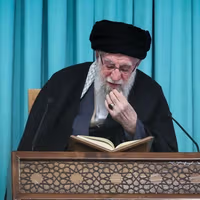
Iran's 86-year-old ruler appeared to double down on his hard line against a rapprochement with Washington on Monday, saying the United States must quit military bases in the region and sever ties with Israel to mend fences with Iran.
The former Iranian chief negotiator urged the United States to “set aside the illusion of demanding Iran’s unconditional surrender” and instead engage in “genuine negotiations” to ensure the program remains peaceful.
Zarif called for reviving diplomacy through initiatives he said he had proposed to promote peaceful nuclear cooperation and rebuild trust with the West.
“One practical step that I proposed in a recent Foreign Policy essay could be a US–Iran non-aggression pact,” Zarif said. “Another initiative that a colleague and I proposed in The Guardian a couple of months ago is the Middle East Network for Atomic Research and Advancement, or MENARA — a collaborative regional network dedicated to non-proliferation while harnessing peaceful nuclear cooperation.”
The United States has demanded Iran renounce domestic uranium enrichment while Tehran maintains its nuclear program is an international right.
Zarif said the network would include “an enrichment consortium bringing together existing capabilities into a collective peaceful and transparent effort,” adding that it would be open to all Middle Eastern countries willing to renounce nuclear weapons and accept strict safeguards.
Iran’s daily Kayhan, overseen by a representative of Supreme Leader Ali Khamenei, has called for a shift in the country’s foreign policy from “engagement” to “power building,” arguing that decades of diplomatic outreach to the West have failed to secure Iran’s national interests.
In a commentary published on Monday, the paper said Iran’s long-standing policy of détente -- adopted since the 1990s -- was based on “unrealistic optimism” about the international system and “has not sustainably guaranteed the country’s national security.”
The article described the current approach as interaction-oriented and said it must be replaced by a power-oriented doctrine focused on strengthening military, economic, and technological capabilities to deter foreign pressure.
Citing the experience of the 2015 nuclear deal, Kayhan said Western powers exploited Iran’s transparency to intensify sanctions and political leverage, concluding that “national security cannot be achieved through trust in adversaries, but through active deterrence and national cohesion.”
The call for a “paradigm shift” aligns with the growing dominance of hardline narratives within Tehran’s policymaking circles, which advocate a move away from engagement with the US and Europe toward self-reliance and expanded regional influence.
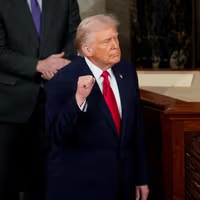
US President Donald Trump said his approach to Iran is central to securing broader Middle East stability, repeating that US military action had removed Tehran’s nuclear capability and hinting that an agreement with the Islamic Republic could pave the way for regional diplomacy.
“They have no nuclear capability, no,” Trump said in a CBS 60 Minutes interview aired on Sunday, adding that he had “blasted the hell out of” Iran and praising US pilots for operations he said were conducted in Iranian airspace.
Trump said progress on Arab-Israeli normalization would have been impossible “if you had a nuclear Iran,” arguing that curbing Tehran’s capabilities was a prerequisite for any agreement.
He added, “You could’ve never had any kind of a deal if you had a nuclear Iran… And I blasted the hell out of ’em,” while also saying the United States halted operations, characterizing his decisions as calibrated to deter Tehran while preserving space for diplomacy. “We stopped,” he said. “When it was time to stop, we stopped.”
The president described Iran as wanting an agreement even if they don’t say it, and cast a potential understanding with Tehran as “the key to peace in the Middle East.” He did not outline new diplomatic proposals or timelines.
Iranian officials have long rejected US accusations about nuclear ambitions, saying enrichment and related activities support power generation and medical research. The International Atomic Energy Agency has previously urged Tehran to address questions about its program.
Trump’s remarks come as Washington and regional partners weigh next steps on containment and possible talks with Tehran amid intermittent back-channel messaging.
Iran’s foreign minister on Sunday accused Israel of misleading the United States on a fabricated Iranian nuclear threat and called on President Donald Trump to change course.
The United States held five rounds of negotiations with Tehran over its disputed nuclear program under a 60-day deadline set by President Trump earlier this year.
When no agreement was reached by the 61st day, Israel launched a surprise military offensive on June 13, followed by US strikes on June 22 targeting key nuclear facilities in Isfahan, Natanz, and Fordow.
"Israel targeted diplomacy because its real fear is the failure of its 'Iran Demonization Project,'" Iranian Foreign Minister Abbas Araghchi said in a post on his X account.
"POTUS entered office promising to put an end to Netanyahu's bamboozling of Obama and Biden. It's not too late to reverse course," he added.
The 12-day conflict ended on June 24 after a US-brokered ceasefire, but global alarm over Tehran’s nuclear program deepened as 400 kilograms of Iran’s highly enriched uranium remained unaccounted for.
Tehran says the material lies buried beneath debris from US and Israeli airstrikes, rendering it unreachable, yet it has so far refused to grant international inspectors access to the damaged sites.
Trump and Israeli Prime Minister Benjamin Netanyahu asserted that Tehran had resolved to race toward building nuclear weapons after they launched attacks on nuclear sites in a 12-day war in June.
The characterization appeared to contradict prior public US intelligence assessments. Iran denies seeking nuclear weapons.
In his Sunday remarks, Araghchi cited remarks by the UN nuclear watchdog's chief and Oman's foreign minister to reiterate Tehran's longstanding position that its nuclear program is for peaceful purposes.
"In the past 48 hours, the heinous lie that the unlawful Israeli and US bombing of Iran was motivated by an imminent nuclear threat has been thoroughly debunked by the International Atomic Energy Agency Chief, who has explicitly stated that Iran 'is not and was not' developing nuclear weapons, and my Omani counterpart, H.E. AlBusaidi, an intermediary trusted by both Iran and the US, who has made clear that there was never any Iranian "nuclear threat"."
Enough uranium for ten a-bombs
The UN atomic watchdog chief warned last week Iran holds enough uranium to build ten nuclear weapons if it chose to enrich further, but stressed that there was no sign Tehran seeks atomic arms.
In an interview with Swiss daily Le Temps, Rafael Grossi said Iran’s stockpile includes roughly 400 kilograms of uranium enriched to 60 percent, just short of weapons-grade.
“If it went further, Iran would have enough material for roughly ten nuclear bombs,” he added. “But we have no evidence that Tehran intends to build one.”
On Sunday, former advisor to Iran's Supreme Leader, Mohammad‑Javad Larijani, said Tehran has developed a new theoretical doctrine: one in which it chooses not to develop a nuclear weapon even though it is capable of building one in under two weeks.
Oman on Saturday called on Iran and the United States to resume suspended nuclear negotiations, as Tehran’s foreign minister ruled out halting uranium enrichment or curbing its missile program.
Omani Foreign Minister Badr Albusaidi said during the Manama Dialogue conference in Bahrain that Muscat wanted to see “a return to negotiations between Iran and the United States.” He said the talks, which Oman had hosted earlier this year, were derailed in June when Israel launched air and missile strikes on Iranian nuclear sites.
“Just three days before the sixth and possibly decisive round of talks, Israel unleashed its bombs and missiles in an illegal and deadly act of sabotage,” Albusaidi said, according to AFP.
Oman, a traditional mediator between Tehran and Washington, has helped facilitate indirect talks this year aimed at reaching a deal to limit Iran’s nuclear work in exchange for sanctions relief.
Iran’s Deputy Foreign Minister Majid Takht-Ravanchi visited Muscat earlier this week for a meeting of the Iran-Oman Political Strategic Committee, where he and Albusaidi discussed regional developments and plans to expand bilateral cooperation, according to Iranian media.
Tehran denies US message via Oman
The United States did not send a message to Iran through Oman, Iran’s IRGC-affiliated Tasnim News Agency reported on Saturday, citing an informed source. The outlet said the comment came after Iraq’s Baghdad Al-Youm alleged that Washington had used Muscat to convey a proposal to resume suspended nuclear talks.
Iranian Foreign Minister Abbas Araghchi told Al Jazeera on Saturday that Tehran would not stop uranium enrichment or negotiate on its missile program, warning that any new Israeli attack would have “bad consequences.”
Araghchi said Iran was open to indirect talks with Washington to reach what he called a fair agreement on its nuclear program but would not make concessions after being attacked. He added that Iran would not accept Western pressure or what he described as “dictates.”
Cairo urges Iran, IAEA to resume cooperation
His comments came a day after Egypt said it had urged both Iran and the International Atomic Energy Agency to end the standoff over inspections of damaged nuclear sites. Egyptian Foreign Minister Badr Abdelatty said he conveyed the appeal to Araghchi and IAEA chief Rafael Grossi in separate phone calls aimed at reviving cooperation between the two sides.
Iran suspended full cooperation with the UN nuclear watchdog after the June war with Israel and the United States. Under a post-war law, inspections now require approval by Iran’s Supreme National Security Council and exclude access to bombed facilities.
Albusaidi said regional states should seek dialogue rather than confrontation. “Over the years, the Gulf Cooperation Council has at best sat back and permitted the isolation of Iran,” he said. “I believe this needs to change.”