UN watchdog presses Iran to restore nuclear site access
International Atomic Energy Agency (IAEA) Director General Rafael Grossi
Iran must make a serious improvement in its cooperation with United Nations nuclear inspectors to prevent further escalation with Western powers, International Atomic Energy Agency (IAEA) chief said, the Financial Times reported on Wednesday.
Rafael Grossi told the newspaper that although the IAEA has conducted roughly a dozen inspections in Iran since its June conflict with Israel, inspectors have not been allowed to access key nuclear sites -- including Fordow, Natanz, and Isfahan -- which were bombed during US airstrikes.
The agency chief said the IAEA was maintaining dialogue with Tehran despite “bumpy” relations but warned that Iran remained bound by its obligations under the Nuclear Non-Proliferation Treaty (NPT).
“You cannot say, ‘I remain within the non-proliferation treaty,’ and then not comply with obligations,” Grossi was quoted as saying. “Otherwise, what I will have to do is report that I have lost all visibility of this material.”
Grossi added that while some movement had been detected near Iran’s enriched uranium stockpiles in October, it did “not imply that there is activity on enrichment.”
Iranian officials dismissed his comments at the time, accusing the IAEA of spreading “unfounded opinions.”
Foreign Ministry spokesperson Esmail Baghaei said Grossi was “fully aware of the peaceful nature” of Iran’s nuclear program.
Tehran has also blamed the IAEA for allegedly giving Israel a pretext to attack its facilities, after the agency’s board voted in June to declare Iran in violation of its NPT commitments.
Western diplomats have voiced growing concern over the IAEA’s limited visibility into Iran’s nuclear activities following the strikes and subsequent restrictions on inspections.
Combative comments by senior officials in Tehran about Iran’s nuclear program have drawn sharp criticism at home and abroad, with analysts warning that the rhetoric makes another round of war on Iran more likely.
During a visit to a nuclear facility on November 2, President Masoud Pezeshkian declared that “Iran will resume its nuclear activity with renewed force,” while reiterating that the country does not seek to build a nuclear bomb.
On the same day, Mohammad Javad Larijani, a former senior adviser to the Supreme Leader and brother of Tehran’s security chief, made an even more provocative claim: “Iran can make a nuclear bomb in a matter of two weeks.”
Though both later walked back their remarks, saying Iran has no intention of producing a bomb, critics argue the damage was done.
The statements, they say, reinforce suspicions among world powers about Tehran’s intentions and could provoke preemptive action from Israel or the United States.
‘Iran and North Korea only’
One of the strongest cautions came from prominent economist Kamal Athari, who questioned the rationale behind such statements in an interview with the moderate daily Arman Melli on Monday.
“In the entire world, only two governments seem to want war for war’s sake: North Korea and a certain faction in Iran. The rest of the world approaches war as an unwanted extension of politics, grounded in national interest,” Athari said.
While criticizing Pezeshkian’s comments, Athari pointed to deeper forces that few dare mention publicly inside Iran.
“(Pezeshkian) inherited only the saddle of the previous government’s dead horse,” he said. “Both the nation and the broader establishment chose him over others merely sitting in the shadow of that saddle, each hoping he would rescue them from the mess they helped create.”
‘No exit strategy’
Some observers believe Pezeshkian’s comments are intended to delay direct or indirect negotiations with the United States—perhaps in the hope that Israeli Prime Minister Benjamin Netanyahu will be unseated in the next election, or that President Trump will lose interest in confronting Iran.
Others see the remarks as symptoms of deeper indecision within the government. In the absence of a coherent strategy, officials appear to shift positions daily—evident in the government’s changing stance on talks with Washington between November 1 and 3.
Political commentator Namvar Haghighi told Iran International, “Iran currently has neither a roadmap forward nor an exit strategy from its crises. The president should be mindful of this before making sweeping declarations about nuclear activity.”
Since Israel’s 12-day war with Iran in June, Tehran has faced mounting setbacks: loss of control over parts of its airspace, restricted access to foreign-held financial assets including cryptocurrencies, and a unified European front aligning more closely with the United States on Iran’s nuclear and missile programs.
Pezeshkian appears either unaware—or unwilling to recognize—that the geopolitical landscape has shifted dramatically since the war.
US Senator Chris Van Hollen urged Iran to engage in nuclear negotiations, saying it must resolve the issue diplomatically as President Trump signals openness to talks to resolve the lingering impasse.
“President Trump has said he wants to sit down and negotiate this with Iran," the Democratic senator told Iran International.
"Iran having a nuclear weapon is unacceptable, so it's important that they be willing to resolve this,” the Maryland lawmaker added.
He was speaking before a defiant speech by Iran’s Supreme Leader on Monday in which the veteran theocrat appeared to double down on a hard line toward Washington.
Khamenei, 86, ruled out any cooperation with the United States, saying every US president had demanded “Iran’s surrender” but failed.
“Only if the United States completely cuts its backing for the Zionist regime, removes its military bases from the region, and ceases interfering in its affairs, their request for cooperation with Iran—not in the near future but much later—could be examined,” Khamenei said.
Iran denies seeking nuclear arms and says its program is peaceful.
The United States held five rounds of negotiations with Tehran over its disputed nuclear program earlier this year, for which President Donald Trump set a 60-day ultimatum.
When no agreement was reached by the 61st day on June 13, Israel launched a surprise military offensive, followed by US strikes on June 22 targeting key nuclear facilities in Isfahan, Natanz and Fordow.
Senator Van Hollen has previously expressed skepticism of military efforts to deny Iran a nuclear bomb.
“I have long supported the goal of ensuring that Iran never obtains a nuclear weapon. But bombing is not, in my view, the best and certainly not the most sustainable way of achieving that goal,” he told the Arms Control Association in a speech in September.
Van Hollen has said the window of diplomacy is still open in his remarks in September and there should be a coordinated effort to reach an agreement.
“The United States, the E3 (France, Germany, and Britain) and Iran should move swiftly to restart negotiations on a pragmatic, effective nuclear agreement,” he said.
US President Donald Trump said his approach to Iran is central to securing broader Middle East stability, repeating that US military action had removed Tehran’s nuclear capability and hinting that an agreement with the Islamic Republic could pave the way for regional diplomacy.
“They have no nuclear capability, no,” Trump said in a CBS 60 Minutes interview aired on Sunday, adding that he had “blasted the hell out of” Iran and praising US pilots for operations he said were conducted in Iranian airspace.
Trump said progress on Arab-Israeli normalization would have been impossible “if you had a nuclear Iran,” arguing that curbing Tehran’s capabilities was a prerequisite for any agreement.
He added, “You could’ve never had any kind of a deal if you had a nuclear Iran… And I blasted the hell out of ’em,” while also saying the United States halted operations, characterizing his decisions as calibrated to deter Tehran while preserving space for diplomacy. “We stopped,” he said. “When it was time to stop, we stopped.”
The president described Iran as wanting an agreement even if they don’t say it, and cast a potential understanding with Tehran as “the key to peace in the Middle East.” He did not outline new diplomatic proposals or timelines.
Iranian officials have long rejected US accusations about nuclear ambitions, saying enrichment and related activities support power generation and medical research. The International Atomic Energy Agency has previously urged Tehran to address questions about its program.
Trump’s remarks come as Washington and regional partners weigh next steps on containment and possible talks with Tehran amid intermittent back-channel messaging.
Iran’s 400 kilograms of uranium enriched to 60% remain buried beneath debris from the recent US strike on nuclear facilities, and Iran has no plan to recover them until conditions permit, Foreign Minister Abbas Araghchi said in an interview with Al Jazeera published on Sunday.
“Almost all of the material lies under the rubble, and we have no plan to retrieve it until the circumstances permit,” Araghchi said. “We do not know how much of it remains intact or has been destroyed, and we will not know until we can remove it.”
Israel and the United States attacked Iranian nuclear sites in a 12-day June war, setting back the nuclear program but leaving its fate unresolved.
Tehran has since declined to allow IAEA inspectors to resume their inspections.
The strikes, Araghchi said, caused extensive structural damage but failed to destroy Iran’s nuclear know-how.
“Our facilities were hit hard, but technology cannot be bombed,” he added. “More importantly, our determination has not been lost; it has even grown stronger after the war.”
Iran denies seeking nuclear weapons and has accused Western countries of instrumentalizing a technical dispute with the IAEA to deploy onerous sanctions.
No direct talks with Washington
Responding to questions about prospects for negotiations with the United States, Araghchi said Tehran sees no need for direct talks.
“Many countries, for historical and political reasons, avoid direct negotiations,” he said. “We once held direct talks with the Americans and achieved no result. If they are serious, results can be reached even through indirect talks.”
Iran’s preference for indirect channels was based on experience and distrust, he added. “We have no confidence and no interest in direct negotiations,” he said. “Indirect talks can lead to the same outcome.”
‘Equal footing’ for future diplomacy
Discussions, according to Araghchi, could resume whenever Washington was ready to negotiate “from an equal footing and on the basis of mutual interests.” He added: “They seem in no hurry, and we are in no hurry either.”
Diplomacy, he maintained, remains Iran’s guiding principle. “War was imposed on us while we were negotiating,” he said. “For us, diplomacy is essential. We are ready to engage with the world and the West, but it is they who have betrayed diplomacy.”
Iran’s postwar policy, the minister said, would focus on strengthening regional cooperation. “Our priority is our neighbors… We began a policy of good neighborliness with determination and will expand it after the war. We negotiate with the West, but we do not take dictation.”
Limits of nuclear negotiation
Addressing renewed mediation efforts, Araghchi said Tehran remains open to restoring the framework of the 2015 nuclear deal. “The same formula can still apply -- confidence-building on our nuclear program in exchange for lifting sanctions.”
But he drew a firm line on Iran’s defense programs. “There is no reason to negotiate our own security with anyone,” he said.
“A fair nuclear agreement is possible, but the Americans have made unreasonable and excessive demands. When they are ready to negotiate fairly and as equals, we will consider resuming talks.”
Earlier this year, the United States held five rounds of negotiations with Tehran over its disputed nuclear program under a 60-day deadline set by President Donald Trump.
When no agreement was reached by the 61st day, on June 13, Israel launched a surprise military offensive, followed by US strikes on June 22 targeting key nuclear facilities in Isfahan, Natanz, and Fordow.
Araghchi’s remarks come as the International Atomic Energy Agency continues seeking access to Iranian sites to verify the status of enriched uranium stocks following the attacks.
Iran’s foreign minister on Sunday accused Israel of misleading the United States on a fabricated Iranian nuclear threat and called on President Donald Trump to change course.
The United States held five rounds of negotiations with Tehran over its disputed nuclear program under a 60-day deadline set by President Trump earlier this year.
When no agreement was reached by the 61st day, Israel launched a surprise military offensive on June 13, followed by US strikes on June 22 targeting key nuclear facilities in Isfahan, Natanz, and Fordow.
"Israel targeted diplomacy because its real fear is the failure of its 'Iran Demonization Project,'" Iranian Foreign Minister Abbas Araghchi said in a post on his X account.
"POTUS entered office promising to put an end to Netanyahu's bamboozling of Obama and Biden. It's not too late to reverse course," he added.
The 12-day conflict ended on June 24 after a US-brokered ceasefire, but global alarm over Tehran’s nuclear program deepened as 400 kilograms of Iran’s highly enriched uranium remained unaccounted for.
Tehran says the material lies buried beneath debris from US and Israeli airstrikes, rendering it unreachable, yet it has so far refused to grant international inspectors access to the damaged sites.
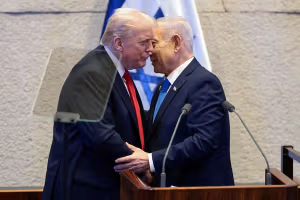
Trump and Israeli Prime Minister Benjamin Netanyahu asserted that Tehran had resolved to race toward building nuclear weapons after they launched attacks on nuclear sites in a 12-day war in June.
The characterization appeared to contradict prior public US intelligence assessments. Iran denies seeking nuclear weapons.
In his Sunday remarks, Araghchi cited remarks by the UN nuclear watchdog's chief and Oman's foreign minister to reiterate Tehran's longstanding position that its nuclear program is for peaceful purposes.
"In the past 48 hours, the heinous lie that the unlawful Israeli and US bombing of Iran was motivated by an imminent nuclear threat has been thoroughly debunked by the International Atomic Energy Agency Chief, who has explicitly stated that Iran 'is not and was not' developing nuclear weapons, and my Omani counterpart, H.E. AlBusaidi, an intermediary trusted by both Iran and the US, who has made clear that there was never any Iranian "nuclear threat"."
Enough uranium for ten a-bombs
The UN atomic watchdog chief warned last week Iran holds enough uranium to build ten nuclear weapons if it chose to enrich further, but stressed that there was no sign Tehran seeks atomic arms.
In an interview with Swiss daily Le Temps, Rafael Grossi said Iran’s stockpile includes roughly 400 kilograms of uranium enriched to 60 percent, just short of weapons-grade.
“If it went further, Iran would have enough material for roughly ten nuclear bombs,” he added. “But we have no evidence that Tehran intends to build one.”
On Sunday, former advisor to Iran's Supreme Leader, Mohammad‑Javad Larijani, said Tehran has developed a new theoretical doctrine: one in which it chooses not to develop a nuclear weapon even though it is capable of building one in under two weeks.