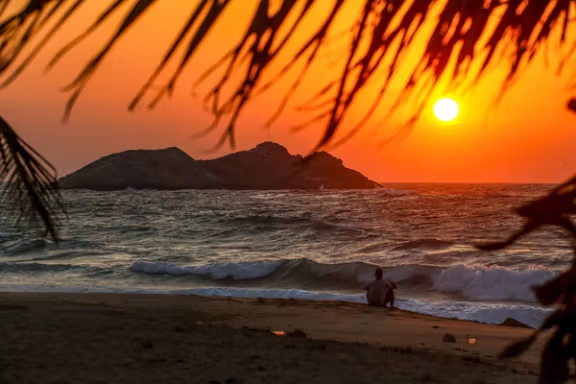
A man sits on the shore of Iran’s Abu Musa island watching the sun set over the Persian Gulf, November 2024
Europeans may have intended to pressure Tehran when they demanded last month an end to Iran’s “occupation” of the three Persian Gulf islands, but the move instead exposed how badly they misread Iran’s public mood.
From steadfast loyalists of the Islamic Republic to secular, pro-Western dissidents, the response was swift and fierce.
To Iranians, these islands are not bargaining chips in regional diplomacy; they are emblems of sovereignty, woven into the texture of national identity. Yet, once again, Europe misjudged the sensitivities of the very society it claims to champion.
Greater Tunb, Lesser Tunb, and Abu Musa islands have been held by Tehran since 1971 after the withdrawal of British forces from the Persian Gulf. They are claimed by the United Arab Emirates, but voices across the Iranian political spectrum reject that.
In a joint statement last month, the European Union and the Gulf Cooperation Council (GCC) urged a peaceful settlement to the issue or its referral to the International Court of Justice.
For decades, Western policymakers have oscillated between containment and engagement, human-rights advocacy and strategic pragmatism—without ever truly understanding the national psyche that binds Iranians together across divides of religion and ideology.
Unlike many post-Ottoman or post-colonial societies in the region, Iran is defined by a deep sense of civilizational continuity. Its modern nationalism did not arise from a struggle to unite disparate tribes but from the preservation of a centuries-old cultural identity.
This makes Iran simultaneously ancient and modern, conservative and revolutionary. It also explains why gestures that seem minor to outsiders—like the choice of a name for the Persian Gulf—carry profound symbolic weight.
‘Sing O’Iran’
Even the Islamic Republic, which for decades has relied on religious and ideological slogans to sustain its legitimacy, instinctively recognizes the power of this sentiment when under pressure.
During the recent Israeli strikes that killed several senior Revolutionary Guards commanders, authorities abruptly set aside their usual religious fervor for overt nationalism.
The defining moment came when Supreme Leader Ali Khamenei asked his official singer to perform “O Iran”—a patriotic anthem long shunned by the clerical establishment. The symbolism wasn’t lost on Iran’s rivals either.
In Persian-language media, Prime Minister Benjamin Netanyahu repeatedly invoked Iran’s ancient civilization, cited Cyrus the Great, and emphasized Israel’s respect for Iran’s territorial integrity—appealing to the very patriotic pride that Western leaders too often misjudge or inadvertently offend.
Missing solidarity
Paradoxically, Iran stands apart from many of its neighbors: its rulers are among the most radical, but its society is among the most secular, Western-oriented and civic-minded.
Yet Western governments have repeatedly failed to connect with this civic energy. Whether through regime change or gradual reform, they have struggled to earn the trust of Iran’s secular opposition.
The 2009 Green Movement remains a turning point. When millions of protesters urged Barack Obama to choose between them and the Islamic Republic, his muted rhetoric on the demonstrations disappointed many.
The protests were crushed, and many Iranians concluded that the West had chosen stability over solidarity. Since then, the credibility gap has only widened.
Cultural identity
Even well-intentioned human-rights initiatives often reinforce that mistrust.
A sprawling network of NGOs and advocacy groups—mostly funded by Western grants—has created a class of professional activists in exile. Their reports, while often accurate, tend to mirror donor expectations more than the full complexity of Iranian society.
The result is an echo chamber: the West hears what it already believes, rather than what Iranians are actually saying.
Western analysts often interpret Iran through Europe’s own historical lens, where nationalism emerged from state formation. But Iran’s identity long predates its state; its nationalism is cultural before it is political.
Academic frameworks focused on ethnic fragmentation or postcolonial grievance may resonate in Western circles but often alienate Iranians who see their struggle as a defense of national unity against a theocratic ideology.
Respect, not rescue
The traumas of Syria and Libya have further reinforced this anxiety—to the extent that some Iranian dissidents fear disintegration more than continued authoritarianism.
Every Western statement that appears to question Iran’s territorial integrity deepens that fear, and Tehran eagerly exploits it to portray reformists and protesters as tools of foreign powers.
If the West truly seeks to engage Iran’s people, confronting this psychological reality head-on is essential. The recent EU-GCC statement did the opposite, alienating the very voices the West claims to support.
For all its complexities, Iran remains a nation profoundly open to the world. Most Iranians dream not of isolation but of reintegration—of restoring Iran’s place as a proud, responsible member of the international community.
Its dissidents seek fundamental change to Iran’s rule, not its soul. Most welcome solidarity if it comes with dignity, not domination—and strive for respect, not rescue.
Iran on Thursday rejected the Group of Seven foreign ministers’ final statement, accusing the bloc of lying about Iranian nuclear activities and alleged support for Russia's war in Ukraine.
In a joint statement on Wednesday, the G7 grouping of wealthy democracies (Canada, France, Germany, Italy, Japan, the United Kingdom and the United States) urged Tehran to resume full cooperation with the UN nuclear watchdog and to engage in direct talks with the United States.
Foreign Ministry spokesman Esmail Baqaei called the request "duplicitous and interventionist", saying the G7 had ignored what he described as years of unlawful pressure and military actions by the United States and Israel.
“The United States, because of its unlawful and unilateral withdrawal from the Joint Comprehensive Plan of Action (JCPOA) in 2018 and its military attack on Iran’s peaceful nuclear facilities, is the main party responsible for the current situation,” he said, referring to Tehran's 2015 nuclear deal with world powers.
He added that the three European parties “followed Washington's suit, failed in implementing their commitments and dismissed all of Iran’s diplomatic initiatives with clear bad faith.”
Tehran and the United States engaged in five rounds of negotiations before Israel launched a surprise military campaign on Iran in June. The attacks were capped off by US strikes on Iranian nuclear sites.
The negotiations have not resumed despite US entreaties.
Baqaei also criticized the G7's backing of the European move to trigger the snapback mechanism under the UN Security Council Resolution 2231 which led to the restoration of UN sanctions on Iran in late September.
“The repetition of the irresponsible position of G7 member states in endorsing the unlawful and unjustified action amounts to endorsing an internationally delinquent act,” he said.
The G7 communiqué called on UN member states to adhere to their obligations following what the ministers referred to as the legal activation of the mechanism.
Ukraine war
The Iranian spokesman rejected the G7’s allegation that Iran is supplying military assistance to Russia.
“The Islamic Republic of Iran has no involvement in the Ukraine conflict,” he said. “Those who accuse others should correct their own mistaken policies on global peace and security instead of insisting on a sense of superiority.”
The G7 ministers condemned what they called the provision of military assistance to Russia by North Korea and Iran, reaffirming support for Ukraine’s territorial integrity.
Iranian-designed drones have been key to Russia's war effort against Ukraine. However, Tehran has long denied it provides any military support for the Russian war efforts, insisting that the drones had been supplied before the Ukraine war started.
A senior member in Supreme Leader Ali Khamenei's office said on Thursday that Iran's leader views talks with the United States as acceptable if they mitigate threats to the country and advanced its interests.
The comments by Mehdi Fazaeli, a political analyst and member of the Office for the Preservation and Publication of the Works of the Supreme Leader, were a rare nod to the idea of dialogue with Tehran's arch-enemy from the theocrat's circle.
He is widely regarded as among the few officials authorized to interpret Khamenei's views.
Talks were ended by a surprise Israeli military campaign on Iran in June capped off by US attacks on Iranian nuclear sites. The negotiations have not resumed despite US entreaties as Khamenei led senior officials in accusing Washington of perfidy and aggression.
"Negotiations with the United States are not absolutely forbidden, but are only allowed if they are conditional, closely controlled, and in line with the system’s higher interests," Fazaeli told a diplomacy forum at Baqir al-Ulum University in the holy city of Qom, describing Khamenei's position. "No strategic trust in the United States exists."
"The Supreme Leader does not reject negotiations per se," he added, "but evaluates them based on their purpose and framework. Negotiations that imply retreat are unacceptable, but controlled, intelligent talks aimed at averting threats are permissible."
Despite what he described as deep strategic mistrust, Fazaeli said Khamenei has at times allowed narrow, issue-specific contacts “to safeguard higher national interests,” citing earlier talks on Iraq, Afghanistan and the nuclear issues.
Khamenei, 86, came out strongly against renewing talks with the United States after the June war killed hundreds of military personnel and civilians. Iranian counterattacks had killed 32 Israeli civilians and an off-duty soldier.
"The Americans sometimes say they would like to cooperate with Iran. Cooperation with Iran is not possible as long as the United States continues to support the accursed Zionist regime, maintains military bases, and interferes in the region," he said in a speech earlier this month.
US President Donald Trump said last month that the United States was ready to reach a deal “when Tehran is ready,” saying “the hand of friendship and cooperation is open.”
The United States wants Iran to halt domestic enrichment and rein in its missile program and support for armed allies in the region.
Tehran denies seeking a nuclear weapon citing a religious decree by Khamenei, rejects giving up its nuclear activities and has said discussions on its defense posture are a non-starter.
Fazaeli said Khamenei’s order against nuclear arms “is a ruling that remains fixed and cannot be changed,” adding that it bars “production, stockpiling and use”
The UN nuclear watchdog said on Wednesday it had not been able to check Iran’s enriched uranium stock for five months because Tehran has not allowed inspectors to reach the seven sites bombed in June. It said verification is “long overdue” and that it has lost “continuity of knowledge” of Iran’s nuclear material.
Before the attacks, inspectors had confirmed Iran held about 440 kilograms of uranium enriched to 60 percent purity.
Meanwhile, Foreign Minister Abbas Araghchi wrote to UN chief António Guterres on Wednesday saying Trump publicly admitted to directing Israel’s initial strikes on Iran, demanding the United Nations extract reparations from Washington.
Israel’s destruction remains a core aim for the Islamic Republic, Iran’s top armed forces spokesman said on Thursday at a memorial ceremony in Tehran, as senior officials sharpened their rhetoric amid growing talk of another clash with Israel.
Abolfazl Shekarchi said the late Revolutionary Guard commander Hassan Tehrani Moghaddam, widely regarded as the father of Iran’s ballistic-missile program and killed in a 2011 explosion at an IRGC base west of Tehran, had “carried the wish to see Israel wiped out,” adding: “With God’s help, this wish will be fulfilled.”
He said Iran’s aerospace forces grow “more powerful by the day” and insisted the Islamic Republic becomes stronger when its commanders are killed.
“We never become weak — with every martyr we become more steadfast,” he said.
Other senior commanders used the same gathering to revisit the twelve day June war with Israel. Deputy IRGC chief Ali Fadavi said “all the world stood with Israel but they did not succeed,” adding that Iran had “acted on its duty” during the fighting and that “when duties are carried out, the promises of God are fulfilled.”
Vahid Azizi, head of parliament’s national security committee, said Tehran viewed the conflict as “an opportunity to understand the shortcomings and the needs” and as a chance to “prepare for what may come next.”
Growing signals of a new confrontation
The messaging reflects broader signals in Tehran, where several officials have spoken more openly in recent weeks about the prospect of fresh fighting with Israel. Some have said Iran is ready for “all scenarios” as political and military rhetoric intensifies.
Israeli Prime Minister Benjamin Netanyahu told the Knesset this week that Iran “remains a threat,” yet was weakened in the June war. He said Israel had “distanced and neutralized the nuclear threat and the ballistic threat alike” and warned that any next clash would be “much more aggressive” and could last far longer than twelve days.
Iran will run a drill to test its mobile phone warning system on Friday, Iranian media said, sending test alerts to selected users between 10 and 12 local time as officials speak more often of renewed conflict with Israel.
The reports said the test is part of a technical review of the Cell Broadcasting system used to warn residents during earthquakes, floods and other emergencies. Officials said the alerts will appear automatically on some phones, may include sound and vibration, and require no action from the public. They stressed the exercise does not reflect any real threat.
The test follows weeks of warnings from senior figures in Tehran. Foreign Minister Abbas Araghchi said that the country expects “any aggressive act” from Israel and is preparing for all scenarios, while former parliament speaker Ali Larijani said the war “is not over.” In Israel, former intelligence officials have also warned of a second round of fighting.
Tehran council chief says only 'special places' have new shelters
The drill comes as Tehran’s city council chief Mehdi Chamran said no new public shelters had been built for civilians, saying only “in special places” had new structures been prepared. “It is not necessary to say where,” he told the council, adding that the locations were not intended to be publicly disclosed.
Chamran said some metro stations were designed as shelters, including for chemical incidents, and were inspected during the twelve-day June war with Israel. He said work to complete these areas was ongoing, while stressing that he hoped no conflict would erupt.
His remarks echoed earlier comments from Iran’s passive defense agency, which said most residents would still rely on metro stations, underground car parks and basements in an emergency. The agency noted that limits on services and sanitation prevent the wider use of metro stations as full shelters.
During the June conflict, senior Iranian officials, including Supreme Leader Ali Khamenei, took cover in secure underground sites, while ordinary residents had no designated public shelters, prompting criticism. Tehran council members later admitted that no citywide shelter plan had been built in the past decades.
A British couple held in Iran on spying charges have begun a hunger strike inside Evin prison, their son told the BBC on Thursday, saying his mother described the move as her only means of protest.
Joe Bennett said his mother, Lindsay Foreman, told him in a brief phone call that “not eating was the only power she’s got.” The call, he said, ended without warning. Foreman and her husband, Craig, were arrested in January while travelling through Iran on a motorbike tour and deny the charges.
The family says the pair entered the country with valid visas, a licensed guide and a cleared itinerary, but were detained after Foreman asked locals routine questions for a personal project. Both were first held in Kerman, where they spent 30 days in solitary confinement, before being transferred to separate cells in Evin.
Bennett said his mother is isolated among inmates who do not speak English, while his stepfather is suffering from an untreated tooth abscess. He said the couple had been promised a visit with each other last Sunday, but it did not take place.
The couple were tried in October as tensions between Tehran and European capitals deepened following new nuclear-related sanctions. Rights groups say their case fits a wider pattern of detentions used to gain political leverage, an accusation Iran denies.
Bennett has urged officials to secure the pair’s release and said the charges against them are “completely bonkers.” He said the couple had praised Iran before their arrest, calling it “a beautiful country.”