Iran says IAEA vote nullified inspections deal with UN watchdog
Egyptian Foreign Minister Badr Abdelatty, Iran's Foreign Minister Abbas Araghchi and Director General of the International Atomic Energy Agency (IAEA) Rafael Grossi in Cairo, Egypt, September 9, 2025.
Iran’s foreign minister said an accord it reached with the UN nuclear watchdog is now invalid after the agency’s 35-member Board of Governors adopted a Western-backed resolution demanding greater transparency from Tehran.
The resolution demanded Iran allow international verification of its enriched uranium stockpile and access to atomic sites hit in June by US and Israeli strikes.
“Today, in an official letter to the Director-General of the Agency, it was announced that this understanding is no longer valid and is considered terminated," Abbas Araghchi said on Thursday.
He was referring to an interim agreement signed between Tehran and the International Atomic Energy Agency in Cairo in September aimed at eventually resuming inspections of sites stricken by the attacks.
"With this action of theirs and their disregard for Iran’s interactions and goodwill, these countries have damaged the agency’s credibility and independence and are causing disruption in the process of the agency’s interactions and cooperation with Iran," Abbas Araghchi said.
The resolution, adopted on Thursday and submitted by the United States, Britain, France and Germany, urges Iran to give the agency access and information about its nuclear program, Reuters reported, citing diplomats.
The measure passed with 19 votes in favor, three against and 12 abstentions, the Reuters report added citing diplomats. Russia, China and Niger voted against it.
Reuters cited the diplomats as saying the resolution demands that Iran inform the agency without delay of the status of its enriched-uranium stock and the condition of its atomic sites that were bombed in June.
"Iran must ... provide the agency without delay with precise information on nuclear material accountancy and safeguarded nuclear facilities in Iran, and grant the agency all access it requires to verify this information," said the draft resolution text submitted to the board and cited by Reuters.
Iran’s foreign ministry spokesperson Esmail Baghaei branded the move “a clear misuse of an international body" to advance the interests of the United States and its allies.
“Neither in the resolution nor in the statements of the three European countries and the United States is there the slightest reference to the fact that Israel and the United States attacked Iran’s nuclear facilities in June,” he told Iran's state broadcaster on Thursday.
“The reason for the cessation of the agency’s inspections and the reduction of Iran’s cooperation has been nothing other than this illegal action by the United States and Israel,” he added.
The UN General Assembly’s Third Committee adopted a resolution on Wednesday condemning Iran’s human rights record, in a move praised by the UN rapporteur on rights on the country.
The resolution passed with 79 votes in favor, 28 against and 63 abstentions.
According to the text, it “condemned in the strongest terms the alarming and significant increase in and the sustained and extensive use of the application of the death penalty” in Iran.
Many executions, it added, were carried out without fair trials, in secrecy or on the basis of “forced confessions” obtained from detainees.
The resolution also raised concerns about transnational repression by Iranian authorities.
Iran carried out “repressive activities” aimed at harming, silencing and intimidating critics of the government, including human rights defenders, journalists and dissidents, the text continued, asserting that some individuals “were targeted overseas by transnational repression.”
It said Iranian authorities used digital targeting, including online harassment, surveillance and intimidation, adding that authorities also relied on physical force and other means, including threats and coercion, against individuals abroad.
Iranian officials targeted family members inside Iran through “surveillance, harassment and intimidation”, it asserted, as a way to pressure critics overseas.
Victims, survivors and families seeking accountability, including those linked to the 2022 protests, faced harassment as well.
The committee also expressed “serious concern” about Iran’s treatment of women and girls. It referred to the continuing enforcement of compulsory veiling laws and described them as discriminatory policies that undermined fundamental rights.
“I’m pleased to see strong condemnation of the alarming use of the death penalty... and the call for transparency in death penalty practices (in Iran),” UN’s Special Rapporteur on human rights in Iran, Mai Sato, said in a post on X.
"Pleased to see transnational repression included in the resolution," she added.
Sato said Iran has executed over 1200 individuals in the first 10 months of the year.
Iran has asked Saudi Arabia to help persuade the United States to restart nuclear talks, Reuters reported citing two regional sources with knowledge of the matter.
A day before Saudi Crown Prince Mohammed bin Salman met US President Donald Trump in Washington, Iranian President Masoud Pezeshkian sent him a letter saying Iran “does not seek confrontation” and remains open to resolving the nuclear dispute through diplomacy if its rights are guaranteed, the Reuters report cited the sources as saying.
Earlier on Monday, Saudi state news agency SPA reported that Saudi Crown Prince Mohammed bin Salman received a letter from Iranian President Masoud Pezeshkian, a day before the crown prince traveled to the United States for talks with President Donald Trump.
SPA did not provide any further details about the letter or say whether it was connected to the US trip.
Iran’s Foreign Ministry spokesperson Esmaeil Baghaei on Wednesday said the letter was “purely bilateral,” while Riyadh has not commented.
US talks with Tehran over its disputed nuclear program began earlier this year with a 60-day ultimatum.
On the 61st day, June 13, Israel launched a surprise military campaign which was capped with US strikes on June 22 targeting key nuclear sites in Esfahan, Natanz and Fordow.
The Reuters report comes after US President Donald Trump said on Tuesday he seeks a deal with Iran and believes Tehran does too, speaking alongside Saudi Crown Prince Mohammed bin Salman who said he would try to help Tehran and Washington reach a deal.
"I think they very badly want to make a deal. I am totally open to it, and we're talking to them, and we start a process," Trump said.
The crown prince said he was ready to help Iran and the United States reach a deal that would also benefit the Middle East.
"I will be working closely together on the (Iran) issue, and we will do our best to help to reach a deal between America and Iran," he said.
Earlier on Thursday, the UN nuclear watchdog’s 35-member Board of Governors approved a resolution submitted by the United States, Britain, France and Germany calling on Iran to promptly clarify the status of its enriched uranium and the condition of atomic sites hit in June by US and Israeli strikes.
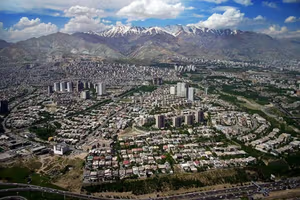
Iran’s capital must be moved because the country “no longer has a choice,” President Masoud Pezeshkian said on Thursday in remarks carried by state media, warning that severe ecological strain has made Tehran impossible to sustain.
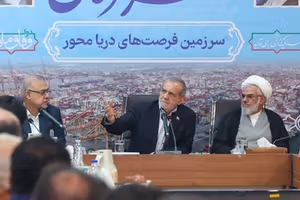
Pezeshkian said the pressure on water, land and infrastructure had left the government with “no option” but to act. “When we said we must move the capital, we did not even have enough budget. If we had, maybe it would have been done. The reality is that we no longer have a choice; it is an obligation,” he said in a speech in Qazvin.
He said Tehran now faces “catastrophe” as land in parts of the capital sinks by up to 30 centimeters a year and water supplies shrink. “When we say the land subsides 30 centimeters each day, this means disaster,” he said. He warned that mismanagement, construction in upstream areas and cuts to downstream water flows risk irreversible damage.
Pezeshkian said officials across government must work together or “a dark future” awaits. “Protecting the environment is not a joke,” he said. “Ignoring it means signing our own destruction.”
The president said the mismatch between water resources and demand had reached a breaking point. “We can bring water from the Persian Gulf, but it will be costly,” he said, arguing that Tehran’s population and construction load can no longer expand.
Makran: potential and limits
Iran announced in January that the government was studying plans to move the capital to the southern Makran coast, a remote region overlooking the Gulf of Oman. Officials said the shift could ease Tehran’s overcrowding, energy shortages and water stress.
The idea has surfaced repeatedly since the 1979 revolution but has stalled due to political resistance and soaring costs. Past administrations explored alternatives including Semnan, Qom and Isfahan but financial constraints halted progress.
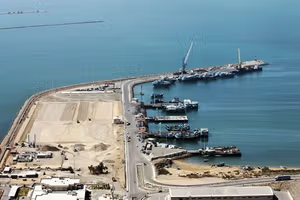
Officials have said Makran’s coastline offers access to the Indian Ocean and a base for sea-linked economic projects. The area includes Chabahar, Iran’s only oceanic port and a gateway to Central Asia.
But critics say the region is underdeveloped, exposed to security risks and far from ready to host a national capital. Opponents argue the country cannot afford the tens of billions of dollars such a move would require at a time of economic strain, high inflation and renewed UN sanctions.
The UN nuclear watchdog’s 35-member Board of Governors on Thursday approved a resolution calling on Iran to promptly clarify the status of its enriched uranium and the condition of atomic sites hit in June by US and Israeli strikes.
The measure renews and updates the International Atomic Energy Agency’s reporting mandate on Iran’s nuclear program. It also urges Tehran to grant inspectors immediate access to verify information about its nuclear materials and facilities, according to the diplomats cited by Reuters.
A senior European diplomat told an Iran International reporter ahead of the vote that the resolution would pass easily, saying that “the draft has the necessary support.” The diplomat added that discussions on Iran’s compliance with the Non-Proliferation Treaty began Wednesday night and resumed Thursday morning before the vote.
The resolution, submitted by the United States, Britain, France, and Germany, urges Iran to “act strictly in accordance” with the Additional Protocol, which allows for snap inspections, and to resume full cooperation with the IAEA. It follows a recent agency report that said Iran has not allowed inspectors to access damaged sites or provided a full accounting of uranium enriched up to 60 percent purity, close to weapons grade.
Iran has warned that any new resolution would damage what it described as “a positive course of cooperation” with the agency. Tehran says it has cut cooperation under a law passed by parliament and will not resume it until its demands under the Non-Proliferation Treaty are met.
The Western powers’ draft stops short of declaring Iran in breach of its obligations but increases diplomatic pressure on Tehran to restore monitoring and transparency.
Hamas and Hezbollah are quietly rebuilding their military capabilities amid a tense ceasefire with Israel, the Jerusalem Post cited Israeli defense officials as saying on Thursday.
According to the officials, Hamas’s military wing “has been rebuilding its force since the ceasefire took hold, gathering intelligence, recruiting and training operatives, and preparing for escalation,” the paper said.
The assessment followed an air strike the Israeli military said killed a Hamas battalion commander in Gaza and recent air strikes in Lebanon, one of which killed 13 people in a Palestinian refugee camp this week.
The officials said US pressure is “for now, restraining a sharper Israeli response” to Hezbollah’s ceasefire violations.
Southern Command sources said Hamas is seeking “operational opportunities to launch a surprise, limited attack against IDF units inside Palestinian territory, in violation of the deal.”
Military sources told the paper that Hezbollah is acting “in clear violation of the ceasefire understandings” and is moving “in the opposite direction of demilitarizing southern Lebanon and disarming.”
They said weapons were being moved into southern Lebanon and the Bekaa Valley as part of efforts to restore infrastructure with Iranian support.
Hezbollah’s quiet revival
Western and regional intelligence reports say Iran’s Quds Force helped Hezbollah rebuild its command structure after the killing of leader Hassan Nasrallah last year.
According to Le Figaro, Iranian operatives led by Quds Force commander Esmail Ghaani reorganized the group’s military wing within days, introducing younger commanders and tighter secrecy.
Hezbollah has agreed to withdraw its forces from the southern front but continues to store weapons north of the Litani River and in the Bekaa Valley, the report said.
Iran’s strategy, it added, aims to preserve Hezbollah’s deterrent power while avoiding direct confrontation with Israel.
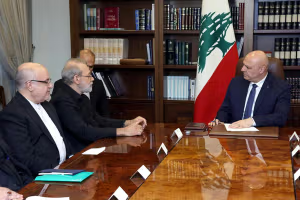
Lebanese President Joseph Aoun reportedly confronted Iran’s role in the country, breaking precedent by calling for Hezbollah’s disarmament. In a since-withdrawn interview, Aoun said he told Iran’s security chief Ali Larijani that “the Shi'ites of Lebanon are my responsibility, not yours.”
Aoun said Hezbollah’s military wing was “finished” and that he was seeking “an honorable end” to its armed role.
His comments followed a cabinet decision approving a US-backed roadmap to dismantle Hezbollah’s arsenal by the end of the year. Tehran has rejected the plan, accusing the West of trying to weaken Lebanon’s defenses.
Tension spills into Syria
Israel’s security leadership fears the growing coordination between Hamas, Hezbollah, and Tehran could extend into Syria.
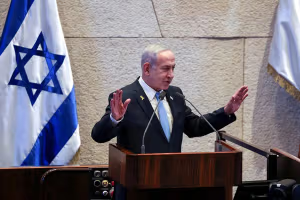
Prime Minister Benjamin Netanyahu’s visit to the country's south this week, with top defense and intelligence officials, signaled Israel’s determination to maintain its security buffer on the Golan Heights.
The visit came after Syrian President Ahmed al-Sharaa said he would normalize relations with Israel if the IDF withdrew from the Syrian Golan.
Security officials said they were not impressed by the rapprochement between the White House and Damascus and argued that al-Sharaa’s “jihadist past cannot be erased so quickly,” adding that he “does not necessarily control his own country.”