Iran weighs NPT withdrawal after IAEA censure | Iran International
Iran weighs NPT withdrawal after IAEA censure
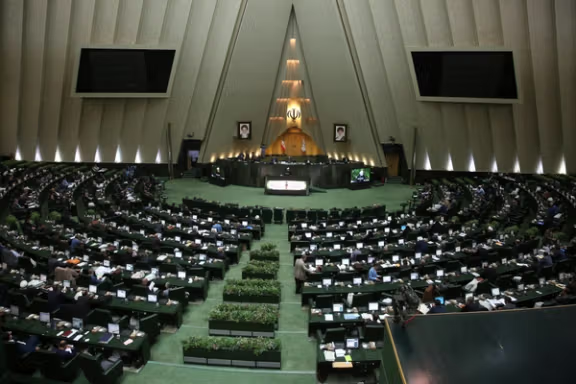
Tehran is considering suspending or withdrawing from the Nuclear Non-Proliferation Treaty (NPT) following a Western-backed resolution passed by the UN atomic watchdog this week, a member of Iran’s parliament said on Saturday.
Amir Hayat-Moghaddam, a member of parliament’s National Security and Foreign Policy Committee, told Rokna news agency that the option is “on the table” and under expert review. “Several meetings have been held since the IAEA Board of Governors adopted its anti-Iran resolution,” he said. “Withdrawal from the NPT is one of the preliminary options, but no final decision has been made. The review of all dimensions and possible consequences is still underway.”
He said a final decision could be announced by Tuesday, adding that any such move would be coordinated between parliament and the Supreme National Security Council. “There is no structural conflict between these institutions. Issues related to national interests are decided jointly,” he said. “Legally, however, withdrawal from international treaties falls within parliament’s authority.”
Separately, the spokesman for the National Security and Foreign Policy Committee said on Saturday that Iran’s parliament has begun drafting a bill on countermeasures in response to the recent International Atomic Energy Agency resolution.
Ebrahim Rezaei said the proposal aims to boost “nuclear and sanctions-related deterrence” and strengthen Iran’s defensive and legal capabilities. “A six-article draft has been prepared covering nuclear and sanctions counteractions as well as strategic, defense and judicial measures,” he told reporters.
Backdrop of renewed nuclear tensions
The discussions come days after the IAEA’s 35-member Board of Governors adopted a resolution urging Iran to provide full access to its nuclear sites and enriched uranium stockpiles. The measure, submitted by the United States, Britain, France and Germany, passed with 19 votes in favor, three against and 12 abstentions.
Iran condemned the vote as “illegal and unjustified” and said it has nullified the inspection accord reached in Cairo in September with IAEA chief Rafael Grossi and Egyptian mediation. Foreign Minister Abbas Araghchi said the resolution “killed” the Cairo accord and reflected a pattern of Western escalation.
“The US and the E3 attacked diplomacy just as they attacked our nuclear facilities,” Araghchi wrote on X on Thursday. “Iran is not the party seeking another crisis.”
Tehran says its cooperation with the agency remains within the framework of the NPT but insists that access to bombed facilities cannot resume until safety and legal questions are resolved.
Iran’s long-held position on the NPT
Iran has been a party to the NPT since 1970 and has repeatedly said it does not seek nuclear weapons. Officials in Tehran have described NPT membership as a sign of Iran’s commitment to peaceful nuclear energy, but they have also warned that continued political pressure could force a policy review.
Foreign Ministry spokesperson Esmail Baghaei said on Friday that Western powers were “misusing an international body” and that their actions “undermine the credibility and independence of the Agency.”
In Vienna, Russia’s envoy Mikhail Ulyanov said the situation had reached a “complete deadlock,” blaming the Western sponsors of the resolution for “stalling diplomacy.”
Brigadier General Ali Jahanshahi has been appointed commander of Iran’s Army Ground Forces, replacing Brigadier General Kioumars Heydari, who held the post for more than seven years, Iranian media reported on Saturday.
Jahanshahi previously served as deputy coordinator of the Army Ground Forces, commander of the 77th Thamen al-Aemeh Division, and deputy for assessment at the central Khatam al-Anbia Headquarters.
The reshuffle, while not officially highlighted by the military, continues a pattern of quiet personnel adjustments across Iran’s armed forces after the war in June.
In early October, the Revolutionary Guards appointed Brigadier General Hojatollah Ghoreishi as its coordinating deputy commander, replacing Mohammadreza Naghdi, who had held the role since 2020. Ghoreishi, a former deputy defense minister, was first referred to by his new title during a visit to Aligoudarz, signaling the formal transition.
The US State Department called the death of political prisoner Farzad Khoshboresh an example of Islamic Republic abuses, saying that the establishment is suppressing dissent with violence instead of addressing public needs.
“Officials in Iran said Farzad Khoshboresh’s health deteriorated in detention and that he died after being transferred to a hospital,” the department wrote Saturday on its Persian-language page on X.
“But the bruises and signs of torture on his body tell a different story, one that Iranians know all too well: the story of someone who dared to speak out and paid a heavy price,” it added.
Judiciary outlet confirms death
Mizan, the news agency of Iran’s judiciary, confirmed Khoshboresh’s death on Wednesday and said he had been taken to a hospital with signs of illness, released on bail the same day, and died two days later from illness.
His death, the State Department said, fits into what it called a “violent pattern” by the Islamic Republic to silence dissent and spread fear. “Even in the face of such repression, the brave people of Iran continue to demand justice, dignity, and freedom,” the department wrote.
The Hengaw rights group reported Tuesday that witnesses saw bruising on Khoshboresh’s body. Mizan did not mention any injuries.
Local sources said Khoshboresh was detained for a second time by the intelligence ministry on November 12. They said he suddenly suffered acute pain and vomiting in custody after consuming cake and water at the Behshahr detention center, lost consciousness, and was taken to hospital.
He was kept shackled to a bed and died 24 hours after receiving antibiotics, following a rejected request for transfer to another medical facility, according to the sources. Medical equipment, they added, was removed without informing his family and that his body was taken to a morgue.
A prison in Iran
Khoshborash was buried Thursday under heavy security in a village near Neka in northern Mazandaran province.
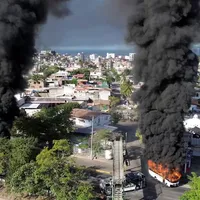
Iranian officials said on Saturday that the massive wildfire burning for a week in the Hyrcanian forest in northern Mazandaran Province was most likely caused by human activity, as authorities investigate suspected attempts to clear forest land for real estate projects.
Reza Aflatouni, head of Iran’s Forests Organization, said initial findings “strongly suggest a human cause.” “Expert teams are in the area, and evidence points to deliberate or negligent action,” he told state media. “We are also examining possible connections between the fire and efforts to rezone forest and farmland for private construction.”
Mazandaran Governor Mehdi Younesi-Rostami also said security assessments confirm that the fire in the Elit area was caused by human activity.
The investigation follows mounting controversy in Mazandaran Province, where environmental experts have accused local officials and developers of converting protected farmland and forest edges into villa plots.
The blaze, centered in the Elit region near the town of Chalous, has spread through steep, densely wooded terrain and is being driven by high winds and dry conditions. Firefighting officials said eight helicopters from the Defense Ministry, police and Red Crescent are operating in the area, along with two Ilyushin aircraft from the Revolutionary Guards, each capable of carrying 40,000 liters of water per flight.
Turkey to send aircraft as Iran weighs Russian help
Two Turkish firefighting planes, a helicopter and eight personnel are expected to arrive on Saturday to support local crews, and officials said Iran may request additional assistance from Russia if needed. “If necessary, we will request cooperation from the Russian government to help contain the Elit forest fires,” Environment chief Shina Ansari said.
Authorities said the difficult terrain has slowed efforts to create firebreaks and reach isolated hot spots. Ansari warned that “the risk of fire spread remains high” and that teams have been working around the clock to prevent the blaze from reaching nearby villages.
The Hyrcanian forest, a UNESCO World Heritage site along Iran’s Caspian coast, is one of the world’s oldest temperate rainforests and home to thousands of plant and animal species, including endangered Persian leopards and brown bears.
Kaveh Madani, director of the UN University Institute for Water, Environment and Health, called the Elit blaze “heartbreaking,” saying Iranians are “losing a natural heritage older than Persian civilization.”
Officials said the full extent of the damage and the cause of the fire will be announced after investigations conclude.
The Association of Iranian Studies Committee on Academic Freedom on Friday urged top Tehran’s officials to drop charges against five independent scholars, calling it a politically motivated move.
“We express our deep concern over the Iranian government’s ongoing violations of academic freedom, particularly in light of the recent politically motivated arrests and detentions of independent scholars,” the group wrote.
The open letter was addressed to Iranian Supreme Leader Ali Khamenei, President Masoud Pezeshkian and Chief Justice Gholam-Hossein Mohseni Ejei.
The AIS was referring to a recent crackdown on leftist academics Parviz Sedaghat, sociologist Mahsa Asadollahnejad, writer Shirin Karimi, economist Mohammad Maljoo, and scholar Heyman Rahimi.
“All face national security charges over their intellectual work. Sedaghat, Asadollahnejad, and Karimi were released on bail November 12, but charges persist; Maljoo and Rahimi face ongoing interrogations,” the group said.
"We are profoundly concerned by this latest violation of basic rights of citizenship and scholarly independence," the letter said. "We... consider it a clear violation of their fundamental right to academic freedom."
The group called on Iran to drop all charges, allow academic freedom and respect the UN human rights charter.
'Crackdown campaign'
AIS, founded in 1967, represents global experts on Iran and advocates for free scholarly exchange.
The arrests have drawn wider condemnation. The Committee to Protect Journalists (CPJ) called for the immediate release of Sedaghat and other detained scholars, while PEN America denounced Iran’s “escalating campaign against freedom of expression.”
Human rights groups have described the arrests and summonses as part of a broader campaign of arrests meant to stifle public debate following Iran’s 12-day June war with Israel.
In an article published three weeks after the June war, Sedeghat had written that despite the ceasefire with Israel, “we continue to live within the same rhetoric, the same confrontational tone.”
He warned that Iran’s economy “has been caught in structural blockage” and that without political reform, the country is headed "toward systemic collapse.”
Two Turkish firefighting planes, one helicopter and eight personnel will arrive in Iran on Saturday to help quell fires in the Hyrcanian forest in the country's north, Iranian environment chief Shina Ansari said on Friday.
“There are warnings that the fire spread risk is high and we need to act accordingly,” official media cited Ansari as saying.
The blaze in the Elit area ongoing since last week, fueled by wind and dry conditions. Iranian helicopters and ground teams deployed round-the-clock, but rugged terrain has hampered efforts.
Iran seeks international aid as the massive wildfire rages in UNESCO-listed Hyrcanian forest near the town of Chalous.
“Heartbreaking scenes from Elit, Iran, where wildfire is damaging parts of the ancient Hyrcanian forests — a UNESCO World Heritage treasure and one of Earth’s last temperate rainforests,” Kaveh Madani, director of the UN University Institute for Water, Environment and Health posted on X.
“Iranians are losing a natural heritage older than Persian civilization,” he added.
Authorities said protection units remained on high alert along the forest front in western Mazandaran, where several smaller fires have been reported in recent days.
Iran's Vice President Mohammad Reza Aref ordered on Friday urgent provision of firefighting equipment and resources for the ongoing Elit forest wildfire.
The Hyrcanian Forests stretch along the southern Caspian Sea coast in Iran and Azerbaijan. This ancient temperate broadleaf and mixed forest ecoregion dates back 25-50 million years, surviving past ice ages as a refugium.
They host over 3,200 vascular plant species, 150 endemic and 180 bird species, plus mammals like the Persian leopard, brown bear, lynx and Caspian red deer.
Wildfires have been burning for over two weeks as officials warned that heat, wind and dry vegetation were fueling the blaze.