US forces abseil onto an oil tanker during a raid described by US Attorney General Pam Bondi as its seizure by the United States off the coast of Venezuela, December 10, 2025, in a still image from video.
The seizure by US forces last week of an oil tanker in the Caribbean for allegedly transporting sanctioned oil from Iran and Venezuela may signal a policy shift that could endanger the funding of Iran's Islamic Revolutionary Guard Corps.
US seizure of tanker off Venezuela may squeeze Iran's shadow oil trade | Iran International
Iran's budget for this fiscal year had given the sprawling paramilitary body new economic power by tasking it with selling nearly 600,000 barrels of oil per day to fund military expenditures.
The dramatic raid by Washington, which is the latest move in an escalating pressure campaign against Venezuelan President Nicolas Maduro, now puts the shadowy trade buoying targeted economies in Caracas and Tehran in the crosshairs.
“The seizure underscores Washington’s escalating efforts to crack down on dark-fleet activity tied to Iranian and Venezuelan crude trades,” analytics firm Kpler said in a research note.
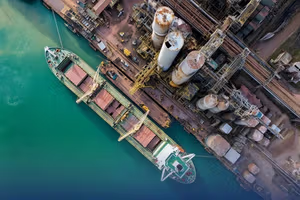
The Guyana-flagged ship, called Skipper, had loaded crude earlier this year at Iran’s Kharg Island terminal and has frequently shuttled between Venezuela, Iran and China—a top customer for the sanctioned powers.
Kpler notes that Skipper has been repeatedly linked to sanction-evasion tactics, including spoofing its location and mislabeled Iranian cargoes routed through Asia.
The tanker, formerly known as Adisa, was sanctioned on November 3, 2022 for transporting oil on behalf of the IRGC-Quds Force to Iran-backed Hezbollah in Lebanon—both of which are deemed terrorist organizations by US authorities—as well as to Syria.
The US campaign targeting the dark fleet has intensified for months. In an October report, Kpler said that over 60% of the vessels that have loaded Iranian crude in the last 12 months are now sanctioned by OFAC, up from 38% one year ago.
Still, according to shipping analytics firm Vortexa, Iran's shadow trade to China appears to be operating at full tilt. Export volumes stood at around 1.5-1.7 million bpd so far in 2025, it said, up slightly from last year but a full 25% from 2023.
"This consistency underscores the maturity of Iran’s sanctions-evasion logistics," it wrote in an analyst note, adding that Iran's capacity to get its crude to Chinese markets was limited by the number of eligible vessels and muted buyer interest.
Impact on Iran's revenues
Venezuela is offering its sanctioned crude at a $14–15 per barrel discount, according to reporting by Reuters. Kpler previously estimated that Iran, too, has increased its discounts to around $8 per barrel.
Along with Russia, the sanctioned exporters are effectively in direct competition with one another to lure Chinese buyers by offering deeper discounts.
Complicating matters further, with the global market oversupplied, the baseline price of oil has fallen to around $62 per barrel.
Discounts of $11-15 dollars therefore wipe out a substantial portion of export revenues for the sanctioned trio — all of which remain under pressure to lower prices even more to retain Chinese clients.
Chartering a Very Large Crude Carrier the size of the Skipper typically costs around $100,000 per day, and much higher for sanctioned cargoes.
For Iran — now holding 200 million barrels on the water according to Vortexa, the pressure to sell quickly is immense.
To the costs of chartering and discounting must also be added the expensive sanctions-evasion operations: ship-to-ship transfers, falsified documentation to rebrand cargoes, intermediaries and non-standard insurance.
Kpler data indicates that Iranian crude discharge in Chinese ports has fallen to 1.2 million bpd in the last two months after hitting near 2 million bpd in September and October as Chinese buying pauses late into the trading cycle.
Along with global low oil prices, the combined pressures may hit at Iran’s oil revenues when its economy can tolerate it least. The Iranian rial has depreciated at an accelerating rate in recent weeks and inflation has surged.
The currency lost nearly 15% of its value in just the past month and hit a new low on Monday of 1.31 million to the dollar.
Iran faces a stark choice to address a cost of living crisis: preserve subsidized exchange rates that have failed to protect purchasing power and fueled corruption or remove it and risk triggering another wave of uncontrolled inflation.
Former Central Bank of Iran governor Mohammad-Hossein Adeli summed up the core dilemma in an editorial for Donya-ye-Eghtesad last week.
“The gap between subsidized and free-market exchange rates produces severe distortions, instability, and unjust rents—while simultaneously serving certain political and distributive goals,” he wrote.
Iran’s “preferential” currency system began in April 2018 under President Hassan Rouhani, when the exchange rate was fixed at 42,000 rials per dollar.
The rial plumbed new record lows of over 1.31 million to the dollar on Monday.
Designed to curb price shocks, protect low-income households, and guarantee access to essential goods and medicine, the subsidy was funded through oil and petroleum revenues.
But as the gap between the official and free-market rates continued to widen—and maintaining the system strained the budget—the administration of Ebrahim Raisi scrapped it as part of its so-called “economic surgery.”
Officials defended the move by pointing to massive arbitrage opportunities, rent-seeking among importers of essential goods, waste of foreign-exchange reserves, and the failure of subsidies to reach consumers.
The system, they argued, had become a costly burden on the state.
The “economic surgery” triggered Iran’s highest annual inflation since World War II and sparked widespread protests.
After several months, the government reintroduced subsidized foreign exchange at 285,000 rials—about half the free-market rate at the time.
The subsidized currency initially covered 25 categories of goods, though several items were later removed from the list.
In recent months, the government has also eliminated preferential currency from the import chain for several key commodities such as rice, vegetable oil, red meat, animal feed and medicine.
The state provided importers with roughly $18 billion at the 285,000-rial rate in 2023 and about $15 billion in 2024, and allocations are expected to fall to around $12 billion this year.
An economy distorted
Supporters of the multi-rate structure contend that it keeps essential goods and industrial inputs affordable, curbs inflation, and preserves some purchasing power.
Critics argue that while cheap currency slowed price increases temporarily at first, the widening gap with the market rate ultimately entrenched systematic corruption and prevented subsidies from reaching consumers.
Adeli, the former Central Bank governor, wrote that keeping prices artificially low through “subsidized, rent-laden exchange rates has only marginally contained prices while generating huge rents for importers who gain access to cheap currency.”
“Allocating subsidized currency in the name of supporting the final consumer ends up serving special-interest groups, diverting resources, and fueling informal markets.” Importers, he warned, often manipulate invoices to amplify profits.
Still too risky to end?
One of the starkest illustrations of the system’s failure was the Debsh Tea corruption scandal. Between 2019 and 2022, the company received an estimated $3.4–$3.7 billion in subsidized foreign currency.
Large portions were never used to import high-quality tea. Instead, part of the allocation was sold on the open market for profit, while some was used to import low-quality tea, later repackaged and marketed as premium.
The scandal became emblematic of how subsidized currency rewarded manipulation over genuine import needs, further eroding public trust.
Despite the failures, Adeli argued that Iran is not prepared for a unified exchange rate. Geopolitical tensions, intensifying sanctions, weak economic growth, the risk of inflation rising above 50%, and the possibility of a budget deficit exceeding 50% together create a fragile environment.
He therefore advises maintaining a cautious two-tier system, with essential goods and medicines supplied at a controlled rate.
Former economy Minister Ehsan Khandoozi has similarly echoed this caution, warning that abrupt unification could ignite fresh inflation and insisting on a gradual approach.
Economist Morteza Afghah told ILNA that some advocates of free-market policies act “as if they do not realize that we are in an extremely critical situation, and we cannot apply formulas designed for advanced economies under normal conditions to Iran’s current crisis.”
A senior adviser to Iran’s Supreme Leader said Iran is pushing a strategy to link security with economic development in its southeast, arguing that closer trade with neighboring countries will blunt the impact of US sanctions.
Major General Yahya Safavi, also head of the Sacred Defense Sciences and Teachings Research Institute, said a national conference focused on sustainable development and security in Iran’s southeast aims to produce an operational strategy for the region, which borders Afghanistan and Pakistan.
“The country’s southeast region is a hidden treasure... This region has unique capacities with geopolitical, geostrategic, and geocultural significance. It can develop economic potential that serves as an alternative to an oil-based economy.”
Safavi said the region, spanning parts of Sistan-Baluchistan, Kerman, Hormozgan and South Khorasan provinces, accounts for about one-fifth of Iran’s territory and around one-tenth of its population.
He said 64 academic centers and universities, along with armed forces institutions, are participating in the initiative.
“Security and development are interconnected and must be pursued together,” Safavi said, adding that security in the region is provided through coordination between the Revolutionary Guards, the army and other forces.
He said the southeast’s 1,400 km (870 miles) of shared borders with Pakistan and Afghanistan give it the potential to function as an economic corridor, noting that current trade with Pakistan totals about 2 million tons annually and that the capacity of Chabahar port runs into several million tons.
He called on state bodies and investors to focus on the Makran coast and surrounding areas, describing them as national assets requiring special attention, and said a proposed monitoring center would track economic and security indicators and report regularly to the public.
Referring to US sanctions, including those affecting Chabahar port, Safavi said Iran should deepen economic ties with its 15 neighbors.
“If we strengthen private-sector trade with neighboring countries, the Americans cannot control Iran’s economic relations,” he said, adding that despite US pressure, “they cannot stop us.”
The University of Arkansas has stripped the head of its Middle East Studies program of the position after she praised Iran’s Supreme Leader and allegedly used university letterhead to support a convicted Iranian war criminal, the New York Post reported.
The university removed political science professor Shirin Saeidi on Friday, the Post reported on Saturday citing a university spokesman.
Lawmakers and a group of Iranian dissidents are demanding further disciplinary action against her, the spokesman added.
Saeidi is accused of using official University of Arkansas letterhead to advocate for the release of Hamid Nouri, a former Iranian prison official convicted in Sweden in 2022 for ordering the execution of thousands of political prisoners in 1988 at Gohardasht Prison.
The professor appealed for Nouri’s release using university stationery, raising concerns about misuse of institutional resources, The Post reported citing documents provided by the US-based Alliance Against Islamic Regime of Iran Apologists (AAIRIA).
The Post reported that in several posts shared on X in November, the professor praised Iran’s Supreme Leader Ali Khamenei, offering prayers for his safety and describing him as “the leader who kept Iran intact during the Israeli attack,” while also referring to Israel as a “terrorist state” and a “genocidal state.”
A spokesman for the University of Arkansas confirmed to the New York Post that the professor is no longer serving as head of the Middle East Studies program and that the university is investigating her apparent use of official letterhead “in accordance with university policies.”
On Friday, US Ambassador to Israel Mike Huckabee condemned Saeidi's remarks in an email to the Post, calling them “hate-filled antisemitic venom.”
“Whether she should be fired is a decision for the administration and the UA board,” Huckabee wrote. “But praising the Iranian leader — who calls not only for the slaughter of Jews but also calls for the destruction of America — makes me think this deranged professor would probably be better suited to being given a one-way ticket to Tehran and taking a job of teaching in their hate-infested schools.”
The controversy has drawn political attention in Arkansas. Republican State Representative Mary Bentley told the Post she was “deeply disturbed” by the allegations.
“I can assure you that my constituents do not want their tax dollars being used to support unethical and antisemitic behavior from professors at our public universities,” Bentley said.
The Alliance Against Islamic Regime of Iran Apologists previously organized an online petition urging the university to take action, collecting 3,782 signatures.
AAIRIAA founder and human rights activist Lawdan Bazargan said the case reflects a broader effort by Tehran to shape narratives in Western institutions.
“That is why the Islamic Republic relies on ideologues and useful idiots in Western institutions to launder its image,” the Post quoted Bazargan as saying.
Iranian dissident and journalist Masih Alinejad also criticized the professor, calling on US authorities to prevent what she described as the “infiltration of Islamic Republic apologists" into American academia.
In August, former Iranian nuclear negotiator and senior diplomat turned Princeton academic Hossein Mousavian left the university in what is described by Princeton as retirement, while AAIRIA calls it a dismissal following its two-year campaign aimed at exposing his alleged ties to the Islamic Republic and widespread calls for his dismissal.
Mousavian’s 15-year tenure at Princeton University ended on June 1, according to an "employee retirements" statement by the university dated June 4.
Iranians are increasingly discontented with how their country is run but the Islamic Republic persists because of its ability and willingness to crush dissent by force, ex-CIA analyst and National Security Council director Ken Pollack told Eye for Iran.
Pollack’s assessment comes as Iran faces overlapping crises at home and abroad.
The country is under intense economic strain, social dissent has become more visible and the Islamic Republic is recalibrating after military setbacks suffered by the June war with Israel.
Yet despite the pressure, Pollack said the system remains intact for a simple reason.
“Revolutions only succeed when regimes lose either the capacity or the willingness to use force,” he said. “The Islamic Republic learned from 1979. It is determined not to repeat the Shah’s mistake.”
“There is no question this country is in a pre-revolutionary state,” Pollack added. “They’re trying to have a revolution.”
Pollack pointed to Iran’s long cycle of unrest, tracing repeated efforts to challenge the Islamic Republic back to the 1999 student uprising.
Since then, protest waves have erupted every few years, including nationwide demonstrations and the women-led revolt that followed the death of Mahsa Amini in morality police custody.
Each time, he said, the population pushed harder, experimented with new tactics and widened the social base of dissent.
What stopped those efforts, Pollack said, was not a lack of public anger but the clerical establishment's consistent readiness to deploy force.
Pollack said episodes of unrest, such as at a public memorial service on Friday for a lawyer who died under mysterious circumstances, highlight the paradox defining Iran today: visible cracks in social control paired with an unflinching security response.
Looking ahead, Pollack identified the eventual death of Supreme Leader Ali Khamenei as the most serious potential inflection point.
At 86, the health of the veteran theocrat has become a subject of quiet speculation even inside Iran. Succession, Pollack warned, can destabilize authoritarian systems by exposing elite rivalries or paralyzing decision-making.
“Succession can just as easily lead to chaos, fragmentation or something worse,” he warned. “These systems often survive by becoming more repressive, not less.”
Pollack also criticized US policy for focusing too narrowly on Iran’s nuclear program while sidelining Iran's regional behavior and domestic repression. He warned that treating nuclear negotiations as the central problem risks missing broader forces shaping Iran’s future.
“The nuclear program is an irritant,” he said. “The real issue is the regime’s drive to dominate the region and its willingness to repress its own population to survive.”
For now, Pollack said, Iran remains suspended in a dangerous middle ground: a society actively trying to change its political fate and a state still capable of stopping it.
“These regimes can endure for a long time,” he said. “But when they finally break, it usually happens faster than anyone expects.”
The FBI on Thursday warned that Iran's campaign to avenge the US killing of Revolutionary Guards commander Qassem Soleimani remains active and persistent.
Testifying before the House Homeland Security Committee, the bureau’s operations director, Michael Glasheen, said the FBI has made more than 70 arrests tied to hostile foreign intelligence activity since January.
“Iran continues to plot attacks against former government officials in retaliation for the January 2020 death of IRGC-QF Commander Qassem Soleimani,” he said.
“They also have continued to provide support to their proxies and terrorist organizations throughout the world, such as Lebanese Hizballah.”
Soleimani was killed in a US drone strike near Baghdad airport in January 2020.
The strike, ordered by President Donald Trump, became a defining rupture in the archfoes’ relations and has since been invoked by Iranian officials as justification for long-term retaliation.
Glasheen said the FBI has already disrupted several alleged plots, noting that in October 2024 federal prosecutors charged “an asset of the IRGC” who was allegedly tasked with directing a network of criminal associates to target US officials, including Trump.
The June War factor
Tehran's threat, Glasheen said, extends beyond targeted killings to “periodic surveillance of Jewish and Israeli facilities and individuals inside the United States.
“It is possible the Israel-Hamas conflict and ensuing strikes between Iran and Israel will provoke increased Iranian surveillance of US-based Jewish and Israeli persons,” he told lawmakers.
Israel struck targets inside Iran in June, triggering retaliatory missile and drone attacks that continued for 12 days before a US-brokered ceasefire halted the exchange.
The confrontation marked the most direct military clash between the two rivals in decades and elevated concerns in Washington over Iranian activity worldwide.
Glasheen also described Iran as one of the United States’ most capable cyber adversaries, operating in “a blurred space where criminal groups and state-directed actors often converge.”
He said the FBI’s Iran Threats Mission Center (ITMC) has intensified coordination across cyber, counterintelligence and counterterrorism units “to address the threat to US interests from Iran and its proxies,” but did not outline new, specific threats.