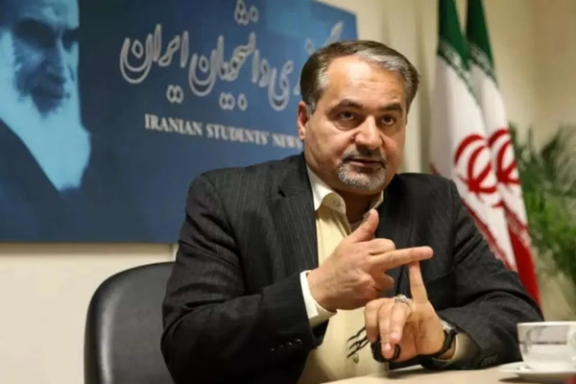
Princeton parts ways with controversial ex-Iranian official after 15 years
Hossein Mousavian
Former Iranian nuclear negotiator and senior diplomat turned Princeton academic Hossein Mousavian has left the university in what is described by Princeton as retirement, while activists call it a dismissal following sustained campaign pressures.
Mousavian’s 15-year tenure at Princeton University ended on June 1, according to an "employee retirements" statement by the university dated June 4.
However, the nonprofit organization Alliance Against Islamic Regime of Iran Apologists (AAIRIA) says his departure was a result of its two-year campaign aimed at exposing his alleged ties to the Islamic Republic and widespread calls for his dismissal.
In a press release on Saturday, AAIRIA said it organized multiple events, press conferences, and engaged with US legislative bodies to highlight concerns about Mousavian’s background, accusing him of supporting terrorism and anti-Israel propaganda.
The group also called for his deportation and prosecution based on alleged involvement in historical assassinations linked to the Islamic Republic.
AAIRIA describes itself as "a group of former political prisoners in Iran, families of executed political prisoners, human rights activists who seek justice and accountability, and international jurists who have examined the record of the Islamic Republic of Iran’s gross human rights abuses."
Princeton University did not respond to Iran International's request for comment.
On August 10, Mousavian said in a post on his X account he retired at his own request.
"After 15 years of service at Princeton University, I retired at my own request at the end of May 2025. I am deeply grateful to the university officials for their support and especially for their commitment to 'freedom of expression."
Mousavian served as a Middle East security and nuclear policy specialist in Princeton's Program on Science and Global Security.
Mousavian was ambassador to Germany when Bonn-based Iranian exile Fereydoun Farrokhzad, a singer and outspoken critic of the Islamic Republic, was murdered in 1992 apparently by agents of the Islamic Republic.
A veteran Iranian commander in March detailed the state's role in his killing, in remarks Mousavian said left him "stunned, amazed, and shocked."
In 2023, several top Republicans, including House Oversight Committee Chairman James Comer of Kentucky and now-DOGE Caucus chairman Aaron Bean of Florida, wrote to Princeton with their concerns about Mousavian's tenure.
Several Republican lawmakers wrote an open letter to Princeton in 2023 expressing their concerns over Mousavian's employment.
"A German court found (the Iranian embassy in Germany) served as the headquarters for the planning of the 1992 assassination of four Iranian dissidents," the letter said, referring to the 1994 assassination of four Iranian-Kurdish dissidents in a Berlin restaurant.
"Did Princeton consult with US government officials regarding the hiring of Mousavian?"
Several Iranian officials have bristled at Donald Trump’s mocking remarks about the slain commander Qasem Soleimani, calling his assassination in a 2020 US drone strike an act of terrorism that should have been avenged by killing American leaders.
On Thursday, during a Purple Heart ceremony at the White House, Trump mentioned Soleimani by name and called him “the father of roadside bombs.”
Immediately after, Trump scoffed, “Where is he? Where is he?” As the attendees burst into laughter, he asked again, 'Where is Soleimani?'"
“There is a simple answer to the question ‘Where is Soleimani?’ He is precisely where your gaze points — at the heights of heaven,” Mohammad Hossein Ranjbaran, an advisor to Iran’s foreign minister, posted on X.
During his first term as president, Trump authorized the 2020 drone strike in Baghdad that killed the senior Iranian commander.
“They killed Haj Qasem, and we should have executed all American leaders because Haj Qasem’s worth was far greater than that,” said Elias Hazrati, head of the Government Information Council.
“But since war was not our strategy, we let it go. Then they martyred our guest Ismail Haniyeh, and still, we chose patience and silence,” Hazrati added.
Hamas leader Ismail Haniyeh was killed on July 31, 2024, along with his bodyguard inside a military-run guesthouse in Tehran shortly after attending the inauguration of President Masoud Pezeshkian.
The killing of Qasem Soleimani sparked outrage among hardliners in Iran, who vowed to exact revenge against Trump.
Iran will stop the establishment of a US-backed transit corridor in the South Caucasus even without Moscow’s help, as it would endanger regional security and alter the geopolitical map, Ali Akbar Velayati, a senior adviser to Iran’s supreme leader, said on Saturday.
“Mister Trump thinks the Caucasus is a piece of real estate he can lease for 99 years,” Velayati told IRGC-affiliated Tasnim News, referring to the route included in Friday’s US-brokered Armenia–Azerbaijan peace deal.
“This passage will not become a gateway for Trump’s mercenaries — it will become their graveyard,” he said, dismissing the idea as “impossible” and “political treachery” aimed at undermining Armenia’s territorial integrity.
He stressed that Iran has “always opposed” the so-called Zangezur corridor, saying it would alter borders, fragment Armenia, and restrict Iran’s own regional access. He said that when Turkey and Azerbaijan previously pushed the plan, Iran staged multiple military drills on its northwestern frontier to signal readiness to block it.
US-brokered deal signed in Washington
Velayati’s remarks came a day after Armenian Prime Minister Nikol Pashinyan and Azerbaijani President Ilham Aliyev signed a US-brokered peace agreement at the White House alongside US President Donald Trump.
The accord grants Washington exclusive development rights to a strategic transit route across Armenia that would link mainland Azerbaijan to its Nakhchivan exclave, without passing through Iran or Russia. The White House said the “Trump Route for International Peace and Prosperity” would boost energy exports and trade across the region.
Armenia and Azerbaijan have been in conflict since the late 1980s over Nagorno-Karabakh, fighting several wars, most recently in 2023 when Baku regained full control of the enclave. Russia mediated in past years, but its influence has waned since its 2022 invasion of Ukraine.
Tehran warns of foreign interference
Iran’s foreign ministry on Saturday said it “welcomes” the peace text as an “important step” toward lasting stability, but warned that projects near its borders should be implemented “within the framework of mutual interests, with respect for national sovereignty and territorial integrity, and without foreign interference.”
Velayati echoed that line, saying “whether with Russia or without Russia, we will move to protect the security of the South Caucasus” and adding that he believes Moscow is also opposed to the corridor on strategic grounds.
NATO ‘snake’ at the border
Calling the corridor “a political plot, not just a trade passage,” Velayati said it would open the way for NATO to position itself “like a viper” between Iran and Russia. He argued that no Armenian government could legitimately agree to the “partition” of its territory, regardless of US pressure, and claimed that even Prime Minister Pashinyan had previously told Iranian leaders he opposed the route.
Iran cautioned on Saturday that any foreign interference near its borders could undermine security in the South Caucasus after Armenia and Azerbaijan signed a US-brokered peace agreement.
“We express our concern about the negative consequences of any foreign intervention, especially in the vicinity of our shared borders, that could harm the region’s lasting security and stability,” the foreign ministry said in a statement.
It said Iran “welcomes the finalization of the peace text by the two countries” as “an important step in achieving lasting peace in the region,” but added that projects near its borders should be developed “within the framework of mutual interests, with respect for national sovereignty and territorial integrity, and without foreign interference.”
Agreement signed in Washington
The announcement came a day after Armenian Prime Minister Nikol Pashinyan and Azerbaijani President Ilham Aliyev signed the agreement at the White House with US President Donald Trump. The agreement includes exclusive US development rights to a strategic transit corridor through the South Caucasus that the White House said would facilitate greater exports of energy and other resources.
That route will connect Azerbaijan and its autonomous Nakhchivan exclave, which are separated by a 32-kilometer-wide (20-mile-wide) patch of Armenian territory. The deal includes an agreement that will create a major transit corridor to be named the Trump Route for International Peace and Prosperity, the White House said.
Armenia and Azerbaijan have long been in conflict over territory and fought several wars. Russia acted as the main mediator for years, but its influence has declined since its 2022 invasion of Ukraine.
Tehran calls for regional framework
The ministry said Iran is ready to continue “constructive cooperation” with Armenia and Azerbaijan through bilateral and regional channels, including the 3+3 mechanism, which brings together Armenia, Azerbaijan and Georgia with Iran, Russia and Turkey to address regional issues without outside powers.
Iran’s revamp of a top national security body signals a ruling system in decline, former US State Department official Len Khodorkovsky told Eye for Iran, calling it “pure theater” and likening it to “rearranging deck chairs on the Titanic.”
“We’re seeing the leadership desperate and flailing away in various ways to try and preserve its control and its hold on power,” he said. “Whether you stand up the defense council, whether you change the name of the currency ... the ship is still sinking.”
Khodorkovsky served as Deputy Assistant Secretary of State during the first Trump administration, working closely with the Special Representative for Iran on the administration’s “maximum pressure” campaign.
Born in the Soviet Union, he emigrated to the United States as a child after experiencing life under the communist system. From abroad, he watched the country of his birth unravel — a collapse that, he says, offers lessons for Iran today.
His prediction rests on a convergence of forces the leadership cannot reverse: an economy in freefall, a public that has lost faith in the system, and leaders resorting to cosmetic moves to mask deep structural decay.
Drawing on the lessons of the Soviet collapse, he argued that once cracks appear in an authoritarian system, its fall can come faster than expected.
Chaired by the president, it includes the heads of the judiciary and parliament, senior military commanders, key ministers, and two representatives of Supreme Leader Ali Khamenei.
Veteran lawmaker Alaeddin Boroujerdi called it “necessary given the current wartime situation,” saying it would allow military and defense decisions to be made “in a concentrated manner” during critical moments. Esmaeil Kowsari, a former Revolutionary Guards commander, said it would speed the chain of command and “with timely strikes, suppress threats.”
The revival of such a body — last active during the 1980–88 Iran–Iraq War — follows a 12-day war with Israel in June, during which Iranian military and nuclear facilities were hit by Israeli and US strikes.
Larijani’s return: rebrand, not reboot
Two days after the council’s creation, President Masoud Pezeshkian appointed Ali Larijani as SNSC secretary.
Khamenei quickly followed, naming Larijani his personal representative to the body. A political veteran, Larijani previously served as SNSC secretary from 2005 to 2007, was speaker of parliament for over a decade, and has long been an adviser to the Supreme Leader.
Khodorkovsky said Larijani’s appointment will not change the system’s trajectory. “They’re trying to look strong externally, but internally the system is rotting,” he said. “The personnel changes are cosmetic — the fundamentals are the same.”
Mounting internal strain
Iran’s ruling system is buckling under severe economic pressure. The rial has collapsed—dropping from around 300,000 per USD in 2020 to over 1 million in early 2025—losing more than 80 percent of its value. Inflation remains among the highest in the world.
For Khodorkovsky, these are the real forces eroding the state’s foundations — and they cannot be reversed by councils or reshuffles.
“You can change the faces, you can change the names, you can create new institutions,” he said, “but when the people have turned away and the economy has collapsed, the end is only a matter of time.”
The National Council of Resistance of Iran (NCRI) denied on Friday that its affiliate, the exiled opposition group Mujahedin-e Khalq (MEK), played any role in the assassinations of two figures involved in Iran’s nuclear program, in a statement sent to Iran International.
The group rejected involvement in the 2010 killing of physics professor Masoud Ali-Mohammadi and the 2011 killing of nuclear scientist Majid Shahriari, calling the allegations “pure lies fabricated by the intelligence services” of the Islamic Republic to “demonize the MEK.”
Response to renewed allegations The statement followed comments by Vida Mehrannia, wife of Swedish-Iranian researcher Ahmadreza Djalali, in an interview with Iran International’s “Cheshmandaz” program, in which she noted that some Iranian state media outlets had accused the MEK of aiding in the scientists’ assassinations.
Djalali was arrested in 2016 while visiting Iran at the invitation of universities in Tehran and Shiraz and later sentenced to death on espionage charges. He has repeatedly denied the allegations, saying they stem from his refusal to cooperate with the Revolutionary Guards in spying on Western countries.
Past denials and nuclear disclosures
The MEK said it has repeatedly condemned Djalali’s death sentence and called for his immediate release, adding that it had previously, including in a 2012 statement, categorically denied involvement in the nuclear scientists’ killings.
While rejecting the assassination allegations, the group emphasized its history of exposing Iran’s nuclear activities. It said to have made 133 disclosures in the past 34 years aimed at preventing Iran from acquiring nuclear weapons, including a May report to Fox News alleging the existence of a secret nuclear site in Semnan province, and a 2020 report that facilities in Tehran and Abadeh were linked to weapons production.