Trump to host Armenia, Azerbaijan for peace deal with corridor at Iran’s doorstep
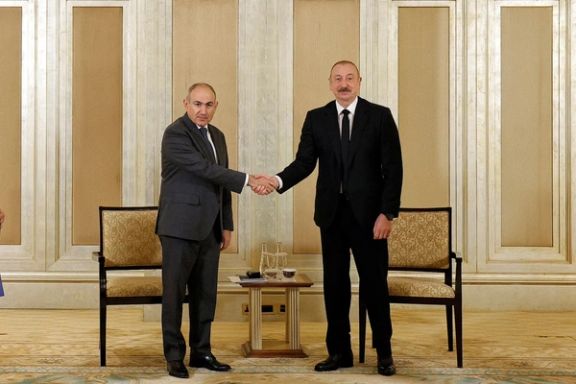
Armenian Prime Minister Nikol Pashinyan and Azerbaijani President Ilham Aliyev meet in Abu Dhabi, United Arab Emirates July 10, 2025.
US President Donald Trump will host Armenian Prime Minister Nikol Pashinyan and Azerbaijani President Ilham Aliyev at the White House on Friday to sign a US-brokered peace agreement creating a transit corridor at Iran’s doorstep, Axios reported.
The deal seeks to end decades of conflict between the two countries and includes a 43.5-kilometer corridor across Armenian territory, Axios reported. The route, to be developed by the United States and called the Trump Route for International Peace and Prosperity, will connect Azerbaijan’s mainland with its Nakhchivan exclave, which borders Iran and Turkey.
Armenia and Azerbaijan have fought over Nagorno-Karabakh since the late 1980s, most recently in 2023 when Azerbaijan seized the territory. The corridor would enable travel and trade between Turkey, Azerbaijan and Central Asia without crossing Iran or Russia. Iran has opposed the project, saying it would cut off its only direct land route to Armenia and reduce its influence in the South Caucasus. Russia has also criticized it, while Turkey supports it.
Washington’s quiet diplomacy
Axios said the Trump administration’s work began in March when White House special envoy Steve Witkoff visited Baku after a trip to Moscow at Qatar’s request. According to a US official who spoke to Axios, Witkoff then asked Aryeh Lightstone, a former aide to US Ambassador to Israel David Friedman and close to Trump’s son-in-law Jared Kushner, to lead the talks. Lightstone made five trips to the region to negotiate with both sides.
The same US official told Axios that negotiators pitched Pashinyan on the idea that by allowing a US-developed route, Armenia would gain a strong partner in Washington and a safeguard against future pressure from Baku. Armenia dropped its long-standing objection to the corridor during these talks.
Geopolitical and economic stakes
The route is expected to boost regional trade by billions of dollars a year, US officials told Axios. It would also limit the role of Russia and Iran, whose influence in the South Caucasus has been challenged since the Ukraine war.
The US official said Tehran fears the corridor will leave it more dependent on Azerbaijan for access to Russia and Europe.
The same official described the plan as “very Trumpian,” focusing on trade and economic growth rather than framing it purely as a security issue, and said the deal opens Armenia to the world and gives it the United States as a key partner instead of Iran.
From quiet talks to public signing
Trump called the upcoming gathering a Historic Peace Summit and praised both leaders for “doing the right thing” for their people in a post on Truth Social.
“Peace is not finalized there is still more work to do, but the accord sets out the main issues and steps to resolve them,” the US official told Axios. The agreement will begin with government-to-government cooperation, with hopes it will grow into warmer relations between citizens over time.
A US-based advocacy group on Thursday called on Washington and its European allies to confront Iran’s transnational repression by issuing a credible military threat, a week after they accused Tehran of plotting to kill individuals in Europe and the US.
"In the past few months, the regime has been escalating its efforts to target civilians in Europe and North America, not least those from within the Iranian diaspora and Jewish community," United Against Nuclear Iran (UANI) said in a statement.
"These acts of transnational repression, which are a flagrant violation of Europe and North America’s territorial sovereignty, must be met with severe consequences," UANI Chairman Governor Jeb Bush and CEO Ambassador Mark D. Wallace said.
“These services are increasingly collaborating with international criminal organizations to target journalists, dissidents, Jewish citizens, and current and former officials,” the US State Department said in a joint statement with European countries.
The UANI statement applauded the US and its European allies for condemning what it called the Islamic Republic's "continuous acts of transnational repression on Western soil."
However, Bush and Wallace stressed that such statements "need to be paired with a diplomatic isolation campaign, sanctions, and the credible threat of targeted military force."
"These cases cannot be handled solely as law enforcement matters where once the authorities thwart the terror plots, the situation is brushed under the rug. This only emboldens the Islamic Republic’s terrorism as it will calculate the benefits outweigh the costs."
The UANI statement urged Western governments to “be on heightened alert for terror plots targeting Jewish communities as well as the Iranian diaspora,” citing explicit death threats from Iran’s intelligence ministry against 45 Iran International journalists.
"It is time to hold #Iran's regime accountable for transnational repression. Just today the regime threatened to execute @IranIntl journalists and their families. It's unacceptable," former Republican presidential candidate Jeb Bush said in a post on X.
Iran International on Tuesday filed an urgent appeal with United Nations experts urging them to take action against Tehran over serious risks to the lives and safety of their journalists worldwide and relatives inside Iran.
Since its formation in 2017, Iran International journalists have been targeted by the Iranian authorities for their reporting. However, since the start of a 12-day war between Iran and Israel in mid-June, the situation has deteriorated rapidly and there is now a real risk to the lives of multiple Iran International staff and to their family members.
A future uprising in Iran could lead to peace with Israel and would be thanks to Israel's attacks on the country in a 12-day war in June, Prime Minister Benjamin Netanyahu told Fox News in an interview on Thursday.
“If the liberation of Iran happens, it will happen because we delivered a very strong blow to Iran’s seeming invincibility, and the people will rise from within,” Netanyahu said.
Netanyahu said he was pleased with the responses he said he received from Iranians following his direct video messages addressed to the Iranian people advocating for the overthrow of the Islamic Republic.
“I’m amazed. Millions and millions of responses from Iran, sometimes with their names, even their faces. You can't believe they’re doing that, but it shows the thirst for liberation there,” he said.
Israel prime minister’s remarks on regime change in Iran came on the same day Tasnim News, an outlet affiliated with the Islamic Revolutionary Guard Corps (IRGC), called the goal of regime change in Iran a futile scheme by Israel.
“In the recent war, Israel bet heavily on political and social collapse in Iran, expecting the public to turn against the Islamic Republic. But what actually happened was the complete opposite of their expectations,” Tasnim said.
Asked about the prospect of more countries in the region normalizing ties with Israel in the so-called Abraham Accords, Netanyahu said he remains hopeful that even Iran might eventually do so.
“Iran could be too, if the people of Iran rise,” he said. “I think many of them want that, they want to relieve themselves of that tyranny.”
Israel launched a series of strikes on June 13 targeting Iranian military and nuclear sites, assassinating senior commanders and killing hundreds of civilians. In retaliation, Iranian missiles killed 29 Israeli civilians.
Asked whether Iran was discussed during a recent call with Russian President Vladimir Putin, Netanyahu suggested Iran's superpower ally did not approve of its uranium enrichment.
“I took note of the fact that (Putin) said Iran should not have nuclear enrichment, which is the American position and our position. I thought that was very good,” Netanyahu said.
The United States on Thursday sanctioned seven people and 11 entities allegedly tied to Iran’s financial and technology networks in what the Treasury Department described as a crackdown on sanctions evasion, repression and hijab law enforcement.
“As a result of President Trump’s maximum pressure campaign and increasing isolation from the global financial system, the Iranian regime is running out of places to hide,” said Treasury Secretary Scott Bessent.
“Treasury will continue to disrupt Iran’s schemes aimed at evading our sanctions, block its access to revenue, and starve its weapons programs of capital in order to protect the American people.”
The designations target Iran’s banking systems, offshore finance networks and technology firms providing surveillance tools to the state.
Among the entities sanctioned is the RUNC Exchange System Company, which developed Iran’s Cross-Border Interbank Messaging System (CIMS), designed to bypass conventional banking controls and facilitate cooperation with sanctioned banks like China’s Bank of Kunlun.
The Treasury also designated Cyrus Offshore Bank, which it said operates from Iran’s Kish Free Zone and is secretly controlled by the already-sanctioned Parsian Bank.
According to the press release, Cyrus Bank has helped route oil proceeds to the Islamic Revolutionary Guard Corps (IRGC).
Other sanctions focused on Pasargad Arian Information and Communication Technology Company (FANAP), a tech firm linked to Iran’s Ministry of Intelligence and the IRGC.
The Treasury said FANAP and its subsidiaries have developed tools used to surveil citizens, enforce internet restrictions, and identify women who defy mandatory hijab laws.
Iran's repaired air defenses and stock of unused missiles mean it can fend off Israeli attack and wreak more damage in another war, a media outlet affiliated with Islamic Revolutionary Guard Corps said on Thursday.
“Iran’s air defense was damaged early in the 12-day war, but since then Iran has rebuilt and modernized its systems. Israel now realizes that Iran’s air defense in a future war would be multiple times stronger,” Tasnim News wrote in an editorial.
One of the most comprehensive official takes from Iran's security apparatus which was badly bludgeoned in the June conflict, the article doubled down on an official narrative that Tehran had triumphed and pledged greater future accomplishments.
Another Israeli attack is highly unlikely, it added, warning that concerns in Iran of renewed hostility in Iran was unhelpful speculation.
“Iran’s missile arsenal remains intact, and some of its most destructive missiles haven’t even been used yet. Any new war would mean greater destruction in Israeli-occupied territories,” the article said.
'Regime change failed'
Israel launched a surprise military campaign on June 13 targeting military and nuclear sites, assassinating senior Iranian commanders and killing hundreds of civilians. In response, Iranian missile strikes killed 29 Israeli civilians.
According to an Iranian government spokesperson, 1,062 Iranians were killed during the conflict, including 786 military personnel and 276 civilians.
The United States capped off the conflict with attacks on Iranian nuclear facilities at Isfahan, Natanz and Fordow with long-range bombers and submarine-launched missiles on June 22. Washington brokered a ceasefire on June 24.
Tasnim also warned that some media outlets and social media users continue to raise the alarm about another imminent Israeli attack. However, it argued that Israel’s core objective “regime change in Iran” had failed.
“In the recent war, Israel bet heavily on political and social collapse in Iran, expecting the public to turn against the Islamic Republic. But what actually happened was the complete opposite of their expectations,” the article said.
In response to the attacks on its nuclear facilities, Iran suspended cooperation with the International Atomic Energy Agency (IAEA), conditioning any future engagement on new terms.
Iran’s foreign minister said on Wednesday that the UN nuclear watchdog must clarify how it intends to inspect nuclear sites bombed by Israel and the United States.
Israel not positioned for a second attack
The article contended that Israel’s surprise attack was the result of years of intelligence preparation, and that replicating such an operation would require years more planning.
“After decades of intelligence gathering and planning, Israel attempted to catch Iran off guard, assassinating commanders, disabling defense systems and aiming for a swift decapitation strike,” the report said.
“It did kill several high-ranking military officials and nuclear scientists, but failed to achieve its main goal: the collapse of Iran’s political and social structure and its defense systems,” Tasnim added.
Among those killed during the war were several senior IRGC commanders, including Armed Forces Chief of Staff Mohammad Bagheri, IRGC Commander Hossein Salami, IRGC Aerospace Force Commander Amir Ali Hajizadeh and IRGC Deputy for Operations Mehdi Rabbani.
“Israel gambled everything on this surprise attack but lost. Rebuilding its intelligence network will now take years, meaning Israel is not logically positioned to mount another assault,” the report said.
An Iranian analyst said in July that Israel had hacked Iran’s entire air defense system during the war and that more than 100 Iranian missile launchers exploded upon activation.
“Israel has already lost a war it spent decades preparing for. With exposed defense systems, internal political chaos, and Iran growing stronger and more united, a second act of aggression would not only fail, but would bring even more devastating consequences,” Tasnim added.
Efforts to disarm Hezbollah will fail, a senior Iranian military official said Thursday, two days after Lebanon's cabinet tasked the army with ensuring it has a monopoly on weapons in the country.
“They are seeking to disarm the resistance in Lebanon, but they will take that wish to the grave,” said Iraj Masjedi, deputy coordinator of the Revolutionary Guards’ Quds Force, according to Iranian media.
“Resistance forces remain fully prepared and equipped, and the Islamic Republic of Iran is completely ready for any scenario,” he added.
Masjedi's remarks followed Beirut’s announcement Tuesday that the Lebanese army would be tasked with collecting weapons from groups operating outside the state’s command.
Lebanon's cabinet instructed the army to develop a plan by the end of the year aimed at creating a state monopoly on weapons—an implicit challenge to Hezbollah, which has resisted disarmament since last year’s war with Israel.
Hezbollah decried the move as a "grave sin" and vowed to ignore it.
The Lebanese government has long been under international pressure to assert monopoly over arms, particularly from Western states who view Iran-backed Hezbollah’s military structure as a parallel force within the state.
Israel, Armed Forces General Staff spokesman Abolfazl Shekarchi said on Thursday, aimed to undermine the Iran-backed network of armed groups in the region.
“The Zionist regime is attempting to alter regional equations, but the resistance front stands firm,” Shekarchi said, naming Hezbollah, Hamas, Yemen’s Houthis, Iraq’s Hashd al-Shaabi and other groups as active components of what he called a growing axis.