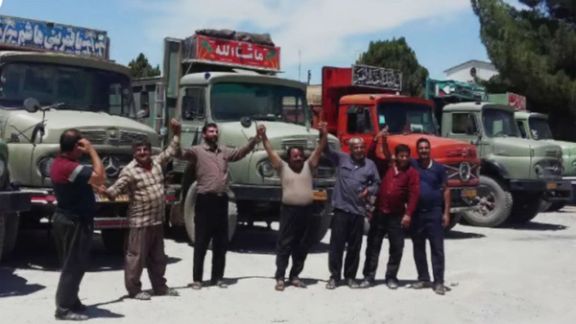
A growing nationwide strike by Iranian truckers could cripple the economy and spark a broader civil movement, experts said on Eye for Iran, calling it the most serious challenge the government has faced in recent years.
“Strikes in Iran, particularly transportation strikes, have the potential to paralyze the regime,” said Alireza Nader, a political analyst and former senior policy advisor at the RAND Corporation, a non-profit, nonpartisan think tank based in the United States.
The truckers’ strike began on May 22 in the strategic port city of Bandar Abbas and has rapidly spread to over 141 cities across Iran in less than a week. What started as a protest against fuel quota cuts has evolved into a nationwide movement exposing deep-seated grievances.
“This unity and solidarity is the result of your determination,” the truckers' union wrote in a statement. “Thanks to all the drivers, small freight operators, teachers, retirees, workers and free citizens who joined us. Our path is clear and we will persist.”
Truckers are demanding fair fuel pricing, insurance coverage, and livable freight rates. Footage from cities like Marivan and Bandar Abbas shows major highways eerily empty, a striking visual of collective defiance.
“If bus drivers, train drivers, and energy workers strike, you have communications, transportation, and energy cut off. That’s why the regime is worried,” said Nader, drawing parallels to the pivotal economic strikes that brought down the Shah during the 1979 revolution.
'A cry for dignity'
For human rights advocate Nazanin Afshin-Jam, the protests are about more than economics.
“This is not just about wages or fuel prices,” she said. “It’s a broader cry against corruption, mismanagement, and the regime’s failure to provide basic needs.”
Economist Mahdi Ghodsi, with the Vienna Institute for International Economic Studies, noted that truckers are emblematic of a larger crisis.
Even basic survival is out of reach for most Iranians. The statistics are chilling:
“60% of Iranians can’t meet basic calorie needs. Truckers earn less than €200 a month and pay European-level food prices,” he said, adding that the Iranian rial has lost 98% of its value since 2011, while inflation hovers above 40%.
Afshin-Jam shared that she regularly receives desperate messages from inside Iran. “Every day I get messages from people saying they have no food, they’re getting evicted. This is the reality across Iran.”
The Islamic Republic's dilemma
Unlike past protests, the truckers are not openly calling for regime change, nor are they violating the law by refusing to work. This puts the Islamic Republic in a difficult position: it cannot easily suppress the strike without risking escalation, nor can it offer concessions without appearing weak—especially amid ongoing nuclear negotiations with the US.
Iran’s freight sector is uniquely decentralized, with over 550,000 drivers operating 433,000 trucks—93% of which are individually owned. This grassroots structure makes the movement harder to crush.
“Most of these truckers own their vehicles. So technically, they’re not breaking any laws by refusing to work,” said Nader. “They’re not explicitly calling for the overthrow of the political system—they just can’t work.”
That ambiguity puts the Islamic Republic in a bind: the strike is disruptive but not overtly political, making it harder to justify a violent crackdown without risking backlash or further unrest.
Nonetheless, the Islamic Republic has begun cracking down. At least 20 people have been arrested, including drivers accused of filming strike footage for foreign-based media.
Echoes of past uprisings
Iran has a history of economic protests turning political. The 2019 “Bloody Aban” or "Bloody November" uprising, triggered by a 200% fuel price hike, quickly morphed into a movement against the government and was met with lethal force.
Today’s trucker strike shows similar signs of escalation. More than 180 rights and student organizations linked to the Woman, Life, Freedom movement have announced their support.
“We're seeing a deep cross-sectional support from other unions, students, teachers, and marginalized groups,” said Afshin-Jam. “This is about justice and dignity.”
Award-winning filmmaker Jafar Panahi and Nobel Peace Prize laureate Narges Mohammadi have also publicly backed the strike. “The strike is a loud cry to the government: enough is enough! Stop the massive suppression and plundering,” Panahi wrote on Instagram.
Iran’s exiled Prince Reza Pahlavi has also voiced his support and advocated for non-violent civil disobedience.
A tipping point?
As the strike disrupts supply chains and inflation worsens, some believe Iran is reaching a critical juncture.
“Economic strikes are hard to suppress because they don’t follow the usual playbook,” Ghodsi explained. “They’re not violent. They’re not demanding regime change. But they can shut the country down.”
Iran’s government is reportedly using trucks linked to the Islamic Revolutionary Guard Corp (IRGC) to transport goods, but experts say this is unsustainable.
Looking ahead, Ghodsi warned of further unrest if the truckers’ demands go unmet. “If this continues, other sectors could join. And that’s when it becomes unstoppable.”
The diaspora’s role
Afshin-Jam called on Iranians abroad and international allies to raise awareness and provide support.
“The Iranian diaspora community needs to dig deep in their pockets and find ways to send money back home to keep this strike going,” she said.
She also urged action from Western governments and labor unions, including the AFL-CIO and the International Labour Organization, to support Iran’s striking workers—much like they did during South Africa’s apartheid era.
For now, the truckers’ movement continues to grow, fueled by desperation—but also by a vision of justice.
Hossein Shariatmadari, the representative of Iran's Supreme Leader in the hardline daily Kayhan, has called on authorities to question French nationals visiting Iran about their stance on Israel, and to detain those who refuse to condemn it.
The suggestion follows the continued detention of Mahdieh Esfandiari, a 39-year-old Iranian translator living in Lyon who has been detained since early March for supporting Hamas' October 7 attack on Israel in Telegram posts.
Shariatmadari framed the arrest as politically motivated and urged a reciprocal response.
"If religious principles do not permit imprisoning them, at the very least, arrest them and then expel them from the country," he said.
In addition to Esfandiari, France has arrested a dual Iranian-French national, Shahin Hazamy, on charge of “apologie du terrorisme,” a criminal charge under French law covering praise of terrorist acts.
The Iranian Judiciary's official news agency Mizan described him as an independent journalist and said the arrest stemmed from his support for Palestine, without citing French legal charges.
Posts on Hazamy’s Instagram account show support for Hezbollah and Palestinian factions backed by Tehran, as well as images taken during recent visits to Lebanon.
Iran’s foreign ministry has criticized both arrests, demanding explanations and consular access. Spokesman Esmail Baghaei said in April that the detentions raised serious concerns over the rights of Iranian nationals in France.
France, meanwhile, says Iran detains French citizens as leverage in diplomatic disputes. Foreign Minister Jean-Noël Barrot urged French nationals not to travel to Iran, citing the risk of arbitrary arrest.
In January the European Parliament adopted a motion for a resolution condemning Iran’s detention of European Union citizens, labelling the practice as “hostage diplomacy" accusing Iran of using the prisoners for political ends.
Western powers are preparing to push the International Atomic Energy Agency’s (IAEA) Board of Governors to formally declare Iran in breach of its non-proliferation obligations for the first time since 2005, Reuters reported on Friday citing diplomats.
Reuter's report said that United States, Britain, France, and Germany are expected to submit a draft resolution at the board’s next quarterly meeting, beginning June 9, after the UN nuclear watchdog issues a comprehensive report on Iran’s nuclear activities and level of cooperation.
According to Reuters, the report is expected to be critical of Iran, particularly in response to a November board resolution demanding improved cooperation.
“We expect the comprehensive report to be tough, but there were already no doubts over Iran not keeping its non-proliferation commitments,” Reuters quoted one European official as saying.
The United States will draft the resolution declaring Iran in breach of its safeguards obligations once the IAEA report is issued, three diplomats were quoted as saying.
A fourth diplomat said the Western powers were already preparing the draft, though did not specify its language.
The last time the IAEA board took such a step was in September 2005, leading to Iran’s referral to the UN Security Council in February 2006. That referral resulted in a series of UN sanctions on Iran.
“The board has passed all recent resolutions proposed by the Western powers on Iran, and there is little doubt that this one would go through as well. The only question is how large the majority would be,” Reuters quoted a diplomat as saying.
Russia and China are expected to oppose the resolution, as they have with past Western-led efforts
At least 20 people have been arrested across Iran since truck drivers launched a nationwide strike on May 22, with political prisoners in Tehran’s Evin Prison voicing support on the protest’s ninth day.
Arrests have been made across Iran, including in the north, south, and west, according to a report on Friday by US-based rights group Human Rights Activists News Agency (HRANA).
The Union of Truck Drivers and Transport Workers called for the immediate release of those detained and vowed to continue the strike until their demands are met.
Drivers are demanding better working conditions, higher freight rates, and relief from high insurance costs and fuel restrictions.
Earlier, the Union of Truck Drivers and Transport Workers had announced that 11 drivers were arrested in Kermanshah and some others in Sanandaj, both Kurdish-populated cities in western Iran.
The union accused security forces of using pepper spray and violence against protesters at the Sanandaj terminal.
Iranian authorities in several provinces confirmed further arrests.
Iran's Revolutionary Guards (IRGC) in Gilan province, in northern Iran, said a citizen was detained in Rasht for allegedly supporting opposition groups.
Its branch in Khuzestan province, in the southwest, reported two arrests in Bandar Imam.
The police chief of Bandar Lengeh, a southern port city in Hormozgan province, said one person was detained for posting a video encouraging participation in the strike, which was shared with foreign-based media.
In Shiraz, located in the south-central province of Fars, the local prosecutor announced the arrest of several drivers on charges of “disrupting transportation,” without specifying how many were detained.
The strike has spread to more than 141 cities despite the crackdown, signaling one of the largest coordinated labor actions in Iran in recent months.
Growing support for strikes
The nationwide strike has drawn support from activists and political prisoners.
On Friday, 13 political prisoners at Evin Prison in Tehran issued a message backing the strike, saying: “We, the political prisoners, stand alongside the truck drivers and all those on strike at this critical moment in history.”
The strike has spread to more than 141 cities despite the crackdown, signaling one of the largest coordinated labor actions in Iran in recent months.
Iran’s exiled prince Reza Pahlavi on Friday called on labor unions around the world to support striking truck drivers and workers in Iran, who he said are risking their lives by demanding their rights amid arrests and intimidation.
“Only in a free Iran will all workers have the right to freely and openly organize,” Pahlavi wrote on X. “I invite you, labor unions and leaders, to stand with your fellow workers in Iran and show your solidarity.”
The truckers’ strike is one of Iran’s largest labor protests in recent years—halting freight, disrupting supply chains, and exposing deeper undercurrents of discontent in a nation already under economic strain.
While the immediate impact is felt on the roads, the strike’s significance reaches beyond transport, tapping into wider frustrations over living costs, state policy, and the struggle for basic economic dignity.
When and where did it start?
The strike began on May 22 in the southern port city of Bandar Abbas and spread quickly. Within two days, drivers in dozens of cities joined.
Truckers in more than 135 cities and towns are on strike now, according to the Alliance of Iran Truckers and Truck Drivers’ Unions (AITTD).
Key provinces crucial to transport, industry, and agriculture—including Kermanshah, Khuzestan, Tehran, Yazd, Kerman, and Esfahan—have been especially affected.
Why are they striking?
Truckers are protesting deteriorating working conditions and rising costs. Their demands include:
Affordable fuel and higher quotas
Relief from insurance and toll fees
Improved road safety and infrastructure
Fairer freight rate calculations, which are state-regulated
At the center of the protest is a new diesel pricing plan that drivers say will make their work financially unsustainable.
What’s the issue with fuel?
Truckers currently receive heavily subsidized diesel at 3,000 rials per liter, based on GPS-tracked mileage and valid cargo waybills. That is about 1.5 cents per gallon.
A new three-tier pricing plan, set for 21 June, would sharply raise prices for fuel used beyond quota limits—up to 250,000 rials per liter at market rate.
Officials say the changes are aimed at curbing smuggling, but drivers argue that quotas don’t reflect real freight needs and that the costs could ruin livelihoods.
Who is organizing the strike?
The AITTD, a semi-underground network active in a 2018 strike, is coordinating the protest via Telegram. Though not officially recognized by the state, it has become a central organizing force.
Government-recognized unions, such as the Union of Nationwide Transportation Truckers’ Cooperatives (UNTTC), have criticized the AITTD, including during a smaller 2023 protest.
How has the government responded?
Authorities have offered limited concessions while cracking down on dissent.
The diesel pricing plan has been suspended pending review, and officials pledged fuel bonuses for non-striking drivers.
At the same time, security forces have arrested drivers accused of road blockades or filming strike scenes. In Kordestan Province, clashes were reported, with police using pepper spray to disperse crowds.
Are others joining in?
Yes. The strike has drawn support from other labor groups and civil society. Some prominent dissidents have endorsed it, and drivers from Snapp—Iran’s version of Uber—have posted videos backing the truckers or joining the protest.
What’s the impact?
The strike’s effects were immediate. Videos and reports show stalled deliveries of agricultural goods, industrial inputs, and supplies for key sectors like steel, petrochemicals, and automotive manufacturing.
The disruption underscores how essential truckers are to Iran’s economic infrastructure.
How important are trucks to Iran’s economy?
Trucks move 80–90% of all domestic freight. In the year to March 2023, nearly 505 million tons of goods were moved by road.
More than 11,000 trucks also cross Iran’s borders daily, underlining the sector’s critical role in regional trade.
As of March 2024, around 365,000 trucks were active in Iran, most privately owned. Only about 28,000 are operated by hired drivers.
The sector’s fragmented, owner-operator model makes it difficult for the government to manage—and easier for strikes to spread.
Iran is conducting increasingly hostile intelligence operations targeting Finland, the Finnish Security and Intelligence Service (Supo) told public broadcaster Yle in comments published Friday.
For the first time, Supo officially named Iran as one of the states actively spying on Finland, alongside Russia and China. The agency did not specify what kind of information Iran seeks but cited a broader rise in espionage threats.
Supo noted that Iran's tactics could include recruiting organized crime groups to carry out operations in Finland—an approach it described as part of Tehran’s use of proxy actors to obscure its involvement. The agency did not provide details on what kinds of acts might be involved but said similar Iranian-linked plots have been uncovered elsewhere in Europe.
Iranian surveillance targets exiles abroad
The agency also warned of surveillance targeting members of exiled opposition groups and other individuals viewed by Tehran as threats, often using personal data collection and pressure on family members abroad.
Supo said Iran’s actions reflect deteriorating relations with Western countries and highlighted that the threat is growing in other Nordic countries as well.
Sweden previously flagged similar threats from Tehran
The warning from Supo comes amid similar concerns raised by Sweden earlier this year. In its March annual threat assessment, the Swedish Security Police (SAPO) said Iran had escalated its intelligence activities and was increasingly using criminal networks within Sweden to suppress opposition and target perceived threats — including Israeli-linked groups. SAPO also reported efforts by Tehran to acquire sensitive dual-use technologies to bypass international sanctions and support weapons programs.
At the time, SAPO accused Iran of using a Shiite mosque in Stockholm for surveillance operations and warned that the security situation could deteriorate in unpredictable ways. That assessment followed a major diplomatic crisis last year, which ended in a prisoner swap between Stockholm and Tehran.