Iran truckers defy crackdown as nationwide strike expands to 140 cities
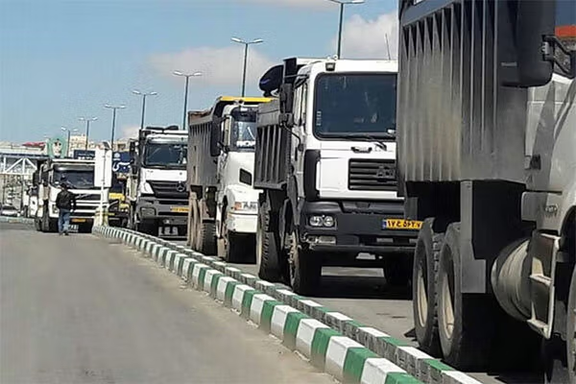
Eight days into a sweeping strike that has paralyzed freight movement across Iran, truck drivers are defying arrests and mounting pressure from authorities, as support for their protest spreads across key sectors.
The Truckers and Drivers Union said on Thursday that strikes had expanded to over 141 cities, vowing to continue until demands are met.
“This unity and solidarity is the result of your determination,” the union wrote in a statement. “Thanks to all the drivers, small freight operators, teachers, retirees, workers and free citizens who joined us. Our path is clear and we will persist.”
Truck drivers first walked off the job on May 22 to protest surging fuel costs, a lack of insurance coverage, and stagnant freight rates. Despite efforts by authorities to suppress the action—including arrests and interrogations in multiple provinces—footage from cities such as Bandar Abbas and Marivan shows major highways emptied of heavy vehicles.
Strikes go beyond occupational grievances
Over 180 rights and student organizations aligned with Iran's Woman, Life, Freedom movement announced their backing for the truckers.
“We do not see this as a purely professional dispute,” they said in a joint statement released on Thursday. “It is part of a broader political and nationwide struggle to reclaim livelihood and dignity.”
They urged other sectors—teachers, factory and service workers, healthcare staff, shopkeepers, students—to form coordination councils and join the movement through synchronized action.
Student groups from Tehran, Kordestan, and Isfahan also lent support, along with teachers’ collectives and grassroots youth organizations.
Iran Labor Confederation, based abroad, called the strike emblematic of systemic repression.
“The truckers’ strike is a response to persistent economic abuse and denial of independent union rights,” the group wrote to the International Labor Organization. It demanded the expulsion of Iranian state delegates from the ILO and the release of detained labor activists.
Iran’s freight industry is unusually fragmented. According to official data, more than 550,000 drivers operate 433,000 trucks, but just 7% are owned by companies. The remaining 93% are controlled by individual owner-operators, making collective pressure harder to dissolve.
“Dispersed ownership is exactly why this strike is so hard to break,” said Firooz Khodaei, head of the truckers union. He confirmed the government has temporarily suspended a tiered diesel pricing plan and invited trucker representatives to participate in policy talks.
Russia and Iran have coordinated a multi-billion-dollar project to produce Iranian-designed drones inside Russia for use in the war in Ukraine, according to report published Thursday by the Washington-based research organization C4ADS.
Leaked records reviewed by C4ADS showed that the Iranian company Sahara Thunder collaborated with the Russian firm Alabuga JSC to transfer the technology and expertise needed to produce a variant of the S-136 drone, which Russia used in military operations against Ukraine.
“This collaboration spanned multiple years and persisted in the face of global censure and sanctions against both countries,” the report said.
C4ADS said Sahara Thunder was “deeply embedded in state defense networks” and operated as “a prime example of Iran’s use of middlemen to carry out its activities,” while Russia leveraged Alabuga JSC for defense industrial use. Both firms had long-standing ties to their respective governments, the report said.
The investigation found that the companies used a UAE-based intermediary to conduct parts of their partnership, allowing them to “minimize evidence of direct contact in the UAE’s low-barrier business environment.”
Alabuga JSC made payments through wire transfers via the UAE and gold shipments. “The combination of the two offered agility in circumventing sanctions,” the report said.
C4ADS said the cooperation expanded beyond the drone project. “Reciprocal visits by both parties served not only to expand UAV localization but also focused on other defense industrial domains,” it said.
Iranian authorities have arrested several individuals accused of filming ongoing truckers’ strike activity in the south of the country and sending the footage to foreign-based media, Iranian media reported.
According to a statement from the Islamic Revolutionary Guard Corps (IRGC) in Khuzestan province, the suspects were identified and detained following intelligence operations.
The suspects are accused of trying to create “media pressure” against the state by sharing videos of strike scenes with what officials described as “hostile networks.”
“These individuals, with the goal of fueling media pressure against the Islamic Republic, had recorded and sent multiple videos of truckers’ gatherings and strikes to anti-Iranian networks,” the statement said.
The arrests come as a nationwide truckers’ strike enters its second week, disrupting freight transport across Iran. The protest, launched over fuel quotas and working conditions, has affected major transport hubs and drawn increased attention from security forces.
The IRGC said the detainees have been handed over to judicial authorities for further proceedings.
US President Donald Trump said on Thursday that a new nuclear agreement with Iran was close despite persistent public disagreement over enrichment, though media reports citing sources close to the talks suggested various novel ways out of the impasse.
“We are very close to a solution,” Trump said on Wednesday. “If we can make a deal, I’d save a lot of lives," adding that Iran appears willing to engage seriously and that they had constructive discussions.
The talks mediated by Oman have entered crunch time with no date and location yet announced for a sixth round.
The United States and Iran are nearing a broad agreement on the future of Tehran’s nuclear program, CNN reported on Wednesday, with talks progressing in recent weeks toward a framework that could be finalized at a future meeting.
Washington and Tehran are considering a potential multinational consortium—possibly including regional partners and the International Atomic Energy Agency—to produce nuclear fuel for Iran’s civilian reactors and may include US investment, CNN reported citing source familiar with the talks.
A White House official, speaking to Fox News, said nothing had yet been agreed on Iran’s nuclear energy program.
Iran denies enrichment freeze proposal
Tehran says its nuclear program is purely peaceful but Western countries and its Mideast adversary Israel doubt its intentions.
Iran says it is keen to reach a nuclear deal but has maintained a right to domestic enrichment despite US demands to shutter it.
Iran on Thursday denied a Reuters report citing two Iranian officials saying they were mulling a proposal to halt uranium enrichment for a year and ship part of its highly enriched stockpile abroad or convert it into fuel plates for civilian nuclear purposes.
“The continuation of enrichment in Iran is a non-negotiable principle,” Foreign Ministry spokesman Esmaeil Baghaei said Wednesday.
The suggestion mulled by Iranian officials, according to the sources cited by Reuters, envisions the disbursement of funds frozen by Washington and the recognition of Tehran's right to enrich uranium for civilian use in return for the pause.
Meant as a political deal that could pave the way for a broader accord, the proposal not yet been floated in the talks, Reuters cited the Iranian sources as saying.
Austria on alleged Iranian nuclear arms ambitions
Austria’s domestic intelligence agency released a report this week saying Iran's program to develop nuclear arms is far advanced, in wording which appeared to outstrip that of its Western counterparts.
"Nuclear weapons are intended to make the regime untouchable and to expand and consolidate its dominance in the Near and Middle East and beyond," the Austrian Federal Office for the Protection of the Constitution said in its annual report.
"The Iranian program for the development of nuclear weapons is far advanced."
The United States has publicly assessed that Iran has not yet decided to build a nuclear weapon but maintains that its nuclear program is aimed at becoming a nuclear threshold state to deter foreign attack.
The Austrian report further alleged that Tehran aims to develop long-range ballistic missiles capable of delivering nuclear warheads, without citing any evidence.
"An arsenal of ballistic missiles is ready to carry nuclear warheads over long distances."
Iran open to US inspectors
In an apparent policy shift, the head of Iran’s Atomic Energy Organization said Tehran may reconsider its longstanding ban on US nuclear inspectors if current talks with Washington lead to a successful agreement.
Mohammad Eslami said American inspectors affiliated with the International Atomic Energy Agency (IAEA) could be allowed into Iranian sites under a future deal, despite current restrictions on personnel from adversary states.
“It is normal that inspectors from hostile countries are not allowed, but if a nuclear deal is reached, we might allow American inspectors,” Eslami said.
Later on Wednesday, IAEA chief Rafael Grossi said any deal between Tehran and Washington that would impose fresh nuclear curbs on Iran should include very robust inspections by the UN nuclear watchdog.
"My impression is that if you have that type of agreement, a solid, very robust inspection by the IAEA ... should be a prerequisite," he said.
"I'm sure it will be, because it would imply a very, very serious commitment on the part of Iran, which must be verified."
US officials have repeatedly said that any new nuclear deal with Iran to replace a lapsed 2015 accord between Tehran and six world powers must include a commitment to halt enrichment, viewed as a potential pathway to developing nuclear bombs.
Iran's stockpile of 60% enriched uranium had increased to 275 kg, enough to theoretically make about half a dozen weapons if Iran further enriches the uranium.
Trump has previously warned that if no agreement is reached, military options remain on the table. “We can blow up a lab,” he said, referring to a hypothetical enforcement scenario under a possible inspection regime, “but nobody’s going to be in the lab.”
Trump, speaking to reporters, also confirmed that he warned Israeli Prime Minister Benjamin Netanyahu not to interfere with ongoing US-Iran negotiations.
The comments followed a New York Times report citing Israeli officials saying the Jewish State was preparing for a potential strike on Iranian nuclear sites even if Tehran and Washington clinch a deal.
The Islamic Republic has entered a new phase of security governance—one where control is no longer maintained solely through arrests and bullets, but through data analysis, surveillance, and information engineering.
This shift from overt violence to algorithmic discipline is framed in official discourse as “smartification” and “psychological security”—buzzwords that mask a deeper objective: building a more efficient, anticipatory system of social control.
As Iran negotiates with the United States abroad, it is preparing for a future at home without a deal. Figures once tainted by high-level corruption—such as Babak Zanjani—are now rhetorically rehabilitated as symbols of national resilience, reflecting a broader effort to rebrand dysfunction as discipline.
Authorities are deploying everything from internet monitoring and mobile signal tracking to facial recognition, shop surveillance, and even mandatory in-home cameras to build a digital control society. The goal: neutralize dissent before it begins.
This new architecture of repression aims to present a softer, even “benevolent” face of policing—one nearly invisible thanks to smart technologies. The result is a seamless, predictive regime designed not only to watch citizens, but to sort, anticipate, and contain them.
Policing internet, profiling people
In recent years, the Islamic Republic has adopted a more systematized and technical approach to digital control.
A clear marker of this trend was the resolution passed by the Supreme Council of Cyberspace in January 2025. While billed as a plan to “lift filtering,” the directive in practice expands regulation of online activity.
It authorizes the government, along with the Ministry of Culture and the Judiciary, to police “criminal content,” restrict VPNs, and penalize the spread of so-called “fake news.”
This legislative tightening is matched by tactical enforcement. During protests in Izeh in March 2024, authorities imposed localized internet shutdowns that left hundreds of thousands offline. These quiet, surgical disruptions have become a recurring method of quelling unrest.
In parallel, authorities deactivated SIM cards of journalists, activists, and political users—targeting not speech, but connection itself.
The same tools are now used to enforce dress codes. In Isfahan, authorities reportedly use contactless payment readers and surveillance cameras to identify women who defy compulsory hijab.
Threatening messages are sent not only to the women, but to their families—a form of psychological policing that leverages fear and shame.
Urban surveillance, algorithmic control
These measures show no sign of slowing. In May 2025, traffic police announced plans to use facial recognition for pedestrian violations—a tool once limited to license plates now trained on people.
In October 2024, the national police (FARAJA) began equipping 50,000 officers with body cameras that livestream to command centers, turning patrols into mobile surveillance nodes.
Surveillance is also extending into the private sector. Under the “Septam” system launched in late 2024, businesses must install cameras linked to law enforcement to receive operating licenses.
In April 2025, building codes were updated to require surveillance cameras in any residential or commercial complex with four or more units. The state now watches not just public streets but the thresholds of private homes.
These initiatives fall under the “Police Smartification” plan outlined in the FARAJA Architecture Document. Though couched in the language of public service, its purpose is unmistakable: to restructure digital and urban life for maximum predictability and control.
Pre-empting dissent
The driver behind this system is not technological ambition—it is fear. Officials anticipate the return of mass protests, spurred by economic hardship, power outages, and the possible failure of negotiations.
In response, they are building a pre-emptive framework of repression, where law and policing blur, and surveillance becomes the default mode of governance.
This strategy does not merely suppress resistance—it aims to erase the very possibility of it. By severing communication, dissolving public and digital spaces, and inducing despair, the state hopes to prevent disobedience not just in action, but in thought.
If realized, Iran will not merely be a surveillance state—it will be an anticipatory one. A state where individuals are profiled, categorized, and neutralized before they act.Where repression no longer wears a uniform, but operates silently—to predict and pre-empt dissent.
A week into a sweeping truckers’ strike in Iran, the protest appeared to be continuing unabated despite increased arrests by authorities according to sources close to the movement.
Initially launched to protest fuel quotas and working conditions, the industrial action has brought freight traffic to a standstill. Videos from Bandar Abbas, Marivan, and the Kahak-Qom highway show deserted routes normally busy with cargo trucks.
Authorities have escalated efforts to suppress the strike with arrests, sources close to the strikers told Iran International, adding that security forces have summoned many drivers and detained some.
The truckers union on Wednesday called for immediate and unconditional release of those arrested, reporting crackdowns in several provinces including Isfahan, Hormozgan, Fars, Kermanshah, Ardabil and Khuzestan.
On Tuesday, the Islamic Revolutionary Guard Corps (IRGC) in Kerman province announced it had dismantled an “organized anti-security network,” though it gave no details or clear link to the strike.
Drivers are calling for better working conditions, higher freight rates, and relief from high insurance costs and fuel restrictions.
IRGC-affiliated vehicles have been spotted transporting goods, in what appears to be an attempt to break the strike.
One citizen who filmed an IRGC-marked truck told Iran International the force was stepping in to cover routes abandoned by striking drivers.
Hard to break
The government faces a logistical and political challenge. Despite efforts since 2018 to increase corporate control of the freight industry—doubling the number of company-owned trucks and drawing figures like Babak Zanjani into the sector—most trucks remain in private hands.
Official data shows that 552,000 drivers operate 433,000 trucks nationwide. Of those, just under 7% (around 30,000) are company-owned, while the rest are controlled by individual owner-operators, many of whom are now aligned with the strike.
The action could be poised to spread beyond truck drivers, with some working for ride share company Snapp voicing solidarity.
In messages sent to Iran International, one driver said he would continue to strike alongside the truckers; another urged colleagues and other professions to join the movement.
Officials announced on Wednesday that a plan to introduce a tiered diesel pricing system was suspended—in appeared to be a government response to a key demand of the strikers.
“All aspects of fuel allocation will be reviewed with the participation of trucker representatives,” head of truckers union Firooz Khodaei said.