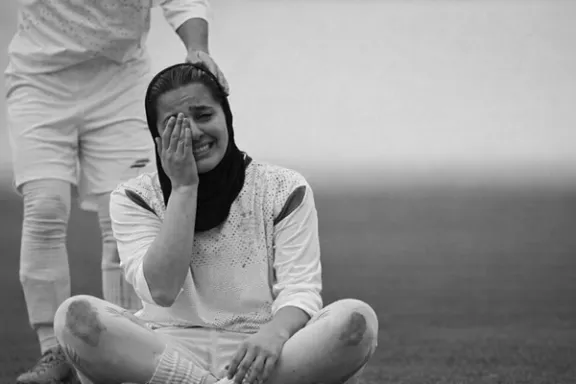
Maryam Mohammadhosseini, a player for the Esteghlal women’s team, refrained from celebrating after scoring on January 19, 2026 and instead broke down in tears.
With tens of thousands killed and society still reeling, the Islamic Republic has turned to sport to project normalcy as matches return, but players’ muted celebrations and empty stadiums show how little of the script still holds.
Iran’s bid for normalcy via sport: Matches return but players refuse the script | Iran International
Domestic leagues have resumed, fixtures have been brought forward, and state-aligned media have amplified claims that the country is returning to ordinary life.
That portrayal clashes with lived reality. Even under severely restricted internet access, videos of brutal crackdowns – particularly from January 8 and 9 – have circulated, showing the scale of violence used against protesters.
Much of society remains in mourning. Families are grieving thousands of young people, including dozens of athletes, and official claims of normalcy ring hollow. What disrupts the state’s carefully assembled image are unscripted gestures that resist being folded into the official storyline.
The match goes on but the joy does not
For the state’s project of normalcy to work, sport must deliver more than competition. It must deliver emotion. A goal is meant to be followed by celebration; a win is meant to bring release. Instead, a visible rupture has set in. Players score and walk away. The whistle blows and faces remain closed, expressions blank.
In recent weeks, many players have kept their celebrations muted as a gesture of solidarity with the uprising and a mark of respect for the dead, including fellow athletes – while stopping short of openly defying orders to play.
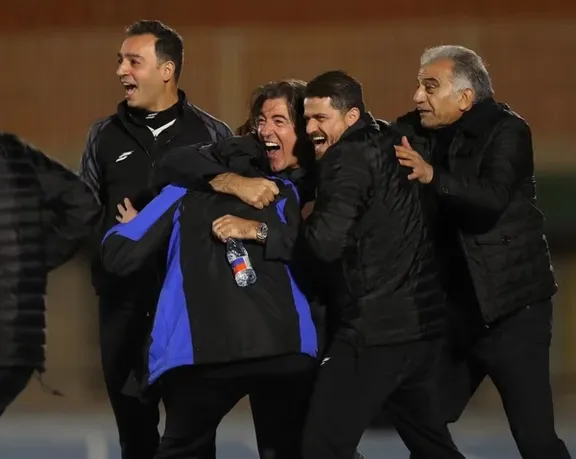
That tension has also fueled backlash against the few moments that look like unguarded celebration or emotion. After a Mes-e Rafsanjan F.C. victory and following Esteghlal F.C. staff reactions to a disallowed goal against Tractor S.C., criticism spread quickly across social media.
Former national team player Mohammad Taghavi voiced the sentiment plainly, arguing that players should not be taking the field at all.
“These footballers had no right to play under these circumstances. They could have claimed illness and avoided playing,” he told Iran International.
Coaches of Esteghlal F.C. react after a goal was disallowed against Tractor S.C. on January 18, 2026.
Sports journalist Mohsen Salehi described the resumption of matches as a staged display, even when players refrain from celebrating.
“The regime wants to turn footballers’ legs into tools of propaganda, projecting a false image in which life appears to be continuing as usual,” he wrote.
The question remains whether athletes – especially footballers – are willing to become props in that spectacle. When a country is in mourning, sport cannot remain a neutral island. Footballers are not only players; they are public figures with obligations to the communities that elevated them.
“Running on a field that reeks of blood is participation in a grand lie. Until the true scale of this repression is made clear and those who ordered and carried out these crimes are held accountable, what value does soccer really have? Players stand before the judgment of history. They must choose between being instruments of power or standing with the people,” Salehi added.
Taking such a position can carry consequences for the players.
though those costs pale in comparison with what the country is enduring. Tehran prosecutor has recently opened cases against 15 sports figures and actors for supporting the national uprising.
round the same time, reports emerged that Persepolis F.C. player Reza Shekari and Omid Ravankhah, head coach of Iran’s under-23 national team, were briefly detained on arrival at Tehran’s international airport over support for the protests.
Women’s soccer and foreign involvement
Signs that normalcy has not returned are also visible in institutional decisions. Farideh Shojaei, the federation’s vice-president for women’s football, announced the cancellation of two planned women’s national team friendlies against Uzbekistan and Belarus.
At club level, foreign participation has also thinned. Assistants to head coach Dragan Skočić at Tractor S.C., and one assistant to Ricardo Sá Pinto at Esteghlal F.C., have terminated their contracts. Several foreign Esteghlal players who left Iran during the mid-season break have yet to return.
The departures appear driven less by symbolic protest than by risk assessments. Matches continue, but confidence – especially among outsiders – has not been restored.
Tears as a counter-image
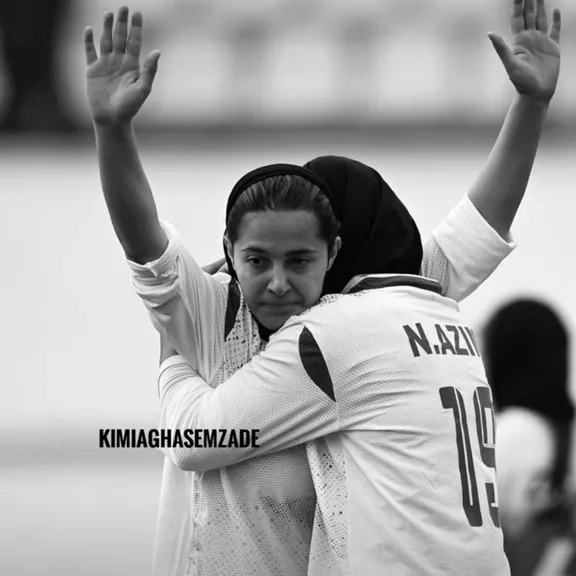
One of the most destabilizing moments for the state’s push for normalcy came in a single image: a women’s footballer scoring and then crying. In the visual economy of state messaging, it was the opposite of what is needed. A smile would complete the frame. Tears break it.
Maryam Mohammadhosseini, a player for the Esteghlal women’s team, refrained from celebrating after scoring on January 19, 2026.
Last week, Maryam Mohammadhosseini, a player for the Esteghlal women’s team, did not celebrate after scoring and instead broke down in tears.
The image spread quickly because it showed what the official narrative tries to contain. Athletes can compete while remaining psychologically unsteady. Participation is not the same as emotional recovery. The body registers what the script denies.
Empty stadiums, louder signals
Matches continue, but spectators remain barred from stadiums, extending the same logic of control. The ban reflects authorities’ fear that protest chants and political displays could erupt on live broadcasts.
A match without a crowd may be technically possible, but for many it is drained of meaning. There is an image, but no collective response.
The limits of performative normalcy are even clearer beyond Iran’s borders.
The Asian Football Confederation has ruled that Iranian clubs cannot host certain continental matches at home, moving them to neutral venues. Under the decision, Esteghlal F.C. and Sepahan S.C. will stage Asian Champions League fixtures outside Iran, while Tractor S.C. will play on neutral ground.
If conditions were genuinely stable, those clubs would be allowed to host. A version of “normal” that holds only within domestic media does not withstand external assessment.
A growing list of athletes killed
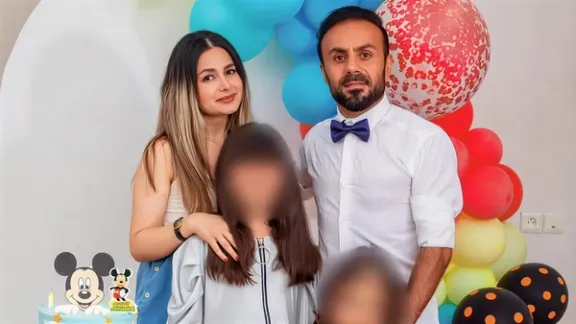
Rights groups and media reports have documented the deaths of numerous athletes during protests so far, including former beach soccer national team goalkeeper Mohammad Hajipour; karate champion and referee Hassan Ghasemi; boxer Arshia Ahmadpour; mountaineer Sara Behboudi; women’s football assistant referee Sahba Rashtian; youth players Amirhossein Mohammadzadeh and Rebin Moradi; and former Tractor player Mojtaba Tarshiz, who was killed while shielding his wife.
Mojtaba Tarshiz, a former player for Tractor S.C., was killed after being shot by Islamic Republic security forces during the Iranian national uprising against the Islamic Republic.
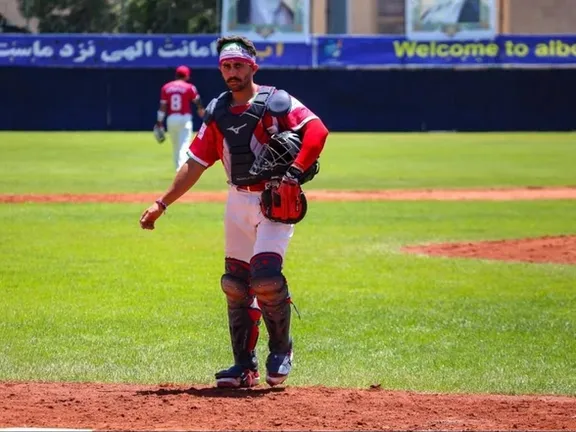
The most recent confirmed case is Ahmad Ramezanzadeh, a catcher for the Iran national baseball team, who was killed after being shot with a handgun in eastern Tehran.
Ahmad Ramazanzadeh, a catcher for the Iran national baseball team, was killed by a handgun shot by security forces during protests in eastern Tehran on January 8, 2026.
Other confirmed cases include soccer coach Milad Lavasani, futsal figure Amirmohammad Kouhkan, bodybuilder Masoud Zatparvar, taekwondo coach Afshin Mirkiani and arm-wrestling champion Erfan Bozorgi.
These are not the only athletes killed by the Islamic Republic. More names are likely to emerge in the future, as thousands of victims have yet to be identified.
More than 36,500 Iranians were killed by security forces during the January 8-9 crackdown on nationwide protests, making it the deadliest two-day protest massacre in history, according to documents reviewed by Iran International's Editorial Board.
Iran International's Editorial Board can confirm the death toll after reviewing newly obtained classified documents, field reports, and accounts from medical staff, witnesses, and victims’ families.
The new information provides a clearer picture of the killing pattern and the scale of a crime that can now be described as the largest and bloodiest massacre of civilians during street protests, over a two-day period, in history.
Iran International has received reports and evidence indicating the extrajudicial execution of a number of detainees in Tehran and other cities. Images released from morgues leave little doubt that some wounded citizens were shot in the head while hospitalized and undergoing medical treatment. It is evident that, had these individuals sustained fatal head wounds on the streets, there would have been no reason to admit them to hospital or begin treatment in the first place.
The images also show that in some cases, medical tubes and patient-monitoring equipment remained attached to the bodies. In other cases, cardiac monitoring electrodes are visible on the chest, suggesting these individuals were under medical care before being shot in the head. A number of doctors and nurses have also told Iran International that so-called “finishing shots” were fired at wounded patients.
That figure was explicitly cited in a report by the IRGC Intelligence Organization submitted to the Supreme National Security Council and the Presidential Office on January 11, two days after the two-day massacre, reviewed by Iran International.
36,500 killed in 400 cities
Our Editorial Board has now obtained more detailed information provided by the IRGC Intelligence Organization to the Supreme National Security Council.
Other state institutions have also received differing figures from other security bodies. However, given the scale of the killings, deliberate concealment, and what appears to be intentional disorder in the registration and transfer of bodies – along with pressure on families and, in some cases, the quiet burial of victims – it appears that even the security agencies themselves do not yet know the precise final death toll.
In a report presented on Wednesday, January 21, to the Iranian parliament’s National Security and Foreign Policy Committee seen by Iran International, the number of those killed was listed as at least 27,500.
According to sources within Iran’s Interior Ministry who spoke to Iran International on condition of anonymity, a consolidation of figures received from provincial security councils by Tuesday, January 20, showed the death toll had exceeded 30,000.
Two informed sources from the Supreme National Security Council also told Iran International that in two recent reports by the IRGC Intelligence Organization, dated January 22 and January 24, the number of those killed was listed as more than 33,000 and more than 36,500 respectively.
Interior Ministry reports say security forces confronted demonstrators in more than 400 cities and towns, with more than 4,000 clash locations reported nationwide.
Despite the confusion and concealment, the rapid increase in death toll figures in classified government reports has heightened concerns that the actual number of those killed may be even higher.
Due to communication restrictions and security pressure, independent verification remains impossible. However, based on credible information from hospital sources and eyewitnesses, the number of deaths in several major cities is described as shocking.
Conservative assessments by medical sources, based on the number of bodies delivered to hospitals and medical centers, estimate more than 2,500 killed in Rasht, at least 1,800 in Mashhad, more than 2,000 in Isfahan, Najafabad, and Khorasgan, at least 3,000 in Karaj, Shahriar, and Andisheh, 700 in Kermanshah, and 400 in Gorgan.
No clear aggregate figure has yet been obtained for Tehran. However, images released from Kahrizak morgue and hospitals across the capital indicate that thousands were killed in Tehran, with a significant proportion of the deaths occurring in southern Tehran.
Horrifying details of a historic crime
1 - Three doctors and four nurses in Tehran who spoke to Iran International said security forces entered hospitals and took away some wounded patients who were undergoing treatment. Images received by Iran International, along with videos circulating on social media, also show that some bodies with gunshot wounds to the head bear clear signs of hospitalization.
Two other nurses told Iran International that after a wounded young man was transferred to an ambulance in a clash area in western Tehran, a security agent suddenly entered the vehicle and, in front of them, killed him by firing two consecutive shots. The nurses said the man had been severely beaten before being moved and was semi-conscious. A trusted specialist physician at a Tehran hospital confirmed their account.
There are also reports that individuals were detained at home and that their families were later told to go to Kahrizak to collect their bodies. Other reports say security forces went to homes and drew people to the door – including under the pretext of delivering a package – before shooting and killing them.
These deeply alarming reports have in recent days been published by families or provided to Iran International by credible eyewitnesses.
If confirmed through independent investigation, the accounts would amount to clear cases of extrajudicial killing and, if found to be widespread, could be examined under the rubric of crimes against humanity.
The withholding of detainee numbers, the unknown locations of detention sites, and the lack of clarity over prisoners’ access to medical care and legal representation have heightened concerns among human rights activists.
A prominent lawyer inside Iran, who requested anonymity, described the situation as an “international human rights crisis.” He said, “Unofficial reports indicate that tens of thousands have been arrested, and the IRGC or whichever security body has custody of them can kill as many as it wants, send their bodies to Kahrizak or other morgues, and claim they were killed on the streets.”
2 - The organized killings across Iran indicate the brutal crackdown was carried out with the agreement and cooperation of state institutions and on the orders of the highest authorities of the Islamic Republic.
According to information received by Iran International, following a speech by Supreme Leader Ali Khamenei on January 9, phrases such as “al-nasr bil-ru‘b” (victory through terror) and “fight them until there is no sedition” were used in briefings and discussions among senior IRGC commanders. The same phrases also appeared on January 9 in Telegram channels affiliated to hardliners.
3 - Numerous reports and other evidence indicate that in many cities, bereaved families were forced to pay large sums described as “bullet fees” in exchange for receiving the bodies of their loved ones. In some cases, despite families’ objections, those killed were presented as members of the Basij militia.
4 - While most of the killings were carried out by IRGC and Basij forces, reports received by Iran International indicate that proxy forces from Iraq and Syria were also used in the crackdown. The deployment of non-local forces suggests a decision to expand repression capacity as quickly as possible.
Should Iran International obtain further information, it will inform its audience in subsequent statements.
Call for submission of evidence
Iran International once again calls on all compatriots inside and outside the country to send any documents, videos, photographs, audio testimonies, information about those killed or wounded, medical centers, locations of clashes, timing and geography of events, and any verifiable details related to the events of the past weeks.
The security of sources and confidentiality of information are our highest priorities. If you are concerned about your safety, do not send identifying information and provide only general, verifiable details.
Following verification and careful assessment, Iran International will publish its findings and share them with all relevant international bodies and institutions.
The truth will be recorded and documented. The names of the victims will be preserved. This crime will not be buried in silence.
Iran’s state broadcaster has reached a point where control no longer translates into attention, exposing how years of manipulation, omission and distrust have hollowed out its authority and left a system that still fills airtime but is no longer watched.
Islamic Republic of Iran Broadcasting has lost the few audience it once assumed it possessed. According to a 2024 survey by the state-run ISPA, only 12.5 percent of Iranians follow the news through the state broadcaster, and 11.5 percent watch films and TV series on state TV.
Viewers have migrated elsewhere, disengaged, or stopped watching altogether. The result is a broadcaster that retains infrastructure and reach on paper but has been stripped of public relevance in practice.
This erosion matters because the system was never designed to retain an audience. Its function was to define reality by default, assuming passive consumption rather than active belief. Once viewers disengaged, repetition lost its force. Control of distribution no longer compensates for the absence of viewers.
During moments of nationwide crisis, when internet shutdowns leave citizens with few information sources, state television no longer functions as a reference point. Instead, it serves as a tool of narrative management: selecting what can be shown, omitting what cannot be explained, and substituting political reality with staged images of normalcy.
Broadcasting without an audience
For decades, Iran’s media model assumed a captive audience. State television and aligned agencies – particularly Guards-affiliated outlets such as Tasnim and Fars – operate not as independent newsrooms but as synchronized instruments of governance. Their role has been to speak in a single vocabulary, regardless of whether anyone is listening.
This model depends on two conditions: uninterrupted control of distribution and a public compelled to accept official framing as the baseline. Periods of unrest strain both. Authorities respond by narrowing the information space – blocking platforms, jamming opposition satellite networks, sidelining independent outlets and cutting internet access – to prevent images and testimony from circulating outside official filters.
Yet this strategy also exposes weakness. When viewers are forced back to a channel they no longer trust, omissions and contradictions become more visible, not less. Absence of alternatives does not restore authority; it highlights how little credibility remains.
Managing perception through omission
One of the clearest techniques used by Iranian state media during crises is substitution: replacing destabilizing political reality with curated depictions of normalcy. While protests across the country have been driven by explicit rejection of the political system – including chants calling for the overthrow of Supreme Leader Ali Khamenei – state television has persistently reframed unrest as a response to economic pressure.
Instead of addressing violence, casualties or political slogans, IRIB dispatched reporters to city streets to highlight the availability of basic goods such as chicken meat. These segments emphasized supply while omitting that prices had surged several times over in recent weeks.
By focusing on availability rather than affordability – and by recasting a political uprising as economic grievance – the broadcasts constructed an image of stability. The effect was to depoliticize a movement defined not by price demands, but by calls for the end of the ruling order.
Alongside omission sits coercive performance: televised confessions aired by Fars and Tasnim from detained protesters presented as “leaders” of unrest. These segments are not designed to persuade skeptics. They function as demonstrations of power, signaling the state’s ability to script guilt and enforce compliance.
From staged crowds to synthetic reality
What distinguishes the current phase is not the presence of propaganda, but its tools. Traditional methods – recycled crowd shots, selective framing and inflated attendance claims – have long been used. What is new is reliance on digitally manipulated or AI-assisted content that blurs the line between documentation and fabrication.
A recent example illustrates such shift. State media circulated a video presented as aerial helicopter footage of pro-government rallies, promoting it as evidence of mass popular support. Viewers quickly questioned its authenticity, pointing to visual inconsistencies in lighting, movement and composition, as well as the absence of basic helicopter safety features.
The state’s instinctive response – denial, external blame and further restriction – reinforced the cycle. Each tightening of control signaled anxiety. Each refusal to address substantive questions accelerated the erosion of credibility.
Whether every technical critique was correct was secondary. The significance lay in the reaction. Official visuals were no longer treated as authentic; they were examined as artifacts to be tested for manipulation.
This marked a shift from propaganda as persuasion to propaganda as evidence production. The aim was no longer only to frame events, but to manufacture visual proof. Paradoxically, the more sophisticated the techniques, the faster trust eroded.
Rasht Bazaar: A disaster told through one voice
The fire at Rasht’s central bazaar showed how narrative control operates under blackout conditions.
During protests in the northern city on January 8 and 9, a large section of the historic market caught fire as internet and phone services were cut, limiting residents’ ability to document events. State television retained full operational capacity and sent reporters to the scene while the fire was still burning.
Official coverage attributed the blaze to protesters and focused on material damage, repeatedly citing the number of shops destroyed. Casualty figures were absent. Later segments emphasized economic losses through interviews with selected shopkeepers and officials, while avoiding scrutiny of security forces.
Eyewitness testimony carried by Iran International described a sharply different sequence: crowds pushed toward the bazaar, people trapped by smoke in narrow corridors, and security forces firing on those emerging with raised hands to surrender.
In this environment, state broadcasting operated with technical access but without an audience willing to accept its account. The absence of open networks and real-time citizen reporting produced a one-sided evidentiary landscape shaped by coercion and selective disclosure.
Rasht Bazaar
Beyond access: a crisis of credibility
Iran’s media crisis is often framed as a problem of access – blocked platforms, censored outlets and restricted bandwidth. It is more fundamentally a crisis of credibility.
A broadcaster that has lost its viewers may still produce content, but it no longer produces belief. Control without an audience is not influence. And in politics, messages that are not believed might as well not be seen.
As Iran’s authorities impose silence through violence and disconnection, what the world is witnessing is not unrest but defiance at its most basic—people refusing to disappear, to be reduced to numbers, or to surrender their names.
For more than two weeks and counting, the country has existed inside a manufactured silence. The public internet, the basic infrastructure of modern life, has been reduced to rumor and fragments. What remains functional are the regime’s approved channels, whitelisted networks that keep the state connected to itself while cutting the country off from civic circulation.
From outside Iran, this condition is often described as another episode of unrest. From inside, it feels closer to a new revolution that has already cost the country thousands of lives.
Iran has experienced a massacre and entered a post-massacre moment, a phase in which the state no longer performs restraint. It kills, buries, rewrites the narrative, and disconnects.
The blackout is not a byproduct of disorder. It is part of the machinery. Violence is easier to carry out when it is harder to document, and easier to deny when proof is delayed, partial, or erased.
From the studio of The Program with Kambiz Hosseini, where Iranians have been calling into a live call-in program broadcast to Iran, the question no longer sounds abstract. It sounds prosecutorial.
What, exactly, does the world believe it is watching?
The calls do not arrive as speeches. They arrive as exertion, as voices pushing through dead air and dropped connections.
'No more fear'
Ali, calling from Mazandaran in northern Iran, addresses the security forces directly. “You do not need to put your weapon down. No one is afraid of you.” He repeats it, not as bravado, but as fact. Fear, he suggests, is no longer the organizing principle.
Pouria, calling from Shiraz in southern Iran, offers a different register. “We did not abandon a single wounded person, and we did not allow anyone to be left behind or written off.” The language is practical, almost logistical. It describes a moral line that held even as institutions collapsed. Do not leave anyone behind.
Bahram, from a working-class neighborhood in southern Tehran, explains why he went into the streets. “For my country, and for my children.” It is not an ideological statement. It is an intergenerational one.
Mahsa, from Najafabad, asks for something simpler. “I want to tell the story of my city.” The request itself is an indictment. In Iran today, telling the story of a place can be an act of defiance.
From the southern port city of Bandar Abbas, Alia’s anger is controlled and unsentimental. “You thought we were afraid. We are not afraid. We are angry, and we are waiting.” She repeats it, sharpening the point. “They think we are afraid. We are not. We are angry, and we are waiting.” She does not ask to be comforted. She asks to be heard.
These voices share a quality that has become rare in authoritarian systems. They are unembellished. They do not seek spectacle. They insist on being recorded.
The power of names
That insistence recalls the life of Raha Bohlouli-Pour, a university student who was shot and killed by Iranian security forces near Fatemi Square in Tehran on January 8, 2026. Raha, whose name in Farsi means free, was interested in art and music, according to her online profiles.
She was not an organizer or a public figure. She carried no slogans and belonged to no faction. In a political culture trained to search for enemies, she was unexceptional.
Raha did not die because she exercised power or issued demands. She died because she embodied a way of being the state has learned to fear. Her generation does not aspire to heroic gestures or sacrificial myths. It seeks something quieter and more difficult to suppress, the right to live an ordinary life with dignity, continuity, and attention. To breathe without permission. To imagine tomorrow without explanation.
She left behind no manifesto. What remains are fragments, short reflections, carefully chosen lines. Her language returns again and again to elemental concerns, breathing, continuing, tomorrow. Even when fear appears, it is not dramatized. Her writing is restrained and lucid. If it is political, it is so in the most basic sense. It insists that being alive is not negotiable.
One detail matters. Raha wrote names. She named detainees and the missing. She recorded people as people, not as abstractions. She understood how repression begins, not with bullets, but with erasure. Violence becomes easier once names disappear and individuals dissolve into numbers.
That is why the callers matter. They produce the most destabilizing thing such a state can face, a record. Names. Places. Timelines. Descriptions of fear moving through neighborhoods, and of solidarity moving faster. Strangers pulling one another out of danger. Shopkeepers closing doors. Families taking risks that would be unthinkable in a normal society.
Navid, a physician from Tehran, describes hospitals overwhelmed, security forces stationed inside wards, families pleading for information, and staff pushed beyond exhaustion into something closer to moral injury. He does not sound ideological. He sounds like someone trying, with diminishing success, to remain human inside a system designed to punish humanity.
'Uncertainty as camouflage'
The numbers, always and only the numbers, arrive as estimates.
One widely cited figure suggests the death toll may exceed twenty thousand. Whether the final count is higher or lower will matter to historians and prosecutors. The deeper point is simpler. The state has made counting dangerous, and then uses uncertainty as camouflage.
This is what post-massacre means.
Not only that people have been killed, but that proving they were killed becomes a second battlefield.
People no longer sound shocked. They sound worn down by the reliability of cruelty.
Iran today is no longer merely in internal crisis. When a government treats its own population as an enemy force, the consequences do not remain contained. They ripple outward through refugee flows, regional instability, and a precedent that other regimes quietly study.
The calls continue coming into the show. Not because a phone line can defeat a security apparatus, but because history is written by those who insist on being counted as human.
The state can disrupt the signal. It cannot fully erase the insistence.
That insistence, name by name and breath by breath, may be the most dangerous thing in Iran right now.
What we are witnessing in Iran today can be categorized as a crime against humanity.
Emory University has dismissed Fatemeh Ardeshir Larijani, the daughter of the US-sanctioned security chief of the Islamic Republic, the university confirmed to Iran International on Saturday, following growing calls for her removal.
"A physician who is the daughter of a senior Iranian government official is no longer an employee of Emory," the university’s Winship Cancer Institute, where Larijani worked, said in response to Iran International’s inquiry.
"Because this is a personnel matter, we are unable to provide additional information," the university said.
The US Treasury last week sanctioned Ali Larijani, the secretary of Iran's Supreme National Security Council, for “coordinating” the Islamic Republic's response to nationwide protests on behalf of Supreme Leader Ali Khamenei and for publicly calling on security forces to use force to repress peaceful demonstrators.
It sanctioned him alongside other alleged "architects" of the deadliest crackdown on protests in Iran's history earlier this month.
Emory University did not specify whether her dismissal was related to the US sanctions, but said its "employees are hired in full compliance with state and federal laws and other applicable requirements."
Ardeshir-Larijani was an assistant professor in the department of hematology and medical oncology at Emory medical school, whose official website described her research as focusing on "new target discovery and defining an immune resistance mechanism in lung cancer."
Her biography page at the university's website is no longer available following the Saturday dismissal.
US Representative Buddy Carter of Georgia earlier this week called for her removal from Emory and the revocation of her Georgia medical license.
Carter wrote in a letter to the university and the Georgia Composite Medical Board that Larijani had “recently and publicly advocated violence against Americans and US allies” while holding a senior national security position, and argued that his daughter’s continued role treating patients in the United States was unacceptable.
“Physicians are entrusted with intimate access to patients, sensitive personal information, and critical medical decision-making,” Carter wrote, adding that allowing someone with close family ties to a senior Iranian security official to hold such a position posed risks to patient trust, institutional integrity and national security.
The dismissal comes a few days after a protest gathering by a group of Iranians outside the Winship Cancer Institute, where protestors demanded her removal over her father's role in the brutal crackdown on Iranian protesters.
Iran’s near-total internet blackout since January 8 did not only shut down social media but collapsed the country’s last channels to the outside world, isolating families and sharply limiting what evidence of the crackdown could escape.
The shutdown, imposed on January 8 as protests spread nationwide, follows a familiar pattern in the Islamic Republic’s response to unrest. But its scale and duration have once again exposed a critical vulnerability for both Iranians and the outside world: when domestic networks go dark, how does information still get out?
The answer lies in a narrow and increasingly contested ecosystem of satellite-based and offline technologies that operate beyond Iran’s communications infrastructure.
Among the actors working in that space is NetFreedom Pioneers (NFP), a US-based nonprofit that has spent more than a decade developing tools for societies living under digital repression.
“People in Iran are asking for basic freedoms and basic livelihoods, and they are facing live fire,” said Evan Firoozi, NFP’s executive director. “The question is whether the outside world can still see what is happening.”
Founded in Los Angeles in 2012, NFP initially focused on countering Iran’s expanding censorship regime.
Its best-known technology, Toosheh, is a one-way satellite file-casting system that delivers information using widely available household equipment: free-to-air satellite dishes, receivers and USB drives. Because it does not rely on internet connectivity, Toosheh can continue operating even during nationwide shutdowns.
Over the years, the system has been used to distribute global news, digital security guidance and educational material inside Iran. During periods of unrest, NFP says it adjusts the content it sends, prioritizing personal safety information and verified reporting.
After a five-month pause linked to US funding disruptions, Toosheh resumed broadcasts in January as the blackout took hold.
Two-way communication is far harder to sustain. That gap has increasingly been filled by Starlink, the satellite internet service operated by SpaceX.
NFP is supporting Starlink access for Iranians, delivering terminals and covering subscription costs–that is, until Elon Musk lifted subscription fees for users in Iran–thanks to public's donations.
During the 2022 Women, Life, Freedom protests, NFP began helping deliver Starlink terminals into Iran, enabling limited but crucial connectivity for activists, journalists and civil-society networks.
“Without satellite internet, much of what the world sees from Iran simply wouldn’t exist,” said Mehdi Yahyanejad, an NFP co-founder and board member. “Most of the photos and videos that do emerge during shutdowns are transmitted through Starlink.”
The number of Starlink terminals inside Iran is impossible to verify. Activists estimate that tens of thousands may be scattered across the country, smuggled in via third countries and used not only by political groups but also by businesses, students and households seeking uncensored access.
Countermeasures
Iranian authorities have acknowledged the threat posed by such systems, and users report intermittent jamming, reportedly using Russian-supplied technology.
This week, monitoring groups including NetBlocks and Access Now reported brief, inconsistent openings in Iran’s shutdown, allowing limited messaging and data access.
The restrictions, however, remain largely in place, leaving satellite systems, one-way tools like Toosheh and trusted circumvention software as the primary lifelines for both Iranians and those trying to document events from abroad.
Groups working in this space have relied in part on public fundraising to finance satellite terminals and subscriptions, drawing support from the Iranian diaspora and technology donors.
For now, Iranians are forced to rely on a fragile patchwork: shared Starlink terminals switched on briefly to avoid detection, one-way satellite systems like Toosheh, and circumvention tools that work only intermittently.
It is enough to let fragments escape, but not enough to guarantee sustained, safe communication for millions living under blackout conditions.
New satellite technologies, including Direct-to-Cell services that allow ordinary mobile phones to connect directly to satellites without ground infrastructure, could fundamentally alter the balance.
Yet for Iranians, these services remain out of reach, constrained by sanctions, licensing barriers and political hesitation, even as the blackout model becomes an increasingly central tool of repression.
Until that changes, the outside world’s view into Iran will continue to depend on a narrow group of actors willing to take extraordinary risks to keep information moving.
Their work does not end repression, but it prevents it from disappearing entirely into darkness—and in moments like this, that distinction matters.