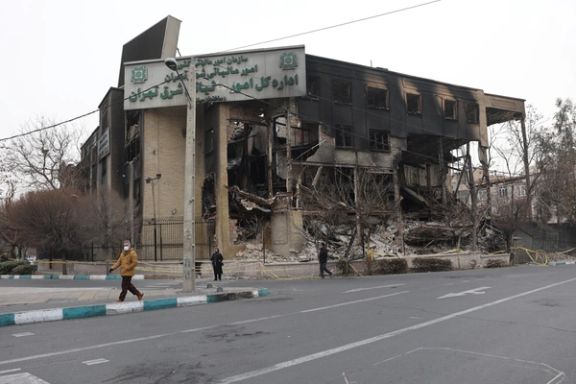
The state tax building burned during Iran's protests, on a street in Tehran, Iran, January 19, 2026.
Iran cannot simply rewind to the weeks before the protests began. The crackdown hardened public anger, while an already overstretched economy and energy system lost what little room they had to absorb another shock.
Iran crossed point of no return as protests collide with economic exhaustion | Iran International
On December 28, a strike by shopkeepers in Tehran’s markets ignited protests that rapidly spread far beyond their original setting. What followed was not a short-lived wave of unrest, but a nationwide rupture whose scale and consequences now make a return to the previous status quo virtually impossible.
Nearly a month later, estimates point to at least 36,500 people killed in clashes and crackdowns across more than 400 cities and 4,000 separate sites of confrontation. The magnitude marks a turning point in the country’s modern history.
Even before the protests began, Iran was already under severe strain: an economy caught in persistent inflation, an energy system stretched beyond capacity, environmental stress that had begun to affect daily life, and security structures weakened by external shocks and internal attrition.
The events that unfolded after December 28 did not create these pressures. They exposed them, intensified them, and fused them into a single, compounding crisis.
What the data now show is not simply escalation, but irreversibility.
An economy with no cushion left
Long before markets closed and strikes spread, Iran’s economy had entered a phase of chronic instability.
Official figures put unemployment at just over seven percent, but nearly 40 percent of the unemployed were university graduates, a mismatch that had been widening for years. The national currency continued to lose value, the Tehran stock exchange spent most days in decline, and liquidity pressures rippled through the private sector.
Inflation was no longer episodic. Point-to-point inflation rose from about 39 percent in early spring to nearly 53 percent by late autumn.
Even households traditionally considered middle-income were cutting back on basic goods. Reports of installment-based purchases for food items, including fruit and nuts, had become routine.
Fiscal policy offered little relief. The government’s proposed budget projected wage increases of 20 percent, well below the officially acknowledged inflation rate.
Lawmakers rejected the bill outright, citing unrealistic revenue assumptions and a growing gap between costs and household incomes. Similar gaps in previous budgets had already pushed salaried workers and pensioners further into precarity.
The banking sector added another layer of fragility. One major private bank formally acknowledged insolvency weeks before the protests began.
Across the system, only a small number of banks met international capital adequacy standards, while several large institutions showed negative ratios. Credit expansion continued largely through money printing, reinforcing inflation rather than growth.
When markets shut down after December 28, they did so without reserves. A month of disrupted commerce has left many businesses with no buffer at all, while reports of burned commercial districts and threatened asset seizures have compounded losses.
Even under optimistic assumptions, restoring activity would require vast public spending. The resources to do so are no longer visible.
Energy and limits of revenue
Energy has long been treated as Iran’s most reliable economic lever. That assumption has eroded.
Oil exports never fully recovered from earlier sanctions, and recent enforcement efforts further narrowed room for maneuver.
Other energy sales once described as insulated – particularly gas and electricity exports to neighboring countries – have also come under pressure.
At the same time, domestic shortages intensified.
Power plants turned to heavy fuel oil, worsening air pollution, while export volumes were quietly reduced to meet internal demand.
The contradiction became structural: exporting energy reduced domestic stability, while keeping energy at home limited revenue.
These constraints matter because energy income underpins much of public spending, including security outlays. Budget plans approved in December to bolster military capabilities for the next Iranian year depend heavily on oil-backed revenues, funding streams that are increasingly uncertain.
Without a stable energy surplus, neither fiscal recovery nor political containment looks financially viable.
Environmental stress
Environmental pressures have moved from background concern to immediate risk. Official estimates attribute around 58,000 deaths annually to air pollution. Water scarcity has become acute enough that authorities have publicly acknowledged difficulties supplying drinking water to the capital, with rainfall described as the only short-term relief.
Agriculture, which consumes over 90 percent of national water use and employs nearly a fifth of the workforce, cannot be restructured quickly without triggering new social shocks.
Modernization would require investments that current budgets cannot support.
Security erosion
Alongside these pressures, the security apparatus has shown visible strain. Equipment losses during recent regional conflicts, the deaths of senior commanders, and repeated cyber breaches exposing sensitive databases have weakened internal cohesion.
Reports circulating online suggest disciplinary measures against personnel who refused to participate in lethal crackdowns, adding to signs of internal fracture.
Externally, Iran has lost key regional partners, while negotiations with Western powers remain stalled and unpredictable.
Diplomatic defections abroad, including asylum requests by senior officials, point to diminishing confidence within the system itself.
After December 28
What distinguishes the period since December 28 is not only the scale of violence, but its social reach.
If the current death toll is even roughly accurate, millions of people are now directly connected to loss – families, relatives, neighbors – creating a reservoir of anger that cannot be neutralized through force alone.
Inside the country, prolonged internet disruptions have obscured events, but not halted them. Outside, large diaspora communities have mobilized in parallel, amplifying pressure and attention.
Taken together, the figures sketch a stark conclusion. The crises that existed before December 28 were severe but fragmented. The response to the protests fused them into a single, systemic break. Reversing that break would require resources, legitimacy, and internal cohesion that no longer appear to exist.
The numbers, more than the slogans, explain why there is no going back.
An independent research group said on Saturday it had identified a large, coordinated social media influence operation it linked to the Islamic Republic, aimed at shaping global narratives and suppressing dissent during the country’s uprising.
Golden Owl, an open-source intelligence research initiative, said its investigation found thousands of coordinated accounts on X and Instagram working in support of the Iranian state, amplifying regime narratives while targeting opposition voices.
The group said it analyzed nearly 8,000 account records on X, identifying more than 7,500 unique accounts operating in what it described as a state-aligned network.
According to the findings, about 500 accounts acted as high-impact “originators” producing narratives, while more than 2,500 others functioned as amplifiers, reposting content at volumes consistent with centralized or automated control.
Golden Owl said the network showed clear signs of coordination, including synchronized messaging, mass account creation around major geopolitical events and sustained activity during periods when Iranian authorities imposed internet blackouts at home.
The researchers said more than a quarter of the accounts were created after October 7, 2023, and that the network expanded further during periods of regional escalation and protest crackdowns.
Activity remained high during Iran’s internet shutdown, which Golden Owl said suggested privileged access or operations conducted from outside Iran.
Content promoted by the accounts included praise for Iran’s leadership and the Islamic Revolutionary Guard Corps, attacks on opposition movements – particularly supporters of the exiled Pahlavi family – and anti-Semitic rhetoric, the report said.
Some accounts also pushed narratives aligned with separatist or fringe opposition groups, which the researchers said appeared aimed at fragmenting dissent.
Declared locations for many accounts were outside Iran, including in the United States, Britain and Germany, which Golden Owl said pointed to a focus on influencing Western public opinion rather than domestic audiences.
Golden Owl said the findings were based on reproducible data and that some datasets had been published for independent verification.
It called on social media platforms to investigate the accounts and on policymakers to recognize what it described as the scale of Iranian state-linked influence operations.
Cryptocurrency is a rare tool embraced by both Iran’s rulers and its citizens—used at the top to enrich elites to dodge sanctions and at the bottom to survive the economic devastation wrought by their policies.
Blockchain forensics firm Chainalysis estimates that Iran’s crypto ecosystem exceeded $7.78 billion in 2025.
Any figure attached to Iran’s crypto economy is of course partial: both the state and private users have powerful incentives to conceal activity, whether to limit sanctions exposure or avoid domestic scrutiny.
What is increasingly clear, however, is that the state now dominates a large share of that volume.
Chainalysis estimates that the Islamic Revolutionary Guard Corps processed more than $3 billion in crypto transactions last year. Israel’s counter-terror financing authority has published a seizure order listing 187 crypto addresses worth roughly $1.5 billion in Tether, a crypto denomination pegged to the dollar.
New findings by the blockchain analytics and crypto-compliance firm Elliptic link Iran’s central bank to at least $507 million in purchases of dollar-pegged Tether (USDT).
That stockpile could supplement constrained foreign-exchange reserves and help authorities lean against sudden spikes in the rial’s parallel market.
In effect, USDT can function as an off-balance-sheet foreign-exchange buffer: accumulated outside correspondent banking channels, mobilized through intermediaries, and sold into rial markets via local exchanges and over-the-counter desks when pressure builds.
Access, however, is not evenly distributed. Reports indicate state blessing for—or "whitelisting"—internet connectivity for certain traders, even as much of the country has endured a pervasive internet blackout since a deadly crackdown on protestors ramped up on Jan. 8.
When the rial comes under pressure, connectivity itself becomes an instrument of intervention: stablecoin-based market operations still require traders who can connect, quote prices, and settle transactions.
Alternate reality for households
Iran’s central bank has imposed limits on currency trading and transaction flows, while rolling out an anti-speculation tax regime covering gold, jewelry, foreign currency and cryptocurrencies.
The effect has been to raise the cost of traditional inflation hedges while signaling that policymakers now view household portfolio shifts as a macroeconomic risk.
The central bank has moved to cap individual crypto holdings at $10,000, despite warnings from Iranian traders and economists that such restrictions would choke savings and push activity further underground.
On the mining side, the divide is even starker. State-linked and religious institutions are among the largest players, in part because electricity tariffs in Iran are not uniform.
Iran International has reported repeated allegations of crypto mining at state-sponsored sites, including mosques, which benefit from reduced energy rates—an obvious advantage in an industry where profitability hinges on power costs.
The result is effectively two mining economies: small operators running rigs at home or in workshops, attempting to stay invisible, and state-linked actors with access to cheaper electricity, larger facilities, and more predictable protection.
Authorities have periodically blamed illegal neighborhood miners, but some experts see that focus as a way to deflect attention from deeper problems of grid management and governance.
Where the cheapest power is concentrated in privileged institutions and enforcement is uneven, the largest rents accrue not to households plugging in a single machine, but to organized actors with access.
Iran has become a cutting-edge battlefield of monetary adaptation. The central bank experiments with stablecoins to stabilize the rial, while households use the same rails to escape it.
A tightly capped, KYC-only micro-saver lane could offer households limited protection for modest savings while increasing transparency and helping isolate state-connected networks operating at scale.
The unresolved question is whether regulated crypto channels can be structured to distinguish household self-preservation from state-linked finance—or whether policy choices will continue to push both into the same shadows.
Whether the state and its beleaguered citizenry can defy mounting economic pressure may hang in the balance.
Iranian authorities are still carrying out a chain of crimes linked to the protest crackdown, including extrajudicial killings, deaths under torture and the systematic mistreatment of detainees and their families, according to the executive editor of Iran International TV.
Asghar Ramezanpour said the violence has not ended with the suppression of mass demonstrations, warning that detainees face ongoing threats to their lives, denial of medical treatment and collective detention in unconventional holding facilities.
He also cited systematic harassment of families of those killed or detained, as well as continued efforts by authorities to block information from reaching the public.
Ramezanpour’s comments followed the release of a new report estimating that at least 36,500 people were killed in the crackdown on protests, with the deadliest violence concentrated on January 8 and 9, according to classified government documents seen by Iran International.
With tens of thousands killed and society still reeling, the Islamic Republic has turned to sport to project normalcy as matches return, but players’ muted celebrations and empty stadiums show how little of the script still holds.
Domestic leagues have resumed, fixtures have been brought forward, and state-aligned media have amplified claims that the country is returning to ordinary life.
That portrayal clashes with lived reality. Even under severely restricted internet access, videos of brutal crackdowns – particularly from January 8 and 9 – have circulated, showing the scale of violence used against protesters.
Much of society remains in mourning. Families are grieving thousands of young people, including dozens of athletes, and official claims of normalcy ring hollow. What disrupts the state’s carefully assembled image are unscripted gestures that resist being folded into the official storyline.
For the state’s project of normalcy to work, sport must deliver more than competition. It must deliver emotion. A goal is meant to be followed by celebration; a win is meant to bring release. Instead, a visible rupture has set in. Players score and walk away. The whistle blows and faces remain closed, expressions blank.
In recent weeks, many players have kept their celebrations muted as a gesture of solidarity with the uprising and a mark of respect for the dead, including fellow athletes – while stopping short of openly defying orders to play.
That tension has also fueled backlash against the few moments that look like unguarded celebration or emotion. After a Mes-e Rafsanjan F.C. victory and following Esteghlal F.C. staff reactions to a disallowed goal against Tractor S.C., criticism spread quickly across social media.
Former national team player Mohammad Taghavi voiced the sentiment plainly, arguing that players should not be taking the field at all.
“These footballers had no right to play under these circumstances. They could have claimed illness and avoided playing,” he told Iran International.
Coaches of Esteghlal F.C. react after a goal was disallowed against Tractor S.C. on January 18, 2026.
Sports journalist Mohsen Salehi described the resumption of matches as a staged display, even when players refrain from celebrating.
“The regime wants to turn footballers’ legs into tools of propaganda, projecting a false image in which life appears to be continuing as usual,” he wrote.
The question remains whether athletes – especially footballers – are willing to become props in that spectacle. When a country is in mourning, sport cannot remain a neutral island. Footballers are not only players; they are public figures with obligations to the communities that elevated them.
“Running on a field that reeks of blood is participation in a grand lie. Until the true scale of this repression is made clear and those who ordered and carried out these crimes are held accountable, what value does soccer really have? Players stand before the judgment of history. They must choose between being instruments of power or standing with the people,” Salehi added.
Taking such a position can carry consequences for the players.
though those costs pale in comparison with what the country is enduring. Tehran prosecutor has recently opened cases against 15 sports figures and actors for supporting the national uprising.
round the same time, reports emerged that Persepolis F.C. player Reza Shekari and Omid Ravankhah, head coach of Iran’s under-23 national team, were briefly detained on arrival at Tehran’s international airport over support for the protests.
Women’s soccer and foreign involvement
Signs that normalcy has not returned are also visible in institutional decisions. Farideh Shojaei, the federation’s vice-president for women’s football, announced the cancellation of two planned women’s national team friendlies against Uzbekistan and Belarus.
At club level, foreign participation has also thinned. Assistants to head coach Dragan Skočić at Tractor S.C., and one assistant to Ricardo Sá Pinto at Esteghlal F.C., have terminated their contracts. Several foreign Esteghlal players who left Iran during the mid-season break have yet to return.
The departures appear driven less by symbolic protest than by risk assessments. Matches continue, but confidence – especially among outsiders – has not been restored.
Tears as a counter-image
One of the most destabilizing moments for the state’s push for normalcy came in a single image: a women’s footballer scoring and then crying. In the visual economy of state messaging, it was the opposite of what is needed. A smile would complete the frame. Tears break it.
Maryam Mohammadhosseini, a player for the Esteghlal women’s team, refrained from celebrating after scoring on January 19, 2026.
Last week, Maryam Mohammadhosseini, a player for the Esteghlal women’s team, did not celebrate after scoring and instead broke down in tears.
The image spread quickly because it showed what the official narrative tries to contain. Athletes can compete while remaining psychologically unsteady. Participation is not the same as emotional recovery. The body registers what the script denies.
Empty stadiums, louder signals
Matches continue, but spectators remain barred from stadiums, extending the same logic of control. The ban reflects authorities’ fear that protest chants and political displays could erupt on live broadcasts.
A match without a crowd may be technically possible, but for many it is drained of meaning. There is an image, but no collective response.
The limits of performative normalcy are even clearer beyond Iran’s borders.
The Asian Football Confederation has ruled that Iranian clubs cannot host certain continental matches at home, moving them to neutral venues. Under the decision, Esteghlal F.C. and Sepahan S.C. will stage Asian Champions League fixtures outside Iran, while Tractor S.C. will play on neutral ground.
If conditions were genuinely stable, those clubs would be allowed to host. A version of “normal” that holds only within domestic media does not withstand external assessment.
A growing list of athletes killed
Rights groups and media reports have documented the deaths of numerous athletes during protests so far, including former beach soccer national team goalkeeper Mohammad Hajipour; karate champion and referee Hassan Ghasemi; boxer Arshia Ahmadpour; mountaineer Sara Behboudi; women’s football assistant referee Sahba Rashtian; youth players Amirhossein Mohammadzadeh and Rebin Moradi; and former Tractor player Mojtaba Tarshiz, who was killed while shielding his wife.
Mojtaba Tarshiz, a former player for Tractor S.C., was killed after being shot by Islamic Republic security forces during the Iranian national uprising against the Islamic Republic.
The most recent confirmed case is Ahmad Ramezanzadeh, a catcher for the Iran national baseball team, who was killed after being shot with a handgun in eastern Tehran.
Ahmad Ramazanzadeh, a catcher for the Iran national baseball team, was killed by a handgun shot by security forces during protests in eastern Tehran on January 8, 2026.
Other confirmed cases include soccer coach Milad Lavasani, futsal figure Amirmohammad Kouhkan, bodybuilder Masoud Zatparvar, taekwondo coach Afshin Mirkiani and arm-wrestling champion Erfan Bozorgi.
These are not the only athletes killed by the Islamic Republic. More names are likely to emerge in the future, as thousands of victims have yet to be identified.
More than 36,500 Iranians were killed by security forces during the January 8-9 crackdown on nationwide protests, making it the deadliest two-day protest massacre in history, according to documents reviewed by Iran International's Editorial Board.
Iran International's Editorial Board can confirm the death toll after reviewing newly obtained classified documents, field reports, and accounts from medical staff, witnesses, and victims’ families.
The new information provides a clearer picture of the killing pattern and the scale of a crime that can now be described as the largest and bloodiest massacre of civilians during street protests, over a two-day period, in history.
Iran International has received reports and evidence indicating the extrajudicial execution of a number of detainees in Tehran and other cities. Images released from morgues leave little doubt that some wounded citizens were shot in the head while hospitalized and undergoing medical treatment. It is evident that, had these individuals sustained fatal head wounds on the streets, there would have been no reason to admit them to hospital or begin treatment in the first place.
The images also show that in some cases, medical tubes and patient-monitoring equipment remained attached to the bodies. In other cases, cardiac monitoring electrodes are visible on the chest, suggesting these individuals were under medical care before being shot in the head. A number of doctors and nurses have also told Iran International that so-called “finishing shots” were fired at wounded patients.
That figure was explicitly cited in a report by the IRGC Intelligence Organization submitted to the Supreme National Security Council and the Presidential Office on January 11, two days after the two-day massacre, reviewed by Iran International.
36,500 killed in 400 cities
Our Editorial Board has now obtained more detailed information provided by the IRGC Intelligence Organization to the Supreme National Security Council.
Other state institutions have also received differing figures from other security bodies. However, given the scale of the killings, deliberate concealment, and what appears to be intentional disorder in the registration and transfer of bodies – along with pressure on families and, in some cases, the quiet burial of victims – it appears that even the security agencies themselves do not yet know the precise final death toll.
In a report presented on Wednesday, January 21, to the Iranian parliament’s National Security and Foreign Policy Committee seen by Iran International, the number of those killed was listed as at least 27,500.
According to sources within Iran’s Interior Ministry who spoke to Iran International on condition of anonymity, a consolidation of figures received from provincial security councils by Tuesday, January 20, showed the death toll had exceeded 30,000.
Two informed sources from the Supreme National Security Council also told Iran International that in two recent reports by the IRGC Intelligence Organization, dated January 22 and January 24, the number of those killed was listed as more than 33,000 and more than 36,500 respectively.
Interior Ministry reports say security forces confronted demonstrators in more than 400 cities and towns, with more than 4,000 clash locations reported nationwide.
Despite the confusion and concealment, the rapid increase in death toll figures in classified government reports has heightened concerns that the actual number of those killed may be even higher.
Due to communication restrictions and security pressure, independent verification remains impossible. However, based on credible information from hospital sources and eyewitnesses, the number of deaths in several major cities is described as shocking.
Conservative assessments by medical sources, based on the number of bodies delivered to hospitals and medical centers, estimate more than 2,500 killed in Rasht, at least 1,800 in Mashhad, more than 2,000 in Isfahan, Najafabad, and Khorasgan, at least 3,000 in Karaj, Shahriar, and Andisheh, 700 in Kermanshah, and 400 in Gorgan.
No clear aggregate figure has yet been obtained for Tehran. However, images released from Kahrizak morgue and hospitals across the capital indicate that thousands were killed in Tehran, with a significant proportion of the deaths occurring in southern Tehran.
Horrifying details of a historic crime
1 - Three doctors and four nurses in Tehran who spoke to Iran International said security forces entered hospitals and took away some wounded patients who were undergoing treatment. Images received by Iran International, along with videos circulating on social media, also show that some bodies with gunshot wounds to the head bear clear signs of hospitalization.
Two other nurses told Iran International that after a wounded young man was transferred to an ambulance in a clash area in western Tehran, a security agent suddenly entered the vehicle and, in front of them, killed him by firing two consecutive shots. The nurses said the man had been severely beaten before being moved and was semi-conscious. A trusted specialist physician at a Tehran hospital confirmed their account.
There are also reports that individuals were detained at home and that their families were later told to go to Kahrizak to collect their bodies. Other reports say security forces went to homes and drew people to the door – including under the pretext of delivering a package – before shooting and killing them.
These deeply alarming reports have in recent days been published by families or provided to Iran International by credible eyewitnesses.
If confirmed through independent investigation, the accounts would amount to clear cases of extrajudicial killing and, if found to be widespread, could be examined under the rubric of crimes against humanity.
The withholding of detainee numbers, the unknown locations of detention sites, and the lack of clarity over prisoners’ access to medical care and legal representation have heightened concerns among human rights activists.
A prominent lawyer inside Iran, who requested anonymity, described the situation as an “international human rights crisis.” He said, “Unofficial reports indicate that tens of thousands have been arrested, and the IRGC or whichever security body has custody of them can kill as many as it wants, send their bodies to Kahrizak or other morgues, and claim they were killed on the streets.”
2 - The organized killings across Iran indicate the brutal crackdown was carried out with the agreement and cooperation of state institutions and on the orders of the highest authorities of the Islamic Republic.
According to information received by Iran International, following a speech by Supreme Leader Ali Khamenei on January 9, phrases such as “al-nasr bil-ru‘b” (victory through terror) and “fight them until there is no sedition” were used in briefings and discussions among senior IRGC commanders. The same phrases also appeared on January 9 in Telegram channels affiliated to hardliners.
3 - Numerous reports and other evidence indicate that in many cities, bereaved families were forced to pay large sums described as “bullet fees” in exchange for receiving the bodies of their loved ones. In some cases, despite families’ objections, those killed were presented as members of the Basij militia.
4 - While most of the killings were carried out by IRGC and Basij forces, reports received by Iran International indicate that proxy forces from Iraq and Syria were also used in the crackdown. The deployment of non-local forces suggests a decision to expand repression capacity as quickly as possible.
Should Iran International obtain further information, it will inform its audience in subsequent statements.
Call for submission of evidence
Iran International once again calls on all compatriots inside and outside the country to send any documents, videos, photographs, audio testimonies, information about those killed or wounded, medical centers, locations of clashes, timing and geography of events, and any verifiable details related to the events of the past weeks.
The security of sources and confidentiality of information are our highest priorities. If you are concerned about your safety, do not send identifying information and provide only general, verifiable details.
Following verification and careful assessment, Iran International will publish its findings and share them with all relevant international bodies and institutions.
The truth will be recorded and documented. The names of the victims will be preserved. This crime will not be buried in silence.