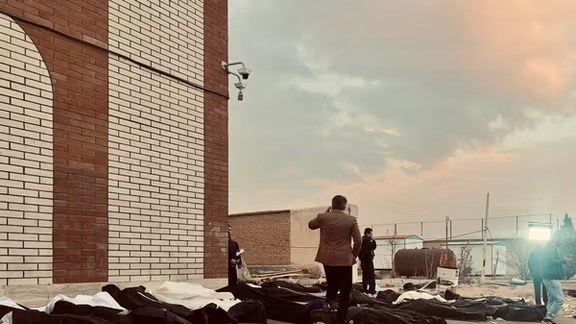
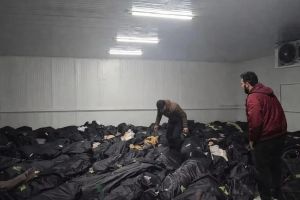
The bodies of slain protesters at an unnamed morgue in Iran (January 2026)
The killing of 36,500 people in just two days represents a scale of violence without precedent in the history of repression under the Islamic Republic – and one that stands out even when compared with some of the deadliest episodes of state violence and full-scale wars worldwide.
The figure is not final and could still rise.
The killing of 36,500 people in just two days represents a scale of violence without precedent in the history of repression under the Islamic Republic—and one that stands out even when compared with some of the deadliest episodes of state violence and full-scale wars worldwide. The figure is not final and could still rise.
Information obtained and published by Iran International this week indicates that Iranian authorities killed more than 36,500 people over a 48-hour period during the national uprising.
Even conflicts that later came to be described as “genocidal” involved far lower casualty rates over comparable periods.
Put differently, the figure implies 18,250 deaths per day, 760 per hour, 13 per minute, or one person killed every five seconds.
At the height of the war in Gaza, the deadliest single day recorded roughly 400 fatalities. During the most intense phase of urban bombardment in the Iran-Iraq war, Iraqi missile and air strikes killed an average of 188 Iranian civilians per day. The scale of the recent killings far exceeds both.
It also surpasses the deadliest crackdowns carried out by authoritarian governments such as Syria under Hafez al-Assad or Iraq under Saddam Hussein.
Gaza war
Figures released by Gaza’s Health Ministry, which is under Hamas control, place the total number of people killed in Israeli strikes at around 71,000. Israeli officials say 17,000 to 20,000 Hamas fighters were among the dead, suggesting 51,000 to 54,000 civilian fatalities.
Those deaths occurred over roughly two years following October 7, 2023 – an average of 70 to 74 deaths per day. The single deadliest day, reported on March 18, 2025, saw about 400 fatalities, though the civilian share remains unclear.
Iran-Iraq War
During approximately 80 days of missile and aerial attacks on Iranian cities, 15,000 civilians were killed – about 188 per day.
1991 Iraqi uprisings
The Sha’baniyah uprising in Iraq lasted about a month from March to April 1991. Iraqi forces killed between 30,000 and 100,000 people over roughly three weeks, using tanks, artillery, and attack helicopters – an estimated 1,400 to 4,800 deaths per day.
Hama, Syria
In 1982, Syrian forces besieged the city of Hama for 27 days, killing 10,000 to 40,000 people – between 370 and 1,480 per day – in a campaign involving air power and heavy artillery.
Killings under the Islamic Republic
Unrest of the 1990s
Limited access to information and the absence of independent media mean that the full scale of protest crackdowns during the 1990s remains poorly documented. Demonstrations in cities including Shiraz, Arak, Mashhad, and Islamshahr were suppressed with force, but detailed casualty records are scarce.
One of the harshest episodes occurred in 1992, during the suppression of protests at the Tollab district in Mashhad. Estimates suggest up to 50 people were killed.
In the July 9, 1999, crackdown on student protests at Tehran University, the number of fatalities has been estimated at between seven and nine.
The Green Movement
Protests following Iran’s disputed 2009 presidential election began on June 13 and continued into early 2010. Major demonstrations took place on several dates, including June 12, 13, 15 and 20; July 19; August 5; November 4; December 7; and February 14.
Across the duration of the movement, estimates place the number of people killed at between 70 and 112. The deadliest single day came during Ashura ceremonies, on December 27, 2009, though precise figures are unavailable. Various sources have put the number of deaths that day at between eight and 37.
Protests of the 2010s
Nationwide protests erupted again between December 29, 2017, and January 8, 2018, marked by the widespread use of monarchist slogans. Authorities reported 25 deaths, while external sources cited figures of up to 50.
A far deadlier wave followed in November 2019, when protests began on November 15 and lasted roughly a week. Authorities imposed a total internet shutdown, and security forces carried out what human rights organizations later described as the most severe crackdown to date.
Human rights groups have independently identified at least 324 victims by name, while other investigations, including reporting by Reuters, estimated the death toll at as many as 1,500, with the majority of killings occurring on November 16 and 17.
Woman, Life, Freedom
The protests known as Woman, Life, Freedom began on September 17, 2022, and continued into early 2023. Authorities did not release official casualty figures. Independent estimates place the number of people killed at between 540 and 600.
Even official figures point to unprecedented violence
Iranian authorities have officially acknowledged 3,117 deaths, categorizing victims as civilians, security forces, or what they call “terrorists.” While observers consider this breakdown unreliable, the admission itself is unprecedented.
Even in the 12-day war, the authorities reported 276 civilian deaths, though given the Islamic Republic’s track record, the accuracy of those figures has also been widely questioned.
Even if the official figure of the crackdown deaths were accepted at face value, it would imply 1,559 deaths per day – a daily toll higher than that of a full-scale war, more than three times the deadliest day in Gaza, and nearly eight times the daily civilian death rate during the Iran–Iraq war.
Some media outlets have cited lower estimates of around 6,000 deaths. Even those figures would still place the January killings beyond any comparable episode in Iran’s recent history –and alongside the most severe mass killings of civilians in the modern era.
A single number – 3,117 – has appeared repeatedly in Iranian official statistics, from protest deaths to public health data, raising doubts about the credibility and methodology behind state-reported statistics.
In a joint statement, Iran’s Martyrs Foundation and the Legal Medicine Organization said 3,117 people were killed during the nationwide protests in January.
The number itself, however, is strikingly familiar.
The same figure – 3,117 – has appeared in multiple, otherwise unrelated official datasets over recent years, including public health statistics, economic reports, and earlier protest-related announcements.
Variants of the number, particularly 1,039 and its multiples, have also been cited repeatedly in COVID-19 infection and hospitalization figures released by state bodies.
Analysts say that while identical numbers can recur by chance, the repeated use of a non-rounded figure across different sectors and time periods is statistically unlikely.
The pattern has prompted questions about whether such figures reflect genuine record-keeping, administrative shortcuts, or the use of standardized numbers in situations where full data are unavailable or politically sensitive.
Independent human rights organizations and international media have consistently challenged official casualty figures following protest crackdowns.
Their estimates – based on eyewitness testimony, hospital documentation, verified video evidence, and reports of serious injuries and enforced disappearances—point to significantly higher death tolls than those acknowledged by authorities.
According to documents reviewed by Iran International, more than 36,500 Iranians were killed by security forces during the January 8-9 crackdown on nationwide protests, making it the deadliest two-day protest massacre in history.
Official statements, by contrast, have offered little supporting detail. Names, locations, dates, and provincial breakdowns have not been released, limiting independent verification and intensifying criticism that casualty figures may be framed to downplay the scale of violence, particularly as international attention grows, including at the UN Human Rights Council.
The reappearance of 3,117 has reinforced long-standing skepticism over the reliability of official statistics in moments of crisis—when numbers carry political weight well beyond their face value.
US President Donald Trump’s dramatic naval buildup in the Middle East appears to have generated more strategic uncertainty than clarity both in Tehran and in Washington.
Over the weekend, as the USS Abraham Lincoln carrier strike group moved closer to the Persian Gulf, US Central Command Commander Admiral Brad Cooper travelled to Israel—a visit widely interpreted as evidence of intensified coordination ahead of a potential move against Iran.
Trump has framed the possibility of intervention in explicitly humanitarian terms, warning Tehran against the killing of protesters and asserting that US pressure has already halted hundreds of planned executions.
Yet despite naval deployments, repeated warnings, and unmistakable signaling, no kinetic action has followed.
This restraint has endured even as credible estimates from human rights organisations and the United Nations place civilian deaths from the crackdown at over 20,000. Iran International’s editorial statement of January 25 cites a figure of 36,000 killed, making this the bloodiest episode in the Islamic Republic’s history.
Jurists and international lawyers have argued that the scale and systematic nature of the violence may fall within the jurisdictional scope of the International Criminal Court under the Rome Statute.
Washington’s response has followed a different rhythm: maximalist language paired with deliberate restraint. Carrier deployments have provided leverage; sanctions and tariffs have expanded; diplomatic and military signaling has intensified. But strikes—despite the scale of civilian killing—have not materialized.
Restraint as policy
What, then, is actually holding President Trump back?
Humanitarian concern looms large in Trump’s public messaging. But this framing sits in visible tension with the administration’s broader strategic doctrine.
The National Security Strategy of November 2025 reiterates an America First approach, prioritizing US interests while explicitly seeking to avoid committing American forces to conflicts that risk metastasizing into “endless wars.”
The 2026 National Defense Strategy adopts a markedly harsher register toward Iran. It accuses Tehran of having “American blood on its hands,” framing it not only as an abusive authoritarian regime but as an enduring strategic adversary.
And yet, in a notable departure from Trump’s instinctive aversion to foreign entanglement, he has drawn explicit red lines around the execution of protesters and the use of lethal force against demonstrators. Any prospective action, he has suggested, would be framed not as conquest or regime change, but as rescue.
The evidence, however, suggests that humanitarian imperatives function more as legitimizing rhetoric than as decisive drivers of policy. Had halting mass killing been the primary determinant, intervention might plausibly have followed the peak of repression in early January.
Instead, Trump has oscillated between “locked and loaded” warnings and expressions of hope that force will not be required.
Strategic calculations
The deeper constraints lie elsewhere—in hard strategic and political realities that humanitarian language alone cannot dissolve.
First, escalation risk dominates the calculus.
Tehran has made clear that any US strike would trigger retaliation across multiple theatres: Israel, American bases in the region, and potentially global energy routes. The prospect of asymmetric escalation—through ballistic missiles, proxy warfare, cyber operations, or disruption of the Strait of Hormuz—carries profound economic and security consequences.
Regional partners, including Israel, are widely reported to have urged caution, acutely aware that even a limited strike could spiral into a broader conflagration.
In this context, the “armada” functions less as a prelude to war than as a tool of coercive signaling: capability without commitment. Trump’s repeated insistence that he “would rather not see anything happen” reflects not humanitarian restraint, but an aversion to cascading costs that could rapidly exceed any political or strategic gain.
Second, domestic political calculations weigh heavily.
American fatigue with Middle Eastern military entanglements remains deep-seated. Polling consistently shows majority opposition to new wars, even when framed around humanitarian catastrophe.
Trump’s political identity remains rooted in rejecting the interventionist excesses of the post–Cold War era. Forceful rhetoric projects resolve, carrier deployments demonstrate action, sanctions impose pain—all without exposing U.S. forces to open-ended conflict.
Third, strategic leverage without war remains attractive.
The current posture weakens Iran indirectly. Pressure on the nuclear program intensifies. Economic isolation deepens through secondary sanctions and tariffs on third-party trade. Internal regime fissures may widen as elites confront the costs of isolation without the rallying effect of a foreign attack.
Humanitarian language helps justify this approach publicly, but the underlying strategy prioritizes containment, deterrence, and attrition—not Responsibility-to-Protect-style intervention.
All tabs open
Taken together, Trump’s posture reflects a president operating within a narrow corridor between moral outrage, strategic constraint, and political risk. Restraint, however, should not be mistaken for permanence.
The current alignment keeps open a range of options that could be activated rapidly should circumstances shift.
A limited, precision strike aimed at degrading Tehran’s capacity for internal repression would suggest a convergence between humanitarian rhetoric and coercive deterrence. A broader campaign would signal that strategic imperatives had finally eclipsed restraint.
For Iranians facing repression, this uncertainty itself exerts pressure—on the regime no less than on Washington.
For policymakers, the lesson is neither complacency nor inevitability, but clarity: intervention, if it comes, will arrive not as a moral reflex, but at the moment when humanitarian catastrophe, strategic threat, and political risk briefly align.
After killing thousands across Iran in just days, Iran’s government is denying families the right to mourn by blocking burials and seizing bodies in its push stamp on the embers of unrest.
In Iranian and Islamic tradition, failing to bury the dead promptly—usually within 24 hours—is considered a profound violation of dignity. Yet many families say they have been deprived of dignified burial and mourning rituals.
The moves appear aimed at preventing public funerals or mourning which could become flashpoints of anger and dissent.
Families of the slain say they have been prevented from holding mourning ceremonies, denied timely burials and pressured into silence—deprived of what they describe as basic human closure.
An account on X writing under a pseudonym, wrote: “I finally got online. I will never forget the moment they shot a 15-year-old boy directly in the head with a Kalashnikov … or the silence the next day when they told his mother if she cried loudly, they wouldn’t give her the body.”
Some families report being notified of deaths only after secret burials had already taken place, or not being told burial locations at all.
Another X user, living in Canada, wrote on X that the family of a slain relative was denied a funeral: “They buried him at five in the morning themselves and threatened the family that if they gathered at the grave, they would dig up the body and take it away.”
One of the most widespread accusations against the government is the use of bodies as leverage. Families report being forced to pay sums of around $5,000 or sign written commitments in exchange for the release of remains.
One such victim was Armin Jashni-Nejad, a 23-year-old petrochemical worker from Mahshahr, who was shot to death by police on January 9.
Two days later, security officials told his family the body would only be released if they agreed to say he had been killed by “thugs.”
Ultimately, Armin was buried by security forces without his family present, after they were compelled to sign a written pledge.
Bardia, who recently left Iran after witnessing the massacre of protesters in Rasht, northern Iran, told Iran International that in some cases authorities demanded deposits as high as 30 billion rials (over $20,000) from families to prevent public funerals.
For most families living through the country's dire economic straits, the sums are impossible.
Further accounts by social media users citing local eyewitnesses describe families burying victims in private homes or gardens to prevent authorities from seizing the bodies.
These reports could not be immediately confirmed by Iran International.
Death toll
Iranian authorities have acknowledged only a fraction of the deaths but assert that of approximately 3,100 deaths, over 2,400 -- both ordinary citizens and security forces -- were caused by “terrorists”.
Iran International has reported at least 36,500 deaths, having reviewed "classified documents, field reports, and accounts from medical staff, witnesses, and victims’ families."
Witnesses report that many victims were shot in the head or chest. Gunshot wounds to the genital area have also reportedly been reported, which some observers say were inflicted deliberately.
At the same time, state television has aired the televised interrogations of ordinary citizens, portraying them as “misled,” “ignorant," or agents of foreign governments.
These broadcasts appear designed to reframe the killings as acts of national defense rather than the violent suppression of mass protests.
A flood of evidence
In the immediate aftermath of the deadliest mass killings, on January 8 and 9, near-total internet shutdowns and severe restrictions on phone communications obscured the scale of the carnage.
Several days later, the first videos began to emerge: black body bags piled into trailers, hundreds of corpses stacked together, or bodies laid out on the ground at Kahrizak forensic medicine compound in Tehran.
In these videos, families of the missing are forced to search among blood-soaked bodies—some partially unclothed—in the hope of finding their loved ones.
Increased access to the internet and social media—largely through the Psiphon conduit—has since enabled a wave of new testimonies and footage to surface. The images are harrowing.
In several of the bodies shown, signs of medical intervention are visible alongside fatal gunshot wounds to the forehead or chest, raising the possibility that some victims were shot after being taken to the hospital.
One of the most searing videos, published on Thursday, documents twelve minutes of a father searching among corpses on the outside pavement of the Kahrizak morgue.
Past the sea of bodies and families collapsing into wails after finding slain young loved ones, he weeps and groans uncontrollably.
"Death to Khamenei," the father whimpers again and again. He repeatedly calls out his son’s name throughout: “Sepehr, daddy’s Sepehr, where are you?”
The video ends with no sign that father and son were reunited.
Iran cannot simply rewind to the weeks before the protests began. The crackdown hardened public anger, while an already overstretched economy and energy system lost what little room they had to absorb another shock.
On December 28, a strike by shopkeepers in Tehran’s markets ignited protests that rapidly spread far beyond their original setting. What followed was not a short-lived wave of unrest, but a nationwide rupture whose scale and consequences now make a return to the previous status quo virtually impossible.
Nearly a month later, estimates point to at least 36,500 people killed in clashes and crackdowns across more than 400 cities and 4,000 separate sites of confrontation. The magnitude marks a turning point in the country’s modern history.
Even before the protests began, Iran was already under severe strain: an economy caught in persistent inflation, an energy system stretched beyond capacity, environmental stress that had begun to affect daily life, and security structures weakened by external shocks and internal attrition.
The events that unfolded after December 28 did not create these pressures. They exposed them, intensified them, and fused them into a single, compounding crisis.
What the data now show is not simply escalation, but irreversibility.
An economy with no cushion left
Long before markets closed and strikes spread, Iran’s economy had entered a phase of chronic instability.
Official figures put unemployment at just over seven percent, but nearly 40 percent of the unemployed were university graduates, a mismatch that had been widening for years. The national currency continued to lose value, the Tehran stock exchange spent most days in decline, and liquidity pressures rippled through the private sector.
Inflation was no longer episodic. Point-to-point inflation rose from about 39 percent in early spring to nearly 53 percent by late autumn.
Even households traditionally considered middle-income were cutting back on basic goods. Reports of installment-based purchases for food items, including fruit and nuts, had become routine.
Fiscal policy offered little relief. The government’s proposed budget projected wage increases of 20 percent, well below the officially acknowledged inflation rate.
Lawmakers rejected the bill outright, citing unrealistic revenue assumptions and a growing gap between costs and household incomes. Similar gaps in previous budgets had already pushed salaried workers and pensioners further into precarity.
The banking sector added another layer of fragility. One major private bank formally acknowledged insolvency weeks before the protests began.
Across the system, only a small number of banks met international capital adequacy standards, while several large institutions showed negative ratios. Credit expansion continued largely through money printing, reinforcing inflation rather than growth.
When markets shut down after December 28, they did so without reserves. A month of disrupted commerce has left many businesses with no buffer at all, while reports of burned commercial districts and threatened asset seizures have compounded losses.
Even under optimistic assumptions, restoring activity would require vast public spending. The resources to do so are no longer visible.
Energy and limits of revenue
Energy has long been treated as Iran’s most reliable economic lever. That assumption has eroded.
Oil exports never fully recovered from earlier sanctions, and recent enforcement efforts further narrowed room for maneuver.
Other energy sales once described as insulated – particularly gas and electricity exports to neighboring countries – have also come under pressure.
At the same time, domestic shortages intensified.
Power plants turned to heavy fuel oil, worsening air pollution, while export volumes were quietly reduced to meet internal demand.
The contradiction became structural: exporting energy reduced domestic stability, while keeping energy at home limited revenue.
These constraints matter because energy income underpins much of public spending, including security outlays. Budget plans approved in December to bolster military capabilities for the next Iranian year depend heavily on oil-backed revenues, funding streams that are increasingly uncertain.
Without a stable energy surplus, neither fiscal recovery nor political containment looks financially viable.
Environmental stress
Environmental pressures have moved from background concern to immediate risk. Official estimates attribute around 58,000 deaths annually to air pollution. Water scarcity has become acute enough that authorities have publicly acknowledged difficulties supplying drinking water to the capital, with rainfall described as the only short-term relief.
Agriculture, which consumes over 90 percent of national water use and employs nearly a fifth of the workforce, cannot be restructured quickly without triggering new social shocks.
Modernization would require investments that current budgets cannot support.
Security erosion
Alongside these pressures, the security apparatus has shown visible strain. Equipment losses during recent regional conflicts, the deaths of senior commanders, and repeated cyber breaches exposing sensitive databases have weakened internal cohesion.
Reports circulating online suggest disciplinary measures against personnel who refused to participate in lethal crackdowns, adding to signs of internal fracture.
Externally, Iran has lost key regional partners, while negotiations with Western powers remain stalled and unpredictable.
Diplomatic defections abroad, including asylum requests by senior officials, point to diminishing confidence within the system itself.
After December 28
What distinguishes the period since December 28 is not only the scale of violence, but its social reach.
If the current death toll is even roughly accurate, millions of people are now directly connected to loss – families, relatives, neighbors – creating a reservoir of anger that cannot be neutralized through force alone.
Inside the country, prolonged internet disruptions have obscured events, but not halted them. Outside, large diaspora communities have mobilized in parallel, amplifying pressure and attention.
Taken together, the figures sketch a stark conclusion. The crises that existed before December 28 were severe but fragmented. The response to the protests fused them into a single, systemic break. Reversing that break would require resources, legitimacy, and internal cohesion that no longer appear to exist.
The numbers, more than the slogans, explain why there is no going back.
An independent research group said on Saturday it had identified a large, coordinated social media influence operation it linked to the Islamic Republic, aimed at shaping global narratives and suppressing dissent during the country’s uprising.
Golden Owl, an open-source intelligence research initiative, said its investigation found thousands of coordinated accounts on X and Instagram working in support of the Iranian state, amplifying regime narratives while targeting opposition voices.
The group said it analyzed nearly 8,000 account records on X, identifying more than 7,500 unique accounts operating in what it described as a state-aligned network.
According to the findings, about 500 accounts acted as high-impact “originators” producing narratives, while more than 2,500 others functioned as amplifiers, reposting content at volumes consistent with centralized or automated control.
Golden Owl said the network showed clear signs of coordination, including synchronized messaging, mass account creation around major geopolitical events and sustained activity during periods when Iranian authorities imposed internet blackouts at home.
The researchers said more than a quarter of the accounts were created after October 7, 2023, and that the network expanded further during periods of regional escalation and protest crackdowns.
Activity remained high during Iran’s internet shutdown, which Golden Owl said suggested privileged access or operations conducted from outside Iran.
Content promoted by the accounts included praise for Iran’s leadership and the Islamic Revolutionary Guard Corps, attacks on opposition movements – particularly supporters of the exiled Pahlavi family – and anti-Semitic rhetoric, the report said.
Some accounts also pushed narratives aligned with separatist or fringe opposition groups, which the researchers said appeared aimed at fragmenting dissent.
Declared locations for many accounts were outside Iran, including in the United States, Britain and Germany, which Golden Owl said pointed to a focus on influencing Western public opinion rather than domestic audiences.
Golden Owl said the findings were based on reproducible data and that some datasets had been published for independent verification.
It called on social media platforms to investigate the accounts and on policymakers to recognize what it described as the scale of Iranian state-linked influence operations.