Clash with state TV exposes limits of Iran's presidential authority

Behrouz Turani
Iran International
Iran International
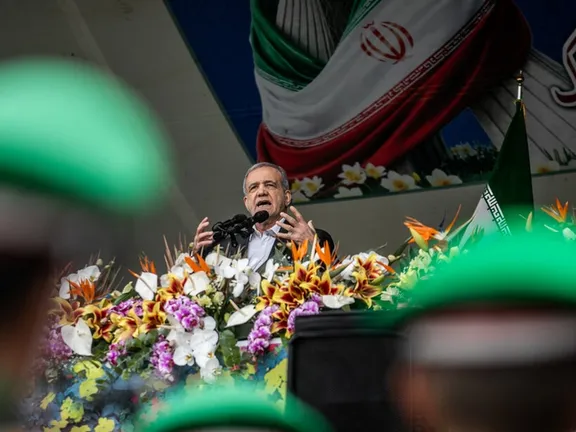
President Massoud Pezeshkian’s increasingly public confrontations with Iran’s state broadcaster have exposed the limits of his authority, underscoring how one of the country’s most powerful institutions operates beyond the reach of its elected government.









The tensions erupted most visibly on Wednesday, when Pezeshkian angrily confronted the head of state television during a cabinet meeting, accusing the broadcaster of refusing to show his administration’s progress.
The exchange was being aired live before the broadcast was abruptly cut off.
During a visit to Golestan Province the following day, Pezeshkian became embroiled in a heated argument on live television with a provincial commander of the Islamic Revolutionary Guard Corps (IRGC) over the military’s role in development projects.
This time, the cameras kept rolling. The commander looked directly into the lens and declared that the IRGC had fulfilled its duties—and that the government had not.
Together, the incidents offered a rare public glimpse into the president’s inability to control institutions that shape both policy and public perception in the Islamic Republic.
Moderate and reformist outlets have rallied to Pezeshkian’s defense, portraying the clash as a sign of the broadcaster’s unchecked power.
“For state TV, news is not the priority; controlling the narrative is,” read a commentary on Rouydad24. If the president’s message does not align with the broadcaster’s preferred narrative, the report said, “it will either ignore him or cut the broadcast.”
An editorial on Khabar Online added that the network’s decision to cut Pezeshkian’s speech reflected “a kind of intoxication with power” and an exaggerated sense of confidence.
“Even if the highest executive authority in the country takes a position against this broadcaster, it feels powerful enough to ignore it entirely,” the editorial said.
Clashes between Iranian presidents and state television are not new. Every president except Akbar Hashemi Rafsanjani, whose brother ran the broadcaster during much of his presidency, faced friction with the organization.
Mohammad Khatami, Mahmoud Ahmadinejad, and Hassan Rouhani all had public disputes with IRIB, the Islamic Republic’s state broadcaster. Rouhani barred a former IRIB chief from cabinet meetings, while Ahmadinejad withheld the network’s allocated budget to punish its managers.
But Pezeshkian’s confrontations come at a moment of growing public dissatisfaction and economic strain, weakening his ability to assert authority. He had promised salary increases of 21% to 43% for government employees, but with inflation running at 60%, even those raises would leave workers falling behind rising prices.
At the same time, Pezeshkian has publicly acknowledged the emotional toll of recent unrest, saying he “can hardly sleep at night” after January’s bloody crackdown. Yet his government’s inability to improve economic conditions or assert control over powerful institutions has reinforced perceptions of weakness.
What much of the media avoids stating openly is that Iran’s state broadcaster answers only to the Supreme Leader. As long as he approves of its conduct, no other authority—not even the president’s—can compel it to change course.
The result is a system in which the elected president can be openly challenged, contradicted, or even silenced by unelected institutions.
The burnings, some reported to have taken place at the same time in different cities, were presented by organizers as a symbolic protest linked to renewed online conspiracy theories surrounding the late financier Jeffrey Epstein and alleged child abuse by Western elites.
Iranian news agency Mehr said the effigy represented “the idol of Baal,” described in religious texts as a false god associated with deviation from monotheism.
Participants, chanting “Death to Israel” and “Death to America,” were quoted as saying the act symbolized resistance to what they described as corrupt Western systems and Zionist ideology.
Images circulated by Iranian and foreign media showed a giant statue with a bull’s head engulfed in flames in Tehran’s Azadi Square. Some versions included additional imagery such as the number “666” and references to US President Donald Trump.
Hardline outlets and channels said the burning was a symbolic reference to documents recently released by the US Justice Department related to Epstein, who was charged in 2019 with running a sex trafficking ring involving underage girls. Epstein died in jail later that year.
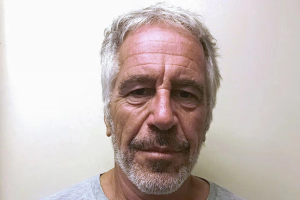
Online speculation in recent weeks has revived unverified allegations linking Epstein to ancient deities such as Baal or Moloch, figures that in some traditions are associated with child sacrifice.
Fact-checkers and mainstream media have previously reported that many such claims stem from misinterpretations of financial documents or from longstanding internet conspiracy theories, including allegations about a “temple” on Epstein’s private island that US media said was designed as a music pavilion.

Baal, a title meaning “lord” in ancient Semitic languages, was worshipped by Canaanite peoples in the ancient Near East and is portrayed in Jewish, Christian and Islamic texts as a false deity. Some scholars say there is limited archaeological evidence of child sacrifice practices in parts of the ancient Levant, though interpretations remain debated.
Iranian organizers described the statue burning as a “symbolic protest” aimed at drawing attention to alleged moral corruption in the West.
One conservative outlet linked the initiative to the Masaf Institute, a group associated with propagandist Ali Akbar Raefipour, which has promoted anti-Western and anti-Zionist narratives.
The coordinated burnings formed part of broader anniversary events that included anti-US and anti-Israel slogans, flag burnings and displays criticizing Western governments.
While state media framed the act as a message from Tehran to the world, some Iranian clerics expressed concern about the symbolism, and online users debated whether the act itself risked unintended religious connotations.
The annual commemoration of the 1979 Islamic Revolution has long served as a showcase of mass loyalty. This year, however, it unfolded under the shadow of what critics describe as a deepening crisis of legitimacy following the January bloodshed.
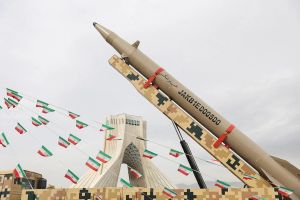
In Tehran, security forces and Basij units maintained a visible presence as supporters gathered in Azadi Square. State media broadcast images of families and children waving flags, and highlighted what it portrayed as festive participation across the country.
Among the more striking displays were symbolic coffins bearing the names and photos of senior US military officials, including US Army Chief of Staff Randy George and CENTCOM Commander Brad Cooper. Cooper was part of the US delegation that recently held talks with Iranian officials in Oman.
American and Israeli flags were also burned during the rally.
The imagery of defiance came as Iranian officials engage in renewed diplomatic contacts with the United States. The juxtaposition reflected a dual message: confrontation abroad and consolidation at home.
President Masoud Pezeshkian, addressing the rally, repeated the government’s narrative about the recent unrest, accusing protesters of sabotage and violence and saying “no Iranian takes up arms to kill another Iranian.”

He acknowledged widespread dissatisfaction but said the government was prepared to “hear the voice of the people,” while emphasizing loyalty to Supreme Leader Ali Khamenei and adherence to his “red lines” in diplomacy, a tacit reference to Iran’s uranium enrichment, missile program and support for regional militia groups.
State television placed particular emphasis on images of children and families at the rallies, a move that analysts say may reflect efforts to soften the government’s image after weeks of reports about civilian casualties.
Rights advocates have long criticized the use of minors in political events, arguing that it instrumentalizes children for propaganda purposes.
The commemorations took place roughly a month after a violent suppression of protests that erupted in late December.
The editorial board of Iran International said earlier this month that more than 36,500 people had been killed in a targeted crackdown ordered by Khamenei.
Even as the government staged its anniversary spectacle, dissent surfaced in other forms. On the eve of 22 Bahman, residents in multiple neighborhoods of Tehran – including Narmak, Ekbatan, Majidieh and Naziabad – shouted slogans such as “Death to Khamenei” and “Death to the dictator” from rooftops and balconies. Similar chants were reported in cities including Mashhad, Arak, Qazvin, Kermanshah and Shahriar.
Videos circulating online showed nighttime fireworks lighting the sky as anti-government slogans rang out.
In one clip from Arak, residents could be heard chanting against Khamenei in response to mosque loudspeakers broadcasting the traditional “Allahu Akbar.”
In Tehran, one resident said the fireworks were so loud “we thought America had attacked.”
In isolated incidents, pro-government speakers appeared to inadvertently repeat anti-Khamenei slogans during live broadcasts, prompting abrupt cuts in coverage.
One state reporter in Sistan and Baluchestan was heard listing “Death to Khamenei” among rally chants before the feed was interrupted.
Political analyst Iman Aghayari told Iran International that the anniversary had become “an arena of confrontation between the government and the people,” adding that unlike in previous years, authorities seemed less concerned with demonstrating broad public backing and more focused on asserting control.
“This time,” he said, “the regime is not trying to prove people are with it. It is simply declaring that it rules.”
As Iran navigates renewed diplomacy abroad and mounting pressure at home, the 22 Bahman (February 11) anniversary appeared to reflect a widening gap between official displays of unity and the anger that continues to surface beyond the state’s stage-managed events.