• Iran Insight
  • Politics
  • Economy
  • Analysis
  • Special Report
  • Opinion
  • Podcast
All rights reserved for Volant Media UK Limited
volant media logo
  • العربية
  • فارسی
Brand
  • Iran Insight
  • Politics
  • Economy
  • Analysis
  • Special Report
  • Opinion
  • Podcast
  • Iran Insight
  • Politics
  • Economy
  • Analysis
  • Special Report
  • Opinion
  • Podcast
  • Theme
  • Language
    • العربية
    • فارسی
INSIGHT

Fatalism spreads in Iran as threat of US strike grows

Maryam Sinaiee
Maryam Sinaiee

Iran International

Feb 24, 2026, 15:13 GMT
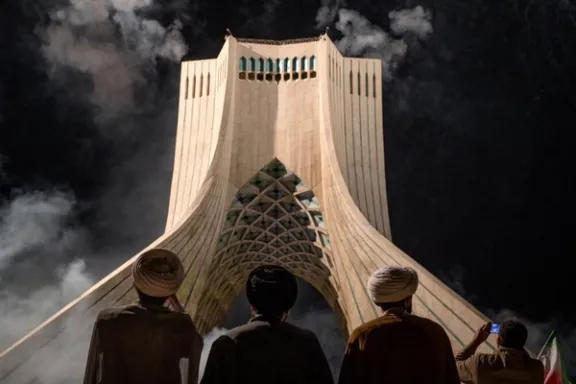
Three turbaned men watch fireworks over Tehran's iconic Azadi Tower in an event to mark the anniversary of the 1979 Revolution in Iran, February 10, 2026

A sense of fatalistic anticipation is spreading in Iran as the threat of a US strike grows, with many expressing fear of war but also resignation that it may be unavoidable—or even transformative.

The mood appears to shift with perceived signals from Washington, where President Donald Trump this week hinted at a deadline for Tehran while repeatedly floating military options if a deal is not reached.

Asked on Friday whether a limited strike on Iran was under consideration, Trump replied: “I guess I can say I am considering that.”

The prospect of conflict has triggered widespread discussion online, where users express a mix of dread, anger, and resignation. While many fear the destruction war could bring, others describe it as an inevitable outcome of escalating tensions.

“Many of us are certainly worried about war,” one user from Iran wrote on X, “but we are more terrified of continuing to live alongside these killers who have no limits.”

“No war means the Islamic Republic stays,” another user wrote. “The choice is yours.”

Casualties—of war and protest

The killing of protesters during nationwide unrest in January, along with the wave of arrests that followed and worsening economic hardship, has left some Iranians deeply pessimistic about the country’s future under continued Islamic Republic rule.

One user arguing against those opposed to a US strike compared casualties from Iran’s recent war with Israel to deaths during domestic unrest.

“12 days at war with Israel—how many did we lose? About a thousand and something,” the user wrote. “On January 18 and 19 how many were killed? Tens of thousands; in two days! Now do you think there’s a less costly way than war to get rid of the monster?”

Skepticism about diplomacy appears widespread.

An online poll conducted by the conservative website Asr-e Iran found that nearly 80 percent of more than 27,000 respondents did not expect negotiations to produce an agreement. In another poll on the same site, more than 70 percent said they believed the United States was using talks primarily to prepare military forces in the region.

Online polls in Iran are informal and not scientifically representative, but they offer a snapshot of sentiment among politically engaged internet users.

“Friends who oppose war, why are you condemning the people?” one X user wrote. “Beg Khamenei to stop the war. The people didn’t bring the country to this point.”

‘Packing bags’

Alongside emotional reactions, some Iranians are taking practical steps in anticipation of possible conflict, sharing advice on storing food, securing essential supplies, and identifying safer areas outside major cities.

Similar patterns emerged during the brief but intense war with Israel last June, when many residents of Tehran left for northern provinces or smaller towns. Long lines formed at gas stations in the early days of that conflict, and parts of the capital were temporarily emptied.

Many also express concern over what they see as a lack of preparation by authorities, noting the absence of public shelters or clear guidance for civilians.

“The government’s reaction to war is indifference and irresponsibility,” one user wrote. “After packing a bag, what do we do? Where are we supposed to go?”

For many Iranians, the uncertainty itself has become a source of anxiety, as the threat of war—once abstract—now feels increasingly real.

Most Viewed

CIA issues rare Persian-language appeal to Iranians for secure contact
1

CIA issues rare Persian-language appeal to Iranians for secure contact

2
INSIGHT

Khamenei ‘rat’ taunt spills from social media onto Iran’s campuses

3
ANALYSIS

Mexico cartel violence revives scrutiny of Iran-linked networks

4
INSIGHT

Trump’s State of the Union may test appetite for Iran strikes

5

Iran’s campuses turn into battlegrounds again forty days after massacre

Banner
Banner

Spotlight

  • Confront or concede: Iran’s brinkmanship reaches its limits
    ANALYSIS

    Confront or concede: Iran’s brinkmanship reaches its limits

  • Trump’s speech leaves Iranians guessing before Geneva talks
    INSIGHT

    Trump’s speech leaves Iranians guessing before Geneva talks

  • Hope and hedge: Tehran braces for decisive Geneva talks
    INSIGHT

    Hope and hedge: Tehran braces for decisive Geneva talks

  • China refiners turn to Russian oil as Iran faces rising uncertainty
    ANALYSIS

    China refiners turn to Russian oil as Iran faces rising uncertainty

  • Mexico cartel violence revives scrutiny of Iran-linked networks
    ANALYSIS

    Mexico cartel violence revives scrutiny of Iran-linked networks

  • Officials in Tehran claim calm, but prices tell another story
    INSIGHT

    Officials in Tehran claim calm, but prices tell another story

•
•
•

More Stories

Trump’s State of the Union may test appetite for Iran strikes

Feb 24, 2026, 14:11 GMT
•
Arash Sohrabi

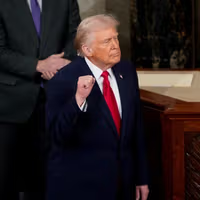
President Donald Trump will step into the House chamber on Tuesday night for a State of the Union address shadowed by the prospect of new US military action on Iran, as his administration sends envoys back to nuclear talks in Geneva and builds up forces in the region.

The prime-time speech offers Trump his most prominent platform yet to signal whether he is still betting on diplomacy in the days ahead, or preparing the public for strikes if talks fail.

While advisers have urged him to focus on affordability, immigration and the economy ahead of November’s midterm elections, the buildup toward a potential confrontation with Iran has overshadowed the run-up to the address.

Mainstream outlets have widely previewed Trump’s State of the Union address, highlighting how he might frame Iran alongside domestic political pressures.

Reuters wrote that the speech could be Trump’s best opportunity to rally skeptical voters behind his approach to Iran, including the possibility of military strikes if negotiations fail.

Trump on Monday brushed aside reports of internal dissent about military action, writing on social media: “I am the one that makes the decision… if we don’t make a deal, it will be a very bad day for that country.”

Democrats have sharply criticized his approach. Senator Tim Kaine said Trump was “bumbling his way toward war,” arguing he had scrapped a 2015 nuclear agreement that had constrained Iran’s program.

Bloomberg similarly described Iran as a major flashpoint Trump may address as he seeks to reset the political narrative after domestic setbacks.

The Associated Press said the address offers Trump a chance to make his case for possible action against Iran, citing polling that shows broad public unease with his handling of foreign affairs.

Iran in past State of the Unions

References to Iran in State of the Union speeches have typically surfaced at inflection points–the hostage crisis, regional conflict and terrorism, nuclear negotiations, or moments when presidents sought public backing for a tougher coercive strategy.

In the Cold War alliance era, Iran appeared mainly as a country whose stability and relationships mattered to Western cohesion.

President Dwight Eisenhower’s 1955 State of the Union message cited “Britain and Iran” among nations that had “resolved dangerous differences,” framing Tehran in terms of security and diplomacy rather than direct confrontation with Washington.

After the 1979 Islamic Revolution and the hostage crisis, Iran became the crisis itself.

Jimmy Carter’s 1980 address opened by saying that 50 Americans were still being held in Iran, calling the episode “terrorism and anarchy” and warning that if the hostages were harmed, “a severe price will be paid.”

After 9/11, Iran references shifted into the terror-and-WMD architecture of US strategy, placing Tehran within a broader post-attack security doctrine.

In 2002 and 2003, George W. Bush repeatedly cast Iran as a serious security threat, famously labeling it part of the “axis of evil” and describing its government as pursuing weapons of mass destruction, supporting terrorism and repressing its people, while distinguishing between the regime and Iranians who “speak out for liberty.”

President Barack Obama repeatedly used the address to press for diplomatic compromise while stressing that the United States would prevent Iran from obtaining a nuclear weapon.

In 2014, Obama said diplomacy had halted the advance of Iran’s nuclear program, warned he would veto sanctions that could derail negotiations, and argued war should be a “last resort.”

In 2015 and 2016, he defended the nuclear agreement reached with Tehran, asserting that it had helped the world avoid another war.

During his first term, Trump invoked Iran to justify withdrawing from the 2015 deal and imposing sweeping sanctions under his “maximum pressure” campaign, portraying Tehran as a central destabilizing force in the Middle East.

In 2018, he said the United States stood with “the people of Iran” against a “corrupt dictatorship” and urged Congress to address what he called “the terrible Iran nuclear deal.”

In 2019, he called Iran the “world’s leading state sponsor of terror.” In 2020, he tied Iran to counterterrorism and deterrence, citing the killing of former IRGC-Quds commander Qasem Soleimani.

The pattern is consistent: presidents have used the nationally televised address to reset Iran policy at decisive moments–to sell diplomacy, justify confrontation, or redefine strategy.

Tuesday’s speech fits that same historical frame.

Dancing for the dead: How protest massacre is rewriting Iran’s mourning rituals

Feb 22, 2026, 15:39 GMT
•
Maryam Sinaiee

Iran’s January massacre of protesters has left scars far beyond the streets. In cemeteries and hometowns, families are transforming centuries-old mourning rites into defiant celebrations of lives cut short.

In a striking break from convention, thousands of families gathering for 40th-day rituals in homes and cemeteries across the country in recent days replaced the traditionally solemn, religiously infused ceremonies with clapping, cheering, and dancing — open displays of defiance.

The iconoclastic ceremonies have angered state supporters. Alireza Dabir, a conservative politician and former wrestling champion, lashed out at grieving families. “Their children got killed and they’re dancing over the corpses. I can't help but take a dig at these useless people. May God give these useless people some brains,” he told reporters.

But for many mourners, the dancing is neither celebration nor denial. It is a refusal to grieve on prescribed terms. The music and dance have become a language of protest — one that transforms funerals into acts of collective memory and, perhaps, the foundation of a new tradition.

Raha Bohloulipour was 23, a student of Italian language at Tehran University. On social media, she wrote about justice and equality and appeared in videos laughing lightheartedly with friends. Before leaving home for what would be the last time, she posted a simple message on Instagram: “Woman, Life, Freedom forever.” She was shot on a street in Tehran.

At her 40th-day memorial in Firouzabad, her hometown in southern Iran, hundreds gathered as her parents danced solemnly to traditional Qashqai folk music, waving green kerchiefs — her favorite color. Some parents in other places danced as long as they could, then broke into tears and collapsed into the arms of relatives, wailing.

Mourners in Mobarakeh in central Iran danced to a pro-monarchy anthem in an act of defiance at the 40th-day memorial for protester Rostam Mobarakabadi, who was shot dead by security forces on January 9 in Esfahan.

The song references Kaveh the Blacksmith, a mythological figure who leads an uprising against the tyrant Zahhak.

Weddings at memorials

When a young unmarried person dies in Iran, families often erect a hejleh: a mourning display decorated with flowers, candles, mirrors, lights and framed photographs. The structure resembles a wedding canopy, symbolizing a life cut short before marriage.

This time, however, the symbolism has expanded beyond décor. Confetti was thrown into the air as women cheered and danced beside the grave of a young man, shouting, “There’s a wedding here.”

At another cemetery, a bride-to-be dressed in white danced and cried, waving her bouquet over a grave. Outside a shrine where only religious songs would once have been permitted, mourners danced with red kerchiefs to a pop song, blurring the line between wedding and wake.

Roots in ancient traditions

The fusion of music, mourning, and defiance is not entirely new in some tribal regions.

The Malekshahi and Shuhan tribes recently held a traditional Chamara ritual on the 40th day of Saeed Tarvand, a 33-year-old oil engineer and father of a three-year-old who was killed in Abadan.

A very large crowd dressed in mourning attire gathered in his village in Ilam province. A riderless horse with an empty, inverted saddle, adorned in black and red and flanked by rifles and cartridge belts, was paraded through the crowd. Drums beat, wind instruments known as sornai played solemnly, and men carrying sticks performed a symbolic war dance — an ancient choreography of sorrow and resistance.

Political defiance and divergence from state ideology

The memorials are highly charged political spaces. Mourners chant “Death to Khamenei", “Death to the Dictator”, and "Long Live the King”, referring to Prince Reza Pahlavi. Crowds also vow to continue the path of the fallen until “Iran is free” or until “the mullahs are in shrouds.”

Instead of clerical speeches and Quranic recitations, many families have chosen to read heroic verses from the Shahnameh, Iran’s national epic, invoking pre-Islamic symbols of resistance, or to sing revolutionary songs inspired by it.

At the 40th-day ceremony for 30-year-old truck driver Rostam Mobarakabadi, his mother held his photograph high above her head, stamping her feet resolutely and leading the crowd in a revolutionary song invoking “Kaveh the blacksmith,” a legendary symbol of uprising against tyranny.

In Firouzabad, Raha’s grandfather drew on a different literary reference. In his speech, he called her “The Little Black Fish,” the protagonist of a beloved children’s story about a curious fish who leaves her narrow stream to explore the world despite warnings and fear — a tale widely read as an allegory of individual freedom and courage.

The language, too, reflects a shift. Rather than calling the dead “martyrs” — shahid — many families now describe them as “javid-nam,” meaning their names will be eternal. The distinction between these matters greatly in a country where martyrdom is closely tied to state ideology. Authorities have reportedly banned the use of “javid-nam” on some gravestones, reinforcing the political weight of the term.

Mohammad-Javad Akbarin, a dissident Islamic scholar living in exile in France, said the 40th-day gatherings show that society is “dissociating itself from the state and the ideology that it promotes”.

“Instead of religious lamentations, it sings songs; instead of religion, it speaks of the homeland; and it describes its beloved not as shahid, but as one whose name will be eternal,” he told Iran International.

Film shot inside Iran breaks censorship ground with intimate scenes

Feb 21, 2026, 22:06 GMT
•
Mo Abdi

A film with intimate scenes shot inside Iran premiered at the Berlin film festival this week, marking a new escalation in Iranian artists’ defiance of censorship at home.

Directed by Mohammad Shirvani, Cesarean Weekend includes scenes of physical intimacy unseen on screens in Iran since the revolution in 1979.

Shirvani has long worked outside mainstream Iranian cinema, producing low-budget, highly personal films that reject conventional storytelling and visual norms.

His latest work follows a small group of characters in private settings, focusing less on plot than on relationships, physical presence, and emotional tension.

The film features composer Nader Mashayekhi appearing under his own name alongside other non-professional actors, blurring the line between performance and lived experience.

Shot with a handheld camera in confined domestic and natural environments, it presents bodies and personal interactions in ways that Iran’s official cinema has avoided for decades.

Iran’s film industry has long operated under strict state supervision. Filmmakers must obtain permits before production and submit their work for approval before release, complying with detailed regulations governing dress, gender interaction, and visual representation.

The depiction of uncovered hair, physical contact, or intimate private settings has been tightly controlled for decades.

Those restrictions remain in place. But in the years following the 2022 “Woman, Life, Freedom” protests and the subsequent crackdown, a growing number of artists appear increasingly willing to ignore them.

Rather than seeking official approval, some filmmakers are producing work independently inside Iran, outside the formal licensing system. These films are typically made with small crews, limited resources, and discreet production methods, then screened abroad.

The Berlin International Film Festival, known as the Berlinale, is one of the more prominent platforms for global cinema which has screened and awarded top prizes for such works.

This year, another Iranian underground film, Dream, directed by Mahnaz Mohammadi, was also selected for screening outside the main competition. Together, the two films reflect the continued presence—and evolution—of filmmaking beyond state oversight.

Many unlicensed films focus on political themes or censorship itself. But a growing number of filmmakers are disregarding it altogether, treating creative autonomy as a given rather than a subject.

In this context, the significance of Cesarean Weekend lies less in its narrative than in its production. Scenes involving bodily intimacy and private life were filmed inside Iran itself, despite rules designed to prevent such imagery from being created or shown.

'Deal would be a miracle': US military buildup fuels uncertainty in Tehran

Feb 20, 2026, 10:41 GMT
•
Maryam Sinaiee

A sharp increase in US military deployments to the Middle East has intensified uncertainty in Tehran, where analysts and officials are debating whether the buildup signals imminent conflict or a bid to gain leverage in nuclear negotiations.

Multiple US outlets reported on Thursday that national security officials have informed President Donald Trump that the military has positioned the necessary air and naval assets in the region to carry out a strike “within days,” potentially even by the end of this week.

In Tehran, some analysts cautioned that the military moves could signal genuine escalation rather than routine pressure.

Political analyst Mohammad Soltaninejad told Entekhab: “If the negotiations fail or the US position changes—as happened before the 12-day war and in the middle of negotiations—it is possible that war could break out.”

Jalal Sadatian, a former Iranian ambassador to the United Kingdom, said in an interview with ILNA that war remains an unattractive option for regional states, particularly given the risk of US bases in those countries being targeted.

“The balance is still tilted somewhat more toward negotiation than toward war,” he said, arguing that Trump appears to be “more focused on threats and exercising pressure.”

‘Real’ prospect of war

The military buildup follows the second round of nuclear talks between Iran and the United States, which ended Tuesday in Geneva without tangible results. Cautious optimism expressed by Foreign Minister Abbas Araghchi has not translated into broad confidence in Tehran.

Financial markets have reacted nervously. Iran’s currency weakened nearly one percent in a single day, with the dollar rising toward 1,630,000 rials, reflecting broader concerns about the risk of escalation.

Prominent economic outlet Eco Iran ran an editorial on Thursday titled Diplomacy Under the Shadow of Military Movements, arguing that US deployments are not merely a show of power but “a sign of maintaining operational readiness in case tensions escalate.”

International relations professor Gholamreza Haddad told Eco Iran that talks proceeding to a third round is not necessarily a positive sign. He said the scale of US deployments suggests “real preparedness for military conflict,” rather than merely a threat intended to extract concessions from Tehran.

Agreement ‘a miracle’

Nour News, a site close to senior security official Ali Shamkhani, went further, suggesting that Washington might opt for a limited, symbolic action to demonstrate readiness without entering full-scale war.

“This scenario would symbolically test Iran’s deterrence and demonstrate America’s power,” the editorial said, warning that “the scene stands on the brink of crisis.”

Iran has also demonstrated heightened military activity. Over the past two days, it has conducted exercises in the Persian Gulf and the Sea of Oman, and a notice to airmen (NOTAM) was issued for a missile test in southern Iran scheduled for Thursday.

US affairs analyst Amir Abolfath delivered one of the more pointed warnings, calling a potential agreement “a miracle” and cautioning that sustaining any deal may prove even more difficult than reaching one.

“We may end up in war,” he told moderate outlet Khabar Online. “And even in the event of war, the problem may not be resolved.”

IRGC moves to tighten internet controls after protest crackdown

Feb 20, 2026, 01:31 GMT
•
Behrouz Turani

Iran’s Revolutionary Guards intelligence chief has confirmed he is driving efforts to tighten restrictions on social media, linking the initiative directly to the country’s security apparatus and the expansion of the so-called “national internet.”

Majid Khademi, head of intelligence for the Islamic Revolutionary Guard Corps (IRGC), said in an interview published on February 19 that a total ban on foreign social media platforms is intended to “prevent enemy plots and immunize Iranians against them.”

He also revealed that Supreme Leader Ali Khamenei had tasked him with overseeing the expansion of Iran’s domestic intranet, often referred to as the “national internet,” and stressed the importance of what he described as “proper governance of the Internet.”

“Sianat”—meaning protection—is the term Iranian officials use to describe legislation aimed at restricting social media under the stated goal of shielding citizens from perceived dangers.

The original proposal, often referred to as Sianat-1, was approved by parliament in March 2022 but implementation was halted shortly afterward amid concerns among senior officials that sweeping restrictions could provoke public backlash.

Since then, the bill has remained under discussion among parliament, the Guardian Council and the Supreme National Security Council.

Targeting platforms

Despite the absence of a comprehensive ban, access to major platforms remains restricted, with most users relying on virtual private networks (VPNs). Recent media reports suggest that WhatsApp, which had previously been accessible, has faced renewed restrictions, while authorities continue expanding policies granting limited access to selected users.

In recent weeks, Iranian media outlets have reported renewed efforts to advance what has been informally described as “Sianat-2,” a broader initiative aimed at strengthening state oversight of online activity and expanding domestic internet infrastructure.

Leaked information cited by Iranian media suggests audiovisual content on platforms such as Instagram, YouTube and Telegram could face tighter regulation, potentially placing greater authority in the hands of state institutions including the Islamic Republic of Iran Broadcasting (IRIB), which holds a legal monopoly over broadcasting.

‘Urban terrorism’

Authorities imposed a near-total internet blackout during the widespread protests of January 8 and 9, cutting off access to global platforms and isolating much of the country digitally.

The shutdown coincided with a violent crackdown in which human rights organizations and independent media reported large numbers of protesters killed, injured and detained.

Khademi framed such measures as necessary to counter foreign threats. He accused outside actors of attempting to spread instability, encourage “urban terrorism,” and undermine public trust in the government, though he did not provide evidence.

“These platforms are used to organize and guide hostile activities,” he said, adding that Khamenei had instructed him: “Do not forget the proper governance of the Internet.”

The blackout in January highlighted the central role of internet controls in Iran’s response to political unrest—a strategy that officials have increasingly framed as a matter of national security.

Khademi’s confirmation of the IRGC’s leadership role underscores the extent to which internet governance has become integrated into Iran’s broader security strategy.