Ahmadinejad Admin, IRGC Accused Of Bagging Missing Carpets At Palace In Tehran
A room in Saadabad Palace
The administration of former Iranian President Mahmoud Ahmadinejad and the Revolutionary Guard have been accused in a case of the missing carpets of Saadabad Palace in Tehran.
Hardliners revealed this weak that dozens of exquisite carpets are missing from the Saadabad Palace complex in Tehran, insinuating that they disappeared during the presidency of centrist Hassan Rouhani (2013-2021).
However, "an informed source", who seems to be close to Rouhani, told ILNA news agency on Wednesday that the disappearance of the carpets dates back to the presidency of Mahmoud Ahmadinejad (2005-2013).
He claimed that those raising the issue now want to "distract minds".
“The transfer of any documents or assets in public offices follows specific instructions, and the more sensitive the centers are, the more precise these instructions are. How is it that a bundle of carpets disappeared without the permission of the security guards that operate under the supervision of the Ministry of Intelligence and the IRGC,” he added.
The unnamed source also called for the intervention of "legal and judicial authorities" in this regard.
IRGC-affiliated Fars news agency reported Monday that 48 exquisite and expensive hand-woven carpets of Saadabad Palace were removed from a building and disappeared during the administration of Hassan Rouhani.
Sadabad is a 110-hectare complex built by the Qajar and Pahlavi monarchs, located in Shemiran, north of Tehran. Today, the official residence of the President is located adjacent to the complex.
The complex was initially built and inhabited by the Qajar dynasty of monarchs in the 19th century. After extensive expansions, Reza Shah of the Pahlavi Dynasty resided there in the 1920s. His son, Shah Mohammad Reza Pahlavi, moved there in the 1970s.
Large parts of the complex are museums, which are accessible to visitors.
Tehran's water dispute with the Taliban must be solved through arbitration, says the country's vice president for legal issues who claimed the Afghan fundamentalists were not acting according to agreed terms.
Mohammad Dehghan said Wednesday that “we have a completely reliable treaty to solve the problem, and accordingly, we expect the Afghans to act based on the treaty.”
While Afghanistan says it needs dams to store water for agriculture or to produce electricity, which it imports from neighboring countries including Iran, many environmentalists are critical of large-scale water engineering projects.
The Iranian government and environmentalists argue constructing the dam on the Helmand River will deepen problems in Iran’s eastern provinces, particularly in Sistan-Baluchestan where water resources are already scarce.
Declining rainfall since late 1990s, which caused prolonged droughts in the Helmand basin, has had serious ecological, economic and social impact.
Wetlands in Sistan have largely turned into salt flats, the once rich wildlife has disappeared, and many local villages abandoned. In 2019, after nearly two decades of drought, water from Helmand reached the wetlands of Sistan and partially revived the Hamoun-e Hirmand Lake. The lake is a UNESCO biosphere reserve.
The dispute between the two countries over water is long standing but it has escalated in the past few years.
Iran’s Supreme Leader Ali Khamenei Wednesday praised the country’s “revolutionary parliament” for passing a bill in 2020 that complicated nuclear negotiations.
“From the beginning of this parliament [2020], based on information I had, I believed that it is a revolutionary parliament, and now after three years I reiterate that,” Khamenei told 290 members of the legislature.
The parliament, dominated by hardliners, passed a bill in December 2020 dubbed the ‘Strategic Action To Eliminate Sanctions and Defend Iranian Nation's Interests.’ The bill authorized higher-level uranium enrichment to force the United States to lift economic sanctions imposed in 2018, when former President Donald Trump withdrew from the JCPOA nuclear agreement.
The bill also mandated restrictions on nuclear monitoring by the United Nations watchdog, the International Atomic Energy Agency (IAEA). Since the passage of the law, Iran has further restricted international monitoring and inspections, adding to the complicated dynamics of renewing the JCPOA.
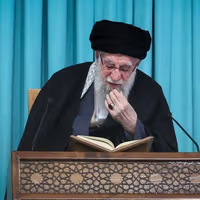
Iran’s ruler Ali Khamenei during a meeting with parliament members on May 24, 2023
The current parliament was elected in February 2020 in a controversial vote when the Guardian Council, loyal to Khamenei, banned hundreds of relatively moderate candidates and allowed hardliners to gain a strong majority in the legislature. Few doubt that Khamenei was not aware or did not approve the engineering of the 2020 elections to pack the parliament with hardliners.
The timing of the bill in December 2020 was curious. The proposal emerged in parliament in early November just days after the US presidential election and Joe Biden’s victory. In September of that year, Biden had already announced thatif elected he would return to the JCPOA agreement to correct Trump’s “reckless” policy of dumping the nuclear deal that capped Iran’s uranium enrichment.
The Iranian regime knew that the incoming Biden administration wanted to restore the JCPOA, which would lift crippling sanctions, but nevertheless decided to pass the parliamentary law that made negotiations more difficult.
The bill’s stipulation about higher levels of uranium enrichment was not an empty negotiating tactic. Iran actually began enrichment at 20 percent in early 2021, breaking the JCPOA limit of 3.65 percent. Subsequently, enrichment was increased to 60 percent during the talks, and by all estimates, Tehran now has enough fissile material for at least two nuclear bombs. Tehran also gradually restricted IAEA monitoring access to its nuclear facilities, introducing another complicating factor into the JCPOA talks.
The government of President Hassan Rouhani initially opposed the legislation, saying it will complicate talks, but the hardliners went ahead anyway.
However, Khamenei Wednesday told lawmakers, “The Strategic Action law brought the country out of a wandering state in the nuclear issue. This law fully clarified what we needed to do.”
Negotiation to revive the JCPOA began in Vienna on April 7, 2021, between the members of the JCPOA, Iran, the United Kingdom, France, Germany, Russia and China, with the US on the side lines as Tehran rejected any direct talks with Washington.
After 11 months of talks, the Vienna process ended without success in March 2022 after the Russian invasion of Ukraine. Subsequent efforts by the European Union to bridge the gaps failed and the talks reached a deadlock in September 2020.
In the meantime, Iran’s economic crisis triggered by US sanctions got much worse, with annual inflation nearing 70 percent and the national currency losing much of its value. This and continued domestic repression led to nationwide protests in the fall of 2022, destabilizing the clerical regime, with no immediate prospect of ending sanctions.
Saudi Crown Prince, Mohammed Bin Salman, the de facto ruler, has made a series of bold moves in recent months, not least, in his reconciliation with Iran.
From the US to China, the young ruler is trying to show his force in a region where power plays are constantly shifting. Most recently, that power play seems to be blowing up a little, with the UAE’s President Mohammed Bin Zayed shunning the recent Arab League Summit in Saudi, following MBS boycotting a meeting in January of GCC heads of state amidst clashes over policy including oil sales and the Yemen war, as the two vie for GCC hegemony.
But it is Saudi’s dancing between Iran and Israel which is causing all eyes to be on Riyadh. Just weeks after the detente between Saudi and Iran, breaking years of tension between the two regional powers, it appears MBS has received a call from Israel’s Prime Minister Benjamin Netanyahu and Foreign Minister Eli Cohen. Such a move would have been followed by a torrent of abuse from Iran had this happened just weeks earlier, but as things are shifting in MBS’s favor, Iran has largely remained quiet.
At the Arab League Summit, Qatar’s ruling Emir Sheikh Tamim bin Hamad Al-Thani walked out before a speech given by the newly readmitted Bashar al-Assad in a stand against the Syrian dictator. While Al-Thani welcomes warming ties with Saudi and Qatar’s Gulf neighbors after the recent lifting of the embargo, the gas-rich state still flexed its muscles to show Riyadh is not calling the shots in Qatar’s regional relations.
Saudi Arabia's Crown Prince Mohammed bin Salman meets with Syria's President Bashar al-Assad, in Jeddah, Saudi Arabia, May 19, 2023.
Confrontation with America under the Biden administration, stronger alignment with China, expanding relations with Russia and inviting Ukraine’s President Volodymyr Zelensky to the Arab League meeting, show MBS playing an interesting game on the global stage for the world’s largest oil exporter.
Iran’s Etemad newspaper wrote of the shifting sands: “From the point of view of some experts, this action of bin Salman is reminiscent of the policy of reducing problems with all regional and international parties to zero, while others consider it to be stepping on the edge of an abyss that can destroy all plans even with one step or one wrong behavior.”
Warning of the risks at stake, moving between some of the world’s biggest rivals, Etemad said of MBS: “Whether in the domestic dimension or in the regional and international arenas … he loves to walk in minefields and play with contradictions.”
While the Saudi media describe his behavior as the creation of a new Arab order, MBS the flag bearer of the beginning of a new chapter in the region and the man to see an end to its conflicts, others see his position between democracies and dictatorships as a major gamble.
The UAE has long shown itself as a diplomatic kingmaker in the region, the first country to sign the US-brokered Abraham Accords in 2020, it also made peace with Iran last year, long before Saudi. Meanwhile, Qatar and Egypt also pride themselves as long-standing regional peacemakers and want their share of the peace-pie before they hand the reins to MBS. It is unlikely that any of these nations will be happy to see MBS call the shots, in spite of regional frustrations with the Biden administration and the growing influence of Russia and China, the latter of which played a significant role in the Saudi-Iran detente.
“It is not believed that Muhammad bin Salman has the ability to play on several ropes for a long time,” wrote Etemad.
MBS is still seen by the West as a brutal dictator responsible for the likes of mass displacement as whole tribes are removed to make way for the NEOM development and executions in spite of a sharp PR campaign to suggest the country is undergoing major reform and opening up to the world with a raft of jaw-dropping mega projects.
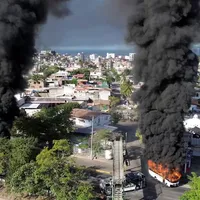
At least nine people were injured on Tuesday after a fire caused a major explosion at a chemical reactor in Eshtehard.
The Red Crescent Society's Control and Coordination Center dispatched a team to the industrial town 100 kilometers west of Tehran.
It is the latest major incident to hit Iran's industrial workers. On Saturday, seventeen people were injured, and several were taken to hospital after a large fire engulfed a warehouse in southern Tehran.
Last month another large blaze broke out across three warehouses of a home appliances manufacturer in the northeastern city of Mashhad. The building belonged to Electrosteel, a large and well-known company in Iran.
There have been a number of explosions and fires near Iran’s military, nuclear and industrial facilities in recent years.
On January 28, a huge fire erupted at an Iranian military industry factory following a suspected drone strike in the central city of Esfahan.
Iran blamed Israel for the drone attack, vowing revenge.
Israel’s top military official has raised the prospect of "action" against Iran amid renewed concerns over Tehran’s nuclear activities.
Lieutenant-General Herzi Halevi, chief of Israel's armed forces, warned: "Iran has advanced with uranium enrichment further than ever before ... There are negative developments on the horizon that could bring about (military) action.”
Speaking at the Herzliya Conference, an international security forum, Halevi said global efforts to curb Iran’s nuclear activity have so far been in vain.
An Associated Press report Monday showed the regime is building a deep underground nuclear facility near the Zagros Mountains in central Iran, close to the Natanz nuclear site, with experts claiming development “is likely beyond the range of a last-ditch US weapon designed to destroy such sites."
Completion of such a facility “would be a nightmare scenario that risks igniting a new escalatory spiral,” warned Kelsey Davenport, the director of nonproliferation policy at the Washington-based Arms Control Association.
“Given how close Iran is to a bomb, it has very little room to ratchet up its program without tripping US and Israeli red lines. So at this point, any further escalation increases the risk of conflict,” Davenport added, reiterating worries that Iran is producing uranium close to weapons-grade levels after the collapse of its 2015 nuclear deal with world powers, officially known as the JCPOA.
Israeli National Security Adviser Tzachi Hanegbi told the Herzliya Conference that while the new underground site would be challenging to attack, ”there is nowhere that cannot be reached."
Experts are divided over whether Israel has the military might to deal lasting damage to Iranian nuclear facilities that are distant, dispersed and defended, leading to speculations that Israel might use countries on Iran's borders – such as Azerbaijan -- as springboards for strikes.
Deputy Azeri Foreign Minister Fariz Rzayev, who spoke at the same conference, said "We refrain from interfering in the disputes or problems (of other countries), including by allowing or giving our territory for some operations or adventures," denying previous reports about preparing an airfield to assist Israel during an attack on the Islamic Republic.
Halevi, Israel’s top general, said elsewhere in his speech that "We have capabilities, and others also have capabilities,” in an apparent allusion to the military clout of Israel's US ally which this month posted pictures of a powerful bomb designed to penetrate and destroy underground facilities.
The US Air Force released rare images of the weapon, the GBU-57, known as the “Massive Ordnance Penetrator,” designed to destroy weapons of mass destruction located in well protected facilities. However, it immediately took the photos down because they revealed sensitive details about the weapon’s composition and punch.
According to Rahul Udoshi, a senior weapons analyst at open-source intelligence firm Janes, the latest photos revealed stenciling on the bombs that listed their weight as 12,300 kilograms (27,125 pounds). It also described the bomb as carrying a mix of AFX-757 — a standard explosive — and PBXN-114, a relatively new explosive compound. The weight of the bomb, coming from its thick steel frame, allows the explosives to chew through concrete and soil before exploding.
This is not the first time reports surface about Iran building a vast tunnel network near Natanz, purportedly able to withstand cyberattacks and bunker-penetrating bombs.
Last year, the spokesman for the Atomic Energy Organization of Iran, Behrouz Kamalvandi, reacted to a report by the New York Times revealing underground work, claiming Iran had notified the UN nuclear agency of its plan to relocate the activities of the Iran Centrifuge Technology Company (TESA) complex in Karaj to the city of Natanz.
He claimed the move aimed to prevent the recurrence of attacks, referring to a recent drone attack at the TESA complex near Karaj which manufactures parts for centrifuges.
Over the years, a series of attacks has seemed to slow Iran’s nuclear activities. In 2010, the Natanz uranium enrichment facility suffered serious damage following a major cyber-attack involving the Stuxnet virus. Three years later, the Fordow enrichment site was rocked by an explosion. More recently, in July 2020, a centrifuge assembly facility was hit by an explosion and in April 2021 an explosion at the enrichment plant caused a power outage that reportedly damaged thousands of centrifuges.