Canada Launches Second Edition Of Scholarship Honoring Flight PS752 Victims
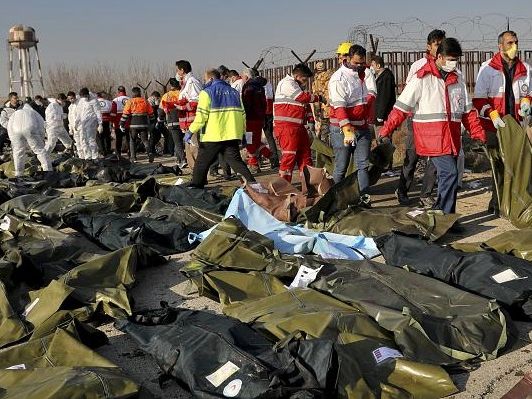
The crash site of flight PS752 near Tehran on January 8, 2020
Canada’s Minister of Foreign Affairs announced the start of the second round of a commemorative scholarship in honor of those who lost their lives in the unlawful downing of the Ukraine International Airlines Flight 752.
The Government of Canada's website stated on Wednesday, “Among these victims were brilliant minds and dedicated students who made significant contributions to Canadian educational institutions.”
Students must have a field of study that aligns with a victims’ academic or professional backgrounds or focuses on the prevention of air disasters, as the program aims to commemorate the tragedy.
The Iranian Revolutionary Guards (IRGC) shot down the plane shortly after it took off near the Imam Khomeini International Airport near Tehran on January 8, 2020, killing all 176 people on board, including 82 Iranians, 63 Canadians, 11 Ukrainians, ten Swedes, four Afghans, and three Britons.
In July, Britain, Canada, Sweden, and Ukraine filed complaints against Iran at the International Court of Justice, alleging that the Islamic Republic purposefully shot down the plane. In January, they also filed a complaint with the UN Aviation Council to hold Iran accountable for the downing.
In April last year, a Tehran military court sentenced the operator of the system who fired missiles at the plane to 13 years in prison. No high-ranking military or government officials of the Islamic Republic were named among the military personnel accused.
Two Texas residents have pleaded guilty for their roles in an illicit scheme to transfer tens of thousands of dollars from the US to Iran, including for the benefit of Iran’s Supreme Leader Ali Khamenei.
The US Department of Justice announced on Wednesday that between December 2018 and December 2019, Muzzamil Zaidi, 40, and Asim Mujtaba Naqvi, 40, collected payments of khums—a religious tax on wealth—and donations purportedly from individuals in the US to help victims of the ongoing civil war in Yemen.
In 2018, Zaidi was granted permission to collect this tax on behalf of several Imams, according to court documents from the Justice Department.
To avoid law enforcement scrutiny, the pair enlisted friends, family, and other associates to transport cash out of the US in amounts less than $10,000.
One dollar transfer to Iran involved a group of 25 travelers going on a religious pilgrimage in Iraq and the subsequent transport of US dollars hand-carried by those travelers to Iran. They were arrested in Houston on Aug. 18, 2020. Zaidi's sentencing is scheduled for Aug. 13, and Naqvi's for Oct. 1.
Due to US economic sanctions imposed on Iran since 1995, money transfers are illegal. The State Department has designated Iran a state sponsor of terrorism every year since 1984. Additionally, on June 24, 2019, former US President Donald Trump imposed additional sanctions on the Supreme Leader of Iran, prohibiting the provision of funds to or for his benefit.
Iran’s Supreme Leader Ali Khamenei warned about ‘normalization with Israel’ Wednesday, as US and Saudi Arabia got closer to a bilateral deal that might help Washington's parallel efforts to normalize ties between Riyadh and Tel Aviv.
The Biden administration has been trying to push Saudi Arabia and Israel to sign a peace agreement for months. A deal was said to be close last summer but it fell apart and effectively died on 7 October 2023, when Iran-backed Hamas rampaged Israeli border areas, killing several hundred civilians, and Israel began its onslaught on Gaza, which has killed at least 30,000 people.
Now in his last six months in office, Joe Biden seems eager to somehow revive the pact with Saudi Arabia, even though Israel has rejected any notion of a Palestinian state, which is central to Saudi Arabia’s offer of ‘normalization.’ A trilateral deal, therefore, seems unlikely. But President Joe Biden is hoping that a second-choice bilateral deal with Saudi Arabia would help restrain the Israeli government, further isolate Iran, and keep the door open to a potential deal between Israel and Saudi Arabia at a later date.
“These people imagine the matter [of Palestine] will be settled if they persuade regional countries to normalize relations with the Zionist regime,” Khamenei said in a speech Wednesday. “They’re wrong. The problem won’t be solved until Palestine is returned to the Palestinian people.”
Khamenei did not mention the kingdom in his speech, but it was not hard to guess who he had in mind. The regime in Iran would not welcome any such arrangement, bilateral or trilateral, especially at a time of marked improvement in its relationship with Saudi Arabia –and a time when the crisis in Gaza seems to have bettered its standing in the eyes of the public in some parts of the region.
Iran’s unprecedented attack against Israel last month was cheered on by many across the Muslim world, who resent what they view as their own leaders’ inaction in the face of Israeli brutalization of Palestinians in the Occupied Territories. But the attack also drew some Arab governments closer to Israel, as they joined forces with the US to fend off Iran’s large-scale missile and drone attack.
This new alignment could be cemented if the Biden administration manages to persuade Israel and Saudi Arabia to ‘normalize’ ties. But that’s a big if, since the kingdom is calling for a ceasefire in Gaza and the establishment of an independent Palestinian state, both of which the Israeli prime minister, Benjamin Netanyahu, has rejected. And on the other side, Biden has little time left in the White House to get his darling deal done.
Some experts say if a trilateral agreement is unlikely, a bilateral one without Israel, is almost impossible, because it would have to be approved by the Senate, and Senators would not do so if Israel is excluded.
“Now is the time to be crystal clear about what can and cannot happen in the US Senate regarding potential agreements between the US and Saudi Arabia,” Senator Lindsey Graham (R-SC) posted on X Wednesday. “Without normalizing the Israeli-Saudi relationship and ensuring the security needs of Israel regarding the Palestinian file, there would be very few votes for a mutual defense agreement between the US and Saudi Arabia. This has been true since the very beginning and remains so today.”
European Union Foreign Policy Chief Josep Borrell urged the need to keep working on nuclear non-proliferation in a phone call with Iran’s Foreign Minister Hossein Amir-Abdollahian.
Iran’s ongoing nuclear program continues to pose one of the world's biggest threats to peace. In April, Rafael Grossi, the Director-General of the International Atomic Energy Agency, announced that Iran has significantly moved towards the threshold of being able to produce a nuclear bomb in days rather than weeks.
According to his account on X, Borrell also stressed “the importance of restraint and de-escalation in the region,” which has witnessed intense tensions in recent weeks following tit-for-tat military attacks between Israel and Iran. “I explained EU’s sanctions on Iran’s UAVs and missiles,” Borrell wrote on X in reference to the recent bans against Tehran following the regime’s April 13 missile and drone offensive on Israeli territory.
Further in his conversation with Iran’s top diplomat, Borrell discussed the case of EU citizens who have been detained in Iran, including a Swedish EU representative, one of multiple diplomatic hostages held in Iran.
The call came a week after the European Parliament slammed the Iranian regime’s notorious “hostage diplomacy,” demanding that the bloc “launch a strategy to counter it with a dedicated task force to better assist detainees’ families and effectively prevent further hostage-taking,” according to the parliament’s website.
Last month, Iran's head of the Atomic Energy Organization said plans continue to expand the number of nuclear power plants in the country, aiming to reach a production capacity of 20,000 megawatts of nuclear electricity.
However, while Iran continues to exceed levels of 60 percent purity for uranium enrichment in the face of global sanctions, the IAEA has admitted no country with plans for the peaceful uses would need to exceed the set levels.
The head of the Australian Jewish Association is urging the government to expel the Iranian government’s ambassador to the country due to recent antisemitic remarks made by the diplomat.
“[Prime Minister] Albanese’s government should expel the ambassador. There shouldn't be an embassy of the Islamic Republic of Iran in Australia at the moment,” AJA CEO Robert Gregory said in an interview with Iran International’s Alireza Mohebbi.
The call comes after the Islamic Republic’s Ambassador, Ahmad Sadeghi, posted a series of tweets on X (formerly known as Twitter).
In one of his tweets Sadeghi said humanity had no choice but to put"an end" to Israel, calling it “the most notorious killing machine in current world history.
The posts followed Hamas’ surprise attack on Israel on October 7, where thousands of gunmen killed around 1,200 Israelis and foreigners. It was the worst loss of life in a single day since Israel's founding in 1948. More than 240 people were taken hostage.
In retaliation, Israel declared war on the militant group. Since then, the numbers compiled by Gaza’s Ministry of Health, run by Hamas, says Israeli strikes have killed around 30,000 people since.
The Iranian Ambassador has used his official X account to post numerous images of what appeared to be dead children – along with violent rhetoric against Israel throughout this recent conflict.
Although the Australian government condemned Iran’s ambassador for the posts, Gregory criticized the Prime Minister of Australia for offering "mere words of condemnation" regarding anti-Semitism.
The tit-for-tat military attacks between Israel and Iran last month further fueled tensions between the AJA and the Islamic Republic's embassy in Australia.
On April 13, Iran launched 300 missiles and combat drones in retaliation for Israel's April 1 air strike on the Iranian embassy in Damascus. Six days later, a suspected Israeli attack hit the central part of anair defense system at an Iranian air base in Isfahan. No casualties were reported.
"While [Iran’s] attack may have largely failed, there is no doubt that it was intended to kill thousands of innocent people,” the statement read, drawing anger from Iran's ambassador to Australia, who called AJA a “demon Zionist lobby.”
AJA’s statement further stressed the distinction between the Iranian people and the regime. It urged the international community to support the people of Iran to “overthrow the monsters who oppress them.”
“The reported Israeli attack, if we have a look at just how calculated just how precise it was, we can see that it was not intended to hurt the Iranian people at all. It was directed at the regime in such a precise way and to send such a strong message that Israel can strike where it wants to,” AJA CEO told Iran International.
“We're calling for a strong response because the nuclear weapons program of the Islamic Republic of Iran is illegal. And we think action needs to be taken,” the AJA CEO explained to Iran International.
The Australian government has been urged to take a more rigid stance against Iran amid escalating tensions with Western nations due to reported intimidation tactics and claims that it funds Hamas.
In March, the Australian government wasaccused of concealing the danger posed by Iran's Islamic Revolutionary Guards (IRGC) by withholding documents regarding the backstory to the reversal of its decision to proscribe the state-backed terrorist group.
The Instagram page managed on behalf of imprisoned human rights activist Narges Mohammadi released a video memorializing Nika Shakarami, a 16-year-old murdered by the Iranian security forces.
Shakarami became an icon of the Woman, Life, Freedom uprising after her death in 2022 amid the nationwide protests after she was filmed burning her hijab.
The post by the Iranian Nobel laureate condemned the actions of the Iranian regime, stating, "Brave Nika, your stature embodies the power of the protesters and the brutality of the aggressors.
“What a scandalous regime the Islamic Republic is, arresting and imprisoning women under the pretext of their hair, and sexually assaulting the same women.”
A recent BBC investigation unveiled a "highly confidential" document implicating three security personnel in the direct assault and murder of Shakarami.
The report detailed a disturbing account of the events leading to her death, including an officer forcefully restraining her while others sexually assaulting her and beating her with batons. Despite her resistance, the sexual assault ended fatally, with the regime later falsely claiming she had committed suicide.
Shakarami's murder came after that of Mahsa Amini, whose death in September 2022 in police custody for hijab defiance ignited nationwide protests.