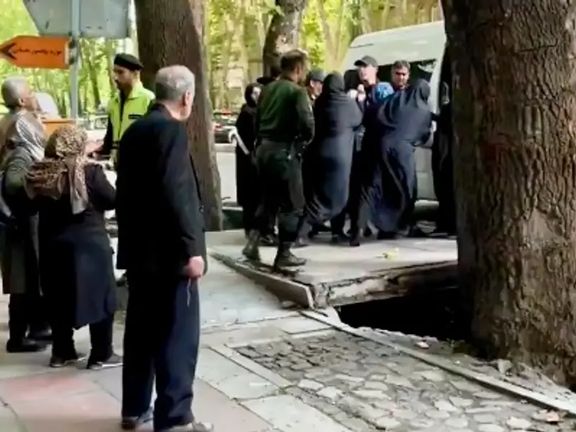
A woman being arrested by hijab police in Tehran on May 7
A video showing agents of Iran's hijab patrol forcibly arresting a young woman for failing to comply with the mandatory hijab has surfaced showing her being forcibly thrown into a van as brutal crackdowns continue.
According to the person who recorded the video, the hijab patrol has adopted a new strategy where an officer films the reactions of those detained to use as evidence of their behavior in legal proceedings.
The incident has sparked outrage on social media with some users criticizing bystanders for merely recording the event rather than intervening to help the young woman.
One user expressed frustration, saying, "These savages live among us; identifying them is the easiest thing, throwing paint at them or scaring them... Why don't you fight instead of crying, screaming, and being scared? Are we to become more miserable than this? Poorer than this?"
The crackdown is part of what the Iranian regime describes as a "national and public demand." Supreme Leader Ali Khamenei has launched a street war to intensify the enforcement of hijab laws under a new initiative named the Noor plan.
Morality police have returned to the streets with renewed intensity, particularly around the central districts of Tehran, marked by an increased number of police patrols, vans, and motorcycle units.
The incident is reminiscent of the 2022 death of 22-year-old Kurdish Iranian Mahsa Amini, who died in morality police custody after having suffered severe head injuries. Her death ignited the most significant protests against the regime since the establishment of the Islamic Republic.
Dozens of Baha'i women in Iran have been summoned to court facing baseless criminal charges amid an escalation in the persecution of the Baha'i community.
Currently, two-thirds of all Baha'i prisoners in Iran are women. Many were detained without due process, with some detainees' whereabouts still unknown.
The ongoing wave of persecution is part of a broader pattern of targeting women in Iran in the wake of the 2022 uprising.
Simin Fahandej, a representative of BIC to the United Nations in Geneva, emphasized the unity of women's struggles in Iran, stating, " The Iranian government puts you in jail, expels you from university, terminates your job, and persecutes you for standing up for your aspiration to live a full life as equal human beings."
Unofficial estimates suggest that Iran is home to over 300,000 Baha'i citizens. However, the Iranian Constitution only officially recognizes Islam, Christianity, Judaism, and Zoroastrianism as legitimate religions.
As the largest religious minority in Iran, the Baha'is have been subject to systematic harassment and persecution since the Islamic Revolution of 1979.
Iran's government is under fire from the nation's pharmacists following a directive that ties a pharmacy's adherence to the mandated hijab law to its allocation of medicine.
Pharmacy officials are speaking out against the government-run Food and Drug Administration's recent hijab mandate, stressing their commitment to patient care above a patient’s personal beliefs.
Earlier this week, the Iran Food and Drug Administration (IFDA) announced that pharmacies failing to enforce the mandatory hijab would face reduced medication allocations.
The IFDA head, Heidar Mohammadi, stated on Monday that violators would first receive a warning, followed by more severe deterrent measures if the warning proves ineffective. Continuous non-compliance could result in legal actions against the violators.
The spokesperson for the Iran Pharmacists Association, Hadi Ahmadi, responded to the warning on Tuesday that “the problem of pharmacies is not the hijab, but the lack of drugs,” as they are now facing a “shortage of nearly 300 drugs”.
Ahmadi also decried "the interference of unrelated bodies in the health sector" in an interview with ‘reformist’ Entekhab outlet.
“The Ministry of Health and Iran Medical Council establish the law for us. We also have an ethics committee, a charter of patients' rights, and an oath. We follow these rules. For us, it doesn't matter what race, color, or creed the patient is; Our job is to serve the patient,” Ahmadi added.
The head of the Supreme Council of Pharmacies of Iran, Hadi Okhovatpour, told centrist outlet Khabar Online that “if the intention is to enforce hijab on patients, it cannot be done. The pharmacy's duty is to supply medicine to the patient."
“No one asks patients about their identity, religion or beliefs while providing treatment,” Okhovatpour stressed.
In an apparent effort to address and soften the blow of criticism, the regime’s official news agency IRNA attempted to clarify the IFDA's stance by stating that the hijab rule pertains to pharmacy "employees, not customers."
Given that the hijab mandate for female pharmacy staff is already in place as a regulation, it seems likely that the new requirement was initially intended to extend to patients as well.
In addition to Iran's standard hijab regulations, an additional meticulous requirement was introduced in August 2021 and reinforced in 2023 for pharmacy staff, mandating the wearing of a black veil among other dress code requirements.
In the wake of Mahsa Jina Amini's killing in September 2022, while in custody of the so-called morality police for allegedly wearing her hijab improperly, nationwide protests surged, under the banner of "Woman, Life, Freedom."
Iranian authorities responded to demands for regime-change by brutally suppressing demonstrations, arresting over 20,000 individuals and causing the deaths of more than 500 young Iranian protesters.
The regime subsequently stepped up its use of facial recognition technology to renew its enforcement of the stringent hijab laws – leading to the closure of various establishments, including pharmacies serving uncovered women.
Iranian media and soccer fans suspect that verbal and physical violence against female football fans is deliberately staged by authorities at stadiums to justify re-imposition of the ban on their presence.
Suspicions grew after a recent incident at Tehran’s Azadi Stadium on Wednesday, May 1, during a Champions League match between Sepahan FC and Persepolis FC. During the match male fans of Sepahan hurled sexually charged abuses against female fans of Persepolis and threw stones at them injuring at least one woman.
The incident has provided further ammunition for those opposed to women’s presence at men’s soccer matches who always argue that male football fans swear profanities, so the atmosphere of stadiums is not suitable for women even if they are seated in a separate section.
Sepahan FC-Persepolis FC match at Tehran’s Azadi Stadium Wednesday
The article called the alleged scheme a “clever” move to avoid direct defiance of the world’s soccer authority (FIFA) that insists on allowing unrestricted access to stadiums to women in Iran.
Authorities banned one Sepahan fan from attending all matches for ten years for disrespecting women.
“This time, rather than issuing a universal ban on women’s entry to stadiums, every big and small incident that happens during games is to be used as an excuse to ban women from entering that same stadium. FIFA will probably be told that the entry of women into the stadium is not prohibited but has been stopped in a certain stadium "for the time being" for certain reasons and that entry will be allowed in the near future after creation of infrastructures [to accommodate women],” the article added.
In an article entitled “The Suspicious Wednesday At Azadi [Stadium]” on Sunday, the conservative Farhikhtegan also alleged that “certain groups” were behind the incident to put an end to female fans’ presence at men’s soccer matches. “Some incidents have taken place in various stadiums in the past few weeks that seem strange and perhaps suspicious,” Farhikhtegan wrote.
Hardliners have been heavily campaigning against female fans’ presence in the past few weeks. In a statement on April 18, fundamentalist seminarians of Tabriz protested to the province’s governor for authorizing women’s attendance at a match.
“The Yadgar Imam Stadium turned into a parade ground for some unveiled women who violated [the hijab] norms,” they said in their statement.
A week earlier, a female fan’s hugging of a player had caused uproar from hardliners. Hossein Hosseini, the goalkeeper of Esteghlal FC was suspendedfor embracing the young girl as any physical contact including an embrace with unrelated females is forbidden by Sharia.
The Islamic Republic banned female spectators from football stadiums for over four decades. FIFA tried to convince the authorities for nearly a decade to lift the unwritten ban and threatened to ban Iran from international competitions if it did not comply.
The matter was finally settled in January by the National Security Council which decided that women could be allowed to attend soccer matches in stadiums.
Prior to that authorities had allowed women on a limited scale to watch some matches at the stadium but a few months after hardliner President Ebrahim Raisi took office, the ban was reimposed despite FIFA’s objections.
In March 2022, hundreds of women who had purchased tickets online to watch the World Cup qualifier between the national team and Lebanon in the religious city of Mashhad were refused entry.
The women were tear-gassed, and pepper sprayed by security forces when they insisted that they had the right to watch the game and protested. Several women were reportedly injured in the incident.
Without apologizing for the violence against women, Iran's football federation blamed “ticket forgers” and women who it accused of lying about their gender at the time of the purchase of online tickets.
The French government on Tuesday accused Iran of adopting a policy of "state hostage-taking" and "blackmail," intensifying calls for the release of a French couple detained for the past two years.
The condemnation by France highlights a rare and escalating conflict between Iran and Western nations over detained foreign nationals.
Cecile Kohler, a teacher and head of the National Federation of Education, Culture and Vocational Training (FNEC FP-FO), and her partner Jacques Paris, also a member of the same trade union, were arrested on May 8, 2022. They are accused by Iranian authorities of inciting labor protests, charges both their families and the French government deny. The couple had traveled to Iran as tourists, visiting Tehran, Kashan, and Isfahan before their arrest while attempting to return to Paris from Tehran’s Imam Khomeini Airport.
"France condemns this policy of state hostage-taking and this constant blackmail by the Iranian authorities," stated the French foreign ministry. The strong stance comes as activists continue to point out Iran's pattern of detaining Western nationals to leverage concessions.
Apart from Kohler and Paris, other French citizens detained in Iran include Olivier, known only by his first name, and Louis Arnaud, a banking consultant sentenced last year to five years in jail on national security charges. France's foreign ministry reiterated its call for their "immediate and unconditional release" and extended its concerns to all European nationals facing what it described as "absurd charges" in Iranian custody.
The ministry also condemned the Iranian practice of airing forced confessions, a tactic Kohler and Paris were subjected to following their arrest. The method of coercion and the sham trials are seen as part of a broader strategy by Iran, criticized internationally for its judicial processes.
While several foreign prisoners, including five Americans, have been released in recent months through diplomatic negotiations, European citizens continue to be held. Among them are German citizen Jamshid Sharmahd and Swedish national Ahmadreza Djalali, both facing the death penalty under charges their families and international observers claim are baseless.
Sharmahd, a 69-year-old California resident, was abducted in 2020 while in the United Arab Emirates and later sentenced to death by Iran on allegations of leading a pro-monarchist group linked to a 2008 bombing. Despite prior arrests and convictions related to the incident, Sharmahd’s charges are maintained without substantive evidence, drawing criticism from human rights organizations like Amnesty International for the lack of fair trial standards.
Swedish EU diplomat Johan Floderus is another high-profile detainee, facing possible death sentences on disputed spying charges. This comes amid heightened tensions following the life imprisonment in Sweden of former Iranian prison official Hamid Nouri for his involvement in mass executions during the 1980s in Iran.
The Tehran prosecutor's office has initiated legal proceedings against two journalists over their reporting on the death of 16-year-old protester Nika Shakarami.
Hadi Kasaeizadeh, editor-in-chief of Meydan-e Azadi Monthly, and Asal Dadashloo are accused of disseminating content against the regime.
A BBC World report recently revealed the existence of a "highly confidential" document, suggesting that 16-year-old Shakarami was sexually assaulted and murdered by Iranian security forces during the Woman, Life, Freedom uprising.
In response to the BBC's revelations, Iran's judiciary has charged multiple journalists and media activists who disseminated the information, accusing them of broadcasting "false, insulting, content against the regime" in cyberspace.
Journalists Marzieh Mahmoudi and Mohammad Parsi are also facing charges linked to their reporting on Shakarami’s death.
The journalists are part of a larger group of media professionals targeted by the government. Since the 2022 protests, at least 79 journalists have been arrested, including two women who initially reported on the arrest and death of Mahsa Amini. Reports suggest that the number could be as high as 100.
Shakarami’s death, characterized by head injuries, recalls the murder of Kurdish-Iranian Mahsa Amini in September 2022, which ignited a nationwide uprising.
Arrested by morality police for improperly wearing her hijab, Amini's death has led to increased repression by Iran's security forces as they attempt to suppress dissent and unrest, alongside the tightening of hijab laws as the country continues to rebel against the state's Islamic dress code.