Nuclear Talks With Iran Paused After Officials’ Deaths, Says IAEA Chief
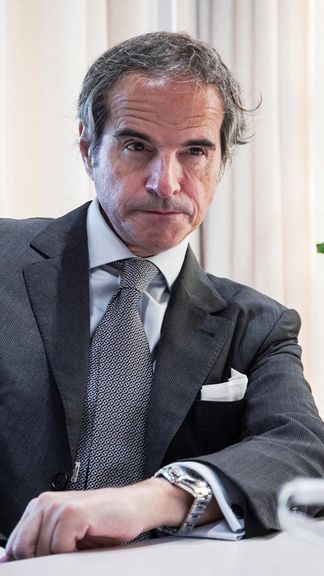
International Atomic Energy Agency (IAEA) Director General Rafael Grossi meets with Finnish Climate and Environment Minister Kai Mykkanen (not pictured) during the Nordic Nuclear Forum, in Helsinki, Finland May 22, 2024.
The head of the UN nuclear watchdog says the deaths of Iran's president and foreign minister in a helicopter crash have caused a pause in nuclear talks with Tehran – just two weeks after the IAEA chief’s visit to Iran for discussions.
"They are in a mourning period which I need to respect," International Atomic Energy Agency (IAEA) chief Rafael Grossi said in Helsinki, speaking at a nuclear conference.
It’s not clear when the “mourning period” may end and when the nuclear talks between the agency and Tehran may resume – though Grossi said his hope was that it would be “over in a matter of days.”
President Ebrahim Raisi, who before his death had long maintained an uncompromising stance on nuclear talks, was not involved in meetings with the IAEA head when Grossi visited Iran earlier this month.
The IAEA chief did meet with Foreign Minister Hossein Amir-Abdollahian on the second day of his visit.
Grossi’s statement comes just a day after IAEA Chief Rafael Grossi ignited backlash from Iranians, when he opened a nuclear security conference by calling for a moment of silence to “honor” both Raisi and Amir-Abdollahian.
“Our thoughts are with their families and the people of Iran during this difficult time,” Grossi later said onX.
Some Iranians dubbed it an inappropriate statement, made to appease Tehran, which has relentlessly pursued sanctions relief with minimal compromise on its nuclear program.
Others questioned why the IAEA Chief sent condolences to Iranians when reportsindicated that many within the country were celebrating the death of the man known as the "Butcher of Tehran" for his involvement in crimes against humanity.
After Grossi’s recent visit to Tehran and Isfahan earlier this month, he said he did not seal any deal but discussed possible steps to implement measures Tehran had committed to in a joint statement last year.
In addition to Raisi’s hard stance on the nuclear issue, backed by the Supreme Leader, talk inside Iran recently floated the notion of abandoning the country’s so-called “fatwa” on nuclear weapons. Grossi previously said that the chatter was “very worrying” and “needs to stop.”
Grossi, who two weeks ago said he wanted to start to see concrete results on improved cooperation from Iran soon, repeated that hope but said a more wide-ranging deal would require "a bit more time".
The IAEA faces numerous challenges regarding Iran’s nuclear program. Tehran has only implemented a small portion of the commitments outlined in the "Joint Statement" on future cooperation made in March 2023.
The few concrete steps that were taken ceased in June of the previous year, complicating the IAEA'sefforts to ensure compliance and transparency.
While Tehran maintains that its nuclear ambitions are entirely peaceful, the country is enriching uranium to up to 60% purity, close to the 90% of weapons-grade – which no other country has reportedly done without developing nuclear arms.
A wave of speculation surrounds who will be allowed or chosen to succeed Iran’s deceased president, amid widespread public apathy evidenced by the historic low turnout in recent parliamentary elections.
Among the names frequently mentioned on social media as potential successors are the caretaker of the presidency, Mohammad Mokhber; outgoing Parliament Speaker Mohammad-Bagher Ghalibaf; former Revolutionary Guards (IRGC) general Saeed Mohammad; ultra-hardliner Mayor of Tehran Alireza Zakani; Chief Justice Gholam-Hossein Mohseni-Ejei; Secretary of the Supreme Security Council Ali Shamkhani; and the shadowy former nuclear negotiator Saeed Jalili. All of these figures belong to the hardliner camp.
Other figures being discussed as possible candidates include moderate-conservative former Speaker Ali Larijani, former Foreign Minister Mohammad-Javad Zarif, ‘reformist’ former Vice President Eshaq Jahangiri, former President Mahmoud Ahmadinejad who separated his way from other hardliners several years ago, and even Hassan Khomeini, grandson of Ruhollah Khomeini who some reformists favor.
“It’s elections again, and ‘wishes’ are being floated in the garb of ‘analysis’ and ‘news’ …Some people say that Zarif, Hassan Khomeini, or people like Jahangiri, Larijani, etc. will be approved to run, and others prompt the same view about Ahmadinejad,” chief editor of the moderate Asr-e Iran news website, Mostafa Faghihi, tweeted Tuesday.
Saeed Jalili, the man said to have been behind many decisions taken by Raisi’s administration (August 2021)
“What difference have they observed in the behavior of the ‘political establishment’ [to make such assumptions] …?” Faghihi asked and argued that the upcoming elections would only be held “within the ranks of revolutionaries.”
This, Faghihi contends, means the elections will be limited to candidates within the hardliner camp, which he believes is a spectrum of different factions as suggested by the escalating infighting among ultra-hardliners and frequent ‘revelations’ and serious allegations of corruption and fraud former allies are constantly bringing against each other.
“What’s the point in involving the rabble rousing reformist and moderate camps with their opposition-like attitudes?” Faghihi asked sarcastically.
Former commander of IRGC’s Khatam ol-Anbia Construction Headquarters Saeed Mohammad
The moderate Rouydad 24 news website suggested Tuesday that four different ‘scenarios’ for the upcoming elections could be envisaged, namely a repetition of the scenario implemented in the engineered presidential elections of 2021, in which Raisi won. This time, acting president Mohammad Mokhber can be endorsed by top hardliners or indirectly by the Supreme Leader. Another option for Khamenei is to allow competition within the closed ranks of hardliners, or allowing other political groups to be represented, to encourage public interest and high turnout.
The most likely scenario, Rouydad 24 contended, is competition within the ranks of hardliners while comparatively freer elections in which other political groups are represented, similar to the 2013 elections in which centrist Rouhani won, is the least likely to happen.
One of the biggest challenges facing the Islamic Republic and its supreme leader is finding a way to reengage an electorate that has been deeply disillusioned by recent elections, while simultaneously ensuring hardliners retain control over the now largely ceremonial presidency.
According to official figures, in the first round of the recent parliamentary elections 40.6 percent of eligible voters turned out at the ballot. In the capital Tehran, 24 percent voted. This was the lowest in any elections in the history of the Islamic Republic.
Turnout in the run-off elections held earlier this month was even lower. Only seven percent of the eligible voters in Tehran went to the polls.
To be able to run, candidates in presidential and parliamentary elections as well as the Assembly of Experts which is responsible for appointing Supreme Leader Ali Khamenei’s successor, must be approved by the constitutional election watchdog, the Guardian Council.
The Council has a long record of disqualifying nominees in all elections, particularly in the past two decades. Disqualified candidates included several former top officials which the Council itself had endorsed before including former presidents Akbar Hashemi-Rafsanjani, Mahmoud Ahmadinejad and Hassan Rouhani as well as former Parliament Speaker Ali Larijani and a host of lesser officials.
Khamenei appoints the six principal members of the Council and, in addition to issuing behind-the-scenes instructions, has the power to overturn their decisions with so-called "state edicts."
Khamenei reinstated two reformist candidates disqualified by the Council, Mohsen Mehralizadeh and Mostafa Moeen, with such edicts in the controversial presidential elections of 2005 which brought hardliner Mahmoud Ahmadinejad to power.
Khamenei’s move was largely seen at the time as a measure to entice reluctant supporters of reforms to vote to increase the turnout as a high turnout would be proof of “legitimacy of the Islamic Republic”.
Iran's Supreme Leader Ali Khamenei has once again hailed the spread of anti-Israel sentiment at protests worldwide in a meeting with the leader of Hamas.
Khamenei even applauded the chanting of “Death to Israel” in Persian at a rally in Japan as the wave of antisemitism globally reaches record highs.
Khamenei's remarks in a Wednesday meeting with Ismail Haniyeh, the head of Hamas's political bureau, have stirred controversy as he portrayed such demonstrations as a divine victory for Palestine, heralding them as the precursor to the "eradication of the Zionist regime."
Khamenei confirmed that Iran's foreign policy towards Palestine would remain consistent, stating that Vice President Mohammad Mokhber, who stepped in following the death of President Ebrahim Raisi in a helicopter crash, would adhere to Raisi’s strategies.
The declaration coincides with Iran intensifying its focus on pro-Palestinian student protests in the US and Europe, leveraging the events to boost Iran’s international image amid growing internal dissatisfaction.
The recent upsurge in student-led protests in the US, fueled by backlash against Israeli military actions in Gaza, has seen students demanding their universities divest from Israeli-linked corporations. The movement has been indirectly lauded by Iran, which seeks to weaken US-Israel relations.
However, the Iranian government's external posturing contrasts sharply with its internal crackdowns, particularly against students and activists within its own borders. The regime's harsh responses to the Woman, Life, Freedom movement, sparked by the death of Mahsa Amini in police custody in 2022, has led to widespread arrests and expulsions of students, highlighting a stark hypocrisy in its stance on human rights and freedom of expression.
Leaders and officials from Iran’s allies and terror proxies attended the funeral of President Ebrahim Raisi killed in a helicopter crash on Sunday.
The high profile attendees included figures such as Saudi foreign minister Faisal bin Farhan and UAE foreign minister Sheikh Abdullah Bin Zayed, with the prime ministers from Iraq and Pakistan also joining, in addition to the Tunisian president.
There was a marked absence of western democratic leaders and dignitaries, reflecting Iran’s isolation on the world stage. Dozens of the world’s democracies have imposed sanctions on Iran due to its military support for Russia in its war on Ukraine, its funding of terror proxies and its nuclear program, in addition to its horrific domestic human rights record.
Meanwhile, the ceremony was attended by controversial Iran-backed terror group figures such as Naim Qassem, deputy secretary general of Lebanese Hezbollah, and Ismail Haniyeh, the political chief of Hamas.
The Wednesday morning funeral, held at Tehran University, saw Iran's supreme leader Ali Khamenei leading prayers over the bodies of Raisi and the delegation he was traveling with, including foreign minister Hossein Amir-Abdollahian.
Iranian media outlets have reported widely differing numbers of foreign delegations attending the ceremony with some claiming as many as 50 high-ranking groups, while others reported significantly lower participation.
Amid funeral ceremonies for President Ebrahim Raisi, Iranian authorities are cracking down on the families of dissidents celebrating his death, issuing threats and making arrests.
This week, following the helicopter crash that killed both Iran's president and foreign minister, Iranians across the country reacted by celebrating the demise of the two men.
In exclusive conversations with Iran International’s English desk, the families of slain protesters and survivors blinded during the 2022 anti-regime protests in Iran, are expressing relief, joy, and what they say is their renewed resolve to continue to fight for justice and freedom in Iran.
The unprecedented nationwide protests, dubbed the "Woman Life Freedom" movement, were sparked by the death of 22-year-old Mahsa Jina Amini at the hands of Iran’s so-called morality police. The months-long demonstrations were said to be the biggest challenge to Iran's clerical leaders in decades.
While Raisi was president, under the directive of Iran’s Supreme Leader Ali Khamenei, the protests were met with severe crackdowns, and the state’s security forces killed at least 500 protesters and imprisoned tens of thousands.
Families of protesters and dissidents have since faced surveillance, threats and intimidation by the authorities to prevent them from speaking out about the fate of their loved ones.
‘Stop celebrating Raisi’s death, or we will kill your other nephews too’
The family of 17-year-old Artin Rahmani Piyani, one of the children killed in the Iranian security forces’ crackdown on protests in 2022, was among those targeted by the authorities this week.
Celebrating the news of Raisi’s death, Foad Choobin, the teenager's uncle, shared videos on X of his nephew Piyani dancing.
Piyani’s mother, Hengameh Choobin similarly posted a video of her son laughing, with the caption “We are feeling better”.
On Tuesday, Foad Choobin revealed that the intelligence ministry contacted him with a warning: they would kill his remaining nephews and nieces if his family, including Piyani’s mother, continued to post content celebrating the President’s death.
“We didn’t have a single day of happiness… Now, with Raisi’s death, we feel a little better... but in my view, a murderer who took the lives of tens of thousands of innocent people had a very easy death,” Foad Choobin said.
Foad Choobin had previously been arbitrarily arrested, tortured, and imprisoned by Iranian authorities in an effort to silence the family for speaking out about his nephew’s killing.
“I will not be silenced and I am determined to continue the path of seeking justice for my nephew Artin, and all those killed by the state and all those silenced,” Choobin said.
Although Choobin said he is rejoicing over Raisi’s death, he knows that the President was “just one of the executioners of the Islamic Republic regime.”
“I want to see the moment of the demise of all of the murderers in the Islamic Republic in front of our own eyes, just as they took our dear ones' lives in front of our eyes. The Islamic Republic regime must be destroyed altogether so that we can feel truly joyful,” he said.
Other family members of protest victims were arrested by security forces.
On Monday, Reza Babrnejadwas arrested by security forces in the northeastern city of Quchan, for allegedly posting Instagram stories about Raisi’s death.
Babrnejad’s brother, 22-year-old Mehdi Babrnejad, who was killed by the Iranian state’s security forces amid the September 2022 protests.
Dadban, an organization offering pro-bono legal support to Iranian dissidents, says Babrnejad’s mother confronted the authorities when they detained her son.
"Your president is dead? Weren't our children human? Why did you kill them?" his mother reportedly told the security forces.
The Islamic Revolutionary Guard Corps' (IRGC) intelligence agents also targeted Babrnejad in 2023, around the time that would have marked his brother Mehdi's 23rd birthday.
This arrest, like that of Foad Choobin, was part of a broader crackdown aimed at silencing victims' families, throughharassment and intimidation, to prevent them from commemorating their loved ones.
Exiled relatives of protesters rejoice over Raisi’s sudden death
Relatives of protesters outside of Iran similarly rejoiced over the sudden death of President Raisi and Foreign Minister Amir-Abdollahian.
Mahsa Pirayi (Piraei), who fled Iran after her 62-year-old mother Minoo Majidiwas killed during the protests, told Iran International that Raisi's death brings her renewed determination.
"All of us—the justice-seeking families of victims—are happy that the murderers of our loved ones and the criminals who restricted the Iranian nation were killed. We are more determined than ever to continue our advocacy and be the voice of our loved ones until we reach absolute victory and freedom!,” she said.
Sharing a video on X, Pirayi and her sister Roya Pirayi toasted to the news of the missing helicopter carrying the President and Foreign Minister.
The sister of slain protestor Shahriar Mohammadi, Asrin Mohammadi, says the news of Raisi’s death brought deep joy to her household.
"We were extremely happy. It felt as if Shahriar had come back to life…I woke up everyone in the house singing ‘Wake up, wake up, it's a party and it smells like barbecue but hold your nose because the barbecue smells like sludge’,” she told Iran International.
According to Mohammadi, a group of mothers whose children were killed in the northwestern city of Bukan during the 2022 protests celebrated the news of the deaths at their children’s graves. She says the mothers placed chocolates on the graves, telling them “we have good news—freedom is near.”
"At the gravesites, they told their buried children that they’re happy. Some of the mothers wanted to dance Kurdish out of joy, but it started raining. They were so happy that they didn’t want to go home," Mohammadi said.
The mother of Abolfazl Amir-Ataei, a 16-year-old Iranian teenager who was shot and later died from his injuries amid protests, also celebrated Raisi’s sudden death.
She says that while she doesn’t wish death upon anyone, her hatred for Raisi and Amir-Abdollahian made her hope that the helicopter crash would end up being fatal.
Dior would share a video on Instagram that begins with an infamous clip of the late Iranian foreign minister denying that anyone was killed during the 2022 uprising.
The video continues to show Dior, speaking about her joy upon hearing the confirmed news of Raisi and Amir-Abdollahian’s death:
“I am very happy. I am very happy that my cries of one year and the pain of nine months were finally answered. I was losing hope in karma and God…but I am very happy now…because those who were the cause of pain and suffering for my son and I…those who destroyed our lives, met their fate and I am waiting for the rest of them to be held accountable,” she said.
‘Raisi should have been tried in criminal court,’ say blinded dissidents
Iranians who survived anti-regime protests with severe injuries, such as blindness, also voiced their reaction to the death of Raisi and Amir-Abdollahian.
Saman, a dissident who widely goes by the pseudonym for security reasons, was blinded amid the 2022 protests.
Like many in the Iranian diaspora, he said he had wished Raisi faced trial for the crimes he committed.
"Humanity always says that the death of any creature is distressing, but with every breath criminals like Ebrahim Raisi and Ali Khamenei and their other mercenaries threaten the world. In a free Iran in the future, all these people should be tried in just public courts,” he told Iran International.
He says he feels happy about Raisi’s death, because a “threat against humanity has been removed.”
“On the other hand, I wish [Iran] would have been freed and that this criminal faced trial before dying, and confessed to his crimes in front of the cameras of the world,” he said.
Yaser Alvandiani, another protester blinded by Iranian security forces during the 2022 uprising, said he had a “strange feeling.”
"The joy in my eyes is accompanied by tears, the tears from my blind eye begin to shed sooner. Tears of joy and happiness, and a heart that longed to see this demon tried in a court of justice for his countless injustices... And yet, the joy of the families of victims seeking justice in their messages to me… families whose hair turned gray within a mere few months… Could this joy be a glimpse of the dawn of freedom for our Iran? Could it? There is this joy that I saw from all of Iran. It is the joy of all the blood-soaked children for the dawn of freedom… Freedom, happiness, and prosperity are the end of our path... Long live Iran.”
Gholam-Hossein Esmaili, the Iranian President’s Chief of Staff, committed to a continuation of the Ebrahim Raisi agenda following the unexpected death of the late President.
It must continue; there is no question," he asserted, urging the electorate to demand that future officials adhere to the same hardline strategies in spite of the fact that under his watch the economy has collapsed and there have been record numbers of executions amid deepened human rights abuses.
"Not only will we not falter in these 45 days, but we will also strive to accomplish the work of 450 days," Esmaili stated on the sidelines of Raisi's funeral.
The administration's heavy-handed approach to dissent, characterized by internet restrictions and violent suppressions of protests, has not only deepened domestic strife but also resulted in further global sanctions.
Unemployment is sky high with at least one third of Iranians now living below the poverty line. Iran has during his presidency also accelerated its nuclear program and escalated its proxy war across the Middle East, in addition to producing drones for Russia in its war on Ukraine.
Under the 1979 Constitution, Vice President Mohammad Mokhber has stepped into the role of acting president with the approval of Supreme Leader Ali Khamenei, serving until the snap elections set for June 28.