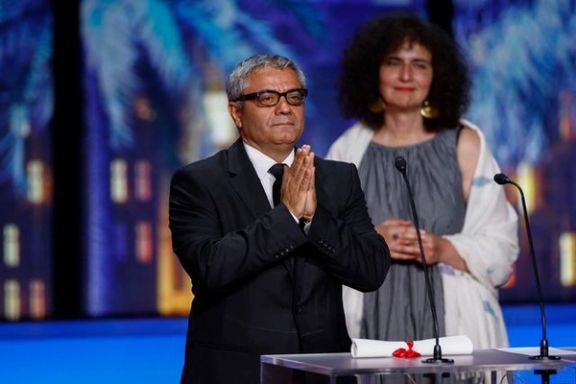
Mohammad Rasoulof thanks the audience for their standing ovation after receiving the Cannes Festival's Special Award on May 25, 2024
The Iranian people are being held hostage, dissident Iranian filmmaker Mohammad Rasoulof told an audience at the Cannes Film Festival awards ceremony, after receiving the festival's special award.
Rasoulof who recently fled Iran after getting an eight-year jail term, won the prestigious festival's Special Award for Best Screenplay during a Friday ceremony for his latest film "The Seed of the Sacred Fig".
After receiving the award, Rasoulof said, "I am very happy for this award, and at the same time, my heart is with the people of Iran who wake up every day, every hour, and every morning to a disaster."
He added, "The people of Iran have been taken hostage."
Rasoulof also spoke about many dissident artists and writers that he said suffer under the rule of a “tyrannical and oppressive regime.”
Referring to political prisoners in Iran, he mentioned the young dissident rapper, Toomaj Salehi, who has been sentenced to death.
The dissident filmmaker fled the country by foot through rugged mountainous terrain after years of intimidation and the confiscation of his passport.
Before leaving the country, he had received a harsh sentence that included eight years in jail, flogging, fine, and property confiscation for “the signing of statements and making of films and documentaries,” which the Islamic Republic claims are “collusion to commit a crime against the country's security.”
After leaving Iran Rasoulof, in a post on the social media platform Instagram, described the pressure exerted on him by Iranian security agencies over the recent years. He mentioned that friends, acquaintances, and other individuals helped him leave Iran.
In an interview with Iran International on the sidelines of the Cannes Festival, Rasoulof elaborated on the main themes of his film which focuses on "an investigating judge in the Revolutionary Court in Tehran who grapples with mistrust and paranoia as nationwide political protests intensify and his gun mysteriously disappears."
"I think the main issue is ‘devotion’. My main goal was to follow and see how this system [of the Islamic Republic] works. Who enters this structure and participates?"
He added that, based on his lived experience of “facing the judge, interrogator, investigator, etc.,” these people are mere "devotees" who have "entrusted their head to another place," with decisions being made by someone else.
Rasoulof further emphasized that the concept of ‘devotion’ is heavily symbolized within the Islamic Republic. He pointed to the role models promoted by state propaganda and added that within such a government, there are individuals who, with arms crossed over their chests, preach surrender and devotion.
Referring to the oath that judges in Iran are required to take, which is also referenced in the film, Rasoulof said, "It is very strange that at the end of the judges' oath, they are asked to be loyal to the Islamic Republic and support the leader. It is very strange that justice and human commitment become victims of such a requirement."
He added that such an oath can only be expected from the Islamic Republic, emphasizing that it is characteristic of this government to create such an oath.
Moreoever, Setareh Maleki, one of the film’s actresses, who had to leave Iran along with Rasoulof to attend the Cannes Film Festival, told Iran International, "The conditions for making the film were very, very difficult."
She added, "It was harder than you can imagine. Our group was small, about 30 people, to maintain security. This made the work much harder for everyone because each person had to do the work of several people."
The actress continued, "The working conditions were full of stress and pressure. Everyone was constantly waiting for something to happen. At night, in our accommodation, we thought this could be the night when they come and arrest everyone."
An explosion in the al-Maza neighborhood of Damascus, which houses the Iranian embassy, has reportedly resulted in at least one death.
The Jerusalem Post citing Syrian sources said the incident occurred early Saturday morning and has escalated tensions in an area already fraught with conflict.
The identity of the dead, a man "close to Iran," has not been disclosed. The explosion follows a series of targeted attacks in the same district, including an air strike last month attributed to Israeli forces.
That attack killed several senior members of Iran's Revolutionary Guards, including senior commander Mohammad Reza Zahedi, intensifying the ongoing shadow war between Israel and Iran in the region.
In retaliation, Iran executed a direct assault on Israel on April 13, launching hundred of drones and missiles, marking an escalation in their confrontations.
However, Israel in turn retaliated with a precision strike on a military base in Isfahan, central Iran.
Reports indicate that shortly before Zahedi’s assassination, the Iranian diplomatic residences were about to be relocated to a new apartment complex on the same street. The move was cancelled at the last minute during a meeting of the senior echelons of the Revolutionary Guards, who chose to remain in the consul building.
Iran's participation in the Syrian civil war, backing President Bashar al-Assad since its onset over a decade ago, has sparked disputes with Israel. Perceiving Iranian forces in Syria as an imminent threat, Israel has regularly targeted their bases and arms depots starting in 2017.
Government ceremonies in Iran have been Islamized since 1979, reflecting the transformation of the state into an Islamist entity. In this process, religious icons and ceremonies replaced national symbols and rituals.
Central to these rituals is the act of mourning, as Shia Islam is a religion deeply rooted in themes of victimhood and martyrdom, with followers shedding tears for saints who, according to Shia beliefs, were all martyrs.
For this reason, during Shia mourning seasons such as Ashura and Arbaeen, the anniversaries of Shia saints' deaths, the anniversary of the Islamic Republic's founder's death, and the sudden deaths of current leading figures, the mourning industry, with the full support of governmental, state, and public institutions (including municipalities), becomes highly active. The objectives are to restore the Islamic Republic's declining legitimacy and popularity and to strengthen its social base.
This multi-billion-dollar industry is a crucial part of the regime's propaganda machine. Gone are the spontaneous and purely religious ceremonies of the pre-1979 era. Today, every national mourning ceremony is a state-sponsored program, meticulously planned and executed, from budgeting and organization to procurement and mass mobilization. The attendees of these ceremonies are not merely independent believers and mourners; officials often inflate the numbers of these engineered crowds, presenting tens or hundreds of thousands as millions to secure more funding. The core attendees are primarily public sector employees and those who benefit from the system, with a smaller portion consisting of the poor and unemployed, attracted by the promise of free meals, drinks, or pilgrimage opportunities.
The budget
There are special budget lines for government propaganda, including mourning ceremonies, in the government’s annual budgets for all ministries and organizations under the title of a 2% cultural contribution (out of the $110b annual budgetfor 2024). There is a direct budget of $600 million, plus the contributions from each ministry and government entity. This propaganda budget is devoted to promoting the Islamic Republic’s ideological tenets, not climate change, equal rights or similar ideals.
Apart from this, hundreds of cultural institutions which pretend to be charities, research institutes, or think tanks are involved in these propaganda activities. The government budget for religious institutions for 2024 was about 360 trillion rials ($600m), which is used to maintain the infrastructure and functions of this industry - such as hiring and taking care of personnel and facilities. We do not know exactly how much money government-owned companies and banks with a share of about 60% of the yearly budget spend in this area; they are all non-transparent. The municipalities take care of the budget for local religious groups, which are the main handlers of the ceremonies.
Khamenei’s office, which oversees several enterprises worth tens of billions of dollars, allocates some budget for religious institutions, but the specifics of these allocations have never been disclosed.
Hotel fees for travelers to attend official funerals or Arbaeen ceremonies in Iraq, thousands of buses that provide transportation services to the attendees, food, insurance, and other services presented by tents and prayer stations are all paid by government and public funds.
Organization
Three large organizations with tens of thousands of employees and budgets of tens of millions of dollarsorganize mourning and other religious-state ceremonies: the Islamic Propaganda Organization, the IRGC’s Basij Organization, and offices of Friday prayer imams and representatives of the Supreme Leader throughout the country. The satellite institutions that run these programs include headquarters for performing prayers, cultural centers of mosques, units for commanding good and forbidding vice, zakat offices, and numerous Sharia enforcement headquarters. Additionally, the ideological units of the Basij, IRGC, and the national army are involved. These organizations are coordinated by the Coordination Council for Islamic Propaganda.
All high-ranking officials are supposed to participate in these programs. The recruitment pool of participants is mainly neighborhood Basij bases, religious delegations, and eulogy and Qur'an groups.
Logistics
With the expansion of the mourning industry, many procurement activities have been entrusted to private sector institutions established by regime affiliates, taking over from governmental and public sectors. These institutions provide a wide range of necessary supplies, from large kitchens and rest areas for children to establishments producing tracts, banners, and advertising pamphlets. They are always ready to mobilize, much like the service sector in Hollywood, providing everything from flags, fake monuments, keffiyehs, and headbands to cardboard tombs, pickup trucks, and sound systems.
Institutions of eulogy
There is a state-sponsored institution in Iran, which is in charge of education and welfare services and social benefits for Islamist eulogists, religious DJs, and masters of ceremonies. Its mission is to propagate the culture of mourning and Shia eulogy. This institution covers tens of thousands of eulogists invited to government and public centers on dozens of occasions. Professional religious singers even provide eulogy services on special jets carrying the bodies of state leaders to their burial sites, such as Raisi's coffin being transported to Mashhad this week. In videos of Raisi’s funeral ceremonies, from Tabriz and Qom to Tehran, Birjand, and Mashhad, the voices of numerous eulogists can be heard resonating over the crowds and participants.
The Iran Human Rights Organization (IHRNGO) reported that the Supreme Court of Iran has rejected a retrial request for Arvin Ghahremani, an Iranian Jewish citizen.
Ghahremani, at the age of 18, was sentenced to death for his alleged role in a fatal street brawl.
According to the IHRNGO, the decision places Ghahremani at immediate risk of execution, underscoring a judicial process marred by oversight and lack of fair representation.
Relatives of Ghahremani have voiced concerns that critical elements of his defense were ignored during the trial. These include his efforts to aid the injured party by attempting to transport him to a hospital and his subsequentefforts to save the man's life—details absent from the court documents. The family insists that he was attacked and only acted in self-defense, disarming the man who had assaulted him with a knife.
The Norway-based rights groupis calling for a halt to Ghahremani’s impending execution and a transparent, thorough review of his case and others similarly jeopardized. The IHRNGO’s plea highlights a trend in Iran’s judicial proceedings, where the right to a fair trial is often supplanted by swift punishment.
On a broader scale, the IHRNGO's latest findings reveal that within the last month alone, at least 103 people were executed in Iranian prisons, marking an acceleration in the use of capital punishment. Mahmoud Amiry-Moghaddam, director of IHRNGO, criticized the global community for its silence on such executions, saying, "The international community's silence... is unacceptable and must end."
Amnesty Internationalhas also weighed in, reporting 853 executions in Iran in 2023, the highest in eight years.
An Iranian protestor has sustained a severe spinal injury following an attack by Islamic Republic loyalists in London on Friday, according to activists who spoke to Iran International.
The attack targeted a group of Iranian dissidents celebrating Ebrahim Raisi's death outside a "community center" run by Islamic Republic loyalists, resulting in injuries to at least four people.
Late Friday, London’s Metropolitan police confirmed the incident and injuries to four people, adding that “their injuries are not believed to be either life-threatening or life-changing".
Speaking to Iran International English on Saturday, Iranian activist, Niyak Ghorbani who was present at the event refuted the police claim. Ghorbani added that one of the protestors identified with his first name as Navid had sustained serious spinal injuries and was currently still in hospital:
“He has sustained serious injuries to his spinal cord,” Ghorbani stated, adding that Navid is “unable to move his leg” and in severe pain.
Ghorbani further added that the attackers even followed them to the hospital.
“They [the attackers ] were waiting in the hospital until we informed the police that they had followed us…the police then called for a number of other police forces to come…and eventually they told them to leave the hospital…”
Ghorbani stated that the attackers “were waiting for them to leave the hospital” raising concerns for their safety even as the Iranian protestors were injured and being treated in hospital.
Moreover, another protest has been scheduled for 19:00 local time by Iranian dissidents in front of the Iranian embassy in London in protest to the vigil planned for Raisi, raising concerns for the protestors given Friday’s attacks.
London’s Metropolitan Police confirmed to Iranian journalist Saman Salmanpour that they are aware of the protest and stated:
"An appropriate policing plan will be in place to ensure both the safety of attendees and that the law is upheld."
Hossein Hosseini, the Chief Justice of Iran’s Kordestan Province, has announced the establishment of a specialized branch at the Sanandaj Revolutionary Court specifically designed to handle cases of hijab removal.
Hosseini revealed that "a significant portion of those who commit hijab removal are under the ages of 15 and 18," highlighting the state's focus on penalizing young women.
The initiative is part of the broader Project Noor, which has ramped up enforcement of the Islamic Republic’s hijab laws, leading to increased violent confrontations on the streets as authorities clamp down on Iranian women. The forceful approach has sparked renewed global outrage.
Hosseini categorized individuals who remove their hijab into three groups: the first receives only a verbal warning for unintentional non-compliance; the second, includes those seen as encouraging others to unveil and are actively pursued by the authorities; the third group involves individuals accused of systematically challenging hijab, targeted by security and intelligence forces for organized defiance.
The newly launched court branch shows Iran's decision to criminalize what it perceives as “acts of rebellion” against its “moral codes,” particularly focusing on the youth. This strategy reflects the government’s desperation to assert control amid growing internal and international criticism.
Further unsettling reports have surfaced since the implementation of Project Noor, detailing police misconduct, including extortion, theft, andsexual harassment by officers tasked with enforcing hijab compliance. Such accusations exacerbate the already volatile relationship between the public and the police, eroding trust and stoking fears among the population.
Global human rights organizations, student bodies, and activists are vocally condemning such measures, highlighting the infringement on basic human rights and personal freedoms in Iran.