Three Hardliners Will Likely Run for President: Report
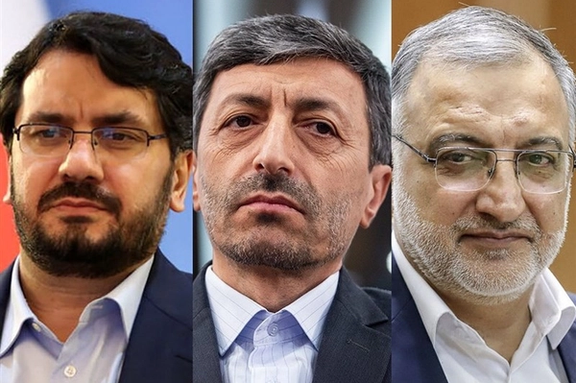
Mehrdad Bazrpash (left), Parviz Fattah (center), and Alireza Zakani
Conservative politicians Parviz Fattah, Mehrdad Bazrpash, and Alireza Zakani are preparing their presidential campaigns and will most likely run for the office in the June 28 snap elections, the IRGC-affiliated Tasnim reported, citing sources.
Fattah, a former IRGC officer, is currently the head of the multi-billion-dollar economic empire controlled by Iran's Supreme Leader.
Bazrpash is the current transport minister who was aboard one of the other helicopters flying with Raisi's doomed chopper.
Zakani is also the current mayor of Tehran who dropped out of 2021 presidential race and backed Raisi.
In an open letter, LGBTQ+ activists and organizations voiced their strong disapproval of Western governments that expressed condolence to Iran honoring President Ebrahim Raisi, who died last weekend in a helicopter crash along with other officials.
The activists condemned the action as an "insult to those who rose chanting Woman Life Freedom to overthrow the Islamic Republic."
They emphasize that such gestures of sympathy are a betrayal to the Iranian people, particularly women and the LGBTQ+ community, who have been fighting against the Islamic Republic's brutal policies.
“Raisi's role in the execution and killing of homosexuals and queers who were unjustly killed by the judicial system of the Islamic Republic cannot be hidden,” the letter read.
The activists call on governments to take a firm stand against the Islamic Republic and cease appeasement policies, and designate the IRGC as a terrorist organization.
The letter includes endorsements from organizations such as Azad Queer, which is a network of Iranian queers in the Netherlands, the Organization of Iranian Rainbows, and 6rang, as well as numerous individual activists from around the world.
According to critics, offering condolences to such a regime implicitly legitimizes its actions, such as suppressing dissent, supporting terrorism, and violating human rights in the present.
Ebrahim Raisi served on a "Death Panel" responsible for the execution of at least two thousand Iranian political prisoners during the 1980s.
As president, he was also in office at the time of the 2022 Woman Freedom Movement in Iran that was sparked by the death in custody of Mahsa Amini.
According to a UN fact-finding mission in March, the Iranian regime committed crimes against humanity in its crackdown on the protests, including killings, imprisonment, torture, and sexual assaults.
She asked UN chiefs to call Raisi by the same term that "Iranians call him: Butcher of Tehran."
At the UN Security Council meeting on Monday, a minute of silence was observed for Raisi and his delegation, and the UN flag was flown at half-mast at its New York headquarters.
Gilad Erdan, Israel's ambassador to the UN, condemned the observance and asked the council, "What's next? Will there be a vigil for Hitler? We wouldn’t be surprised.”
On Thursday, Kylie Moore-Gilbert, a former Australian hostage held in Iran for over two years, also criticized Western governments for their condolences over the death of Iran’s president, saying they lack leadership in denouncing “a man widely regarded to be complicit in mass murder.”
During a commencement speech at the US Military Academy in New York, President Joe Biden, praised American forces for their role in intercepting the Iranian drone and missile attack aimed at Israel.
“Ninety-nine percent of the missiles, drones,” Biden highlighted, never reached their targets “because of the quality of our forces.”
Biden was referring to the unprecedented attack of April 13 when Iran initiated an unprecedented offensive from its territory against Israel, deploying over 350 killer drones, cruise missiles, and ballistic missiles. In response, a coalition of jets from the US, UK, France, and Jordan effectively formed a defensive barrier, thwarting the Iranian offensive.
“Thanks to the US Armed Forces, we’re doing what only America can do as the indispensable nation, the world’s only superpower,” Biden stated.
US Central Command (CENTCOM) detailed that US forces neutralized over 80 one-way attack drones, accounting for 47% of the drones launched by Iran. This marked the first-ever direct attack from Iranian soil on Israel, an action that shifted global attention from the ongoing Gaza conflict towards Iran, rallying international support for Israel and sparking widespread condemnation of Iran.
The attack was an alleged retaliation to an Israeli air strike on the Iranian consulate in Syria. Following the Iranian bombardment, Israel conducted a precise counterstrike aimed at preventing further escalation into a full-scale conflict. This included targeting and destroying a component of the S-300 air defense system at the Isfahan base, a fact revealed through satellite imagery analysis.
Iran, seemingly cautious of igniting a larger regional conflict, played down the damage inflicted on its airbase and declared it would not pursue further retaliation.
The candlelight ceremony planned for Ebrahim Raisi and his companions in front of the Iranian embassy in London on Saturday was canceled due to a gathering of Iranian protesters celebrating Raisi's death.
The cancellation came just one day after Islamic Republic loyalists attacked Iranian protesters in London.
Celebrating the demise of Raisi, outside the embassy on Saturday, protestors chanted "Death to Khamenei, Curse Raisi" and displayed a balloon shaped like a helicopter, symbolizing Raisi's helicopter crash as they danced.
This demonstration was a direct response to the violence from the previous day when supporters of the Islamic Republic attacked anti-government protesters.
Following the attack on Friday, a spokesperson for the London Metropolitan Police confirmed the incident to Iran International. During the attack, four people were injured and one person was arrested, although the identity of the arrested individual had not been disclosed. The police said they are investigating the incident, reviewing videos from social media, and urging the public to provide any additional footage or information.
Eli Borhan, an opposition activist injured during the attack, stated that her mobile phone was stolen by the attackers and later accessed within the Iranian embassy in London.
Meanwhile, another protestor was hospitalized due to a serious spinal injury as a result of being attacked.
The attack sparked a wave of reactions from political activists and opposition figures. Prince Reza Pahlavi condemned the violence, noting that Iranian protesters face threats both at home and abroad. He called for the arrest and trial of those responsible for the attack.
Prominent activist Masih Alinejad criticized the British government for its negligence regarding the Islamic Republic, urging the authorities to take decisive action against such attacks.
Actress and human rights activist Nazanin Bonyadi echoed these sentiments, stressing the need for a thorough investigation by London police and for the perpetrators to be held accountable for the attack.
This attack was not an isolated incident and part of a broader issue of Islamic Republic loyalists' aggression on Iranian dissidents.
Despite the cancellation of the candlelight ceremony in London, similar events continue to occur elsewhere. The Islamic Education Center in Maryland in Michigan held a memorial service for Raisi earlier this week, claiming that it was in solidarity with the people of Iran and supporters of global peace and justice. Meanwhile, Islamic Republic loyalists who went to the ceremony threatened Iranian protestors outside the center with death.
Mojtaba Zolnouri, the representative from Iran's holy city of Qom and a conservative cleric, has announced his candidacy for the speakership of the Iranian parliament.
Zolnouri, who previously held roles within the Islamic Revolutionary Guard Corps and as chairman of the Nuclear Subcommittee, is leveraging the recent death of President Ebrahim Raisi to assert his ambitions amid Iran's political volatility.
Zolnouri's campaign for the speakership highlights his claims to reshape parliamentary dynamics, advocating for a shift from a speaker-centric to a representative-centric model. Amidst this political maneuvering, Iran's parliamentary elections have recently witnessed a historically low voter turnout, reflecting deep-seated public disillusionment with the government's legitimacy.
Reports from state media claimed a turnout of over 40%, yet contrasting narratives on social media suggest significantly lower participation, indicating a divide between official accounts and public sentiment. The voter apathy was even more pronounced in the subsequent run-off elections, where more than 90% of Tehran's eligible voters abstained, signaling a disconnection between the Iranian populace and the government.
As Zolnouri enters the race for parliament speakership and Iran gears up for a presidential electionin June, following the sudden death of President Ebrahim Raisi in a helicopter crash, the forthcoming political events will be pivotal in assessing whether his leadership can redirect the parliament's focus and reinvigorate a disillusioned electorate, or simply maintain the status quo masquerading as reform.
As Iran prepares to hold a snap election after the death of President Ebrahim Raisi, reformist politician Masoud Pezeshkian announced his bid for the presidency on Sunday.
Pezeshkian, known for his previous tenure as health minister and first deputy speaker of the parliament, said he “aims to increase voter turnout,” challenging the disenchantment with the electoral process in Iran.
Pezeshkian's announcement comes at a time as Iran prepares for an early presidential election slated for June 28, following Raisi's sudden death last week in a helicopter crash in northwest Iran.
The election arrives amid the Supreme Leader's efforts to consolidate power within hardline factions, pushing the presidency further into a ceremonial corner while ensuring all key positions are held by loyalists.
Public interest in electionshas plummeted, with recent parliamentary elections marking a historic low in voter turnout. In Tehran alone, only seven percent of eligible voters participated in the recent run-offs, underscoring the growing disconnect between the electorate and the government. In the elections which saw Raisi gain the presidential seat in 2021, it was also record lows for the presidential elections indicating a similar challenge next month in the sham elections.
The upcoming presidential electionis shrouded in uncertainty, with the Guardian Council likely to bar any significant non-hardline candidates.
As the acting president, Vice President Mohammad Mokhber, endorsed by Supreme Leader Ali Khamenei, temporarily fills the void until the elections, the political landscape in Iran remains tightly controlled. Statements from government officials continue to emphasize a hard stance against Iran's perceived enemies and a commitment to unyielding policy directions, signaling no change in the country's political and social climate, ultimately in the hands of the theocratic dictator, Khamenei.