Guards Sexually Assault Iranian Political Prisoner's Wife
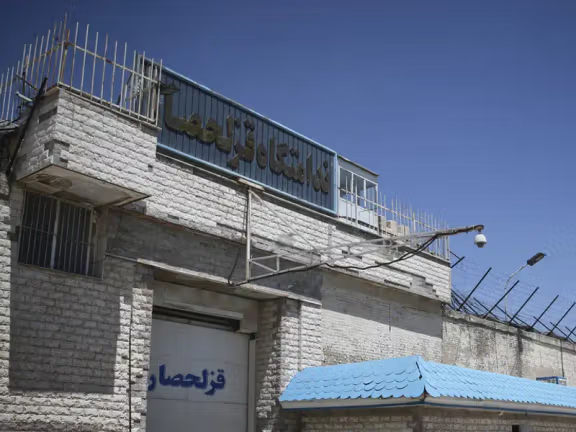
Ghezelhesar Prison in Karaj, West of Tehran
Female guards at a prison near Tehran have sexually assaulted the wife of a political prisoner under the guise of a "search" as state-sanctioned abuse in Iranian prisons continues, Iran International has learned.
Consistent with hundreds of similar reports from Iran's Me Too movement, the woman was stripped completely, subjected to verbal abuse and humiliation, before the sexual assault at Ghezelhesar Prison, near Tehran.
The severity of the assault was such that the woman suffered severe bleeding in addition to the psychological trauma, a source from the association of prisoner families at the prison claiming the practice is a daily occurrence.
From April to December last year, Human Rights Watch and Amnesty Internationalreleased reports detailing "sexual assault" by agents of the IRGC, Basij, Ministry of Intelligence, and various police departments against women, men, and children during the protests following Mahsa Amini's death in police custody in 2022.
In May last year, several female civil and political activists shared their experiences during detention or imprisonment, describing how Islamic Republic forces forced them to strip completely naked in front of guards or on camera, allegedly to ensure they had not concealed anything.
The Iranian judiciary's news agency Mizan confirmed the occurrence of such strip searches yet claimed that "no images were recorded or taken" though it is widely reported by Me Too that such searches are conducted under the video surveillance of male guards.
YouTube has removed the account of Iran's Ministry of Foreign Affairs following the release of a video against Israel.
According to state media, the video entitled "Resistance, the Only Option for Palestine," called for "punishment of Israel", Iran's archenemy. Iran currently supports multiple Palestinian terror groups including Hamas, Islamic Jihad and Lion's Den, in its bid to destroy the Jewish state.
While Iran denies a direct role in the ongoing war in Gaza, triggered by Iran-backed Hamas's October 7 atrocities killing 1,200 mostly civilians, it has long armed, trained and funded the group proscribed by countries including the UK and US.
The YouTube deletion is part of a broader trend where major social media platforms have acted against accounts linked to Iran for violations related to spreading disinformation and breaking platform rules.
In 2020, YouTube, owned by Google, removed the British account of Iran's Press TV after it was exposed by Britain's The Times for engaging in anti-Israeli propaganda. In addition, in 2018, Googleeliminatedtens of Iran-linked accounts across its platforms, including YouTube, Blogger, and Google+, for disguising their affiliations while sharing political content in the US.
Further actions include Twitter's July 2019 suspension of several accounts affiliated with Iranian state mediasuch as the country's supreme leader, who has since been reinstated, due to policy violations. Ali Khamenei among others remains a vocal user of Twitter in spite of calls for his removal.
Instagram also took measures in April 2019 by blocking accounts of Iranian leaders and commanders of the Islamic Revolutionary Guard Corps (IRGC), following the US designation of the IRGC as a terrorist organization.
The Iranian government has also engaged in crackdowns on internet freedom. In the wake of the nationwide protests following the death in custody of Mahsa Amini in 2022, Iran has blocked access to thousands of websites and platforms including WhatsApp and Instagram, in an attempt to control the flow of information and quell dissent.
Iran’s exiled Prince Reza Pahlavi has unequivocally declared his desire for regime change in an interview with Germany’s Spiegel magazine.
Pahlavi says the Iranian people are willing to make sacrifices for a new revolution to overthrow the Islamic Republic “because they know that their country is doomed” otherwise.
“The question is not whether the regime will disappear, but when, and whether we have given Iranian society the maximum support,” Pahlavi insisted.
Describing the 2022 nationwide protests as transformative, Pahlavi said, “The last uprising was already a revolution” and an “authentic reaction against the oppression.”
In its crackdown on these protests, Iranian security forces killed at least 550 protestors, including children, and imprisoned over 20,000 people.
Pahlavi emphasized that the Iranian state is “weaker than ever,” with Supreme Leader Ali Khamenei, who represents the system, rejected by at least 80% of Iranian society.
In the extensive interview with foreign correspondent Susanne Koelbl, Pahlavi was also asked why the various factions of the exiled Iranian opposition have failed to agree on a common approach and with whom he cooperates.
Pahlavi, seemingly avoiding the second part of the question, stated that when he “appears with representatives of the opposition, as recently at Georgetown University in Washington,” he views it as “symbolic cooperation.” He emphasized that the “great unity in Iran and a common vision” are “more important” to him.
Earlier this month, Pahlavi had noted that extreme factions of the right and the left within the opposition to the regime are preventing unity.
Pahlavi reiterated his call for Western governments to maximize support for dissidents and activists in Iran while increasing international pressure on the regime through sanctions. He also reaffirmed his support for listing the IRGC as a terrorist entity.
Discussing the aftermath of a potential revolution in Iran, he advocated for a general amnesty for a peaceful transition, ensuring accountability for certain individuals.
When asked whether he wanted to offer “opportunities” to potential defectors, Pahlavi emphasized his goal to “lose as few lives as possible in the process.” To achieve this, he argued that the resistance of those holding weapons must be minimized.
“If the rulers try to commit a genocide at the last minute, the Iranian security forces must become a shield for the population,” he said.
Pahlavi Distances Himself From Father’s Legacy
Pahlavi noted that there are clear signs indicating that many Iranians have revised their previous stance on the monarchy's legacy and that younger generations desire change, despite the decades of Islamic indoctrination they have faced since 1979.
When the interviewer confronted Pahlavi about his views on the violence perpetrated by Savak, the secret police and intelligence service of Iran during the reign of his father, Mohammad Reza Shah Pahlavi, Pahlavi acknowledged that while there is legitimate criticism of Savak, there is also a “disproportionate exaggeration of facts, especially from radical Islamists and Marxists.”
“They had an interest in discrediting the government, which was largely pro-Western and did not align with their ideologies. Historians should work this out,” he said.
When the interviewer insisted that much is already known about Savak's actions, Pahlavi distanced himself from his father's legacy, emphasizing his own plans and vision, and asserting that he should be judged based on his own proposals and actions.
“I am not my father. I have my own plans, my own vision, and I should be judged by what I propose,” Pahlavi said.
Masih Alinejad, an Iranian journalist and women's rights activist, has slammed the UN for holding a memorial service for the late Iranian President Ebrahim Raisi at its headquarters in New York later this week.
Alinejad, known for her vocal opposition to the Iranian government,addressed an open letter to UN Secretary-General António Guterres expressing her strong disapproval of the event. "Honoring a leader implicated in severe human rights violations sends a deeply troubling message to the victims of his regime’s brutality," Alinejad wrote on X.
The activist who has been subject to multiple assassination attempts from Iran-backed agents for her bold dissent, highlighted the late president's policies of violence and suppression.
"Raisi's tenure is marked by the violent suppression of women and peaceful protesters,” she said, over 500 protesters killed in the wake of the 2022 uprising. “His directive to crack down on women defying the mandatory hijab law has led to widespread violence and deaths, including the tragic case of Mahsa Amini," Alinejad stated.
Shirin Ebadi, another Iranian Nobel laureate, joined the chorus of voices asking the UN to cancel the even, calling it a mockery of the UN's foundational principles.
The United Nations has already observed a minute of silence for Raisi and flew its flag at half-mast last Monday.
However, the UN struggles to deal with the regime. While the UN has claimed 834 people were executed in Iran in 2023 alone, in November, Iran was invited to chair a UN human rights forum while the UN’s own investigation was looking into the country’s gross human rights violations.
The former US Ambassador to the United Nations has blamed Iran, Russia and China for their alleged roles in orchestrating the October 7 Hamas attack on Israel.
During a visit to Israeli communities devastated by the attack at the remnants of the destroyed Sderot police station, Nikki Haley cautioned that similar attacks could potentially occur on American soil if vigilance wanes. "If we are arrogant enough,” such an attack “could absolutely happen in America too," she stated.
Haley blamed the coordinationof the October 7 attack on Iran, claiming it was assisted by Russian intelligence and financed by Chinese funds. Hamas’s attack on October 7 “was orchestrated by Iran. It was helped with Russian intelligence. And it was fueled by money from China. Don’t deny that,” Haley asserted.
She further accused China of long-standing financial support to Iran, which in turn facilitated the training and operational planning carried out by Hamas in the attack which saw over 1,200 mostly civilians murdered and over 250 taken hostage.
In a telling revelation last month, an ultra-conservative Iranian political faction admitted that the late Mohammad Reza Zahedi, commander of Iran's Revolutionary Guard Corps (IRGC), killed in an alleged Israeli airstrike in Syria, played a significant role in the planning and execution of the October 7 attacks.
Zahedi, together with his deputyand five other IRGC members, was killed in the airstrike targeting Iran’s consulate in Damascus on April 1. Israel has not confirmed the attack which led to an unprecedented direct attack from Iran in an aerial assault two weeks later.
Iran's acting president Mohammad Mokhber claimed on Monday that Iran is now much stronger than a few years ago, asserting it could 'hit' neighboring countries and Israel with little to no repercussions.
Mokhber was referring to missile attacks by Revolutionary Guards (IRGC) against targets in Pakistan, Iraqi Kurdistan, and Israel, all of which have taken place in the context of an ongoing conflict after 7 October.
"There was a time when [the IRGC] would test a missile, and all [Iran’s] markets would be unsettled. Government officials would scream, saying, ‘what will happen to our country after what you did’. [But] today, three countries have been hit. We hit Israel. [Yet] people wake up in the morning… and the currency rate is the same. Inflation is the same," Mokhber said.
The interim president was speaking at the opening ceremony of Iran’s new parliament, defending the government of former president Ebrahim Raisi, who died in a helicopter crash in northwestern Iran last week. Mokhber seemed to be undisturbed by the presence of foreign dignitaries, including those whose countries were targeted by the IRGC missiles.
His remarks raised a few eyebrows, not least because Pakistan and Iraq whose targeting Mokhber seemed to be celebrating, declared national mourning following the death of Ebrahim Raisi and sent high-ranking delegations to his funeral.
As undiplomatic as Mokhber’s words may be, it betrays an element of truth that has been brought up by many politicians in the US and elsewhere: that the Islamic Republic of Iran has gained in confidence and aggression in the past few years, especially since Joe Biden entered the White House.
Biden critics say his ‘leniency’ has emboldened Iran and the IRGC. On Monday, Wall Street Journal reported that the Biden administration is advising European countries to "back off plans to rebuke Iran" for advances in its nuclear program, hoping to prevent escalation ahead of the 2024 US elections in November.
Even more controversial than his assertion about Iran becoming immune to repercussions, was Mokhlber’s claim that economy had come out unscathed from Tehran’s aggressive actions –on the day that brokers in two major stock exchanges in Iran halted trading to protest the downturn in Iran’s stock market.
Many users on social media were quick to point out that Iran’s currency hit an all-time low against the US dollar following the IRGC’s drone and missile attack on Israel on April 13. Others mocked Mokhber's words, stating that Iran’s economy was in ruins, and that millions of Iranians were struggling to make ends meet while the nation’s wealth was being spent on the regime’s costly adventures in the region and beyond.
It’s unclear if Mokhber will stand in the upcoming elections to replace Raisi. He is well positioned as vice-president and enjoys the trust of Supreme Leader Ali Khamenei. However, other hardline figures are also contenders, such as Saeed Jalili, a former nuclear negotiator known for his tough stance, and Parviz Fattah, a former IRGC member currently heading the influential parastatal foundation for the Execution of Imam Khomeini’s Orders, a key player in Iran’s economy.