Europeans Send Letter to UN Detailing Iran’s Nuclear Violations
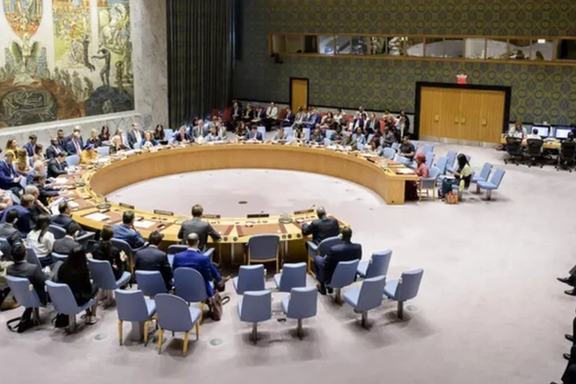
UN Security Council in session. File Photo
Three European powers have written to the UN Security Council detailing Iran's violations of its 2015 nuclear deal, a step diplomats said aimed to pressure Tehran to resolve the issue diplomatically and to avoid reimposing UN sanctions.
The British, French and German letter did not explicitly threaten to "snap back" United Nations sanctions, but it noted that UN Security Council Resolution 2231, which enshrined the nuclear deal and provided that power, expires on Oct. 18, 2025.
In its own letter, Iran rejected the European stance, noting then-US President Donald Trump reneged on the nuclear deal in 2018 and re-imposed US economic sanctions on Iran, arguing they were within their rights to expand their nuclear work.
The effort by Britain, France and Germany, known informally as the E3, to ramp up pressure was also highlighted this week at the International Atomic Energy Agency, where they successfully pushed a resolution critical of Iran despite US reservations.
The E3 letter, which was dated June 3, referred to a report by the UN nuclear watchdog, IAEA, last month that cited Iran's nuclear advances violating the 2015 deal, including by expanding its stockpile and production rates of high enriched uranium. Iran, which has stockpiled more than 100 kilograms of 60% enriched uranium, has enough fissile materials for 3-4 nuclear warheads if it decides to produce weapons.
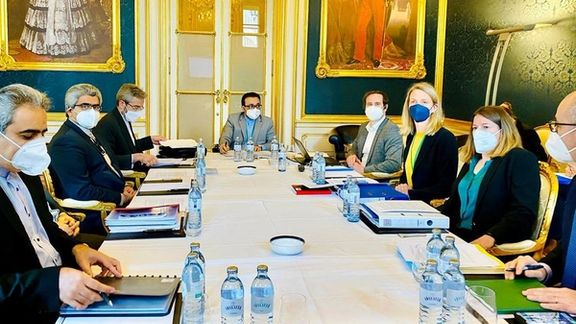
European representatives meet with Iranian diplomats in Vienna in January 2022 on the nuclear issue.
However, Tehran’s overall reaction to the censure at the Board of Governors meeting of the International Atomic Energy Agency, has been relatively low-key so far.
That 2015 nuclear deal, struck with the E3, China, Russia and the United States, limited Iran's ability to enrich uranium, a process that can yield fissile material for nuclear weapons. In return, the US, UN and European Union eased sanctions on Iran.
Tensions with Iran have increased since the Iranian-backed Hamas militant group attacked southern Israel on Oct. 7, other Iranian proxies have attacked US, Israeli and other Western targets, and Tehran has accelerated its nuclear program while limiting the UN nuclear watchdog's ability to monitor it.
"Iran's nuclear escalation has hollowed out the JCPOA, reducing its nonproliferation value," said the E3 letter seen by Reuters, referring to the 2015 deal formally called the Joint Comprehensive Plan of Action.
"Iran's decision to take remedial measures was in full accordance with its inherent right ... in reaction to the United States' unlawful unilateral withdrawal," Iran's UN ambassador said a June 5 letter seen by Reuters.
Reuters quoted Western diplomats and other sources familiar with the E3 letter as saying that its purpose was to try to raise pressure on Iran within the Security Council and to buy time for a diplomatic solution before next year's expiry of their "snap back" power to reimpose UN sanctions on Iran.
The aim is to "take stock of Iran's nuclear advances, which have become unacceptable and are getting worse, and to increase pressure within the Security Council," said a source familiar with the letter.
UN Secretary-General Antonio Guterres reports twice a year to the Council - traditionally in June and December - on the implementation of the 2015 resolution. The Security Council is due to discuss his next report on June 24.
Daryl Kimball, executive director of the nonprofit Arms Control Association, told Reuters the letter may be a way to lay the groundwork for an eventual "snap back" of UN sanctions, though he stressed that a diplomatic solution is still possible.
"The E3 reference to the October 2025 date, when the option to snap back UN sanctions expires, and their communication to the Security Council suggest they are simply trying to establish the legal basis for possibly snapping back sanctions on Iran at a later point," said Kimball.
"However, such an option, especially in the wake of the US withdrawal from the JCPOA, would likely not move Iran to cooperate but lead it to escalate, perhaps even by withdrawing from the nuclear Non-proliferation Treaty," he said.
Israel's Prime Minister Benjamin Netanyahu said he will "present the truth" about the war against Hamas in Gaza when he addresses the US Congress on July 24 during a visit to Washington, Republican leaders said on Thursday.
Netanyahu will speak to a joint session of the House of Representatives and the Senate, House Speaker Mike Johnson and Senate Minority Leader Mitch McConnell said in a statement.
"I am very moved to have the privilege of representing Israel before both Houses of Congress and to present the truth about our just war against those who seek to destroy us to the representatives of the American people and the entire world," Netanyahu said in the statement.
Netanyahu's visit comes amid tensions between him and U.S. President Joe Biden, who has supported Israel's campaign in Gaza but has recently been more critical of its tactics and withheld shipment of some bombs.
It was not immediately clear if Netanyahu would meet with Biden during his US visit.
Biden's support for Israel has emerged as a political liability for the president in the run-up to November's elections, with some Democrats and voters furious over the thousands of civilian deaths in Gaza.
Republicans have also criticized Biden for his position on the war, saying he is not doing enough to help Israel.
Senate Majority Leader Chuck Schumer said in a separate statement that he had joined in making the invitation to Netanyahu.
"I have clear and profound disagreements with the prime minister, which I have voiced both privately and publicly and will continue to do so," Schumer said. "But because America’s relationship with Israel is ironclad and transcends one person or prime minister I joined the request for him to speak.”
A high-ranking aide to Iran's Supreme Leader, purportedly entrusted with Iran's nuclear negotiations said the US and the E3 have been orchestrating a "good cop, bad cop" dynamic to navigate Iran's responses.
“From the JCPOA until the recent International Atomic Energy Agency (IAEA) Board of Governors meeting, in compliance with their roles as good and bad cop, the US and the European Troika have been trying to manage Iran’s reactions to their misbehavior by creating false hope in Iran. They have never been successful & never will be,” Ali Shamkhani wrote on X.
On Wednesday, the Board of Governors of the UN nuclear watchdog passed a resolution censuring Iran and demanding it resolve outstanding issues with the IAEA regarding its nuclear program.
The resolution, initiated by the E3 coalition, France, Britain, and Germany, garnered substantial backing, with 20 member states endorsing it. Notably, the dissenting votes came from China and Russia, staunch allies of Iran. Additionally, 12 countries opted for abstention during the decision-making process.
The United States was widely reported to have opposed the resolution in the days leading up to the IAEA board meeting. Seemingly, Washington was concerned that Tehran might respond to the sanctions with an expansion of its nuclear program marked by the enrichment of uranium and the stockpiling of enough fissile material for several warheads.
Shamkhani had previously stated that Iran would retaliate against any condemnation from the IAEA board. "If some misguided European countries intend to adopt a hostile stance towards Iran's peaceful nuclear program at the upcoming IAEA Board of Governors meeting, on the eve of Iran's presidential elections, they will face a serious and effective response from our country,” Shamkhani had warned.
The Iranian state media also reacted by suggesting that the UN nuclear agency's Board of Governors resolution was premature, particularly given the recent death of Iranian president Ebrahim Raisi in a helicopter crash and the upcoming snap elections.
The Iran-based Fararu news site highlighted “the current executive vacuum in the country” and expressed doubts about “the temporary decision-makers' ability to reach a conclusive decision” regarding nuclear matters.
Another news outlet, KhabarOnline, took a particularly bleak stance, suggesting that "The European Troika [E3] is preparing the groundwork for the activation of the 'snapback' mechanism."
The term "snapback" denotes the procedural mechanism outlined in UN Security Council Resolution (UNSCR) 2231, pertaining to the potential reinstatement of UN sanctions and constraints on the Islamic Republic of Iran. This resolution endorsed the 2015 Iran nuclear agreement, formally recognized as the Joint Comprehensive Plan of Action (JCPOA).
In 2015, Iran and several global powers, including the United States, signed the JCPOA, which imposed significant constraints on Iran's nuclear activities in exchange for sanctions relief. However, then US President Trump withdrew the United States from the agreement in 2018, citing its purported failure to effectively address Iran's missile program and regional influence. Consequently, Iran has continued to disregard the stipulated limitations on its nuclear endeavors. The UN nuclear chief, Rafael Grossi, recently said Iran was “weeks not months” away from a nuclear weapon in spite of Tehran denying it has ambitions for a nuclear weapons program.
Since then, Iran has been non-cooperative with the IAEA on various fronts, and tensions between Tehran and the agency have steadily escalated. The Iranian administration has dismantled surveillance apparatuses, rebuffed senior inspectors' access requests, and withheld information regarding the whereabouts of new nuclear installations. This stance persists despite Iran's assertion that its uranium enrichment endeavors are exclusively for civilian applications and disavowal of any intention to pursue nuclear armaments.
As per an IAEA assessment, Iran is enriching uranium up to 60% purity, nearing the 90% threshold indicative of weapons-grade material. Moreover, it has stockpiled sufficient material for further enrichment, potentially yielding three nuclear warheads.
The Islamic Republic of Iran has thus far shown a relatively mild reaction to a censure resolution passed by the UN nuclear agency's Board of Governors condemning Tehran’s lack of cooperation.
The resolution, tabled by France, Britain, and Germany, received significant support, with 20 member states voting in favor. The two countries who voted against the resolution were Iran's allies, China and Russia. The decision saw 12 countries abstaining from the vote.
Iran's mission to the United Nations said the decision to pass a resolution against Iran by the International Atomic Energy Agency's (IAEA) board of governors was "hasty and unwise.”
The UN nuclear watchdog's 35-nation Board of Governors passed a resolution calling on Iran to step up cooperation with the watchdog and reverse its recent barring of inspectors despite concerns Tehran would respond with atomic escalation.
"The decision of the Western countries was hasty and unwise, and it will undoubtedly have a detrimental impact on the process of diplomatic engagement and constructive cooperation (between Iran and the opposing parties)," state TV cited Iran's mission to the UN.
IAEA's Rafael Grossi meeting with Iran's nuclear chief Mohammad Eslami in Tehran, in March 2023
In the days leading up to the IAEA board meeting, it was widely reported that the United States opposed the resolution tabled by France, Germany and the United Kingdom. Washington was apparently concerned that Tehran might retaliate by a major escalation of its nuclear program, marked by uranium enrichment and stockpiling of enough fissile material for several warheads.
The Biden administration embarked on multilateral talks with Iran in April 2021 that lasted 18 months without achieving a deal. At the same time, Tehran escalated its nuclear activities, which had remained largely static after the Trump administration withdrew from the JCPOA nuclear deal in 2018.
The spokesperson of Iran’s atomic energy agency responded to the IAEA resolution by a vague threat and relatively mild objections late Wednesday.
“From today, we have begun actions within the framework of safeguards. It is expected that Western countries, instead of exploiting international organizations and adopting a pressure approach, will choose the path of interaction and cooperation. Experience should have proven to them that Iran will not forgo its legitimate rights in the face of political pressures,” Behruz Kamalvandi said.
It is likely that Tehran will show a stronger and more concrete reaction after the June 28 snap presidential elections, which are expected to have low turnout due to voter disillusionment. Any escalation with Western powers or aggressive nuclear steps could heighten voter concerns about their future under the Islamic government.
Iran’s foreign ministry also condemned the Western move at the IAEA. “The Islamic Republic of Iran considers the presentation and adoption of this resolution to be a political and nonconstructive action, continuing the failed policies of certain Western countries and an attempt to politically exploit international mechanisms against independent countries.”
Despite Iran's claims of readiness to cooperate with the UN nuclear watchdog, it has significantly curtailed IAEA inspections since early 2021, ramped up uranium enrichment, and refused to provide satisfactory answers regarding its past secret nuclear activities. IAEA chief Rafael Grossi traveled to Tehran in March 2023 and again before the board meeting, but achieved no real cooperation.
The UN nuclear watchdog's Board of Governors passed a resolution on Wednesday, censuring Iran and demanding that it resolves outstanding issues with the IAEA over its advancing nuclear program.
The resolution, tabled by France, Britain, and Germany, received significant support, with 20 member states voting in favor. The two countries who voted against the resolution were Iran's allies, China and Russia. The decision saw 12 countries abstaining from the vote.
Prior to this, Iran vowed to retaliate to any move of condemnation by the IAEA board. The last time Tehran was censured over its nuclear activities was in November 2022.
While the censure may not have immediate implications for Iran, it could be a prelude to what many advocates have called for: referring Iran to the UN Security Council.
Starting in 2006, the UN Security Council imposed several rounds of sanctions targeting Iran's nuclear program. Many of the economic sanctions imposed on Iran were suspended in 2015 as part of the Joint Comprehensive Plan of Action (JCPOA), commonly known as the Iran nuclear deal. The US announced its withdrawal from JCPOA in 2018, and reimposed nuclear-related sanctions on Iran.
Earlier today, the US confirmed its backing of the European powers' initiative to censure Iran pointing to Tehran's lack of cooperation with the IAEA.
The US emphasized, however, that the move should be part of a broader, comprehensive strategy to address the issues surrounding Iran's nuclear program.
"Make no mistake, it is important that resolutions be tied to a broader strategy. This resolution should be a first step in a strategy aimed at achieving a sustainable, effective solution to Iran’s nuclear program that includes full cooperation with the IAEA," US Ambassador Laura S.H. Holgate said in a statement.
Earlier this week, the E3 (UK, France, and Germany) had submitted a draft resolution to the IAEA Board of Governors.
Ahead of the latest US statement, China, Iran, and Russia reaffirmed their support for the JCPOA, although Iran has officially declared that it is no longer abiding by the agreements provisions.
The countries lambasted Western countries for failing to restore the agreement – often dubbed the Iran nuclear deal – insisting on its validity and condemning European nations for maintaining unilateral restrictions.
Referring to the “illegal” US withdrawal from the JCPOA in 2018 and its subsequent maximum pressure policy on Iran, China, Iran and Russia said their support for the nuclear deal has remained unchanged.
“It is time for Western countries to demonstrate political will, restrain themselves from the endless wheel of escalation that they have been spinning for the past almost two years and take the necessary step towards the revival of the JCPOA,” the statement by the allied countries read.
The E3’s own statement on Tuesday, meanwhile, criticized Iran for its actions in advancing its nuclear program and escalating tensions in this area, warning that Iran's nuclear program had reached "worrying levels."
The European statement emphasized that recent remarks by Iranian officials about the capability to produce nuclear weapons and the potential change in Iran's nuclear doctrine have further eroded trust between Tehran and the international community.
Yet, the E3 emphasized the need for transparency and cooperation between Iran and the IAEA, urging Iran to cease threats to produce nuclear weapons and adhere to JCPOA commitments, particularly regarding uranium enrichment.
The latest confidential IAEA report, reviewed by Iran International, reveals that Tehran has increased its enriched uranium stockpile to over 142 kilograms at 60% enrichment, a 20-kilogram rise since the last report in February.
In late April, the agency’s Director General, Rafael Grossi, said that Iran could obtain sufficient enriched uranium for a nuclear bomb within weeks. Experts say that for Iran to develop a bomb delivered by a missile, it could take up to a year.
Grossi, who has criticized the lack of transparency in Tehran's nuclear program, recently traveled to the country, hoping to pursue what many say is in vain: transparency and assurances that Tehran’s nuclear program is peaceful.
While there have been sporadic indirect talks between Iran and the US, efforts to revive the nuclear deal have largely stalled. Tehran has consistently demanded the lifting of US sanctions as a precondition for any agreement.
Iran’s acting foreign minister issued a warning regarding the looming possibility of a new IAEA resolution targeting Iran, accusing the international nuclear watchdog of succumbing to political influence.
Ali Bagheri Kani said, "The non-constructive approach of some member countries in using the agency's capacity for their political goals will undoubtedly harm the identity and role-playing of the agency," afterthe E3 nations, comprising Britain, France, and Germany, jointly submitted a resolution to the United Nations nuclear watchdog’s Board of Governors on Monday.
The resolution highlighted Iran's non-cooperation with the agency, expressing concerns over its pursuit of nuclear weapons amid rapid enrichment. The group also demands answers to undeclared sites.
A recent confidential report from the International Atomic Energy Agency (IAEA), highlights Iran's ongoing enrichment of uranium to levels nearing those required for weapons-grade material. Uranium enriched to 60 percent, as indicated in the report, brings Iran's enrichment capabilities dangerously close to the 90 percent threshold necessary for the production of atomic weapons.
Rafael Grossi, head of the IAEA, said Iran is "weeks not months" away from a nuclear weapon. Iran has consistently refuted the allegations, asserting that its nuclear activities are solely intended for peaceful purposes.