G7 Warns Iran Against Giving Russia Ballistic Missiles
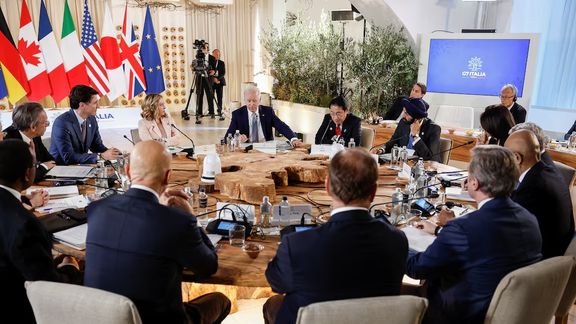
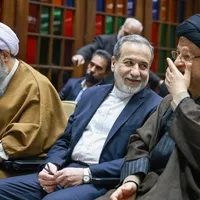
A view from the first day of the G7 summit, in Savelletri, Italy, June 13, 2024
The Group of Seven leaders warned Iran Friday not to give Russia ballistic missiles, only a day after the two countries’ much-publicized strategic agreement was confirmed to have been halted due to “issues” on the Iranian part.
Iran and Russia have grown closer due to the war in Ukraine, which has resulted in sweeping sanctions on Russia from the US and the EU. Iran has supplied Russia with hundreds of kamikaze drones, and unofficial reports suggest that Tehran may be considering enhancing its assistance with missiles.
"We call on Iran to stop assisting Russia’s war in Ukraine and not to transfer ballistic missiles and related technology, as this would represent a substantive material escalation and a direct threat to European security," the G7 stated.
In February, Reuters reported that Iran had provided Russia with “a large number of powerful surface-to-surface ballistic missiles”. The claim was later repeated by UK defense secretary Grant Shapps, who indicated that he had such information but refused to offer details..
Iran and Russia have been working on a long-term agreement for a few years now, hoping to set in stone a trend that has seen Tehran and Moscow expand and deepen ties.
The new comprehensive cooperation agreement was conceived under former President Hassan Rouhani and officially announced by his late successor, Ebrahim Raisi. “Documents of strategic cooperation can outline the horizons of the [two countries’] relations over 20 years,”Raisisaid after he met Putin and presented the draft in 2022.
The agreement was expected to be signed this year, but the Russian side announced Wednesday that the process was halted due to “issues faced by our Iranian partners.” Russia's TASS news agency then quoted foreign minister Sergei Lavrov as saying that several "procedural legislative actions" must be completed before the agreement can be signed.
It is unclear what the “actions” are and if it is related to the unexpected, upcoming presidential elections in Iran, which were announced after Raisi died in a helicopter crash last month.
Earlier on Friday, it was announced that Russian President Vladimir Putin and Iran’s acting president, Mohammad Mokhber, had talked on the phone Thursday evening, in what seems to be the latest attempt to counter rumors surrounding the ‘halt’ of the two countries’ comprehensive agreement.
“Both sides expressed their interest in further development of Russian-Iranian cooperation,” according to the Kremlin, “including in implementing promising joint projects in energy and transport.”
"It's a message from Vladimir Putin to Tehran, warning them not to alter their policies, particularly concerning Ukraine and the Gaza conflict. Additionally, it aims to pressure the incoming Iranian government into negotiations to secure more favorable terms," he stated.
Under severe international sanctions, Russia and Iran have expanded their economic ties, with mutual trade standing at $4 billion, which even Iranian officials admit is far below the target of $40 billion.
The two countries reached an agreement in December to eliminate the use of the US dollar in bilateral trade, a development heralded by Iran's central bank governor as a "new chapter." However, the move has more of a symbolic significance than a real economic act.
G7 Warns Iran Against Giving Russia Ballistic Missiles | Iran International
Pro-reform candidate Massoud Pezeshkian argued in his first economic discussion aired on state television that Iran's international isolation must end and that foreign investment is essential for economic improvement.
Pezeshkian was accompanied by two economic advisers and was questioned by three economic experts during the 45-minute program about his proposed plans. Throughout the program, however, he insisted that he was not an expert and would only follow the advice of economists.
“As a physician, I will ruin everything if I enter the economic arena [on my own],” he said. Some of his critics on social media charge that without economic knowledge he is more likely to ruin the economy anyway.
“Instead of establishing cooperation and attracting investment they do something else [that defeats the purpose]. We cause such catastrophes even when an investor comes to our country that they regret their decision to invest here,” Pezeshkian said.
“Bringing foreign investment can prevent the [continuation of] current pressures,” he said while also criticizing policies that have resulted in the country’s brain-drain problem.
Pezeshkian's remarks are typical of regime insiders, who when compelled to address the worsening economy, avoid mentioning the real reasons for Iran's isolation: its confrontational foreign policy and its controversial nuclear program. Their typical response is to blame inefficient officials, who do not fully follow policies and laws.
Iran's average annual economic growth rate for the past 12 years has been around zero, with international sanctions on oil exports and international banking devastating the economy and preventing investments. Tehran has also refused accession to global financial transparency conventions, which has further impeded foreign investments.
Ahmad Midari, one of the two advisers accompanying Pezeshkian, mentioned that tensions caused by political factionalism in the foreign policy apparatus and other government bodies was an impediment to the economy that Pezeshkian’s government would try to eliminate.
“The truth of the matter is that those who are unfairly called ‘pro-West’ are executives who were in a position of authority when the establishment decided to negotiate with the West or were employed at such times due to their expertise in negotiation,” he said.
In his introduction to the program, Pezeshkian pointed out that official figures indicate the inflation rate has been over 40 percent between March 2021 and March 2023 and that excluding oil the economic growth rate was negative.
All the presidential candidates have admitted that the economy is in trouble, but none have directly attributed it to Tehran's foreign policy, because that would be viewed as a criticism of Supreme Leader Ali Khamenei.
Pezeshkian, however, tried to highlight some negative economic indicators. The government’s debt to the Central Bank has more than doubled to $5.4 billion since March 2021 and its debt to other banks has doubled to $13.5 billion, he said, adding that during the same time the value of securities issued by the government has reached $12.4 billion from $5.5 billion.
Pezeshkian has been criticized for his choice of economic advisers due to their very different expert views. Hossein Abdo-Tabrizi, a former secretary general of the Tehran Stock Exchange (2003-2005), founder of a private bank (Eghtesad Novin), and owner of the banned Sarmayeh (Capital) newspaper is known for defending a free market economy while Midari, deputy minister of cooperatives, labor and social welfare under Hassan Rouhani, upholds left-leaning views and is a researcher in poverty.
Conservative politician Yahya Al-e Es'haq who was a former head of the Tehran Chamber of Commerce and served as minister of commerce under Akbar Hashemi-Rafsanjani sat on the three-member panel that questioned Pezeshkian and his advisers.
Al-e Es'haq was heard several times during the program saying “well said, well said” in response to Pezeshkian’s remarks including when he argued that there was no shortage of laws and problems stemmed from neglecting the existing ones.
Another member of the panel, Davoud Danesh-Jafari who currently sits on the Macro-Economy Committee of the Expediency Council and served as minister of economy under Mahmoud Ahmadinejad also occasionally showed his approval of Pezeshkian and his advisers by nodding his head.
The third 'expert' on the panel, Mohammad-Hossein Hosseinzadeh-Bahraini, a cleric and former lawmaker, tried to pressure Pezeshkian into admitting that he supported the elimination of fuel subsidies—an admission that could alienate the public. However, Pezeshkian responded by stating that he would rely solely on expert opinions if such a measure was necessary and would keep the public informed of the details.
Sudden announcement of an increase in fuel prices under Hassan Rouhani resulted in unrest across the country in 2019, during which security forces killed at least 1,500 protesters.
Ali Shamkhani, advisor to the Supreme Leader and apparent nuclear negotiator, stated on Friday that Iran "won't bow to pressure" amidst US warnings regarding its uranium enrichment activities.
“Iran's nuclear program relies on national will and development strategy,” Shamkhani wrote on X. “The US and some Western countries would dismantle Iran’s nuclear industry if they could.”
The US issued a warning to Iran, stating they will “respond accordingly” if Iran continues to accelerate its nuclear program. This came shortly after the UN nuclear watchdog, the International Atomic Energy Agency (IAEA), highlighted Tehran's expanding uranium enrichment.
The IAEA’s report revealed Iran's response to a censure resolution, indicating expanded uranium enrichment at two underground sites. Iran rapidly installed more uranium-enriching centrifuges at its Fordow site and began work on additional ones at its Natanz facility, the report said.
A week ago, The IAEA's Board passed a resolution urging Iran to cooperate and reverse its decision to bar inspector visits, with the US stressing the need for Iran's compliance. Britain, France, and Germany tabled the resolution, which the US reportedly opposed but later endorsed. Only Russia and China voted against the measure.
Shamkhani, an old-guard military figure who served as the secretary of Iran’s Supreme National Security Council until last year, had previously warned of a "serious and effective response" if European nations pursued the resolution.
According to an IAEA assessment, Iran is enriching uranium to 60% purity, approaching the 90% threshold typical of weapons-grade material. Additionally, it has accumulated enough material for additional enrichment, potentially resulting in three nuclear warheads.
Iran’s Sunni leader Mowlavi Abdolhamid spoke out against the exclusion of a prominent Sunni figure from the presidential race.
A vocal critic of the government's ineffectiveness and systemic discrimination, he blasted the rejection of the Sunni candidate as a sign for the lack of progress toward inclusivity within the establishment.
During his Friday prayer sermons in Zahedan, the provincial capital of Sistan-Baluchestan, he emphasized that "policy changes and improved coordination among governing bodies are necessary to make the president's actions effective and avoid repetitive outcomes."
Jalal Jalalizadeh, a Sunni former representative of Sanandaj in the Iranian parliament, was blocked from running in the elections.
The unelected 12-member Guardian Council, responsible for vetting candidates, approved only six out of over 80 who applied to run, disqualifying prominent figures such as former parliament speaker Ali Larijani and former president Mahmoud Ahmadinejad.
Iran is preparing for snap presidential elections following the death of President Ebrahim Raisi in a helicopter crash on May 19. Vice President Mohammad Mokhber currently serves as the acting president.
As Iran's most prominent Sunni cleric, Abdolhamid has consistently criticized the regime for its discriminatory policies against the Sunni population in political and social spheres.
Sunni Muslims make up around 10 percent of Iran's 88 million people, with many facing economic and political marginalization. They are primarily concentrated in border regions spanning from Sistan-Baluchestan in the southeast to Kurdistan in the northwest.
Nobel Peace Laureate Narges Mohammadi has issued a warning about the deteriorating health of fellow inmate Rezvaneh Khanbeigi, who is in her second trimester of pregnancy.
In a letter from Evin Prison on Friday, Mohammadi detailed the severe conditions faced by Khanbeigi and other prisoners, calling for urgent attention to their plight.
Khanbeigi, who is 21 weeks pregnant, is reportedly experiencing serious health issues, including blood pressure fluctuations and heart palpitations.
“Inadequate nutrition, lack of necessary medical facilities, and the overall closed, tense, and stressful prison environment have made us increasingly concerned for her and her unborn child’s health,” Mohammadi stated in her letter.
Evin Prison's women's ward is gripped by unprecedented overcrowding, according to Mohammadi. “All rooms and beds are full. The number of critically ill and incurable patients is so high that the ward can't provide adequate care,” she wrote. Despite the release of some inmates, the population remains above 65.
In recent months, two prisoners who were previously released on medical grounds have been returned to prison without explanation. Now, the ward also houses pregnant women, including Khanbeigi, whose husband, Behfar Lalehzari, is also imprisoned nearby. “This is the third time Rezvaneh has been imprisoned in recent years, and this time she is accompanied by a daughter,” Mohammadi noted.
Khanbeigi and her husband Lalehzari are currently serving a five year sentence each: 4 years for “assembly and collusion against national security” and an additional year for “propaganda against the regime”according to the activist HRANA news agency.
Mohammadi also condemned the harsh conditions and treatment of prisoners, stating, “The Islamic Republic embodies cruelty and crime in practice. The conditions in the women’s ward of Evin Prison clearly depict a harsh reality. The Islamic Republic, with cruelty, hatred, and callousness, tramples on the rights of prisoners, the sick, mothers, and pregnant women, showing no regard for humanity.”
Earlier in the week, the husband of imprisoned journalist Saba Azarpeik disclosed on X that his wife was hospitalized on Tuesday due to severe bleeding, resulting in the termination of her pregnancy. Ataollah Hafezi further revealed that in February, she lost another fetus at around two months old following a grueling nine-hour court session.
“It seems that whatever concerns the rulers have, they are not worried about humanity, and they fully and completely commit acts of crime,” Mohammadi added.
General Yahya Rahim Safavi, Iran’s Supreme Leader's top military advisor, reiterated for the second time in less than a week that the upcoming president must closely follow Ali Khamenei's guidance.
In his remarks on Thursday, he advised people to select a candidate who “considers himself the second person of the country, not the first.”
“The upcoming elections will shape our nation's future, so stay vigilant in selecting leaders committed to unity rather than division. Look for candidates who prioritize serving the nation over personal ambition, capable of effectively managing the country and addressing people's needs,” Safavi said.
"The president should align with the Supreme Leader’s views, acknowledging himself as second in command,” he said, stressing that “it creates issues if the head of the executive branch doesn't adhere to this hierarchy.”
Following the death of President Ebrahim Raisi and his delegation in a helicopter crash last month, there will be a snap election held on June 28.
Safavi's comments reflect Iran's leaders' efforts to centralize power around a unified ideology, particularly amidst growing internal unrest and external pressures. With his background as the former head of the Revolutionary Guards, his words carry significant influence, underscoring the military's pivotal role in shaping and safeguarding Iran's political sphere.
It's uncertain whom Safavi refers to, but the six candidates chosen by the Guardian Council are notably similar, with all but one having an ultraconservative background.