Pharmaceutical Company Tied to Supreme Leader Under Investigation
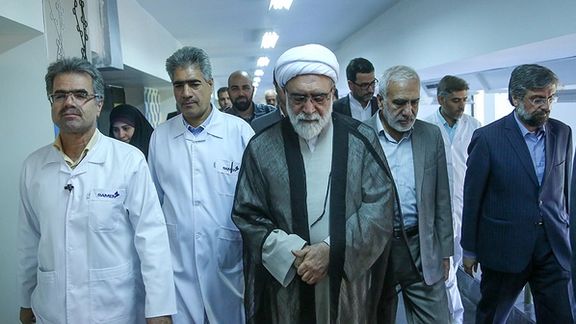
Ahmad Marvi, the head of Astan Quds Razavi at Samen Pharmaceutical Company
Following Iran International's report on a contaminated dialysis solution from a company linked to the Supreme Leader, Iran's acting president has ordered an urgent investigation by the anti-corruption coordination head.
Iranian state media has reported that Mohammad Mokhber called for a thorough inquiry into reports of adverse effects from the dialysis solution.
On Tuesday, Iran International TV's Titre Aval program (First Headline) revealed documents showing that peritoneal dialysis solutions produced by Samen Pharmaceutical Company, owned by US-sanctioned Astan Quds Razavi, are contaminated with aluminum. The report revealed contamination has poisoned several dialysis patients, leading to some fatalities. The Astan business conglomerate is controlled by Ali Khamenei's office.
Peritoneal dialysis is a kidney failure treatment that filters blood through the abdominal lining, requiring a surgical tube insertion into the belly.
Iran International's report featured voice messages from individuals sharing their loved ones' experiences, recounting seizures and coma-like states with decreased consciousness levels. Following the program's broadcast, another individual reported the death of a patient due to the contamination's consequences.
Iran International also published two letters regarding this issue.
The first, dated June 6, from the Iran Food and Drug Administration (IFDA) to Samen's CEO, demanded the halt of the distribution and use of the contaminated solutions.
The second, dated June 8, from the director of the Iranian Nephrology Association, informed nephrologists across Iran about the contamination and patient poisonings. It confirmed that Samen acknowledged the contamination.
During Donald Trump's presidency, the US sanctioned Astan Quds Razavi, a robust religious-business foundation managing the Imam Reza Holy Shrine, for being controlled by Iran's Supreme Leader.
The institution enables “Iran’s elite to sustain a corrupt system of ownership over large parts of Iran’s economy,” according to the US Treasury.
Iran's late president, Ebrahim Raisi, was a former head of Astan Quds Razavi, which has extensive economic holdings in Iran. Raisi's successor, Ahmad Marvi, was also sanctioned under Executive Order 13876.
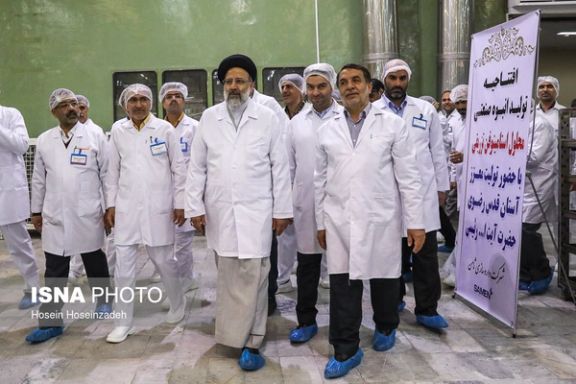
Ebrahim Raisi at Samen Pharmaceutical Company
Swiftly after the Iran International report, state media reported that the Iran Food and Drug Administration (IFDA) also said it had received reports of problems and side effects related to Samen Pharmaceutical Company's peritoneal dialysis solution. They confirmed on Wednesday that an order had been issued to stop the production, distribution, and consumption of this product's entire manufacturing series until more detailed tests were carried out in the country.
According to Hamshahri Online in Tehran, the Samen company also announced that the issue is under investigation.
This report emerges amidst significant concerns over the scarcity and escalating costs of medications in Iran, coupled with pharmaceutical companies facing bankruptcy and closure. Local media report that many common and critical hospital drugs are unavailable.
The government controls medicine imports, allocating foreign currency to public and private sector importers. However, Iran's economic challenges, worsened by numerous sanctions, have stretched the government's ability to allocate foreign currencies. Additionally, reports of widespread corruption in the pharmaceutical sector have exacerbated the current situation.
Despite these challenges in the health sector, the government continues to finance a host of armed militias throughout the Middle East, including Hamas, the Lebanese Hezbollah and Houthis in Yemen, in addition to its military presence in Syria.
Over the past few years, the Ministry of Health and the Red Crescent have seen numerous reports and news reports about corruption in drug imports. It has been revealed that some groups allocated government funds for medicine imports but misused these funds for other purposes.
Pharmaceutical Company Tied to Supreme Leader Under Investigation | Iran International
Iran has rebuffed recent criticisms from the Group of Seven (G7) regarding its accelerated nuclear program, branding its assessments as based on "false claims".
The statement from the foreign ministry comes in the wake of a G7 statement on Friday that admonished Iran for its ongoing nuclear enrichment advancements and hinted at possible new sanctions if Tehran proceeds with the transfer of ballistic missiles to Russia.
"We call on Iran to stop assisting Russia’s war in Ukraine and not to transfer ballistic missiles and related technology, as this would represent a substantive material escalation and a direct threat to European security," the G7 stated.
Spokesman Nasser Kanaani said international efforts to connect Iran's nuclear activities with the conflict in Ukraine are nothing more than “biased political goals.”
Despite the tensions, Iran has continued to escalate its nuclear capabilities, as evidenced by a recent report from the International Atomic Energy Agency (IAEA). The IAEA noted that Iran has been installing additional uranium enrichment centrifuges at its Fordow facility, pushing the enrichment levels up to 60% purity—a threshold alarmingly close to the 90% required for nuclear weapons.
This level of enrichment is unprecedented for a country it claims has no plans for nuclear armament and puts Iran potentially on the brink of having sufficient material for three nuclear bombs. The UN's nuclear chief recently warned Iran is "weeks not months" away from a nuclear weapon.
The response to the G7's statement Friday from the European signatories of the 2015 nuclear deal, the United Kingdom, France, and Germany, known as the E3, was critical, asserting on Saturday that Iran's actions are undermining the landmark agreement.
The decision by the Swedish government to return Hamid Nouri, a convicted criminal against humanity, to Iran in exchange for hostages marks a dangerous precedent with far-reaching consequences.
This exchange, involving the release of Johan Floders, a Swedish diplomat, and Saeed Azizi, a dual-citizen, underscores Tehran’s mastery in leveraging “hostage diplomacy” to further its agenda.
Nouri was convicted for his role in the 1988 massacre of political prisoners, an event that saw thousands executed on the orders of Ayatollah Ruhollah Khomeini. His trial and subsequent convictionin Sweden were recognized as a significant step for international justice. However, his return to Iran in a political exchange undermines these achievements and could potentially embolden other regimes globally.
The decision by Sweden to acquiesce to Iran’s demands sends a message that hostage-taking can be perceived as an effective strategy. Sweden’s decision may encourage more kidnappings and unlawful detentions. This development could embolden not only Iran but also other regimes and organizations, demonstrating that democratic nations can be coerced into compromising their principles and judicial decisions. By negotiating Nouri’s return, Sweden has compromised the integrity of international justice and signaled that political considerations can override judicial outcomes.
Iranian government’s tactics are not new. Since its establishment, the clerical regime has shown a willingness to use extreme measures to achieve its goals, including the suppression of political dissidents and the use of state-sponsored violence. The 1988 massacre is one of the most egregious examples of this, with over 5,000 political prisoners executed in a matter of two months. By negotiating Nouri’s return, Sweden has not only failed the victims of these atrocities but also risked the safety of individuals and the stability of international relations.
A historical precedent that underscores the danger of such concessions is the Mykonos trial in Germany. On September 17, 1992, four Iranian-Kurdish dissidents were murdered. The court concluded that the highest levels of the Iranian government, including then-President Akbar Hashemi Rafsanjani and Supreme Leader Ali Khamenei, had approved the assassinations. The trial also exposed the involvement of Iran's embassy in Germany and its diplomats, such as Seyed Hossein Mousavian. This trial highlighted the extent to which the Islamic Republic (IRI) would go to silence its opponents, even on foreign soil.
Despite the significant verdict in the Mykonos trial, Germany eventually sent back one of the convicted perpetrators, Darabi, to Iran after 15 years in prison. His return was celebrated by the government in Iran, where he was interviewed by state media and published a book. This action emboldened the IRI, leading to renewed threats against the Iranian diaspora and terrorist activities in Europe. This concession nullified the EU's agreement to halt such activities with Iran.
A glaring example of this renewed aggression was the case of Assadollah Assadi, an Iranian diplomat arrested on June 10, 2018, in Germany. Assadi was accusedof involvement in an attempted bombing at a gathering of the National Council of Resistance of Iran (NCRI) in Villepinte, north of Paris. Although Assadi was entitled to diplomatic immunity in Austria, his country of posting, he did not have immunity on German soil. Despite Iran's objections, which claimed the detention violated international law and the 1961 Vienna Convention, Assadi was arrested while returning to Austria, highlighting ongoing concerns regarding state-sponsored terror activities.
Assadi was extradited to Belgium, where the conspiracy had been taking shape and eventually convicted, but in May 2023 Brussels decided to exchange him with another hostage. Iran released Belgian aid worker Olivier Vandecasteele, who had been incarcerated in Tehran for nearly 15 months.
This pattern of using hostage-taking as an act of terror was further exemplified on October 7, when Hamas, a group backed by the IRI, kidnapped more than 200 Israelis, including civilians, women, children, and the elderly, and took them to Gaza. This violation of the rules of combat shows the extent to which such groups are willing to go, knowing they can use innocent lives as bargaining chips in negotiations. This act underscores the dangerous precedent set by Sweden’s decision and the emboldening of regimes and organizations to continue such practices.
Sweden’s decision to return Hamid Nouri, despite his conviction for crimes against humanity, risks emboldening the IRI further. It indicates to other regimes that such activities might not face significant consequences. The Mykonos trial and subsequent events should have served as warnings and calls to action for stricter measures against state-sponsored terrorism. Yet, recent developments suggest that lessons from the past have not been fully heeded.
The international community must take a firm stance against hostage diplomacy. This involves refusing to negotiate with regimes that use such tactics, imposing stringent sanctions, and taking diplomatic action against them. Furthermore, democratic nations must collaborate to ensure that perpetrators of crimes against humanity face justice, regardless of political pressures. This means upholding the principles of universal jurisdiction and supporting judicial decisions made in good faith and through fair legal processes.
The opinions expressed by the author are not necessarily the views of Iran International
The wife of Ahmadreza Jalali, a political prisoner in Iran, has slammed the prisoner swap deal between Sweden and Iran which left her husband behind.
Speaking to Iran International, Vida Mehrannia labeled the recent prisoner exchange which saw the release of convicted Iranian war criminal Hamid Nouri in Sweden in return for two Swedish citizens imprisoned in Iran, as "ridiculous". Her Swedish-Iranian husband remains behind bars in Iran on charges of espionage, which he denies.
On Saturday, Sweden released former Iranian jailor Hamid Nouri who was serving a life sentence for his role in the 1988 mass executions in Iran, and Iran in turn released Swedish EU diplomat Johan Floderus and Swedish-Iranian citizen Saeid Azizi.
According to Mehrannia, her husband has been subjected to solitary confinement and intensified mistreatment as part of Tehran's strategy to leverage detained foreign nationals and dual citizens.
She told Iran International that authorities have failed to provide any substantial answers or efforts to secure Jalali's release. The family, along with their supporters, had no prior knowledge of the negotiations that led to the recent prisoner exchange, only learning about it through media reports.
Jalali was arrested in 2016. The case, purportedly a retaliation for his refusal to spy for Iran's Revolutionary Guard, led to a death sentence.
The political deputy of the Islamic Revolutionary Guard Corps expressed concerns over the potential impact of low voter turnout in Iran's June 28 presidential election, attributing it to external threats.
"This issue encourages the enemy to create disturbances, meaning that when the enemy sees a low turnout, it is tempted to create challenges and can describe officials, whether in parliament or the government, as lacking popular support," stated Brigadier General Yadollah Javani.
He said that elections could either enhance Iran's strength or become a point of vulnerability: "Elections can lead to two outcomes; first, becoming a source of power generation, and second, becoming a source of challenge production."
The portrayal comes as recent elections in Iran, particularly the second round of the Parliamentary elections held in March, saw notably low participation, with only a small fraction of eligible voters in Tehran casting their ballots.
As the country prepares to hold a snap presidential election this month, such diminished electoral engagement has been largely attributed to a pervasive dissatisfaction with the political process, exacerbated by economic struggles and social restrictions that further alienate the public from the political establishment.
The situation was aggravated by the nationwide protests following the death of Mahsa Amini in police custody, which led to a crackdown resulting in over 500 deaths. These events starkly highlighted the government's repressive nature and deepened the sense of despair and disconnection from the state, prompting many Iranians to question the effectiveness of the electoral process as a means for achieving reform or influencing government policies.
Sweden's release of Hamid Nouri, a former Iranian official convicted of war crimes, in a prisoner exchange with the Islamic Republic, has sparked widespread backlash and public protests.
Adding to the public outrage is the fact that Sweden left behind Ahmadreza Jalali, an Iranian-Swedish scientist sentenced to death in Iran after a sham trial lacking due process. In exchange for Nouri, Iran released two other de facto hostages.
Immediately after the news broke on Saturday, Iranians in Sweden converged outside the foreign ministry in Stockholm to voice their indignation, including Djalali's wife Vida Mehrannia. The gathering underscored a broader international reaction that casts a shadow over Sweden's prisoner exchange with Iran.
Prominent Iranian opposition figure Prince Reza Pahlavi criticized the Swedish Prime Minister's decision to release Hamid Nouri, calling it "an affront to the rule of law, human rights, and basic decency." He condemned the move as "feckless appeasement" of Iran's criminal regime, arguing that it failed to save all hostages and would only encourage more hostage-taking and blackmail.
Alireza Akhondi, a Swedish politician from the Center Party, criticized the Swedish Prime Minister's government as "irresponsible" for "abandoning Ahmadreza Djalali." Akhondi described the release of Nouri as an "insult to Sweden's judicial system" and a "cruel blow" to Djalali's family. He suggested that the timing of the prisoner swap was deliberately delayed until after the European Parliament elections to avoid losing votes.
Hamed Esmaeilion, a prominent Canadian Iranian activist and representative of the Association of Families of Flight PS752 Victims, condemned the exchange as a "shameful stain" on Sweden, labeling it as complicity with a regime known for its hostage-taking tactics. "Today justice has been trampled upon," Esmaeilion expressed on social media, highlighting the emotional toll on families affected by Nouri's past atrocities.
In 2022, a Swedish court sentenced Nouri to life imprisonment following his conviction of war crimes for his role in the mass execution of political prisoners in Iran in 1988. Nouri served as the deputy prosecutor of Gohardasht prison in Karaj city near Tehran in 1988, according to the Swedish court. He was arrested at Stockholm airport in 2019 during his visit to Sweden, under the principle of universal jurisdiction.
Iranian Nobel laureate Shirin Ebadi echoed similar sentiments, criticizing the move as detrimental to the cause of justice.
Journalist and rights activist Masih Alinejad further emphasized that the extradition represents a betrayal of human rights.
“It is a profound betrayal of human rights and a grievous affront to the efforts of justice-seeking families from the 1980s who strive to hold these criminals accountable. This action disregards Sweden’s independent judiciary, which rightfully sentenced this criminal to life imprisonment, and emboldens and strengthens a bloodthirsty regime,” she wrote.
Athena Daemi, another human rights activist, remarked on the predictability of Nouri's release, criticizing European nations for facilitating such exchanges at the expense of standing firm against the Islamic Republic's abuses.
As Nouri returned to Iran in exchange for two Swedish citizens, EU Foreign Policy Chief Josep Borrell expressed relief over the Swedes' release while thanking Oman for its mediation.
Yet, the broader implications of this swap continue to stir controversy and debate about the ethics of negotiating with regimes accused of severe human rights violations.
Critics argue that such swaps might undermine international legal standards by effectively rewarding countries that detain foreigners on dubious grounds. The return of Nouri, in particular, raises ethical questions about the implications of negotiating with governments accused of severe human rights violations.
The United States last year released around $6 billion in Iran's frozen funds to secure the release of five dual nationals arrested on trumped-up charges and held in Iran. That arrangement raised strong public criticism about rewarding hostage taking.