Activist Highlights Voter Apathy as Iran Faces Presidential Election
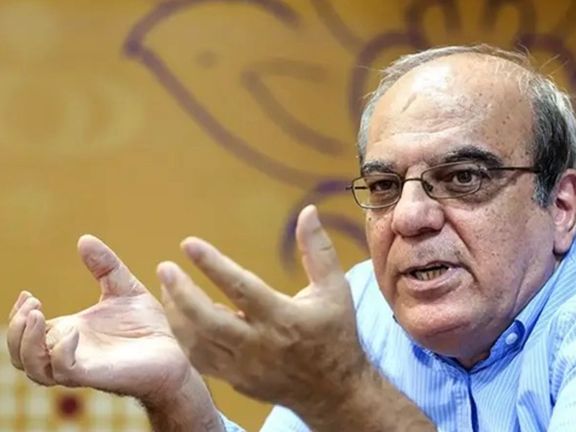
Iranian journalist and political commentator Abbas Abdi
Iranian journalist and political activist Abbas Abdi says a significant number of Iranians are not inclined to vote in the snap presidential elections on June 28, disillusioned with the political system.
In an op-ed for the Etemad newspaper on Sunday, Abdi stated, "the ice of boycotting the elections has not yet begun to melt.”
He added that “one should not need to provide reasons or arguments for not participating, but rather, reasons and analysis are required for deciding to participate.”
The sentiment underscores the broader public dissatisfaction that was evident during the historically low turnout in the March parliamentary elections. Many Iranians, disenchanted with continuous economic struggles and government oppression, feel alienated from the political process. Key issues fueling voter apathy include rampant inflation, crackdowns on protests and dissent, and a pervasive sense of ineffective governance.
Since 2020, the core of the clerical regime loyal to Supreme Leader Ali Khamenei have barred other insider from running in elections, giving control of the parliament and the presidency to hardliners. Seeing little choice among candidates, voters have stayed away, bringing participation well below 50%.
With the presidential election approaching following the sudden death of Ebrahim Raisi in helicopter crash, the lack of enthusiasm suggests that many in Iran continue to see no value in participating in what they perceive as a flawed and predetermined electoral system.
The system faces a challenge in convincing a disillusioned populace that their votes matter and can lead to tangible changes, a task made even more daunting in the current climate of widespread discontent and economic hardship.
Following Iran International's report on a contaminated dialysis solution from a company linked to the Supreme Leader, Iran's acting president has ordered an urgent investigation by the anti-corruption coordination head.
Iranian state media has reported that Mohammad Mokhber called for a thorough inquiry into reports of adverse effects from the dialysis solution.
On Tuesday, Iran International TV's Titre Aval program (First Headline) revealed documents showing that peritoneal dialysis solutions produced by Samen Pharmaceutical Company, owned by US-sanctioned Astan Quds Razavi, are contaminated with aluminum. The report revealed contamination has poisoned several dialysis patients, leading to some fatalities. The Astan business conglomerate is controlled by Ali Khamenei's office.
Peritoneal dialysis is a kidney failure treatment that filters blood through the abdominal lining, requiring a surgical tube insertion into the belly.
Iran International's report featured voice messages from individuals sharing their loved ones' experiences, recounting seizures and coma-like states with decreased consciousness levels. Following the program's broadcast, another individual reported the death of a patient due to the contamination's consequences.
Iran International also published two letters regarding this issue.
The first, dated June 6, from the Iran Food and Drug Administration (IFDA) to Samen's CEO, demanded the halt of the distribution and use of the contaminated solutions.
The second, dated June 8, from the director of the Iranian Nephrology Association, informed nephrologists across Iran about the contamination and patient poisonings. It confirmed that Samen acknowledged the contamination.
During Donald Trump's presidency, the US sanctioned Astan Quds Razavi, a robust religious-business foundation managing the Imam Reza Holy Shrine, for being controlled by Iran's Supreme Leader.
The institution enables “Iran’s elite to sustain a corrupt system of ownership over large parts of Iran’s economy,” according to the US Treasury.
Iran's late president, Ebrahim Raisi, was a former head of Astan Quds Razavi, which has extensive economic holdings in Iran. Raisi's successor, Ahmad Marvi, was also sanctioned under Executive Order 13876.
Ebrahim Raisi at Samen Pharmaceutical Company
Swiftly after the Iran International report, state media reported that the Iran Food and Drug Administration (IFDA) also said it had received reports of problems and side effects related to Samen Pharmaceutical Company's peritoneal dialysis solution. They confirmed on Wednesday that an order had been issued to stop the production, distribution, and consumption of this product's entire manufacturing series until more detailed tests were carried out in the country.
According to Hamshahri Online in Tehran, the Samen company also announced that the issue is under investigation.
This report emerges amidst significant concerns over the scarcity and escalating costs of medications in Iran, coupled with pharmaceutical companies facing bankruptcy and closure. Local media report that many common and critical hospital drugs are unavailable.
The government controls medicine imports, allocating foreign currency to public and private sector importers. However, Iran's economic challenges, worsened by numerous sanctions, have stretched the government's ability to allocate foreign currencies. Additionally, reports of widespread corruption in the pharmaceutical sector have exacerbated the current situation.
Despite these challenges in the health sector, the government continues to finance a host of armed militias throughout the Middle East, including Hamas, the Lebanese Hezbollah and Houthis in Yemen, in addition to its military presence in Syria.
Over the past few years, the Ministry of Health and the Red Crescent have seen numerous reports and news reports about corruption in drug imports. It has been revealed that some groups allocated government funds for medicine imports but misused these funds for other purposes.
Iran has rebuffed recent criticisms from the Group of Seven (G7) regarding its accelerated nuclear program, branding its assessments as based on "false claims".
The statement from the foreign ministry comes in the wake of a G7 statement on Friday that admonished Iran for its ongoing nuclear enrichment advancements and hinted at possible new sanctions if Tehran proceeds with the transfer of ballistic missiles to Russia.
"We call on Iran to stop assisting Russia’s war in Ukraine and not to transfer ballistic missiles and related technology, as this would represent a substantive material escalation and a direct threat to European security," the G7 stated.
Spokesman Nasser Kanaani said international efforts to connect Iran's nuclear activities with the conflict in Ukraine are nothing more than “biased political goals.”
Despite the tensions, Iran has continued to escalate its nuclear capabilities, as evidenced by a recent report from the International Atomic Energy Agency (IAEA). The IAEA noted that Iran has been installing additional uranium enrichment centrifuges at its Fordow facility, pushing the enrichment levels up to 60% purity—a threshold alarmingly close to the 90% required for nuclear weapons.
This level of enrichment is unprecedented for a country it claims has no plans for nuclear armament and puts Iran potentially on the brink of having sufficient material for three nuclear bombs. The UN's nuclear chief recently warned Iran is "weeks not months" away from a nuclear weapon.
The response to the G7's statement Friday from the European signatories of the 2015 nuclear deal, the United Kingdom, France, and Germany, known as the E3, was critical, asserting on Saturday that Iran's actions are undermining the landmark agreement.
The decision by the Swedish government to return Hamid Nouri, a convicted criminal against humanity, to Iran in exchange for hostages marks a dangerous precedent with far-reaching consequences.
This exchange, involving the release of Johan Floders, a Swedish diplomat, and Saeed Azizi, a dual-citizen, underscores Tehran’s mastery in leveraging “hostage diplomacy” to further its agenda.
Nouri was convicted for his role in the 1988 massacre of political prisoners, an event that saw thousands executed on the orders of Ayatollah Ruhollah Khomeini. His trial and subsequent convictionin Sweden were recognized as a significant step for international justice. However, his return to Iran in a political exchange undermines these achievements and could potentially embolden other regimes globally.
The decision by Sweden to acquiesce to Iran’s demands sends a message that hostage-taking can be perceived as an effective strategy. Sweden’s decision may encourage more kidnappings and unlawful detentions. This development could embolden not only Iran but also other regimes and organizations, demonstrating that democratic nations can be coerced into compromising their principles and judicial decisions. By negotiating Nouri’s return, Sweden has compromised the integrity of international justice and signaled that political considerations can override judicial outcomes.
Iranian government’s tactics are not new. Since its establishment, the clerical regime has shown a willingness to use extreme measures to achieve its goals, including the suppression of political dissidents and the use of state-sponsored violence. The 1988 massacre is one of the most egregious examples of this, with over 5,000 political prisoners executed in a matter of two months. By negotiating Nouri’s return, Sweden has not only failed the victims of these atrocities but also risked the safety of individuals and the stability of international relations.
A historical precedent that underscores the danger of such concessions is the Mykonos trial in Germany. On September 17, 1992, four Iranian-Kurdish dissidents were murdered. The court concluded that the highest levels of the Iranian government, including then-President Akbar Hashemi Rafsanjani and Supreme Leader Ali Khamenei, had approved the assassinations. The trial also exposed the involvement of Iran's embassy in Germany and its diplomats, such as Seyed Hossein Mousavian. This trial highlighted the extent to which the Islamic Republic (IRI) would go to silence its opponents, even on foreign soil.
Despite the significant verdict in the Mykonos trial, Germany eventually sent back one of the convicted perpetrators, Darabi, to Iran after 15 years in prison. His return was celebrated by the government in Iran, where he was interviewed by state media and published a book. This action emboldened the IRI, leading to renewed threats against the Iranian diaspora and terrorist activities in Europe. This concession nullified the EU's agreement to halt such activities with Iran.
A glaring example of this renewed aggression was the case of Assadollah Assadi, an Iranian diplomat arrested on June 10, 2018, in Germany. Assadi was accusedof involvement in an attempted bombing at a gathering of the National Council of Resistance of Iran (NCRI) in Villepinte, north of Paris. Although Assadi was entitled to diplomatic immunity in Austria, his country of posting, he did not have immunity on German soil. Despite Iran's objections, which claimed the detention violated international law and the 1961 Vienna Convention, Assadi was arrested while returning to Austria, highlighting ongoing concerns regarding state-sponsored terror activities.
Assadi was extradited to Belgium, where the conspiracy had been taking shape and eventually convicted, but in May 2023 Brussels decided to exchange him with another hostage. Iran released Belgian aid worker Olivier Vandecasteele, who had been incarcerated in Tehran for nearly 15 months.
This pattern of using hostage-taking as an act of terror was further exemplified on October 7, when Hamas, a group backed by the IRI, kidnapped more than 200 Israelis, including civilians, women, children, and the elderly, and took them to Gaza. This violation of the rules of combat shows the extent to which such groups are willing to go, knowing they can use innocent lives as bargaining chips in negotiations. This act underscores the dangerous precedent set by Sweden’s decision and the emboldening of regimes and organizations to continue such practices.
Sweden’s decision to return Hamid Nouri, despite his conviction for crimes against humanity, risks emboldening the IRI further. It indicates to other regimes that such activities might not face significant consequences. The Mykonos trial and subsequent events should have served as warnings and calls to action for stricter measures against state-sponsored terrorism. Yet, recent developments suggest that lessons from the past have not been fully heeded.
The international community must take a firm stance against hostage diplomacy. This involves refusing to negotiate with regimes that use such tactics, imposing stringent sanctions, and taking diplomatic action against them. Furthermore, democratic nations must collaborate to ensure that perpetrators of crimes against humanity face justice, regardless of political pressures. This means upholding the principles of universal jurisdiction and supporting judicial decisions made in good faith and through fair legal processes.
The opinions expressed by the author are not necessarily the views of Iran International
The wife of Ahmadreza Jalali, a political prisoner in Iran, has slammed the prisoner swap deal between Sweden and Iran which left her husband behind.
Speaking to Iran International, Vida Mehrannia labeled the recent prisoner exchange which saw the release of convicted Iranian war criminal Hamid Nouri in Sweden in return for two Swedish citizens imprisoned in Iran, as "ridiculous". Her Swedish-Iranian husband remains behind bars in Iran on charges of espionage, which he denies.
On Saturday, Sweden released former Iranian jailor Hamid Nouri who was serving a life sentence for his role in the 1988 mass executions in Iran, and Iran in turn released Swedish EU diplomat Johan Floderus and Swedish-Iranian citizen Saeid Azizi.
According to Mehrannia, her husband has been subjected to solitary confinement and intensified mistreatment as part of Tehran's strategy to leverage detained foreign nationals and dual citizens.
She told Iran International that authorities have failed to provide any substantial answers or efforts to secure Jalali's release. The family, along with their supporters, had no prior knowledge of the negotiations that led to the recent prisoner exchange, only learning about it through media reports.
Jalali was arrested in 2016. The case, purportedly a retaliation for his refusal to spy for Iran's Revolutionary Guard, led to a death sentence.
Former political prisoner Abolfazl Ghadiani has condemned proponents of reforming Iran's clerical establishment, insisting it is beyond redemption and fervently promoting an election boycott as a bold act of civil resistance.
In his analysis on the Zeitun website on Friday, Ghadiani, once an ally turned vocal adversary of Iran’s Supreme Leader, branded him a "power-loving dictator," casting his reign as a "tyrannical rule, scarred by the atrocities of the fall of 2022 and the scandalous parliamentary elections of March."
In 2022, nationwide protests, ignited by the death of Mahsa Amini in police custody and dubbed the Woman Life Freedom movement, resulted in security forces killing over 550 civilians followed by harsh crackdowns. Women and minorities endure relentless persecution, with executions surging to unprecedented levels.
Ghadiani emphasized that President Ebrahim Raisi's "unexpected" death presents a prime chance for opportunists to exploit the electoral vacuum.
The death of Raisi and his delegation, including the foreign minister, in a helicopter crash last month has precipitated a snap election slated for June 28.
Ghadiani asserted that "participation in these controlled elections won't bring any real change," underscoring that "the inefficiency of Ebrahim Raisi's government, coupled with economic and social crises, international political shifts, and the potential resurgence of the women's rights movement, has compelled Khamenei to pursue" another sham election with the hope of preventing a further decline in the regime's legitimacy.
The outspoken critic posited that these "sham elections" serve to cement the clerical establishment's grip on power and acquire international validation, potentially ushering in a semi-reformist government in a bid to reclaim lost legitimacy.
Reflecting on previous elections, Ghadiani lamented how the “ruling dictator” has "ratcheted up his purification agenda with each passing day," orchestrating elections devoid of competition and marred by predictability in the manipulated outcomes.
In recent years, Iran has seen a decline in voter turnout during parliamentary and presidential elections. Many attribute this trend to segments of the electorate losing faith in elections to address their worsening economic conditions. As a result, there's speculation that these disillusioned voters could potentially sway in favor of a 'reformist' candidate seeking change amidst challenging times.
The only pro-'reform’ candidate among the six hand-picked by the un-elected 12-member Guardian council is Massoud Pezeshkian.
“Even if the name of Massoud Pezeshkian were to emerge triumphantly from the ballot boxes and he, against all odds, earnestly endeavors to revolutionize our nation's governance, shadowy forces will swiftly sabotage such aspirations," Ghadiani wrote.
Ghadiani stated, "No government or parliament in this corrupt authoritarian structure possesses the capacity to impede the epidemic's march."
The activist implored all "democratic forces" to shun the elections and encouraged "political, civil, trade union, and cultural activists" to "seize every opportunity to denounce these sham elections."
Before the March parliamentary elections, Ghadiani issued a similar rebuke, decrying it as "staged, scripted, and engineered."
Ghadiani, 80, has been one of the most vocal and staunch opponents of Iran’s Supreme Leader over the past years. He belonged to a leftist, revolutionary group that was supporting the Islamic Republic and Khamenei until the disputed presidential election of 2009, when the Supreme Leader backed the questionable re-election of Mahmoud Ahmadinejad. Ghadiani, with many others, protested the results and was jailed to become an opposition figure.
Receiving a 10-month jail sentence in July 2023, he said he is ready to go to prison “in Ali Khamenei’s dictatorial regime.” However, he refused to attend the court session and the authorities have refrained from implementing the verdict.