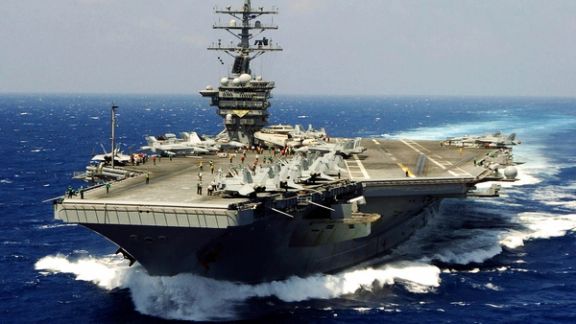
US Navy Rescues Crew from Ship Hit by Houthis in Red Sea
USS Eisenhower aircraft carrier leads US Navy forces in the Middle East
The US Naval Forces Central Command (NAVCENT) said on Sunday that it had rescued the crew from the Liberian-flagged, Greek-owned bulk carrier M/V Tutor that was attacked by Yemen's Iran-backed Houthis on 12 June in the Red Sea.
Sailors assigned to the Dwight D. Eisenhower Carrier Strike Group airlifted the crew out on Saturday, NAVCENT said, adding that one civilian sailor remained missing.
The attack, which occurred near the Yemeni port of Hodeidah, caused severe flooding and damage to the engine room and left the Tutor unable to maneuver.
On Saturday, the United Kingdom Maritime Trade Operations (UKMTO) said the ship's crew was evacuated and that the abandoned vessel was drifting in the Red Sea.
The Houthis claimed responsibility for the small sea craft and missile attacks it used to target the ship as part of their ongoing campaign which they say is in support of the Palestinians and is focused on ships bound for Israel.
Iran supplies weapons to and supports Houthi forces in Yemen, which have been attacking international commercial vessels since November, disrupting a vital maritime route linking Asia with Europe.
The attacks began after Iran's Supreme Leader Ali Khamenei called on Muslim nations in early November to blockade Israeli trade.
Sweden's release of Hamid Nouri, a former Iranian official convicted of war crimes, in a prisoner exchange with the Islamic Republic, has sparked widespread backlash and public protests.
Adding to the public outrage is the fact that Sweden left behind Ahmadreza Jalali, an Iranian-Swedish scientist sentenced to death in Iran after a sham trial lacking due process. In exchange for Nouri, Iran released two other de facto hostages.
Immediately after the news broke on Saturday, Iranians in Sweden converged outside the foreign ministry in Stockholm to voice their indignation, including Djalali's wife Vida Mehrannia. The gathering underscored a broader international reaction that casts a shadow over Sweden's prisoner exchange with Iran.
Prominent Iranian opposition figure Prince Reza Pahlavi criticized the Swedish Prime Minister's decision to release Hamid Nouri, calling it "an affront to the rule of law, human rights, and basic decency." He condemned the move as "feckless appeasement" of Iran's criminal regime, arguing that it failed to save all hostages and would only encourage more hostage-taking and blackmail.
Alireza Akhondi, a Swedish politician from the Center Party, criticized the Swedish Prime Minister's government as "irresponsible" for "abandoning Ahmadreza Djalali." Akhondi described the release of Nouri as an "insult to Sweden's judicial system" and a "cruel blow" to Djalali's family. He suggested that the timing of the prisoner swap was deliberately delayed until after the European Parliament elections to avoid losing votes.
Hamed Esmaeilion, a prominent Canadian Iranian activist and representative of the Association of Families of Flight PS752 Victims, condemned the exchange as a "shameful stain" on Sweden, labeling it as complicity with a regime known for its hostage-taking tactics. "Today justice has been trampled upon," Esmaeilion expressed on social media, highlighting the emotional toll on families affected by Nouri's past atrocities.
In 2022, a Swedish court sentenced Nouri to life imprisonment following his conviction of war crimes for his role in the mass execution of political prisoners in Iran in 1988. Nouri served as the deputy prosecutor of Gohardasht prison in Karaj city near Tehran in 1988, according to the Swedish court. He was arrested at Stockholm airport in 2019 during his visit to Sweden, under the principle of universal jurisdiction.
Iranian Nobel laureate Shirin Ebadi echoed similar sentiments, criticizing the move as detrimental to the cause of justice.
Journalist and rights activist Masih Alinejad further emphasized that the extradition represents a betrayal of human rights.
“It is a profound betrayal of human rights and a grievous affront to the efforts of justice-seeking families from the 1980s who strive to hold these criminals accountable. This action disregards Sweden’s independent judiciary, which rightfully sentenced this criminal to life imprisonment, and emboldens and strengthens a bloodthirsty regime,” she wrote.
Athena Daemi, another human rights activist, remarked on the predictability of Nouri's release, criticizing European nations for facilitating such exchanges at the expense of standing firm against the Islamic Republic's abuses.
As Nouri returned to Iran in exchange for two Swedish citizens, EU Foreign Policy Chief Josep Borrell expressed relief over the Swedes' release while thanking Oman for its mediation.
Yet, the broader implications of this swap continue to stir controversy and debate about the ethics of negotiating with regimes accused of severe human rights violations.
Critics argue that such swaps might undermine international legal standards by effectively rewarding countries that detain foreigners on dubious grounds. The return of Nouri, in particular, raises ethical questions about the implications of negotiating with governments accused of severe human rights violations.
The United States last year released around $6 billion in Iran's frozen funds to secure the release of five dual nationals arrested on trumped-up charges and held in Iran. That arrangement raised strong public criticism about rewarding hostage taking.
The United Kingdom Maritime Trade Operations (UKMTO) said on Saturday the crew of a Palau-flagged cargo ship had been evacuated and the ship was on fire and sinking, referring to an incident that happened 98 nautical miles east of Yemen's Aden on June 13.
Missiles fired by Yemen's Houthi militants struck the Verbena in the Gulf of Aden on Thursday, sparking a fire and severely injuring one of its crew, U.S. Central Command said.
The Iran-allied Houthis have launched dozens of attacks on international shipping in the Red Sea region since November for what they say is solidarity with Palestinians in the war between Israel and Hamas.
The attacks began after Iran's Supreme Leader Ali Khamenei urged Muslim nations to blockade Israel's trade routes. The United States and Britain have launched air strikes against Houthi military targets since January, but the militant group receiving arms and support from Iran has continued its campaign.
The Houthi campaign in the Red Sea region has disrupted global shipping, cascading delays and costs through supply chains. The militants have sunk one ship, seized another vessel and killed three seafarers in separate attacks.
Iran has announced the imminent return of Hamid Nouri, a former Iranian prison official who was convicted of crimes against humanity and incarcerated in Sweden, as part of a prisoner exchange deal.
Kazem Gharibabadi, head of Iran’s High Council for Human Rights, stated on social media platform X that "Hamid Nouri, who has been in illegal detention in Sweden since 2019, is free and will return to the country in a few hours."
Nouri was sentenced to life imprisonment by a Swedish court in 2022 for crimes against humanity linked to his involvement in the mass executions of prisoners during the 1980s in Iran. He was arrested when he visited Sweden according to the principle of universal justice.
In a reciprocal move, Swedish Prime Minister Ulf Kristersson confirmed the release of two Swedish citizens, Johan Floderus and Saeed Azizi, who had been detained in Iran under unclear circumstances.
The Swedish Prime Minister noted, "Today, they will land on Swedish soil and be reunited with their families and loved ones. Welcome home!" He emphasized that the Swedish government had "worked intensively" to secure their freedom.
Saeid Azizi’s lawyer, Reza Shafakhah, revealed that the prisoner exchange deal was conducted without his or the Azizi family's prior knowledge. "This exchange was done without my knowledge as a lawyer and without the client's family's knowledge,” Shafakhah stated on X on Saturday. Shafakhah further disclosed that Azizi was released from prison last night and subsequently flew to Sweden.
The Iranian clerical rulers decided to summarily execute about 5,000 political prisoners in 1988 and prosecutors proved that Nouri was involved in the mass crime as a prison Guard.
The prisoner exchange can become controversial due to the nature of Nouri's convictions, and Iran's practice of arresting foreigners to use them as de facto hostages. Critics argue that such swaps might undermine international legal standards by effectively rewarding countries that detain foreigners on dubious grounds. The return of Nouri, in particular, raises ethical questions about the implications of negotiating with governments accused of severe human rights violations.
The United States last year released around $6 billion in Iran's frozen funds to secure the release of five dual nationals arrested on trumped-up charges and held in Iran. That arrangement raised strong public criticism about rewarding hostage taking.
In recent years, the Iranian Revolutionary Guards have detained numerous dual nationals and foreigners, predominantly on accusations of espionage and security threats. Human rights organizations have criticized Iran for these arrests, suggesting they are strategically used to leverage concessions from other nations.
The US-led campaign against Iran-backed Houthi militants "has turned into the most intense running sea battle the US Navy has faced since World War II," its leaders and experts told AP.
“I don’t think people really understand just kind of how deadly serious it is what we’re doing and how under threat the ships continue to be,” Cmdr. Eric Blomberg with the USS Laboon told the AP on a visit to his warship on the Red Sea.
“We only have to get it wrong once,” he said. “The Houthis just have to get one through.”
Capt. David Wroe, the commodore overseeing the guided missile destroyers, says “it is every single day, every single watch, and some of our ships have been out here for seven-plus months doing that."
The US Navy prepared for decades to potentially fight the Soviet Union, then later Russia and China, on the world’s waterways. However, instead of a global power, it finds itself locked in combat with a shadowy, Iran-backed rebel group based in Yemen, the AP's report said.
The Houthis, an Iranian proxy group, began targeting maritime commercial traffic in mid-November following a call by Iran’s Supreme Leader Ali Khamenei for Muslim countries to blockade Israel. Initially confined to the Red Sea, these attacks have since extended to other crucial waterways, including the Indian Ocean.
The United States and Britain have bombed Houthi military installations several times since January, but the Iran-backed group has accelerated attacks in the past two weeks, as Israel continues operations in Gaza and attacks Iran-backed Hezbollah targets in Lebanon.
The Houthi campaign has disrupted global shipping, forcing firms to re-route to longer and more expensive journeys around southern Africa. It has also stoked fears that the Gaza war - in which the local health ministry says over 37,000 have been killed - could spread and destabilize the wider Middle East.
The Group of Seven leaders warned Iran Friday not to give Russia ballistic missiles, only a day after the two countries’ much-publicized strategic agreement was confirmed to have been halted due to “issues” on the Iranian part.
Iran and Russia have grown closer due to the war in Ukraine, which has resulted in sweeping sanctions on Russia from the US and the EU. Iran has supplied Russia with hundreds of kamikaze drones, and unofficial reports suggest that Tehran may be considering enhancing its assistance with missiles.
"We call on Iran to stop assisting Russia’s war in Ukraine and not to transfer ballistic missiles and related technology, as this would represent a substantive material escalation and a direct threat to European security," the G7 stated.
In February, Reuters reported that Iran had provided Russia with “a large number of powerful surface-to-surface ballistic missiles”. The claim was later repeated by UK defense secretary Grant Shapps, who indicated that he had such information but refused to offer details..
Iran and Russia have been working on a long-term agreement for a few years now, hoping to set in stone a trend that has seen Tehran and Moscow expand and deepen ties.
The new comprehensive cooperation agreement was conceived under former President Hassan Rouhani and officially announced by his late successor, Ebrahim Raisi. “Documents of strategic cooperation can outline the horizons of the [two countries’] relations over 20 years,”Raisisaid after he met Putin and presented the draft in 2022.
The agreement was expected to be signed this year, but the Russian side announced Wednesday that the process was halted due to “issues faced by our Iranian partners.” Russia's TASS news agency then quoted foreign minister Sergei Lavrov as saying that several "procedural legislative actions" must be completed before the agreement can be signed.
It is unclear what the “actions” are and if it is related to the unexpected, upcoming presidential elections in Iran, which were announced after Raisi died in a helicopter crash last month.
Earlier on Friday, it was announced that Russian President Vladimir Putin and Iran’s acting president, Mohammad Mokhber, had talked on the phone Thursday evening, in what seems to be the latest attempt to counter rumors surrounding the ‘halt’ of the two countries’ comprehensive agreement.
“Both sides expressed their interest in further development of Russian-Iranian cooperation,” according to the Kremlin, “including in implementing promising joint projects in energy and transport.”
"It's a message from Vladimir Putin to Tehran, warning them not to alter their policies, particularly concerning Ukraine and the Gaza conflict. Additionally, it aims to pressure the incoming Iranian government into negotiations to secure more favorable terms," he stated.
Under severe international sanctions, Russia and Iran have expanded their economic ties, with mutual trade standing at $4 billion, which even Iranian officials admit is far below the target of $40 billion.
The two countries reached an agreement in December to eliminate the use of the US dollar in bilateral trade, a development heralded by Iran's central bank governor as a "new chapter." However, the move has more of a symbolic significance than a real economic act.