Western Powers Vow to Stop Iran's Nuclear Advances, Warn of Reimposing Sanctions
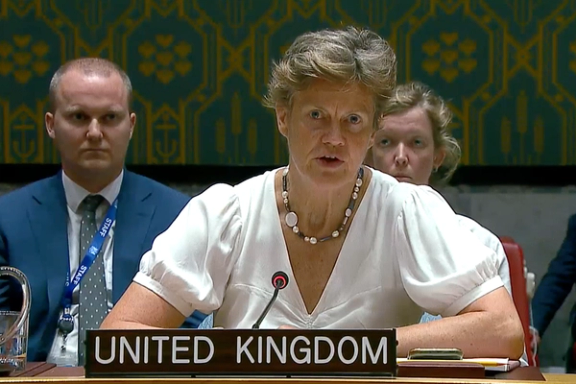
Britain's ambassador to the UN Barbara Woodward
The representatives of Western powers vowed in a UN Security Council meeting to prevent Iran from acquiring a nuclear weapon using "all means necessary" including by reinstating the UN sanctions.
The E3 (Britain, France and Germany) may trigger the UN snapback mechanism that reinstates UN Security Council Resolution 2231 sanctions on Iran before October 2025, Britain's UN envoy Barbara Woodward told a Security Council briefing on Iran.
"In October next year, this resolution is due to expire and with it the right to reimpose UN sanctions on Iran. Given Iran’s dangerous advances which have brought it to the brink of being able to develop a weapon, this situation should be of grave concern for this Council," Woodward said.
"We will continue to keep all diplomatic options on the table, including triggering UN snapback before October 2025, if necessary," she warned.
The snapback mechanism was devised as part of the 2015 nuclear deal between Tehran and world powers, known as the Joint Comprehensive Plan of Action (JCPoA). It would allow an individual participant of the deal to restore all UN sanctions on Tehran should it deem it to be in violation of the deal.
Addressing the same briefing, the United States' envoy to the United Nations said his country is prepared to take any action necessary to prevent Tehran from acquiring a nuclear weapon.
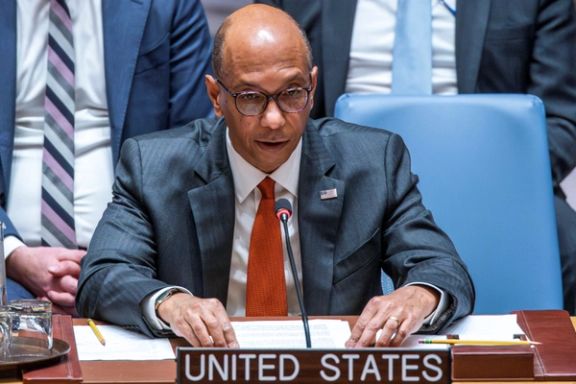
US Envoy to the UN Robert Wood
"The US is prepared to use all means necessary to prevent a nuclear-armed Iran," the US' Alternative Representative for Special Political Affairs Robert Wood said.
Wood stressed that "Iran’s actions suggest it is not interested in verifiably demonstrating that its nuclear program is exclusively peaceful."
"Iran continues to deny the international community visibility into its nuclear activities. It obstructs IAEA efforts to resolve outstanding safeguards issues, and willfully hampers IAEA verification and monitoring activities," he said.
"When Iran flagrantly defies the Security Council repeatedly without consequence, and ignores the published concerns of the IAEA, it undermines the credibility and authority of this body, which is charged with advancing international peace and security," the US envoy said.
Wood's remarks come amid growing concern about Iran’s nuclear program, which has grown rapidly in the last few years, while access has been limited and many UN inspectors have been kept out.
Tehran is set to triple or even quadruple its uranium enrichment capacity at Fordow, one of the country's most secretive nuclear facilities, according to reports published by the Institute for Science and International Security (ISIS) and the Washington Post Wednesday.
The Biden administration had earlier threatened to respond to Iran if it further accelerates its uranium enrichment.
Iran's disclosure of its plans comes after the IAEA member states approved a formal reprimand on June 5 in response to its nuclear defiance.
The IAEA Board of Governors resolution demanded Iran step up cooperation with the watchdog and reverse its recent barring of inspectors.
However, Iran’s top nuclear official made it clear on Sunday that the country's interactions with the UN nuclear watchdog are limited to the legal boundaries of the Nuclear Non-Proliferation Treaty (NPT) and the Safeguards.
Iran’s top nuclear official says the country's interactions with the UN nuclear watchdog, IAEA, are limited to the legal boundaries of the Nuclear Non-Proliferation Treaty (NPT) and the Safeguards.
Mohammad Eslami emphasized that the International Atomic Energy Agency (IAEA) has no right to demand anything beyond these limits.
The statement arises amid increased scrutiny over Iran's nuclear activities, with international concern about potential NPT violations.
In his Sunday remarks, Eslami argued that the IAEA's role should be confined to "legal obligations" that the agency should maintain without exceeding its mandate.
"The agency is responsible for oversight, encouragement, and fair distribution of nuclear technology. This is a legal obligation, and it must be pursued and demanded within this framework. Beyond this, there is nothing else that the agency should bring up," Eslami said.
Critics see the interpretation by Iran as an attempt to avoid comprehensive inspections and conceal the extent of its nuclear activities. The IAEA has repeatedly expressed concerns about Iran's cooperation with its investigations and the transparency of its nuclear program.
Earlier this month, Board members of the IAEA passed a resolution criticizing Iran's lack of cooperation with IAEA nuclear inspections.
A recent report from the nuclear watchdog indicates that Iran's stockpile of enriched uranium now exceeds 30 times the limit established by the 2015 nuclear deal between Tehran and world powers (JCPOA). The uranium is enriched to 60 percent, which is near the 90 percent enrichment level required for nuclear weapons.
The Joint Comprehensive Plan of Action (JCPOA), established in 2015 between Iran and the P5+1 countries (the US, UK, France, Russia, China, and Germany), aimed to curb Iran’s nuclear capabilities in exchange for lifting economic sanctions. However, the accord has been under strain since the US withdrawal in 2018, prompting Iran to progressively breach several of its commitments, such as exceeding the uranium enrichment levels and stockpile limits set by the agreement.
Iran's advancements include resuming enrichment at the Fordow Fuel Enrichment Plant and enhancing enrichment purity up to 60%. These actions reduce the breakout time needed to produce enough fissile material for a nuclear weapon, raising concerns about the dual-use nature of Iran's nuclear program.
The IAEA has struggled with monitoring challenges due to restrictions imposed by Iran, which complicate efforts to verify the extent of Iran’s enrichment activities. The agency's reports suggest that Iran has accumulated enough enriched uranium that could be quickly elevated to weapons-grade levels, amplifying worries about Iran’s intentions.
Iran maintains that its nuclear program is solely for peaceful purposes, but its near-weapons-grade enrichment activities continue to provoke international unease.
In its June report, the IAEA said Iran aims to continue expanding its nuclear program in ways that "have no credible peaceful purpose."
Former Iranian President Hassan Rouhani says Iran incurred an annual loss of some $100 billion over the past three years due to sanctions that forced the country to sell oil and petrochemicals at discounted rates.
Rouhani accused former president Ebrahim Raisi's government of "betraying" the Iranian people by causing $300 billion in damages over the course of three years.
Rouhani's claims come amid a presidential election campaign during which his administration has been harshly criticized by hardliners. His remarks seem to be somewhat exaggerated in terms of the amount of revenue losses. In fact, the Raisi administration has sold much more oil than in 2019-2021, the last three years of Rouhani's presidency, after the United States imposed sanctions.
After former US president Donald Trump withdrew from the JCPOA nuclear accord and imposed third-party oil export sanctions on Iran, shipments declined from two million barrels a day to around 250,000. With the election of Joe Biden, China began increasing its oil imports from Iran, which have reached 1.3 million barrels per day.
In addition, even if Iran exported two million barrels, the revenue would still be far below $100 billion, at less than $60 billion at current average prices.
Rouhani's rebuke also targeted the December 2020 Strategic Action Law to Lift Sanctions and Safeguard Iran's National Interests, enacted under the leadership of conservative parliament speaker Mohammad Bagher Ghalibaf. The bill, intended to pressure the newly elected Biden administration, authorized uranium enrichment at 20%—far higher than the JCPOA limits—and reduced international nuclear inspections by the UN watchdog, the IAEA.
He condemned the legislation as "the worst in the history of the Islamic Republic of Iran," dismissing it as a "conspiracy" to undermine his administration.
"We have never had a worse law. It was clearly designed to ensure that the people cannot breathe. I know exactly who was behind its design and implementation," Rouhani said in a Wednesday speech whose text was published Sunday.
As the Biden administration entered into indirect talks with Iran in April 2021 ro revive the JCPOA, Tehran continued to escalate its nuclear violations and eventually the negotiations failed in 2022. Although the Biden administration has relaxed the enforcement of the oil sanctions, Iran's economy is still under pressure with annual inflation hovering around 50%.
His remarks were in direct response to criticisms from ultra-conservative candidates in the upcoming June 28 elections, who, during televised debates, have lambasted Rouhani’s administration for its “inefficiency” and criticized the 2015 nuclear agreement negotiated under his leadership.
The nuclear issue and the crippling impact of sanctions on the Iranian economy, so far largely avoided by the candidates, appear to be turning into an important part of discussions and debates.
The turning point came Monday when former Foreign Minister Mohammad-Javad Javad Zarif made a bold entrance into the election scene alongside the pro-reform candidate Masoud Pezeshkian with a fiery speech at a televised roundtable discussion.
“The whole of Pezeshkian’s candidacy, even if he is not elected, was worth the few minutes that Zarif spoke to the people on TV. These words were anti-spell to the one-sided slanders of the extremists. The reign of lie will not last,” Mohammadreza Javadi Yeganeh, professor of sociology at Tehran University, tweeted after Zarif’s speech Monday.
Zarif who has always insisted that the 2015 JCPOA agreement with world powers was signed with Supreme Leader Ali Khamenei’s full approval, defended the Rouhani administration and his own performance in crafting the deal and its immediate economic outcome.
He also showed a few graphs to prove the deal and the lifting of sanctions had helped Iran's economic growth in 2016 and 2017 and asserted that hardliners’ ability to sell more oil since 2021, in which they take huge pride, was solely due to US President Joe Biden loosening the sanctions.
Ultra-hardliner Saeed Jalili who is one of the top three contenders to the presidency said Tuesday in response to Zarif’s remarks, “Today I heard that [someone] has said it was Trump [who imposed sanctions on Iran] and that [Joe] Biden had a different approach. Why did you not continue [your talks with him] during the nine months of your time when Biden was [president]?”
In fact, The Rouhani administration did participate in in indirect talks with the United States from April to June 2021, but they did not reach an agreement before the end of his term and the election of hardliner Ebrahim Raisi, who took office in August of that year.
“Biden not only did not remove Trump’s sanctions but also imposed tens of other sanctions,” Jalili added.
“Mr. Zarif's statements yesterday were wrong, and he was unfair. I will answer his insult tomorrow [in televised campaign programs],” ultra-hardliner candidate Alireza Zakani, who many believe is playing a supporting act to Jalili, said Tuesday.
Zarif has thrown all his weight behind Pezeshkian, a former lawmaker and health minister previously little known to many ordinary Iranians, particularly the younger generation, who may potentially cast their ballots for Pezeshkian if swayed to vote rather than boycott the elections.
The former foreign minister accompanied Pezeshkian Tuesday morning at a campaign trip to Isfahan, Iran's third-largest city and delivered a short speech at his campaign meeting in Tehran in the evening of the same day when he urged Iranians to vote for Pezeshkian. “Not voting is voting for the [hardliner] minority,” he said.
So far Pezeshkian has made no indication that he intends to propose Zarif as his foreign minister to the newly elected, hardliner-dominated parliament if he is voted president.
In a meeting on Wednesday with his former deputies and ministers, former President Hassan Rouhani also accused Jalili and the three other hardliner candidates, namely Zakani, Mohammad-Bagher Ghalibaf, and Amir-Hossein Ghazizadeh, of only believing in “war and confrontation”.
“They say we have no way other than fighting and confronting the world powers and defeating them and that [Iran] will never win in the United Nations and negotiations with big countries,” Rouhani, who was barred from running in the elections of the Expediency Council in March by the Guardian Council, said.
At an economic roundtable discussion Wednesday, conservative candidate Mostafa Pourmohammadi also touched upon the issue of the nuclear deal and sanctions. He said his government would complete the “unfinished” business of the JCPOA, which he describes as "not perfect" while accusing hardliners of sabotaging the talks.
“Pressures and damages [caused by sanctions] are serious and certain imprudent actions have increased the damages,” the conservative Pourmohammadi who insists he will negotiate even with the "bitterest enemy" said.
Iran is set to triple or even quadruple its uranium enrichment capacity at Fordow, one of the country's most secretive nuclear facilities, according to reports published by the Institute for Science and International Security (ISIS) and the Washington Post on Wednesday.
The reports said the International Atomic Energy Agency (IAEA) has confirmed new constructions at Fordow.
David Albright, a nuclear weapons expert and president of ISIS, told Iran International his technical report came in response to Iran's announcement that it's going to rapidly deploy 1400 advanced centrifuges.
The advancement, Albright said, came as a surprise
"People didn't know they had that many [centrifuges] ready to go... At the Fordow plant, the centrifuges are called the IR-6s and it's the most advanced centrifuge Iran operates," said Albright.
The 1,400 advanced machines would increase Fordow’s capacity by 360 percent, according to Albright. The plant is a deeply buried facility that is very hard to destroy.
The Washington Post also reported that the major expansion underway inside Fordow could soon triple the site’s production of enriched uranium, according to confidential documents and analysis by weapons experts.
Albright said that within a month, Iran could produce enough weapons-grade uranium for five nuclear weapons at Fordow.
The reports come amid growing concern about Iran’s nuclear program, which has grown rapidly in the last few years, while access has been limited and many UN inspectors have been kept out.
Last week, France, Germany, and Britain, original signatories of the 2015 nuclear deal with Iran, condemned Tehran’s plan to further expand its uranium enrichment.
The United States has also threatened to respond to Iran if it further accelerates its uranium enrichment.
Iran's disclosure of its plans comes after the IAEA member states approved a formal reprimand on June 5 in response to its nuclear defiance.
The IAEA Board of Governors resolution demanded Iran step up cooperation with the watchdog and reverse its recent barring of inspectors.
On June 10, Iran's Acting Foreign Minister Ali Bagheri downplayed the resolution censuring Iran, stating that issuing resolutions has no impact on Iran's "determination" to develop its nuclear projects.
Albright believes Iran's reaction to the resolution was "more aggressive behavior" with regards to "deploying these 1400 centrifuges."
Iran dismisses all concerns as politically motivated. It has officially informed the International Atomic Energy Agency of its expansion and ‘upgrade’ plans at its primary enrichment plant near Natanz.
For two years now, Iran has been enriching uranium to 60% purity. The IAEA chief Rafael Grossi has stated that uranium of this purity has no obvious civilian use. It would be “a matter of weeks,” experts say, if Iran decided to go from 60 to 90 percent that is required for making a nuclear weapon.
Albright said Fordow is now viewed as a plant that could break out and produce several nuclear weapons within weeks, while previously it was never seen as a facility capable of achieving that.
The surprising nature of the plant's capability, and the fact that it's one of the most heavily protected nuclear facilities in Iran, are major concerns, he said.
"We're dealing with a brand new situation," said Albright.
For the first time in more than a year, US and Israeli officials will reportedly meet on Thursday to discuss the state of Iran’s nuclear program, according to a report by Axios.
The reason for the meeting of the US-Israel strategic consultative group (SCG) could be to discuss whether Iran has begun active measures to develop nuclear weapons.
Apparently, Iran has obtained computer modeling that could be used for research and development of nuclear weapons, Axios quotedformer and current US and Israeli officials as saying. However, there is no unanimous agreement on whether the new capability means Tehran has begun the final process to build weapons, or it does not represent a major shift.
Iran has accumulated enough enriched uranium to build at least three bombs if it decides to weaponize, and it has expelled most UN inspectors from the country. The International Atomic Energy Agency, IAEA, has admitted that it has lost its ability to monitor Iran’s nuclear activity. The agency’s board of governors censured Iran earlier this month for lack of cooperation, prompting a response that Tehran will accelerate uranium enrichment. Washington warned Tehran last week not to further accelerate its uranium enrichment. The US and its European allies to take Iran’s case to the UN Security Council for reinstating international sanctions.
One US and one Israeli official told Axios the new intelligence raised “suspicion” and “concern” about Iran’s intentions. According to one official, Israelis are nervous about their failure to predict the October 7 Hamas attack and scrutinize every information available about Iran’s nuclear activities.