Amid Smear Campaign in Iran, Many Warn of Looming Misery
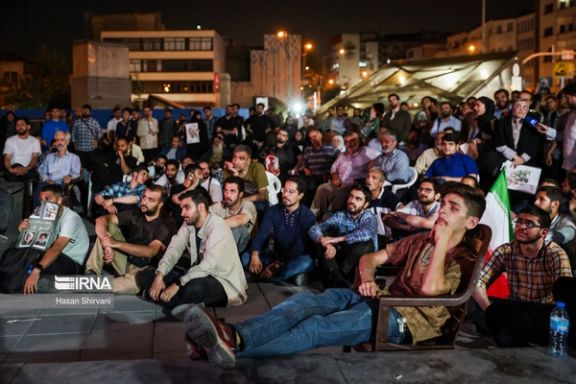
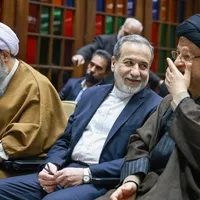
A group of Iranians watching a televised debate between presidential candidates Masoud Pezeshkian and Saeed Jalili in Tehran on July 1, 2024
A few days before the runoff election that will decide whether the relatively moderate Massoud Pezeshkian or the ultraconservative Saeed Jalili becomes President of Iran, a fierce smear campaign is raging between the two.
A specific article links Jalili to hardline cleric Mohammad Mehdi Mirbagheri, who was reportedly behind the chemical attacks on girls' schools in 2022 and 2023. It also claims that the ideology Jalili subscribes to is detrimental to the country's development.
Those opposed to the government-controlled election doctor and merge the pictures of the two candidates alleging that the two men are part and parcel of the same system, calling them "the two halves of the same apple."
Supreme Leader Ali Khamenei has warned the candidates against engaging in smear campaigns more than once. While groups close to their campaigns are clearly involved in these tactics, a larger political force appears to be at play. Election boycotters and foreign-based opposition forces are trying to persuade voters to stay away from the polls on Friday. According to official numbers, at least 60 percent of voters stayed home during the first round on June 28, and the opposition is aiming for an even more extensive boycott this time.
Meanwhile, a report on moderate conservative Khabar Onlinewebsite also highlighted the link between Jalili and Mirbagheri, dubbing Mirbagheri as the new Mesbah Yazdi, the founding father of the ultraconservative Paydari Party. Mirbagheri, who has endorsed Jalili, is known for his belief in conspiracy theories and the clash of civilizations theory.
Their ideology, the article charged, that the fundamentalist group believes it is the mission of the Islamic Republic to to change the nature of the world and to take it back to the "Islamic civilization." They call moderate Islam the "American Islam."
In another development, former President Hassan Rouhani warned "officials," presumably including Khamenei and his aides that "the coming to power of a radical government in Iran will drag the country to the brink of war, more sanctions, poverty and misery. The forming of such a government will be a loss for everyone, whether they vote or not."
Rouhani also warned the boycotters that they would bear full responsibility for the consequences of their actions. He further cautioned those who are passively observing the situation that this is a matter of war and peace, life and death, and that inaction will not protect anyone.
He described the runoff election as a choice between Pezeshkian and Jalili, framing it as a decision between realistic progress and a "wishful U-turn" that could impact the fate of the Iranian nation for at least a decade.
Iran faces a critical shortage of fire trucks with a current deficit of 2,000 vehicles, all while the country faces increasing numbers of deadly fire incidents.
Ghodratollah Mohammadi, the head of Tehran's Fire Department, said most of the existing fire trucks are 30 years old and dilapidated, unable to meet the demands of the force.
Speaking at the Sixth International Fire and Urban Safety Conference, Mohammadi stated that current municipal budgets "only cover firefighters' salaries" and lack the necessary funds for critical equipment. He called for national budget allocation to address the issue, warning that without it, some cities face "very dangerous" conditions.
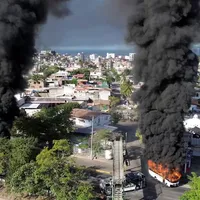
The shortage comes as Iran grapples with a surge in fires at factories, industrial centers, and refineries. These incidents are often labeled as "sabotage" by the government, adding to the pressure on the already strained firefighting services. In Tehran, fires in unsafe buildings continue to claim lives, as seen in the 2017 Plasco building tragedy, which killed 16 firefighters.
Tehran City Council recently identified 35,000 unsafe buildings in the capital.
Criticism is also directed at insurance companies. Mohammadi criticized them for their inaction in supporting firefighting efforts, advocating for a portion of their profits to be redirected to reduce public risk. He lamented that "firefighters have been forgotten in society," despite the high stress and danger of their work.
While the Iranian government allocates millions of dollars to support proxy groups in regional conflicts, domestic needs like firefighting infrastructure are being ignored, fueling unrest in the country which since 2022 has witnessed the largest uprising in the regime's history.
An adviser to Iran’s supreme leader has issued a warning that an all-out Israeli offensive against Hezbollah could trigger a regional war.
Kamal Kharrazi, foreign affairs adviser to Ali Khamenei, stated that Tehran and the “axis of resistance” would support the Lebanese militant movement with “all means.”
“All Lebanese people, Arab countries, and members of the axis of resistance will support Lebanon against Israel," he said.
Hezbollah, Iran's most formidable proxy, funded, trained, and armed by Tehran, continues its daily skirmishes with Israeli forces amid the ongoing Gaza conflict.
In an interview with the Financial Times on Tuesday, Kharrazi claimed that the Islamic Republic was “not interested” in a regional conflict and urged the US to pressure Israel to prevent further escalation. Meanwhile, Iran's regional proxies continue to attack both Israel and US targets in the region.
Kharrazi emphasized the risk of the conflict spreading, stating, “There would be a chance of expansion of the war to the whole region, in which all countries including Iran would become engaged. In that situation, we would have no choice but to support Hezbollah by all means.”
Lebanon's Hezbollah began targeting Israel after the eruption of the Gaza war, sparked by Iran-backed Hamas's invasion of October 7. At least 1,200 mostly civilians were killed and 250 more taken hostage.
The supreme leader's aide added, “The expansion of war is not in the interest of anyone — not Iran or the US.”
In April, Iran launched the first direct attack on Israel with a barrage of 350 missiles and drones following an alleged Israeli strike on Iran's consulate in Syria targeting a senior Quds Force commander and other senior IRGC figures.
A US-led coalition intercepted most of the projectiles in what was seen as the beginning of direct conflict between the two arch-enemies.
Amir-Ali Hajizadeh, the commander of the Aerospace Division of the Islamic Revolutionary Guard Corps (IRGC), expressed an “eagerness” to launch another attack on Israel.
"In the Operation True Promise on April 13, we fired 300 missiles (at Israel). We're eager for the opportunity for Operation True Promise 2, for which I do not know how many missiles should be used," Hajizadeh said on Monday.
Iran launched its first ever direct strike on Israeli territory on April 13, dubbed "Operation True Promise" by Tehran. It involved over 350 drones and missiles. 99% of these projectiles were intercepted by a coalition led by the US, according to the Israeli military.
The attack was purportedly in retaliation for an alleged Israeli strike on the Iranian consulate in Damascus, which resulted in the deaths of seven IRGC officers, including a senior commander.
While confirming that Iran is supplying weapons to Hezbollah in Lebanon, Hamas in Gaza and other militias in the region, the commander highlighted two additional IRGC attacks as deterrents against Israel and the US in the area.
“As evidenced by the weaponry utilized by our allies in Palestine, Lebanon, and other regions, it is unequivocally apparent that Iran provides substantial support and sustenance. We have consistently fulfilled our commitments and will unwaveringly continue to do so in the future,” the IRGC commander added.
Hajizadeh referred to two previous attacks by the IRGC. The first instance occurred in 2019 when Iran downed a US military drone, a Global Hawk, claiming it was on a spy mission over Iranian territory. Washington contended that the drone was targeted in international airspace in what it described as an "unprovoked attack."
The second incident took place in 2020 when the IRGC launched over 12 ballistic missiles at the Al Asad Airbase in Al Anbar Governorate, western Iraq, and another airbase in Erbil in retaliation for the assassination of IRGC commander Qassem Soleimani by a US drone strike.
The thorny issue of a possible fuel prices hike has taken the centerstage in the debates between supporters of the pro-reform Masoud Pezeshkian and ultra-hardliner Saeed Jalili, and among eligible voters.
The duel began Sunday with Jalili supporters claiming on social media that fuel prices would increase several-fold if Pezeshkian wins the runoff elections on July 5, and reach as high as 250,000 rials per liter (around 40 cents).
Currently rationed gasoline is sold at 15,000 rials per liter (2.5 cents). The cost of anything used over the rationed amount (From 25 liters per month for motorcycles and 60 liters for personal cars to 500 liters for ambulances) is 5 US cents per liter.
This heavily subsidized price, coming to less than 10 cents a gallon, is the second cheapest in the world and costs the government tens of billions of dollars per year. Average gasoline prices in the region is closer to $1 per liter.
Jalili’s campaign officials and supporters’ intensive attacks on Pezeshkian’s campaign were followed by a Jalili tweet on Monday. The image posted by Jalili with no comment looked like the map of an Internet Taxi application with Pezeshkian as the taxi’s passenger going to the presidential office. The caption read “Will increase transportation costs” to suggest that Pezeshkian’s government intends to increase fuel prices to 250,000 rials (around 40 cents) per liter.
“Mr. Jalili, I haven’t proposed any plans for increasing gasoline prices but you must say if the price of gasoline will be less than 600,000 rials (nearly $1) after your government implements your ‘The One Plan’,” Pezeshkian’s official X account respondedto Jalili shortly after.
Jalili has proposed "The One Plan" to distribute energy subsidies equally to all Iranians, regardless of income, instead of the current income-based cash subsidies in 2021 by allocations of “One” units which could be used like cash to buy fuel or electricity instead of money. Fuel should be sold at international rates after the introduction of the plan.
The plan, he argued, would allow individuals with less energy consumption to sell saved units at any price through a mobile application or treat them as investments for the future. According to information on Jalili’s website, One units can also be used to pay water bills.
Neither Jalili, nor his campaign had made any reference to the plan during the campaign before Friday’s low turnout elections in which he came second after Pezeshkian but his campaign aides and supporters are now extensively promoting the plan as one of Jalili's measures to improve the lives of low-income Iranians.
Jalili formed a shadow government during the presidency of moderate Hassan Rouhani and maintained it during Ebrahim Raisi’s administration to which he appears to have proposed his plan.
Raisi’s government did not implement The One Plan and the price of gasoline remained the same as in 2019. A mini model, however, was introduced in the Persian Gulf free economic zone Island of Kish as a pilot in March 2022 for four months.
Not only economists, but even hardliners media including the Revolutionary Guards (IRGC) linked Javan newspaper criticized the pilot plan in Kish Island and said it had increased fuel usage instead of decreasing it.
Fuel gasoline has always been highly subsidized by the government. Smuggling of gasoline and other fuel in huge quantities to neighboring countries including Iraq, Afghanistan, Turkey, and Pakistan where it is much more expensive is a serious problem for all Iranian governments. Some economic experts say as much of 20 million liters of fuel is smuggled out of Iran every day.
The quadrupling of fuel prices by Mahmoud Ahmadinejad’s government in 2007 sparked riots, particularly in Tehran where petrol stations were torched by angry protesters. Hassan Rouhani’s government increased fuel prices three times. The last increase in November 2019 the tripling of the prices led to extensive protests across the country that lasted a week. Hundreds were killed and security forces seriously injured thousands during the crackdown on protesters.
Iranian pro-reform candidate Masoud Pezeshkian said on Monday that the low turnout in Iran’s presidential election was “unacceptable” and a sign of flaws in the system, while his hardline rival Saeed Jalili called for strategies to encourage greater voter participation.
The June 28 presidential election marked the lowest voter turnout in the history of the Islamic Republic, with only 39.92 percent participation. This breaks the previous record set during the last election, in which the late President Ebrahim Raisi won with a turnout of 48 percent.
In a televised debate ahead of the runoff election on July 5, Pezeshkian said the concerns of the 60 percent who abstained from voting should be addressed, stressing the importance of caring for all Iranians, especially women and ethnic groups.
Jalili said, "If the current situation is far from the desired level of public participation, we must motivate people with a plan to move towards the desired participation."
Both candidates tried to garner support from Sunni Muslims. Pezeshkian criticized the exclusion of Sunnis from key government positions. Jalili also pledged to restore Sunni rights if elected.
Foreign Policy and Sanctions On foreign policy, Pezeshkian emphasized the importance of expanding Iran's international ties, prioritizing neighboring countries first and then other nations to achieve economic growth. He defended the 2015 nuclear deal (JCPOA), and said why figures like Israeli Prime Minister Benjamin Netanyahu, former US President Donald Trump, and Saudi Arabia opposed the deal if it was against Iran’s interests.
Pezeshkian highlighted the "huge" financial losses incurred without the nuclear agreement and urged adopting the Financial Action Task Force (FATF) regulations, comparing it to FIFA in international sports where non-compliance results in exclusion from global engagements.
Jalili criticized the focus on expansion of ties with just "three world powers" in the moderate faction's foreign policy, arguing that there are over 200 countries that Iran should engage with to seize various opportunities.
He said Iran currently sells "less than two million barrels of oil per day" at standard rates despite the US sanctions.
Pezeshkian asked why despite huge oil sales, the lives of ordinary Iranians remain "miserable".
"Why don't you tell the people at what rate you are selling the country's oil?" he asked.
Smear Campaigns
In another part of the debate, both candidates tried to address smear campaigns against them. Jalili had brought a thick pamphlet which he said was comprised of the articles published online against him. He claimed that supporters of Pezeshkian called his supporters “Taliban” while Pezeshkian said Jalili’s supporters called him “munafiq”.
In Islamic term Munafiq is a person who in public and in community shows that he is a Muslim but rejects Islam or speaks against it either in his heart or among the enemies of Islam. The hypocrisy itself is called nifāq.
Internet Censorship and Technology
Jalili said the already-restricted social media platforms (like Telegram, X, and Instagram) must comply with the Islamic Republic’s regulations to operate in Iran. The hardliner also pledged to significantly increase mobile and home internet speeds if elected.
Pezeshkian explicitly defended the Islamic Republic's restriction of internet and claimed that all governments impose internet restrictions during special times, such as protests or strikes. However, he argued that there is no justification for the current restrictions forcing citizens to rely on VPNs as there is no "special" situation in the country.
Final Words
Pezeshkian, a former health minister and deputy speaker of Parliament said Jalili lacked necessary qualifications to run the country.
"One who has not run even a department is not qualified to run an organization," Pezeshkian said.
Jalili referred his experience in the foreign ministry, and also as the Secretary of the Supreme National Security Council.
Pezeshkian said the Secretary was not the one who made top decisions, and those policies were the decided by Iran's leader Ayatollah Khamenei.