Unpaid workers protest across Iran as government fails to quash dissent
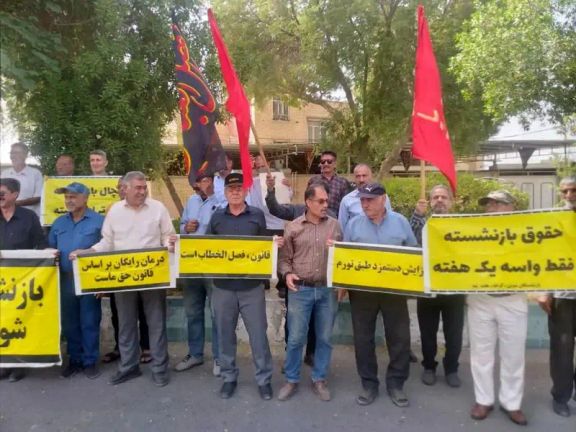
Iranian retirees stage protests on July 7
Workers gathered in at least ten cities across Iran on Sunday to demand better working conditions and unpaid wages as presidential elections ended amid the country's economic crisis.
HRANA, the news agency of the Human Rights Activists in Iran, reported that groups of social security retirees organized rallies in Shush, Ahvaz, Kermanshah, and Tehran.
In addition, steel industry retirees in Isfahan (Esfahan), Damghan, Tehran, and Qaemshahr, unemployed petrochemical project workers in Ilam, and coal mine retirees in Kerman also held demonstrations, demanding overdue payments and benefits.
While annual inflation hovers around 50%, the minimum wage for the current year has been set at a meager 110 million rials (about $190), making it nearly impossible for many to make ends meet.
Workers in Iran are currently grappling with the worst economic crisis since the founding of the Islamic Republic. The minimum cost of living in Tehran is estimated at 300 million rials (about $500), while in other cities it stands at 200 million rials (about $350).
Videos circulating on social media show protesters condemning the death sentence issued against labor activist Sharifeh Mohammadi and calling for the reversal of the verdict. Her punishment highlights the crackdown on dissent and its relentless persecution of those who dare to speak out.
The protesters' demands include increasing pensions to reflect the actual poverty line, providing free and quality healthcare and welfare services, correcting wage disparities, improving working conditions, guaranteeing job security, and raising salaries.
Meanwhile, contractors of the water and sewage network in Rudbar, north of Iran, have entered the twelfth day of their strike, demanding eight months of unpaid wages.
Oil and gas project workers in the south marked the eighteenth day of their industrial action. Approximately 60 of the workers, who have been striking and protesting round-the-clock, have not received their salaries since December and are facing severe financial hardships.
Their demands extend beyond immediate payment of overdue wages, including demanding permanent contracts, the formation of independent labor unions, job security, the right to protest, and timely monthly wage payments.
Additionally, the Council for Organizing Oil Contract-Workers' Protests reported that on Sunday, project workers from at least 123 southern oil and gas companies continued their strike. Thousands of oil and gas project and contract workers have joined the movement, seeking not only to improve their earnings but also to enhance their leave policies, job security, and employment status by eliminating exploitative contractors.
These protests are part of a broader wave of labor unrest in Iran, driven by delayed wages, low pay, and layoffs that have intermittently disrupted numerous industrial sectors since 2018.
Over the past decade, the oil and gas industry has been outsourced to influential government insiders acting as intermediary contractors who under pay workers and impose harsh working conditions.
Traditionally, oil workers in Iran enjoyed some of the best salaries and benefits, but exploitation has significantly eroded their standard of living.
At least 400 people in Iran's Gilan province were poisoned on June 28, the first round of the presidential elections in Iran, with allegations the news was censored by the government.
Etemad Daily reported Monday that the mixing of sewage water with drinking water caused the poisoning, but officials are trying to hide it.
On June 28, residents of Rezvanshahr visited hospitals and medical centers with symptoms such as nausea, headaches, and stomach pain. The number of hospital visitors was initially 130, but it reached 400 two days later.
The president of Gilan Medical University attributed the cause of the poisonings to water contamination. However, the Gilan Water and Wastewater Department rejected this, emphasizing that "there was no connection between the poisoning ... and the consumption of water from the distribution network."
One resident told Etemad, "My family and I visited the hospital twice with symptoms of stomach pain, diarrhoea, weakness, and loss of appetite. The cause of the poisoning is drinking water, but we don't know why the main cause is not being announced."
In May last year, 333 people were poisoned in Badreh city due to drinking tap water while in September 2021, sewage entering the drinking water tank in the village of Desheh in Kurdish Paveh County poisoned most residents.
Turkish President Recep Tayyip Erdogan expressed hopes for a positive development in Turkey-Iran relations under the new president-elect, leveraging Masoud Pezeshkian's ethnic background as a potential diplomatic bridge.
"Masoud Pezeshkian is actually a Turk," Erdogan stated. "He speaks Turkish in Tabriz, can speak Kurdish in Kurdish regions, and is also fully proficient in Persian."
Pezeshkian's ethnic background is in fact rooted in the Azeri community, a significant ethnic group in Iran, particularly in Azarbaijan province, where Turkish is widely spoken. He was born in the Kurdish city of Mahabad.
While Erdogan expressed hopes for a new era of “rapid development” in Ankara-Tehran relations, the reality on the ground in Iran remains fraught with challenges. The Turkish president's overtures, though diplomatically significant, may also be seen as an attempt to exploit Iran's internal vulnerabilities for regional advantage.
Trade between Turkey and Iran peaked in 2012 at nearly $22 billion but has since declined significantly. According to Turkish Trade Minister Omer Bolat, trade stood at $7.4 billion in 2023, down from around $10 billion the previous year.
Iran's economy has been severely crippled by sanctions imposed due to its nuclear program, although Tehran denies Western allegations that it seeks to develop nuclear weapons
Pezeshkian narrowly won a runoff race against ultraconservative Saeed Jalili on Friday, in an election marred by historically low turnout. In the first round, less than 40 percent of eligible voters participated, highlighting the growing disillusionment with Iran's clerical rule.
Yahya Hosseini Panjaki, alias Yahya Hamidi, the deputy intelligence minister for internal security affairs, has been identified as the mastermind behind Iran's overseas assassination operations.
According to information obtained by Iran International, this revelation unveils Hosseini's role in a world of international espionage and targeted killings, marking the first time his identity has been disclosed.
The Islamic Republic has been systematically planning to assassinate its opponents abroad. These plans are orchestrated by high-ranking officials within the ministry of intelligence, aiming to eliminate dissidents who pose a threat to the Islamic government.
Utilizing undercover agents stationed in embassies and operatives disguised as business people, Tehran has been able to plot and execute various attacks globally. This intricate network involves coordination with international drug traffickers and proxy forces to ensure the operations leave no trace back to Iran's intelligence agencies.
A source within the Islamic Republic's ministry of defense indicated that Hosseini is part of a new generation of intelligence managers trusted by Ali Khamenei, the Supreme Leader of the Islamic Republic. The ministry of intelligence, along with the IRGC's Intelligence Organization, has been conducting the most significant sabotage activities abroad for years. However, information received by Iran International shows that the ministry of intelligence has a more cohesive structure than the IRGC for conducting overseas operations.
Who is Yahya Hosseini Panjaki?
Born in 1975 in Karaj, near Tehran, Hosseini holds a PhD in Political Science from Azad University of Tabriz and has published two articles in academic journals. He was sanctioned by the European Union, the United Kingdom and the United States. His role in founding the "Martyr Soleimani" unit, which conducts sabotage operations worldwide in cooperation with the IRGC, marks him as a key figure in Iran's intelligence apparatus.
The Terrorist Infrastructure
The ministry of intelligence employs two main routes for deploying its agents abroad. The first involves intelligence agents under the cover of the ministry of foreign affairs, often stationed in embassies. The second route sends military-intelligence agents under the guise of commercial activities. These agents plan assassinations, kidnappings, and sabotage, typically executed by proxy forces to avoid leaving any traces back to the ministry. Major drug traffickers often serve as primary contractors for these missions.
High-Profile Operations
The ministry of intelligence has executed numerous operations on European soil. One significant plot was the attempted bombing of the MEK's conference in Paris, designed by Assadollah Assadi, an intelligence operative and an employee of the Islamic Republic's embassy in Austria. This plot was foiled, and Assadi was sentenced to 20 years in prison in Belgium but later exchanged for a Belgian citizen imprisoned in Iran.
Assadollah Assadi, Iranian "diplomat" convicted by Belgium and later released.
Another operation involved the assassination of Mohammad Reza Kolahi Samadi, a member of the MEK, in Almere, Netherlands. Two years later, Ahmad Mola Nissi, an Arab political activist, was killed in The Hague. The Times reported that Ridouan Taghi, a Moroccan-born criminal, connected the ministry to these two assassinations.
The eliminations of Saeed Karimian, director of GEM TV, and Masoud Mowlavi, director of the Telegram channel Black Box, both in Istanbul, were also carried out by this branch of the ministry. A Turkish journalist revealed that Mohammad-Javad Azari Jahromi, the then Minister of Communications, threatened Mowlavi over the phone a day before his assassination.
The Broader Impact
These operations underscore the lengths to which the Islamic Republic will go to silence its critics and maintain its power. Utilizing an intricate network of proxies, drug traffickers, and undercover operatives, Iran's ministry of intelligence has developed a sophisticated system for targeting opponents abroad. This system, managed by Yahya Hosseini Panjaki, highlights the ongoing global threat posed by Iran's intelligence operations.
The Islamic Republic has intensified its pressures on nurses protesting in various parts of Iran for improved working conditions and better wages.
Protesting nurses in Iran’s Mazandaran province in northern Iran have been summoned by Labor Dispute Settlement Boards for "participating in illegal gatherings" and given “10 days to present a defense,” ILNA reported Sunday.
However, the threats and summons aren’t limited to Mazandaran province, said the head of the Iranian Nursing Organization, Mohammad Sharifi Moghadam, adding that dozens of nurses have been summoned and threatened across the country.
“This has been the policy of the Ministry of Health throughout the country. About 60 nurses have been summoned in Kerman, some in Kermanshah. In different parts of the country, nurses have been summoned and threatened because of expressing their protest,” Sharifi Moghadam said.
Iran's labor law forbids the formation of trade unions and as such trade unions are not recognized in Iran.
The prohibition means that a wide range of professionals, from teachers and nurses to industrial workers, are unable to freely organize and protest against their challenging working conditions.
Defying the restrictions, Iranian nurses have been protesting for better wages and improved working conditions in recent weeks.
Nurses employed in the private sector risk "non-renewal of their contracts and termination" if they join protests. Similarly, protesting nurses working in the public sector under the Ministry of Health are often "summoned and punished by Labor Dispute Settlement Boards," ILNA said.
According to Sharifi Moghadam, despite the critical shortage of nursing staff, Iranian nurses earn a meager 200,000 rials per hour, equivalent to just 33 cents. Moreover, even this paltry salary often takes months to be paid.
“We have a shortage of nurses, and they force nurses to work overtime with an hourly wage of 200,000 rials, which is paid after six months. Nurses have no right to say that we don't want forced overtime or that we object to this illegal behavior,” Sharifi Moghadam said.
Earlier this year nurses in Kermanshah had not received their salaries for over 12 months, he said. Consequently, the nurses resorted to protests which led to them being summoned by the Labor Dispute Settlement Boards.
The nurses say the current wages are neither legal nor fair and are protesting against mandatory overtime, Sharifi Moghadam said.
The issue of low wages however isn’t just limited to nurses. Iran’s economic landscape for workers is marked by severe hardship, with annual inflation hovering above 40% for five years while wages have only risen marginally.
In March, the Iranian government announced a 35% increase in the minimum wage, raising it to 110 million rials (approximately $186) with benefits.
Despite the increment, the new minimum wage remains woefully insufficient, covering only almost half of the monthly$400 that the average household of three requires for basic food and necessities in a big city like Tehran.
The dire working conditions for Iranian nurses have led to several deaths, suicides, or migration of nurses to other countries, especially Oman.
Last year, Iranian MP Hossein Ali Shahriari reported that around 10,000 healthcare practitioners have left Iran over the past two years, seeking better opportunities in the Arab world.
A popular campaign to unseat Tehran's mayor, Alireza Zakani, is gaining momentum, with reports on Sunday indicating that over 71,000 people have signed a petition against the hardliner.
The ongoing campaign, addressed to the Tehran City Council, calls for Zakani’s dismissal, arguing that the mayor's actions, including repurposing green spaces for building mosques and commercial projects, show his inability to handle the responsibilities of his office.
Back in April, over 147,000 people signed a petition to prevent the destruction of Qeytarieh Park, where Zakani's administration planned to construct a mosque, leading to the cutting down of many trees.
However, Mehdi Chamran, the chairman of Tehran City Council, has downplayed the popular campaigns to dismiss Zakani, saying similar efforts against US President Joe Biden also failed to unseat him.
"Now he is sitting in his place, hale and hearty," Chamran said, emphasizing that even the large number of signatures does not justify changing the mayor.
Zakani's tenure as mayor has been marked by significant controversy and criticism. His involvement in the 14th presidential election, where he withdrew in favor of other conservative candidates, left many issues, such as the construction in parks, unresolved.
During the 2022 “Woman, Life, Freedom” protests, the United Kingdom sanctioned several officials of the Islamic Republic, including Zakani, highlighting his contentious past as the former head of the Student Basij Organization, a group notorious for its human rights violations.
Last year, Zakani’s trip to Brussels for the “World Association of Major Metropolises” assembly stirred further controversy. Darya Safai, a Belgian MP of Iranian descent, criticized his presence, stating that Zakani is the former head of the Student Basij, an organization sanctioned by the European Union for human rights violations. She said it is outrageous that the “regime’s terrorists” can freely walk in the heart of Europe.
Tehran is grappling with numerous challenges, including severe air pollution, heavy traffic, land subsidence, water shortages, high housing costs, and an aging and insufficient public transportation system. Many residents believe these issues have worsened under Zakani's leadership.
Zakani's political career has been fraught with aggressive tactics and controversies, particularly against reformists. Financial and familial scandals have also plagued his tenure, with allegations of nepotism involving his son-in-law and questionable financial dealings by his daughter.
Zakani's recent candidacy in Iran's presidential election also drew criticism, as he took a leave from his municipal duties to participate in a race that almost everyone anticipated he would eventually withdraw from to support other hardline candidates.